

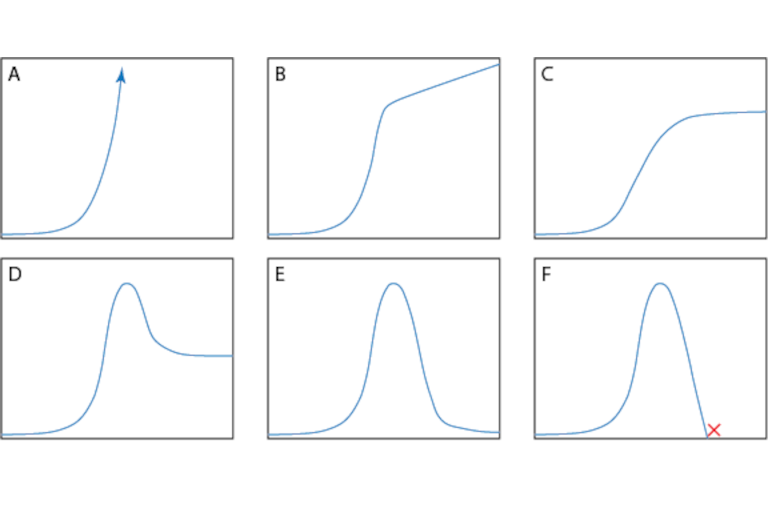
What if we presented possible options for future human developments—let’s say human population as a solid example—and pretend it’s a menu from which we get to choose. What outcome would most people see as the desired goal? What would make them happy, or satisfied? Which population curve below do you think most would select?
I present the following options:
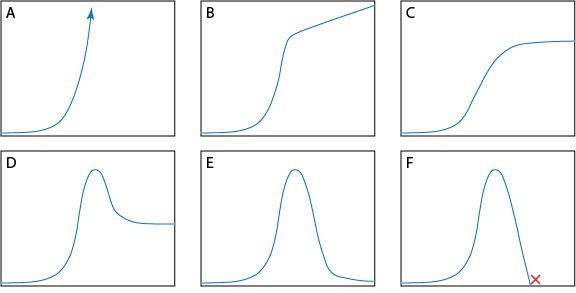
A: Indefinite exponential rise. This implies no biophysical limits, ultimately demanding expansion to space (as if possible).
B: Moderation into a linear rising state, allowing continued growth but not in crazy-pants fashion.
C: Logistic leveling: no drama: we found our place and aimed right for it with no corrections—like it was meant to be and we knew what we were doing all along.
D: Peak and modest decline to some medium and stable value, indicating a slight boo-boo (overshoot) in our trajectory.
E: Peak and substantial fall to a vastly smaller population before stabilizing. In this case, we had it dramatically wrong in a massive overshoot.
F: A post-peak crash to zero (i.e., extinction; could be due to ecological collapse, nuclear annihilation, sex robots, or classic evolutionary failure of our species).
Now picture yourself and a bunch of others sitting around a table at a restaurant holding this menu and trying to decide on the future. What are you having?
Process of Elimination?
Ha! I tricked you all! I would claim it’s not an open choice! It will be no surprise that I rule out option A. Exponentials fail, and juvenile space fantasies aren’t coming to the rescue. Even then, good luck maintaining an exponential against the cruel realities of expansive space! “I’m sorry sir, the kitchen informs me that this option is not available (and never has been).”
Option B also ignores biophysical limits, in that growth of any form is not a long-term realistic prospect, even if not disastrously exponential. Also unavailable from the kitchen.
I suspect many people in our society would pick option C. Looks tasty. This is the dream scenario: we figure out how to live on the planet and smoothly cruise into stability without any obvious sacrifice, then hold it there indefinitely as human civilization flourishes. Except: the scale of today’s activity on the planet far exceeds the community of life’s capacity to survive. Not only would the sixth mass extinction stay on track, but we have zero realistic all-things-considered plans for maintaining high-throughput modernity at the ten-billion person scale. From agriculture to energy to materials (upon which which energy conversion depends), we don’t know how this could possibly work for centuries or millennia. There’s no credible plan. Another note is that real populations seldom follow the no-drama logistic curve. Treat it as a fantasy, and try to ignore the appeal. You’re probably beginning to dislike this restaurant, for its lack of actual choice.
Option D is the first to acknowledge overshoot. I suspect the chef will get a smattering of orders from this category, just like the gluten-free, dairy-free “pizza” that’s on the menu for the rare bird who needs to go that way. This option admits defeat, of sorts. It acknowledges that we’ve gone too far already and need to dial things back in order to carry on. In spirit, I am on board. But if our current attack on the planet is at the level of rapidly initiating a sixth mass extinction, is a factor-of-two moderation nearly enough to tip the scales? “I’ll check with the kitchen—I’m uncertain whether this dish is available today.”
Option E is qualitatively similar to Option D, but quantitatively differs in that the ultimate steady-state level is vastly lower than the peak. This is not a small factor-of-two correction, but an order-of-magnitude or more. It’s the shoe leather option on the menu. Why would anyone ever pick this one? Well, if the other items are truly unavailable… This might be the only way to survive, by the dictates of evolution, ecology, and biophysics. The kitchen can probably oblige and rustle something up. Why is the chef now walking around bare-footed? Serving suggestion: goes down better with ketchup.
Option F is implicitly on the menu, folks. Dismayed by the lack of acceptable choices, we could refuse to order any of the unsavory options, insist on “living large,” and consequently end up starving ourselves in pointless protest.
Grade Analogy
I also like a grade parallel here. Students might desire an A or B, but can live with a C as a passing grade. D is effectively failure, and F is unambiguous failure. That leaves E: an obscure grade that is off our radar (outside Hogwarts). But we need to think out of the box here and accept that we are heading toward uncharted territory, for which we do not yet have set associations. If my choices are E or F, I might as well try this E-thing, which might turn out to exceed expectations.
Happiness?
This post was motivated by a discussion I had with a sharp friend about the path of humanity. I was making the point, unsurprisingly, that modernity is a temporary aberration that will not be ecologically supported for very long. He rejected the idea of any future path that had even a whiff of hunter-gatherer lifestyles, adding something to this effect:
Look: all you have to know to appreciate that human life was miserable in the distant past is that population was held down by external factors. Life was tough [nasty, brutish, short was the gist].
This is very illuminating. When I responded: “Ah, so the only mode of existence compatible with human happiness is unbounded, exponential growth?” it was immediately clear to him the pile he had just stepped in.
But this is the crux of the matter, and worthy of serious consideration. If the only way for humans to be happy (not miserable) is in a world without limits…well then we’ve come to the wrong shop, folks. If defiance of biophysical reality is necessary for us to be the transcendent, liberated former-animals we think ourselves to be, then I’ve got some bad news. Pinocchio will never be a real boy. Translation: our artificial construct of modernity will never have a permanent, integrated place within an ecological context.
Back to the Menu
Now let’s return to our menu. When presented in this way, I think logic circuits kick in so that most people—I hope—would recognize option A (indefinite exponential growth) as not being possible (otherwise it might seem the happiest choice). Once in this mindset, option B might also be apparent as untenable, and that’s certainly progress. If I am correct to suspect that option C would be most popular, aren’t we back to the “miserable” state of imposed limits?
I think the difference is that to most people, the target steady-state population is our choice—not nature’s choice—in which we have two kids on average, medically-enabled longevity, technological goodies, and opera. This is the “arrived” notion: under our control. What seems to be objectionable is when ecological realities are dictating the terms. Two things: first, ecological realities probably remove option C as being unsupportable to begin with; second, even option C is ultimately limited by biophysical reality, in that births are still constrained (restricted, independent of happiness/desire) and deaths still motor on. Population trajectories are all about biophysical realities of birth and death, so that any steady solution goes hand-in-hand with limits on the biophysical front. To maintain steady state, increasing longevity would have to be accompanied by a reduction in births. We can’t just do whatever we want.
I’ll make one other point with regard to my friend’s “misery” statement. It implies that every other species on the planet—constrained as they are by external factors beyond their control—must lead miserable lives, and that happiness rests on control. What a depressing mindset to hold about our glorious planet of life! I reject the notion that squirrels are miserable, or that early humans were miserable—and frightened—much of the time (see next week’s post). I take that attitude to be projection of our own unfamiliarity and fear over the prospect of losing the infantilizing influence of modernity. I have enough respect for early humans to believe that they faced challenges with grit and equanimity, while finding it within themselves to laugh, joke, tease, sing, and dance.
Overall Lesson
The point of this exercise is that not every drawing we could slap on paper is biophysically, ecologically supportable. In fact, the vast majority are not. It is probably approximately true that the area under the curve—above a certain threshold of sustainable population—is limited, as excess/overshoot leads to accumulating ecological damage, and an initially-healthy Earth can only take so much. This precludes, for instance, the pleasant notion of an arbitrarily gradual decline toward sustainable levels. Gotta keep the area below the breaking point. We can’t just do anything we wish. Does that lack of control commit us to misery? Careful: this is a tantrum-free zone.
Even in a deterministic mindset, where the ultimate answer is inevitable, the result is utterly unpredictable to us. Options E and F, for instance, both seem to be on the table, and I would rather that our species survives beyond the modernity episode than execute its extinction as a result of clinging to the colossal mistake of modernity for too long.
That means, if option F is to be avoided, steps must be taken to set us on the path of option E. Efforts in that direction come with no guarantees, but failure to make the attempt is far less likely to end up there.



Comments
We changed commenting systems on September 10, 2026 as part of a site-wide functionality and security upgrade. Your past comments have not disappeared, and you can still log in with your old Disqus account credentials if you wish. Contact us with any questions.
Thanks as always, Tom.
The choices are well delineated, however I don't think population by itself is a helpful metric for analysis.
– resource use and environmental destruction is concentrated in a small percentage of the population. As Americans we don't like to think about it, because most of us are in the upper 20%
– our economic system is based on consumerism and wars. A different system would be much more sustainable.
–
Truly, manner of living is another huge factor, but one can't say population is unrelated or irrelevant or can be arbitrarily chosen. Consider two aligned facts: 1) the only somewhat-proven long-term sustainable mode of existence of humans measured in single-digit millions (1,000 times less than today, or more); 2) distributing mammalian mass equally among all mammal species would result in something like 4 million humans: 2,000 times less than today. The point is that it may well be that sustainable humanity really does measure in millions, not billions, thus a huge change we are justified in confronting.
The main purpose of this post was to ask ourselves if we are prepared to accept that a dramatic reduction may be the only long-term truth—as other "choices" may not really be choices. If one objects, then on what basis or crystal-ball-authority? In other words, if we can't accept the possibility of case E, then that may say more our about the nature of our reaction than anything biophysically real, as we can't somehow decide to carry a footprint that turns out to be unsustainable any more than we can decide to defy physics. Since we can't know the answer, we ought to explore our reaction to distinct possibilities (probabilities?) of very low sustainable population—which happens to be best-aligned with the only evidence we possess. Anyway, grappling is good: the intended result.
I think you left out the most likely outcome, a stair step downwards towards sustainability.
From the peak to D1 then stable for a while then down to D2 stable for a while then down again until you reach something like E. (maybe we could stabilize a bit above E or make the environment a bit worse and end up a bit below E.)
Possibly: as long as the dwell time at each step is not too long, because there's that whole "area under the curve" business of accumulating damage. E is only possible (over F) if the damage is limited to sub-mass-extinction outcomes.
steps must be taken to set us on the path of option E
I agree. Even though I think that E is likely to happen no matter what we do, careful preparation would help ensure that we don't end up with F (extinction). As it stands now, E is the best-case scenario, one we should be working hard to make as probable as possible.
But the psychology of setting us on a path for E is bad. If any government actually implemented policies that would ensure that more people would survive the coming dieoff, it would be hard to avoid extreme negative reactions from the public. Realistic policies would have to acknowledge that most people would die premature deaths and that only a small fraction would survive. Can you imagine the fighting over who those survivors would be?
Another difficulty would be the necessary abandonment of lifestyles to which moderns have become accustomed. Any policy that maximizes the population at the end of the E process would require a dramatic reduction in support for existing economic paradigms, just to save as much of the living world as possible, because that world will be what offers sustainable resources for future generations. Maximizing carrying capacity means minimizing the ongoing depredations of modernity on nature.
I have a hard time imagining a politician getting elected on a platform summarized as, "First we are going to make everyone as poor as possible to save as much of the environment as possible, then we are going to let most people die so that a few lucky ones can thereafter live in harmony with the nature we saved". It's rational and optimizes the future of humanity and the rest of the living world, but it's an impossible sell.
So, in my view, collective preparation is never going to happen. It's up to individuals, families and small groups to see what's coming and try to shelter themselves from collapse. The odds of success will still be poor, but far better than those who continue to blithely rely on modern supply chains for their necessities, as anyone continuing to live in a city is doing.
Get out of the city as soon as possible. They are not long for this world.
I agree with the conclusion. The fact that our instinct is to look to policy or politicians for solutions indicates how misguided we have become, inured to modernity. That system will not remedy itself, so that appropriate responses come from outside the system. Yet, modernity still has a strong grip. We can't simply ignore its presence, yet, and go off violating laws (property rights, hunting, etc.) and expect to get away with it. For the moment, it's a matter of mental and psychological attention and communication, accepting that ultimately modernity's goose is cooked so that we need to live very differently.
Great piece, as usual. Buried within all this is the question of desire. It's assumed that people desire modernity, and yet America, having "achieved" it, finds itself mired in political breakdown, generalized depression, teen suicide, and new drugs to become addicted to. That we might choose to stairstep to E seems unimaginable, yet the humble pleasures of simple living are more deeply ingrained than the flash in the pan "happiness" promised by modernity. While we warn, modernity seduces, yet that simple binary seems to be crumbling, even turning the other direction.
The variables are too many to keep account/track of.
Chances are that various governments/leaders (winners in the current system) will sacrifice all else to keep the system going. That includes subservient systems, and the biosphere. So the sooner the system fails/collapses, the better; more left to work with.
War – be it global, local, or a combination – will be a factor, as will various forms of discrimination; race, class, peer, which will determine who we 'side' with.
Then there's material triage; the attempt will be to maintain – or cannibalize/repurpose – the current collection of infrastructure. That may be like Cuba, or Mad Max, but for a period it will be a factor.
I'm with the [deleted] replying to the girls in Even Cowgirls Get the Blues – "Little pockets of humanity will survive…. and I aim to be one of those pockets". Don't we all…
Come on Resilience: that was his name in the book.
Re-writing history for wokeness reasons, runs the real risk of failing to learn from it.
J'accuse…
Edit – having though it over, I'm going to double down on that. Wokeism topples statues and burns books/bans movies, because someone IN THE PAST did/wrote/filmed something that has become culturally abhorrent IN THE NOW. If you topple/burn/ban, you fail to learn from past mistakes; you've chosen to ignore them; to pretend they haven't happened. The irony of that action, on this thread, is amusing to say the least. Tom Robbins' Even Cowgirls get the Blues is an important piece of literature, and not just US; global. I rate it up there with Cannery Row; ironically, it was an early addressor of the topics being raised on this site.
I am reminded of the nonsense when folk said Gone with the Wind should be banned. First, as with Cowgirls, it's an important piece of cultural history. Secondly, it teaches the lesson of slavery and acknowledges that it happened.
This comes back to Murphy's point about scoping/framing, in a way; censorship via current cultural sensitivity is a reduction of scope, and as such, a blinkering.
Here is another excellent analogy by Tom Murphy where he likens our civilizational scale choices for future outcomes, to menu items at a restaurant.
This story weaving style helps get these complex and painful (loss aversion) concepts across in a very accessible way.
His concept of early humanity's building of a raft and casting off into the tributaries of "The River" is also powerfully thought provoking.
Can we sober up in time to focus what we have left in a wise attempt to coast back down to a softer landing?