


The major development underpinning the prospect for an early-century peak in human population and even earlier peak in civilizational power is a rapid and seemingly unexpected decline in fertility rates across the world. All regions except Africa are now below the replacement rate, and still falling.
This short post—probably my last on the population topic for a while—is centered on the following animated GIF showing how the United Nations’ demographic models have expected total fertility rate (TFR) to evolve into the latter part of this century.
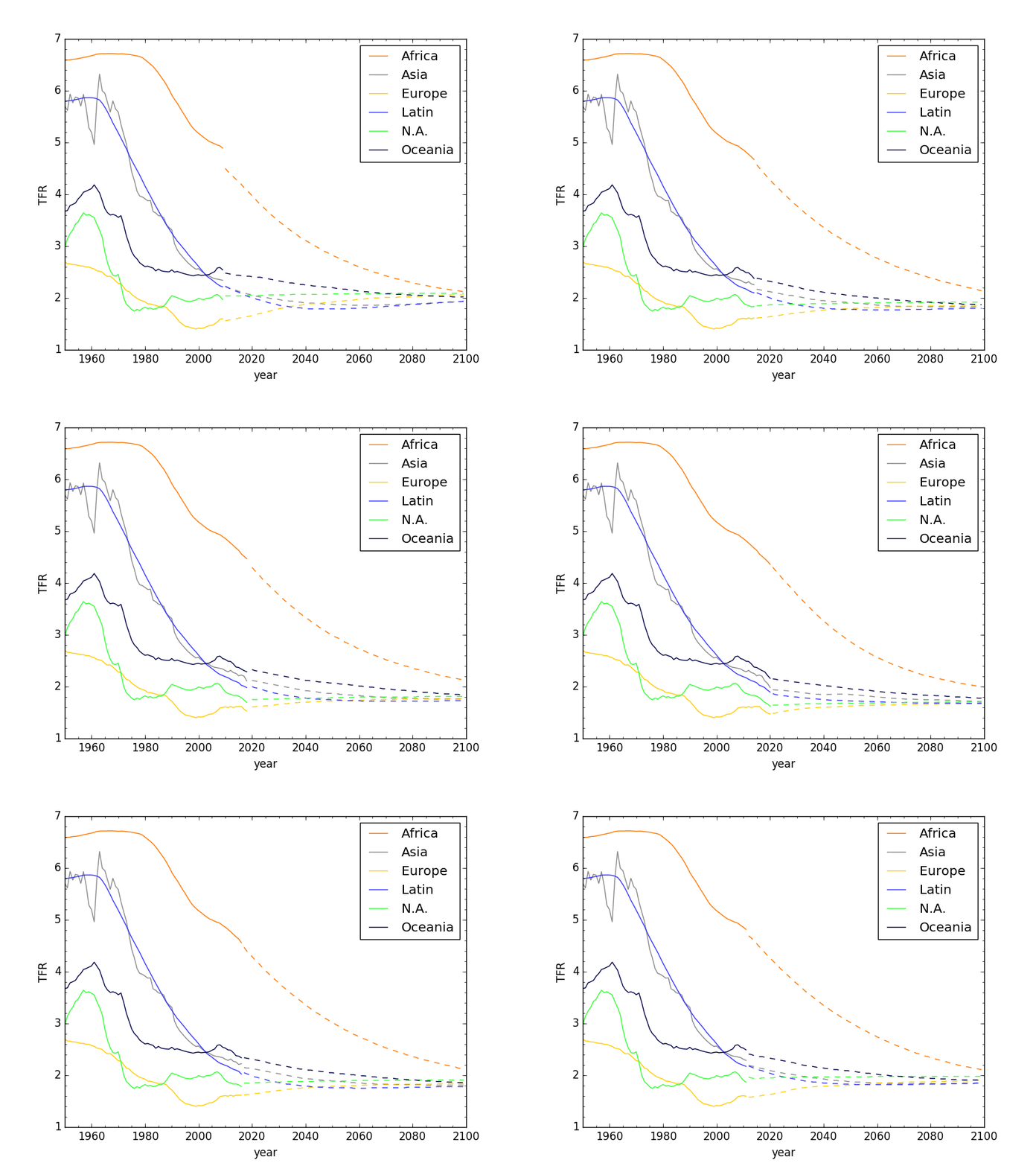
U.N. TFR projections from 2010, 2012, 2015, 2017, 2019, and 2022.
Every few years, the U.N. releases a demographic projection model that includes an expectation of how TFR will behave going forward. I have already pointed out the glaring discontinuity (kink) at 2020 in the latest projection and a gallery of systematic major misses at the country level. What the animated GIF above helps us see is how stubborn the imagined far future is—consistently aiming for a one-size-fits-all convergence.
I have referred to the notional TFR endpoint as a “magnet,” acting like a theoretical convergence point to which all regions are attracted. We see how persistently influential this magnet is on projections in the sequence above.
Okay, so the target point does change a little bit—beginning around a TFR of 2.0 in the 2010 projections, and walking down to 1.7 by the latest projection. So it is not utterly unresponsive to recent trends. But look at the persistent kinks in many of the curves at the moment the models take over. The fact that all the regions (except Africa, after the 2010 projection) converge to the same tight spot speaks to a uniform, stabilized vision of the future that can be nothing but notional. Such a development would be a break from the history of ever-changing TFRs. It’s as if someone believes we’ll finally figure it all out and settle down for a long reign of stability. What it really means is that extrapolation-based projections more than several decades out become highly suspect.
Falling Fertility Factors
First of all, I will register my dislike of the term “fertility” in the TFR metric. It sounds purely biological, like an intrinsic capacity of baby-making humans. Now, indeed some of the TFR decline may be of biological origin as sperm counts decline, endocrine disruptors abound, and microplastics are found everywhere we look. But at least as much of the phenomenon may stem from the myriad reasons people elect not to have children.
The non-biological factors at play for deciding not to have children might include:
- Too expensive (hard enough to tread water without kids)
- Lack of stability (no steady career/job; gig economy; not settled in one place)
- No house or expectation thereof (common practice is house first then family)
- Messed up world (polarization, climate change, environmental harms)
- Increases in non-traditional sexual and gender identities
- Social disconnection in an increasingly virtual world
- Disillusionment and bleak outlook (why perpetuate this terrible game?)
- Resentment at being seen as baby-making machines by a greedy capitalist system
- Do the opposite of whatever that gross Musk wants (and other pro-natalists)
These are not well-researched conjectures, and may be off base. I’m sure you can think of more. The point is, lots of factors are contributing, and these dynamics are not likely to turn around quickly—some likely to become even more pronounced. Therefore, the sharp drops in TFR seem likely to continue for the next decade or so, and that may be all it takes to reach peak population and peak civilizational power in the next 10–20 years—just in time to make the Limits to Growth work look eerily prescient (see LtG plot from last week). After that, demographic inertia will continue to exert an influence as reduced numbers mature to child-bearing age.
I would hope the reaction to this development is not to advocate policies to “restore” population growth. That’s the last thing the planet needs, and stems from a misplaced allegiance to economic fantasies rather than to the community of life (the economy would fail anyway without a functioning ecosphere). A natural population decline by the non-violent process of simply not bearing children would be a gift to humanity and to the earth that supports us.
Positive Feedback
We have no modern precedent for declining global human population, so cannot confidently predict what happens in such a scenario. In the short term, I can imagine more positive feedback mechanisms that accelerate the plunge than corrective negative feedback mechanisms—as it won’t feel “safe” or ethical to bring children into a period of great uncertainty.
Firstly, the economic house of cards—essentially a Ponzi scheme predicated on unsustainable growth—will likely collapse. Since we foolishly based most of modern life on this inherently shaky economic foundation, its implosion will be felt far and wide, potentially setting off violent conflict and famine as nations struggle to maintain their expected but unsustainable material and energy flows. Even without this unfortunate development, how many of the factors itemized above would be reversed? Many are only exacerbated, which could lead to a faster population decline.
My best guess is that whether the process is quick (famine, war) or moderate (demographic factors alone, let’s hope), the process will remain in a positive feedback condition until most of the unsupportable complexity has melted away. At this point, the period of positive feedback might self-terminate as groups of people find themselves enjoying locally self-sufficient lifestyles that are ecologically stable and disconnected from the complexity that once bound modernity together in the same trap.
The New Era
Whatever happens after modernity necessarily self-terminates (one cannot choose or decide to continue a grossly unsustainable approach to life), it won’t be planned, and it probably won’t be monolithic. Differing conditions, remnants, and cultural attitudes around the world will lead to different experiments in what to try next. As with modernity, those practices that are not sustainable will eventually fail (possibly destroying sustainable groups along the way, as has happened plenty of times before). Those that are able to find ecological balance (in right- or reciprocal-relationship with the community of life)—and are isolated from bad actors until those actors necessarily fail—stand a chance at longevity. It’s not a choice, but a fact in the long term. Only those modes of living that are sustainable in relation to the ecological whole can survive.
We who are alive today will not see the outcomes, but based on what I have learned from demographic trends, it seems more likely than I previously thought that we will see convincing evidence of its kick-off by mid-century. Perhaps the best we can do now is in the spirit of acceptance, so that we might re-define what matters and thus what to prioritize during the transition. Clinging to modernity would be a poor choice, doing more harm than good, in the end.





Comments
We changed commenting systems on September 10, 2026 as part of a site-wide functionality and security upgrade. Your past comments have not disappeared, and you can still log in with your old Disqus account credentials if you wish. Contact us with any questions.
This is my vision too–whatever the trajectory of collapse, what comes after will vary from place to place. But I'm very concerned about this:
"As with modernity, those practices that are not sustainable will eventually fail (possibly destroying sustainable groups along the way, as has happened plenty of times before). Those that are able to find ecological balance (in right- or reciprocal-relationship with the community of life)—and are isolated from bad actors until those actors necessarily fail—stand a chance at longevity."
Along with unsustainability, the "bad actors" tend toward aggression, violence, and an expansionary ethic often underlined by religion. The reason we're in this fix in the first place is because the bad actors, in conflict with sustainable groups, nearly always win. I have hopes that humanity as a whole can learn a lesson from collapse, as I suspect many early cultures did from realizing they'd wiped out the megafauna they'd come to depend on, and created deep cultural mores, taboos, religious strictures to keep such foolishness from happening again. And it lasted. Until the tall ships full of bad actors arrived at their shores. But how we can avoid letting the bad actors rule over the rest of us, I don't know.
One possibility is that the low-hanging fruit in terms of easily accessible surface metal deposits (concentrated ores) are all plucked by now, so that a second rise of science and technology of the sort that brought the tall ships will not happen again. No guns, germs (global travel), or steel. We have the vomited remains of ores at the surface now, but dispersed and corroding. I don't know, but it also depends on the timeline: what's left in 10,000 years? The ores are gone for millions, until geological processes expose more.
We have the vomited remains of ores at the surface now, but dispersed and corroding.
The status of metal ores would be an excellent topic for one of your future posts. Natural ore deposits, which formed from the activity of plate tectonics over millions of years, have been depleted to the point that not much is left that can be extracted without modern energy-intensive methods. That fruit has been plucked.
But many of the metal ores we have extracted are still concentrated as pure metals in the artifacts of modernity. Steel, for example, is the backbone of the built structure of every modern city. When modernity fails and all that steel oxidizes as buildings collapse into heaps, will the concentration of iron oxide approximate that of the ore bodies that went into making the steel in the first place? Has modern mining just moved areas of metal oxide concentration from one place to another without any significant change in concentration?