

As May Day approached this year I finally got round to a small project I’d been meaning to do for a few years now. This was to read Peter Linebaugh’s book The Incomplete, True, Authentic, and Wonderful History of May Day, which is a collection of pieces he has written over the years—some pamphlets, some articles—for and about May Day.
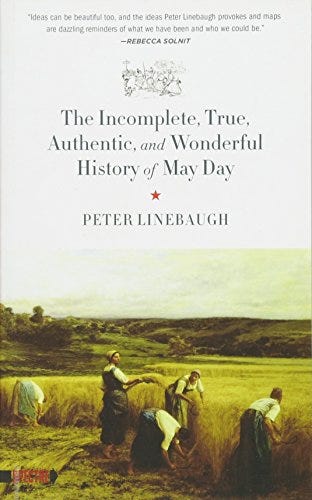 Peter Linebaugh is a radical American historian, probably best known for his books on English history—on 18th century capital punishment in The London Hanged, on the history of the commons in The Magna Carta Manifesto. He’s clear which side he’s on.
We usually associate May Day with the history of the labour movement, and there are good reasons for this, which I’ll come back to. Linebaugh calls this ‘Red May Day’. But he argues that the history of this version of May Day is completely intertwined with a much older and longer tradition which we see across much of Europe. In Celtic culture, this festival is known as Beltane, and it sits about half way between the spring equinox and the longest day of the year. This is ‘Green May Day’.
Going to the woods
He connects this part of the history of May Day with what he calls the “Woodland Epoch of History”, when the huge forests across Europe, Asia and Africa provided our ancestors with the resources they needed to live:
In Europe, as in Africa, people honored the woods in many ways. With the leafing of the trees in spring, people celebrated “the fructifying spirit of vegetation,” to use the phrase of J.G. Frazer, the anthropologist. They did this in May, a month named after Maia, the mother of all the gods according to the ancient Greeks, giving birth even to Zeus.
Different cultures celebrated this in different ways. The Greeks had sacred groves, the Romans had games, the Celts and the Scandinavians lit fires:
Everywhere people “went a-Maying” by going into the woods and bringing back leaf, bough, and blossom to decorate their persons, homes, and loved ones with green garlands. Outside theatre was performed with characters like “Jack-in-the-Green” and the “Queen of the May.” Trees were planted. Maypoles were erected. Dances were danced. Music was played. Drinks were drunk, and love was made. Winter was over, spring had sprung.
(These quotes, by the way, come from the title essay of the book, originally written in 1986 and printed as a pamphlet with alternate red and green covers. It’s the single best in the book.)
A story of opposites
The Red and Green May Days can be described in ways that create the kinds of opposites that narratologists get excited by:
Green is a relationship to the earth and what grows there-from. Red is a relationship to other people and the blood spilt there among. Green designates life with only necessary labor; Red designates death with surplus labor. Green is natural appropriation; Red is social expropriation. Green is husbandry and nurturance; Red is proletarianization and prostitution. Green is useful activity; Red is useless toil. Green is creation of desire; Red is class struggle. May Day is both.
The Red May Day has its roots, in particular, in the bloody history of the American labour movement, and in particular in the city of Chicago, which in the late 19th century was an epicentre of both industrialisation and globalisation.
The eight hour day
The story of the Haymarket riots is told in different ways in most of the pieces in the book. It has May Day at its heart. On May Day 1867, the machinists who made reaping machines for McCormick went on strike for an eight-hour day. McCormick was a huge agricultural machinery business by the standards of the time. The workers didn’t make much progress with this, but over the next twenty years Chicago became known for its waves of strikes and the repressive violence that met them.
In 1884, the Federation of Organized Trades Unions of the United States and Canada declared 1st May 1886 as the date which would mark the start of the eight-hour working day. Throughout the spring of 1886 there was agitation throughout the US for shorter hours. An organisation called the Knights of Labour composed a song for the movement:
We want to feel the sunshine
We want to smell the flowers
We’re sure that God has willed it
And we mean to have eight hours.
‘A storm of strikes’
And on 1st May, a “storm of strikes swept Chicago”, and four machinists who had been locked out by McCormick were shot dead by police. On 4th May, the strikes continued, and thousands of people gathered in Haymarket Square in Chicago to hear speeches from organisers. During the evening—this part might sound familiar—the police charged the crowd, a home-made bomb was thrown, and in the ensuing violence, many were killed, including seven policemen.
Hundreds were rounded up, and eventually eight radical leaders were charged with conspiracy. Nothing linked the defendants to the bomb, but after a showtrial, all eight were found guilty and four of them were hanged.
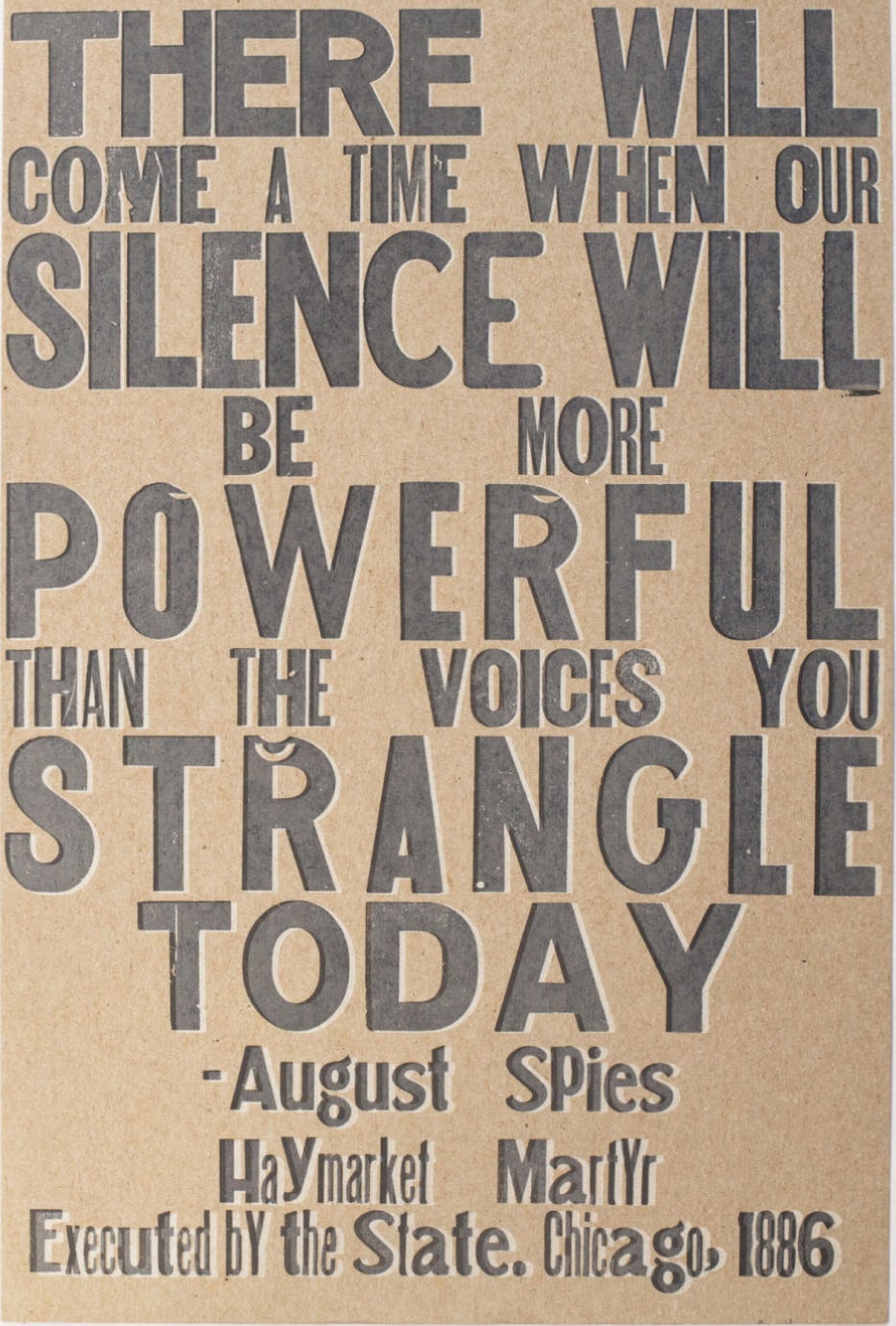
(The last words of the hanged socialist editor, August Spies. Image: Entangled Roots Press.)
A holiday, a holiday
Lucy Parsons, the widow of one of the hanged men, set out to tell the world about this miscarriage of justice. In England she encouraged workers to make May Day a holiday dedicated to a shorter working week; her friend William Morris wrote a poem in her support, in which the Earth talks to the workers. The American Federation of Labour declared it a holiday, and the American union leader Sam Gompers sent someone to Europe to have European trades unions declare it International Labour Day.
By then the idea had caught on: the 1905 Russian revolution started on 1st May. This history runs on through the 20th century. In Mexico, Linebaugh says, May Day is still called “the day of the Chicago Martyrs”. This all spooked American capital enough to have the government declare May Day un-American and move American Labour Day to the autumn.
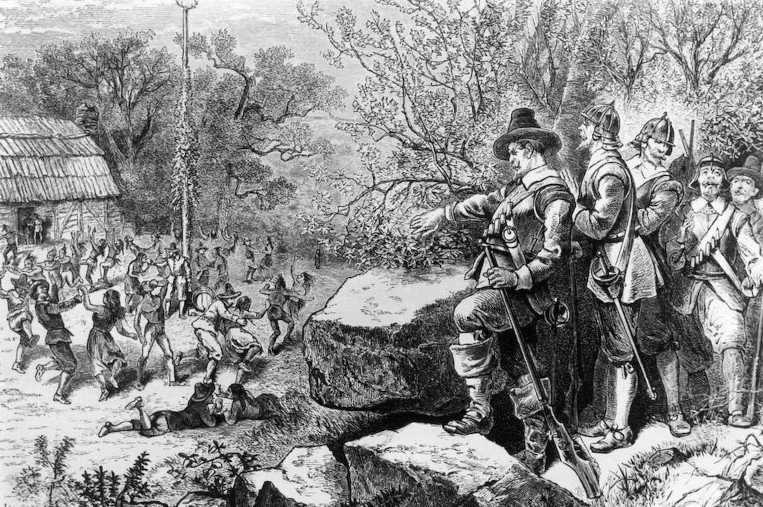
But if this is Red May Day, this violence started much earlier in American history, in suppressing a Green May Day on ‘Merry Mount’ (or Merrymount), as the English migrant Thomas Morton called it, at what is now Quincy, Massachusetts. This history I didn’t know. Thomas Morton had arrived from England in 1625, and found Mount Merry ‘Paradise’. He settled among the native Americans:
Thomas Morton was a thorn in the side of the Boston and Plymouth Puritans, because he had an alternate vision of Massachusetts. He was impressed by its fertility; they by its scarcity. He befriended the Indians; they shuddered at the thought. He was egalitarian; they proclaimed themselves the “Elect.” He freed servants; they lived off them. He armed the Indians; they used arms against Indians.
Merry Mount
On May Day 1627, he and the local native Americans erected an eighty-foot Maypole, and garlanded it. Songs were sung, and beer was brewed. Verses were nailed to the Maypole:
With the proclamation that the first of May
At Merry Mount shall be kept holly day.

As Linebaugh says, Merry Mount became a refuge for runaway servants and the discontented of all kinds. The Governor of Massachusetts called them “all the scume of the countrie.” Morton was told that he was violating the King’s Proclamation, and replied that it was “no law”. The settlement was attacked and burnt down by the Massachusetts Puritans, and Morton was sent back to England as a prisoner, although the Puritans complained about the cost of this.
A necessary programme
In the face of this history, it’s hard to be optimistic. Linebaugh sees the struggle over May Day as a fight about establishing the discipline of work. The Puritans were the vanguard of this, “with their belief that toil was godly and less toil wicked”. Isaac Newton bought London’s 100-foot may pole and used it to prop up his telescope, in one of those details that screams metaphor.
All the same, his near 40-year old idea of the Green and Red May Day, with the values they wrap themselves around, seem suddenly to combine themselves into a necessary programme for our times. Our current forms of work, and the double exploitation they involve of planet and people, are at the heart of the climate crisis: ecological justice also requires social and economic justice.





Comments
We changed commenting systems on September 10, 2026 as part of a site-wide functionality and security upgrade. Your past comments have not disappeared, and you can still log in with your old Disqus account credentials if you wish. Contact us with any questions.
The foundational value and sizzling hot importance of an historical framing of our modern polycrisis cannot be overstated. Only recently have many come to notice that the seeds of our modern problems have been intentionally sown for centuries. The ‘sowing’, that is the socialization, was accomplished through minority produced conceptual machinations, coercion, force and killing. The extreme nature of this historical socialization cannot be overstated. (This is likely why conservatives oppose an education which would produce knowledgeable citizens able to understand the actual nature of aggressive conceptual confinement misrepresented as freedom.)
What essentially promoted this violent socialization was inherently ideological. It has never been anything but primarily ideological. Our political-economic weeds testify to the pervasive nature of this intentionally sown indoctrination which has normalized an aggressive and hostile politics and economics which promotes inequality, domination, violence, never-ending wars, unnecessary suffering, inflation, the unaffordability of life necessities…..and our entrapment within the false ideology which perpetuates failure and deception each election cycle. The socialization to believe and live within these fictions has been very successful.
This ideology includes a violent Christianity full of racism. The ideology also strengthened and forced classism upon society, perpetuating the haves and have-nots, inscribing inequality as a civilized and ‘democratic’ social order. These conservative values normalized an authoritarian, unjust distribution of power fully backed by force. Any possibilities of an authentically democratic freedom and equality were/are opposed, suffocated and destroyed.
Here we are in 2024 with many minds trying to understand our entrapment within a failing social, political and economic order. Educated to not understand the actual nature of our bondage and conformity, we continue to pretend we are free and knowledgeable. Taught to believe that it is natural, just and reasonable for a fringe ideology of political economics to dominate society and individuals, we find ourselves fully conditioned to believe in the fabricated mythology backed by coercion, force, incarceration and killing. Many still erroneously believe that our current order is just, reasonable and democratic!
Even if we do not believe in this long established extremism, we find ourselves having to conform, at least to some degree, due to the pervasive systemic power of state ideological institutions. In other words, the installed conceptual machinery functions and is still able to prevent reforms which would release people from authoritarian, arbitrary social fabrications and forced economic behaviours.
History demonstrates we were captured long ago. Since our political economic problems are rooted in this aggressive and forceful ideology, we continue to be faced, just like people of older times were, with the great social challenge of creating the momentum that would unify enough people to work together to unseat anti-democratic and unequally distributed power. Failing to see the intentional and vicious roots of our present problems, directly connected back through the centuries, we fail to see the distorted history of our modern human project in the light of day. Past history is the present economic political order.
Freedom from this imposed hegemony and anti-social ideology depends upon cultivating a clear and accurate vision of the actual historical foundational nature of the intentionally fabricated, socially indoctrinated, violently enforced, elite imposed, unequal power distribution which prevents people from arising freely and resolving the challenges of our human condition. Systemic change is the only effective and truly remedial change that can release us from bondage.
As the story goes, if you want to escape from prison, listen to those ‘outsiders’ who know the route to safety, freedom and equality. Otherwise, listening to those who imprison and deceive us, we run around inside the bars, fortified walls and razer wire, scratching our heads as to why we fail to be free.