

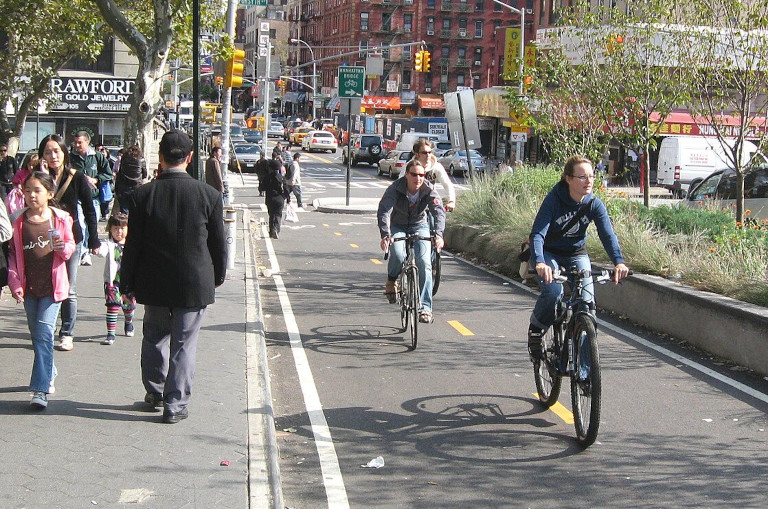
In perhaps one of the great ironies of human civilisation, mechanical devices to truly magnify human power came along as soon as we didn’t need them. Pedal-powered devices like bicycles only appeared after coal had already begun to transform the landscape, however – mass production was necessary for the standardised metal parts — and around the same time that gasoline was first being introduced as a fuel for automobiles.
We tend to forget, then, three important things about the bicycle. First, it remains the most efficient method of using our bodies, allowing us to attain higher machine speeds for longer than we would on muscle power alone – and without using any more fuel or causing any more weather to go haywire.
The average modern person, by one calculation, spends more than 1,600 hours a year to pay for their cars, their insurance, fuel and repairs. We go to jobs partly to pay for the cars, and we need the cars mostly to get to jobs. We spend four of our sixteen waking hours on the road or gathering the resources for the car. Since the average modern American, by one estimate, travels 7,500 miles a year, and put in 1,600 hours a year to do that, they are travelling five miles per hour. Before people had cars, however, people managed to do the same – by walking.
By contrast, a person on a bicycle can go three or four times faster than a pedestrian, but uses five times less energy in the process. He carries one gram of his weight over a kilometer of flat road at an expense of only 0.15 calories. The bicycle is the perfect transducer to match man’s metabolic energy to the impedance of locomotion. Equipped with this tool, a person outstrips the efficiency of not only all machines but all other animals as well.
Bicycles have been used for so long as children’s toys and exercise equipment that we forget what useful technology they represent. They multiply our bodies’ speed and efficiency many times over, allowing us to travel miles without strain. Their widespread adoption in the late 19th century created a ripple of under-appreciated effects in society; for example, they allowed women to commute to jobs away from home and paved the way for the universal sufferage movement.
Second, bicycles have seen many improvements in the last hundred years, most of which have escaped the notice of anyone but enthusiasts. Many of the bicycles we use today function mainly as toys, and racing bikes are built for speed; sturdier bicycles – often going under the name of “military bicycles” can still be ordered.
Most importantly, though, bicycles are only one of many possible pedal-powered machines that were not used for transportation. Beginning in the 19th century, factories began to make and stores to market treadles for manufacturing everything from cigars to brooms to hats. Farms used foot-powered harvesters, tractors, threshers, milking machines and vegetable bundlers, and machinists used pedal-powered drills.
“…no matter how simple it seems to us today, pedal power could not have appeared earlier in history,” wrote Kris DeDecker in LowTech Magazine. “Pedals and cranks are products of the industrial revolution, made possible by the combination of cheap steel (itself a product of fossil fuels) and mass production techniques, resulting in strong yet compact sprockets, chains, ball bearings and other metal parts.”
Today, we have built a world that runs on fossil fuels, which won’t last forever; eventually many of us will not be able to depend on familiar machines like cars and electronics – – either because we won’t be able to afford them, or to afford continually fixing them, or because fuel prices will be out of reach. One way or another, we will have to go back to muscle power, and the best way to do that is to revive the lost technologies of pedal-powered tools. The irony, though, is that we need to build them while we still have fossil fuels.
Perhaps more people around here will take to bicycles again, as I will now that there is enough light to get to the bus and back. Older people here remember when the bicycle was the most popular method for getting from one village to another, and the roads were safer then with so few cars. It’s possible that the schoolchildren of today will see those days again.





Comments
We changed commenting systems on September 10, 2026 as part of a site-wide functionality and security upgrade. Your past comments have not disappeared, and you can still log in with your old Disqus account credentials if you wish. Contact us with any questions.
Biking is much easier on fossil fuel based pavement than the sandy paths and cobble stone roads I grew up biking on. Would horses and donkeys be better during mud season?
Fossil fuels are not needed to make bicycles or anything at all. Fossil fuels are only needed in the sense that our economy is currently based on them and to continue production at the current rate right now requires their use. Many products can be made from alternate technologies eg using electricity instead of carbon as an energy source and hydrocarbons, where needed, can be synthesised from water and carbon dioxide or biomass. https://en.wikipedia.org/wiki/Fischer%E2%80%93Tropsch_process
Agree about fossil fuels.
It is theoretically* possible that in some future (but not today) the mining, smelting, manufacturing and transport associated with industrial production of any kind could become feasible without fossil fuels. But such a world simply does not exist at present. At present, depending on whose data you use, between 80% and 84% of techno-energy (energy produced and distributed by technology — which is distinct from e.g., passive solar energy for home heating) is fossil fuel sourced. So, in practical reality at present, fossil fuels are necessary to bicycle manufacturing. Not one bicycle made today has been made without fossil fuel inputs.
A crucial insight is that all of the devices we mine for, smelt for, manufacture distribute and install as part of the ostensible transition to “renewable” energy requires massive quantities of fossil fuel inputs at each of these stages of production and utilization. “Renewable” energy is fossil fuel dependent in a big way!
———
* While it is theoretically possible, it is nowhere near likely to ever happen, at least not within an energy intensive technological civilization of the sort which we find in the so-called “developed world” of today. For any realistically foreseeable future, “renewable” energy devices and infrastructure will depend upon fossil fuels to exist. Richard Heinberg has said that a rapid expansion of renewable energy devices and infrastructure would lead to a “pulse” of increased carbon emissions and fossil fuel consumption in the near term — not a reduction in these. I believe this assessment to be correct.
https://www.resilience.org/stories/2023-04-05/the-heinberg-pulse/
I contacted Brian and said that there were some doubts about these figures.
AAA says average annual cost of owning a car in the US is $10,728.
https://www.moneygeek.com/insurance/auto/analysis/costs-of-car-ownership/