


“I’ve long argued that the likeliest long-term future for humanity in the face of climate, energy, water, soil and political-economic realities will involve a turn to low-energy, small-scale agrarianism geared to local material needs. This future could be quite congenial or incredibly grim, depending on how it manifests. In my opinion, the sooner humanity takes active steps to manifest it positively rather than ignoring it so it happens by default the more congenial it’s likely to be.”— Chris Smaje, Beyond rescue ecomodernism
I’m really not the sort of person who ought to be throwing my gauntlet down near the feet of the entire profession of economics, but then hardly anyone noticed when I did so last year in October—, by radically redefining the phrase “luxury economy”. Here’s what I said then.
I define a luxury economy as an economic mode of access to livelihood which depends upon luxury goods and services in order to avoid economic and social collapse.1
Normally, both ordinary people and economists think of the phrase “luxury economy” as designating that sector of the economy which “caters to consumers with a high level of disposable income and a desire for premium and exclusive products and experiences,” says ChatGPT. That’s just a common sense understanding. And I meant to suggest there’s a better and more useful application for the phrase, one which acknowledges that energy and material use in “the economy” both must and will decline on a per capita use basis in the rich countries over the next decade or two. Energy and materials flows must (a normative and ethical claim) shrink to avert worst case scenarios of anthropogenic climate disruption. And they will shrink in this time frame due to increasing resource scarcity. And so my proposed definition of “luxury economy” was meant to facilitate the contemplation of the meaning of the word luxury in light of these facts about energy and materials in the economy.
My reframing of the phrase “luxury economy” was intended to point out some rather dramatic transformations in our economy (or, rather, the economies of the richer countries — a.k.a., the global North) which both will and must occur in the very near future.
In today’s dominant mode of economic activity (technological, industrial, capitalist consumerism), energy is right at the center, so much so that GDP / GWP and energy consumption are tightly coupled. Increases and decreases in energy use on a graph line follow the same curves as GDP / GWP. Materials use is also deeply intertwined with energy use, and likewise follows a pattern similar to that of energy. And 84% of world energy use remains fossil fuel sourced, so I’m basically saying that if energy consumption shrinks, so will what we call “the economy”. And when “the economy” shrinks, luxury goods and services shrink at a greater rate than necessities — e.g., food, shelter, clothing, etc.
These observations have everything to do with what I want to call The Future of Livelihood. And they are the basis of my argument that we’re soon to enter a global counterurbanization demographic trend. This deurbanization trend will, in my opinion, be most obvious in the world’s richest countries, because it is in these countries that there is the greatest dependence upon “the luxury economy” as I have defined it.
“… skimming its flows rather than mining its stocks”
In the year 2008, a milestone in a great global demographic shift was announced. This was the year that more than half of the world’s human population lived in cities. Currently, about 56% of the world’s population, or 4.4 billion people, live in cities. This number is expected to increase to 68% by 2050, according to the supposed experts who like to predict the future on the basis of past trends. I’m here today to add my voice to a growing number of voices who believe the trend will very soon begin to move in precisely the opposite direction.
The first of such voices in the “the future is rural” camp to come to mind is Dr. Jason Bradford, Board President of Post Carbon Institute, who in 2019 published a PCI report titled The Future is Rural: Food System Adaptations to the Great Simplification. But Dr. Chris Smaje’s name leaps up alongside Bradford’s. Smaje, after studying and then teaching and researching in social science and policy, in 2007 became a small-scale commercial veg grower in Somerset, southwest England. He has since published two books, one of which is widely considered a foundational contribution to the contemporary “the future is rural” discourse concerning future livelihood in a low carbon and low energy future. That would be A Small Farm Future: Making the Case for a Society Built Around Local Economies, Self-Provisioning, Agricultural Diversity and a Shared Earth.
It’s no surprise, then, that these two men know one another’s work. In a passage in his blog, Smaje says this:
Deurbanization, on the other hand, runs more with the grain of human desires as city infrastructures flounder. And with the grain of creating a human ecology that’s renewable in the long term because it embeds livelihood-making in the cycles of the natural world, skimming its flows rather than mining its stocks, as would be necessary in a high-energy urban world. In many cases it may not even involve huge relocations, just a reorientation of small towns and cities to more populated hinterlands. What’s certain is that in the future people will move whenever they can towards prosperity, as they have in the past. And it seems probable that in the long-term prosperity will generally be found where people can grow food and fibre locally. As Jason Bradford puts it, ‘the future is rural’.
Smaje, Bradford and myself share a common nemesis in the form of ecomodernism, a strange but popular recent permutation of “environmentalism” which oddly presumes that the future is not rural, but very urban indeed — and also very technocratic… to the point of a perverse anti-rural authoritarianism.
In a review of Smaje’s most recent book, Saying NO to a Farm-Free Future, Bradford writes …
One of my pet peeves is ecomodernism. Ecomodernist authors have a knack for adeptly elucidating the polycrisis, and then offering nothing useful for dealing with it. Even if you are unfamiliar with the terms ecomodernism/ecomodernists, you are likely aware of their schtick, as it has come to dominate contemporary environmentalism. It is a groovy eco-philosophy that tells mostly urbanized, highly educated, white-collar folks that although the Earth is in danger, their lifestyles are not. Perfect for inserting a do-gooder vibe into political and business circles, and then fundraising.
Now, I could go on and summarize Bradford’s PCI report, with quotes and footnotes…, and do the same with Smaje’s work, but instead I’ll just encourage the reader who is interested to explore these works for themselves. And I could dig up the names and writings of others who share our perspective that, indeed, the future is rural, not urban (for the most part). But instead I’ll make my own argument in my own way. And there is no better way to begin to make my argument than to reference the graph which accompanied my essay, Energy Transition & the Luxury Economy.
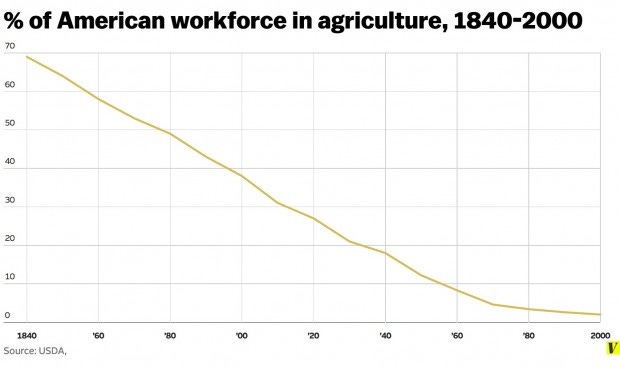
In 1840, 70% of Americans were farmers. Today, about 1.3 (just barely over one percent!) of Americans are farmers. So what happened when mostly technological transformations in agriculture displaced such vast numbers of workers? Where did all the farmers go? Well, most of them didn’t shift from one form of provision of necessary goods and services to yet another sector providing necessary goods and services. Rather, most of these farmers entered into “productivity” within a luxury-based, luxury-dependent mode of economy — which didn’t even exist in 1840 at any scale, and which grew in leaps and bounds between then and now. And the whole kit and kaboodle of the emerging luxury economy depended and depends, directly and indirectly, upon abundant and cheap (financially inexpensive) fossil fuels. (Never mind the non-monetary, ecological costs of fossil fuels which we obviously can no longer afford.) The world’s luxury economy, in simple terms, utterly and completely depends upon cheap and abundant energy. And if fossil fuels can’t provide this, then — say the ecomodernists — “renewable” energy tech will have to do the job. But the evidence for this ecomodernist premise just doesn’t come anywhere near to stacking up into an actual argument. That argument has been picked apart by the best minds in my specialty field — the study of energy, ecology and economy in relation to one another. Call us the EEE club, if you like. Our job is to find out what our realistic future material culture and economic opportunities really are, then to report on what we’ve learned. And the actual EEE experts have torn the ecomodernist premises to embarrassing shreds, to put it bluntly. If our Grand New Future (Brave New World?), bright as honey and gold, requires us to “mine the stocks” rather than to “skim the flows,” our job is to call bullshit on that narrative.
All — without a single exception — versions of a future economy which skim the flows, rather than mining the stocks, are economies which will use enormously less energy and materials than folks in the “developed world” have come to expect as natural and normal.
By some estimates, Global emissions must drop by 50% by 2030. That’s greenhouse gas emissions mainly associated with the burning of fossil fuels. If you’ve been reading attentively, you’ll understand that this means we have to basically halve the global economy (GWP) by 2030. And we can’t do this by simply replacing fossil fuels with so-called “renewables” — for about ten reasons against which there are no plausible arguments. Nope! There will be no such “energy transition” as that. That story has been a public relations stunt meant to distract us from what we really must do if we’re to both care for human needs and dramatically reduce ghg emissions. Please keep in mind that a dramatic increase in build-out of so-called “renewable” energy infrastructure will (a) require more minerals and metals than we have, (b) burn more fossil fuels over the next crucial decade than we can afford to burn, and [c] take more time than we have to do this in.
And my point is?
The luxury economy is about to end. Period. Full stop.
That means that more than half of the jobs now present in urban settings will dry up and blow away. There is no avoiding this conclusion if we examine the facts carefully while presuming that we’re not going to just go ahead and “mine the stocks” rather than to “skim the flows”. But to continue to “mine the stocks” will mean an end to — likely — more than half of whatever integrity the biosphere presently has remaining. Which means mining the stocks is a path straight into the bowels of hell. So our only really meaningful path forward will be a path of radical transformation of the means of access to livelihood, since if more than half of all city jobs disappear those displaced people will have no option other than to flee the city for a life in a rural village context — even if they merely live near, rather than directly in, a rural village setting.
A very low energy needs-based economy requires more land access (acres, hectares) per capita within walking distance than presently exists in most urban settings, to say the least (understatement). That is, access to livelihood needs to be just outside your front door, not miles and miles away.
There are those who will respond to all of this with that “Well, I know a bunch of rural-dwelling folks who are constantly commuting to work in their distant urban workplace, and commuting to shop for groceries and entertainment as well.” But this is a flimsy argument, and I’m growing rather weary of it, as it is either ignorant or disingenuous. A rural village life in a viable rural village economy requires the rural village person to stay put, not commute to work, play and shopping. Odds are, he or she will not own a car at all (though he or she — in the near term — may borrow a car from the village car co-op once or twice a month).
What will become of global tourism, and mass airline travel, then?
It will dry up and blow away.
What will become of the automobile manufacguring and maintenance industry, the road construction and maintenance industry?
It will dry up and blow away.
Will there be trains, then, so folks can travel longer distances sometimes?
I sure as hell hope so!
What about McMansions?
Gone. All gone. More than half of our present mode of economic life will simply disappear. But there will be bicycles, and streets in towns and villages will be friendly to bicycles again.
Just try to imagine running the world on half as much energy and materials, and then see for yourself if such a way of life will be compatible with half or more of the human population living in cities. I think the answer is rather obvious. What on Earth would city dwellers do for access to livelihood? They’d be able to do very little indeed, but if they were to move to a rural village and stay put, they could spend the working portion of their days growing food, creating and maintaining shelter, making shoes and clothing, canning and storing food, and meeting their most basic needs within a short walk of their little casita.
Self-provisioning of our basic needs requires rural, not urban, living. It requires land access. Access to livelihood for most people in the future will require significant land access at a short distance from home — walking distance.
It won’t be an all bad life, really. And the best part is that it won’t require starving slowly in the city.
If my argument isn’t persuasive, do let me know. I can further develop it in future posts. What are your questions? What important points did I miss? And what have I gotten wrong?
1 See – https://www.resilience.org/stories/2022-10-31/energy-transition-the-luxury-economy/



Comments
…. not sure about USA/UK situation, but I live in same urban flat my grandmother and my mother lived for last 50 years. This makes me 3rd gen urban dweller, I guess? I bet a lot of Powers To Be will try to keep some places _they_ consider strategic to their (exclusive) version of bright future … So, 5 mil strong industrial city with railroads and shipyards and nuclear station hardly will be place to just abandon. Priviledge? Yeah, of some sort.
I also lived 1.5 years in more rural setting in Crimea. Returned back with my bonded dog (we walk less here, but still more at dog’s schedule). What I can say ? Not my place … I can help someone to fix drainin pipe, but not much else.
I am not sure mass re-ruralization will hapoen in exactly <20 years. There are urban stories about how ppl after USSR FAIL grow some potatos on their dachas, but I have no land, no family and no skills for blending in among "normal humans". So, who know?
It feels like "humanity" will blow oast all warning signs, get a burn and then ...?? Who knows.
Anyway, community is a key, and not easy to piece together in short time, considering rural was sucked dry in prev. decades.
Well said, but how many are listening? I well remember the exact same points being made over 50 years ago during the energy crises of the 1970s, which prompted the back-to-the-land movement back then (remember the hippie commune scene in Easy Rider?). Then came the North Slope, the North Sea, cheap oil prices, the Reagan Revolution and the “greed is good” 1980s. Re-ruralization was for losers. But now there is no cheap energy source waiting in the wings. Without cheap energy, cities will die and the only “winners” will live on the land. Their lives will be hard, but they will live.
My one quibble is over McMansions. I’m all for them (in rural areas) because they are going to be micro-village centers for multiple families who need a roof over their head. There may not be running water, electricity or central heat, but they could keep dozens of people protected from the elements after a long day working in the fields (fields that used to be vast estate lawns or horse pastures).
Cooking may well be done in a nearby shelter over open fires or on wood stoves and water will be collected from roof gutters, but a McMansion could easily be the main building of a budding ecovillage. It would be the ultimate “bedroom community”.
In sum, any structure built in a location that provides walkable access to arable land or livestock pasture is an investment in our rural future. Such structures should be encouraged even if the intitial user is a rich, SUV driving, “gentleman farmer”.
No doubt the future predicted in the above article will come/be forced upon us, but in 20 years? I cannot see all the big cities disappearing in such a short time span. If they do it will be a hard job for us in the UK – very doubtful if we have enough arable land to feed, what is it now, 65 million people? Even in the Second World War, with a considerably smaller population, we had a hard job sustaining ourselves. A big die off, perhaps. The US, with its much greater land area, would presumably fare somewhat better.
Francis V. –
“No doubt the future predicted in the above article will come/be forced upon us, but in 20 years? I cannot see all the big cities disappearing in such a short time span.”
I don’t imagine a future where there are no cities within that 20 year time frame. What I imagine are very, very different kinds of cities … with smaller and less dense populations, and entirely different modes of engaging in livelihood than what is occurring in most modern cities today. The main reason I placed the time scale for my prediction in so narrow and small a space is mainly because I’m assuming we will neither be willing nor able to maintain the current energy intensive mode of economy (with an economy principally being about — for — livelihood). What I call the luxury economy, which is now fully globalized in its ultimate shape and scope, utterly depends upon energy intensity levels similar to the present. The moment the energy intensity begins to decline will be the moment the luxury economy begins to shrink–and with it the population and density of cities.
I can say that Richard Heinberg’s Our Bonus Decade article, from half a decade ago, has ever since shaped much of my thinking on these matters, and I have often recommended it for some perspective on where humanity is likely heading. https://www.resilience.org/stories/2018-10-29/our-bonus-decade/
It’s quite possible, I suppose, that humanity will generally decide that we may as well just go ahead and keep the fossil fuel flowing just as fast as we can manage to keep it flowing, but there is a massive and rapidly growing rebellion growing to thwart that agenda. But, unfortunately, the energy transition story which the mainstream environmental / climate movement isn’t a narrative which is well grounded in solid facts and good thinking. So I suspect eventually the narrative I’m offering will gain traction and become slowly mainstream, or at least a lot more popular and influential. Again, Heinberg played a rather large role in my assessment here, as well. For it was Richard Heinberg who gave voice to what a lot of us energy/ecology/economy folks were suspecting — that likely a massive and rapid build out of renewable energy infrastructure and devices would result in a paradoxical “pulse” of greenhouse gas emissions over the next crucial decade, rather than lowering emissions. It simply takes a lot of energy to manufacture, transport, install, etc., all of that technology.
In my view, the mainstream, conventional, normalized narrative on energy transition is simply wrong — false. And professor Kevin Anderson, climate scientist, has contributed importantly to my understanding of this. It seems like Kevin has been saying for about a decade, if not longer, that we need to immediately begin to lower GHG emissions very significantly. But a ‘fast’ or rapid “energy transition” would have (paradoxically, one may think) the opposite effect. That “the movement” isn’t discussing this is more than a little surprising to me, and yet it fits perfectly with the commonly held theory that our institutions are all designed to perpetuate BAU for the owning / ruling class.
We desperately need to challenge and alter the mainstream / conventional / popular narrative on “energy transition” — as it simply isn’t true at all.
“If they do it will be a hard job for us in the UK – very doubtful if we have enough arable land to feed, what is it now, 65 million people?”
Chris Smaje has argued that the UK can feed itself on food grown within its own borders (in A Small Farm Future), though some may not want to eat as many potatoes as he calculated into his analysis.
What percentage of food eaten in the UK is presently imported?
Thanks for your long and interesting reply. I don’t know if you are aware but yesterday our Tory Prime Minister, Rishi Sunak, announced a U turn on even our modest policies to fight climate change, on the grounds that it would ‘undermine UK investment and international standing.’ Is there any hope?
A quick internet search indicates that the UK imports no less than 46 per cent of our food ‘and is reliant on both imports and its agricultural sector to feed its population and drive economic growth.’ (government International Trade Association site).
Sunak’s action was to do his job, which is to maintain, protect and advance the purposes of the Megamachine described by Fabian Scheidler. This is the true function and purpose of world governments in modernity.
https://theraven.substack.com/p/the-rise-and-fall-of-the-megamachine
Politically anything can be done if the military agrees, think Russia in WWII. In the US over 100 million people will need to be relocated, most to places with little housing. Personally I have a 40 acre field next to my home (the owner is harvesting corn at the moment). I have purchased and have mostly installed a solar power system with two 6,500 watt inverters, 20 kWh of batteries and 24 460 watt panels.
So now we wait and see if the new administration does anything or do we just stumble along to a total collapse?
Your arguments are totally clear and persuasive. Our luxury life is a pure consequence of the exploitation of the world’s finite fossil fuel stocks.
A human can hardly deliver a kWh of mechanical energy per day. That means his muscles can provide €0.25 worth of electricity in a days work. And this is a hard limit.
Despite the fact that we are aware of the likely disastrous effects of carbon burning for the future of humanity (not to mention the rest of the living world), it is a certainty that we will continue the burning of fossil fuels at the highest possible rate to the last drop (just look at the record). (We will stop at the next to last drop, when it takes more effort to extract it than it can deliver)