


Central Vermont is in disaster rehabilitation mode after things decidedly fell apart on Monday. There are tubes snaking out of buildings, draining basements of water. Belongings are being corralled and cleaned. Trash and irreparably broken things are filling up bins. Front loaders are scooping up tons of mud and gravel from the roads, and trucks are hauling it away. Unfortunately, much of the dirt has to go to the landfill because it got mixed up with all manner of pollution. For example, the mechanic who does my state car inspections had over six feet of muddy water in his shop — all of which is now toxic sludge.
Today, I finished cleaning up the basement and then boiled water. These are not fun tasks. The basement clean involved more vacuuming up water and dumping it in the utility sink downstairs. The rugs from down there have been scrubbed and are airing out and, hopefully, drying on the garden fence. Then the chest freezer had to be moved back to its usual spot. Fortunately, it’s nearly empty, but it’s still too awkward and heavy for me to lift, so that was an exercise in scooting shrieking metal feet over rough concrete. The walls and floors are still wet and smelly, but I think I’ve sufficiently un-flooded the basement. I haven’t started on the garage clean-up yet…
The water boiling project started after I got a call from the state saying that my town is under a boil or buy bottled water advisory. Even if I wanted to go buy plastic bottles of water, I doubt I could find any in the few stores that are open and accessible. So I got the big pasta pot out and started boiling the tap water. I also took this opportunity to clean the charcoal water filter. I almost trust it to filter out the microbes… but only almost. The filters were due for a scrubbing anyway. So it’s all clean now and refilled with boiled water.
I’ve been keeping tabs on my older neighbors. So far, my next door neighbors are doing fine. They don’t have the porous walls that line my basement, so they didn’t get standing water in the basement. Just a bit of damp. They were smart and bought a half dozen gallon jugs of water from the grocery store before the storm shoppers emptied those shelves. Smart and able to do that… by the time I sent Son#1 to go get milk — because he got out of work before I did — there was little left to buy. And by the time I got off work, there was no getting to the grocery store, even if they were open — which I sort of doubt was the case since they were cut off by running water in one direction and a mudslide in the other. (The co-op where I usually shop was underwater by mid-afternoon on Monday… they still haven’t reopened.)
Another elderly neighbor’s son walked by yesterday toting a portable sump pump up to his mother’s house. I think I want one of those things. The shop vac is pretty good, but I wonder how long I’m going to be strong enough to lift it up to the utility sink when it’s full of water. Or even half full, which is about my capacity right now. With a portable pump, I could move it around and run the hose to the drain in the basement floor. I can’t empty the shop vac in this drain because the drain is small, only a four inch opening, and because, for reasons I don’t understand, the PVC pipe protrudes several inches above the floor, making it sort of useless as a drain. But I could easily prop a tube in there and shuffle the pump around from puddle to puddle.
I haven’t got to the stage of taking food to other people. I’m still trying to clean up my own mess. But I suspect bread will be welcome, come this weekend. Few shops but the supermarket on the more elevated south side of town are open, and who knows how their supply lines are faring. The chest freezer might be mostly empty, but what is left is largely baked goods. So I can keep a few households happily fed for a few days if it comes to that.
Vermont being Vermont, most of the people here are busily helping each other out through this mess. Nobody’s particularly happy, but we’re also not as devastated as one might think from the actual level of devastation here. There is the usual New England reticence in the face of disaster. Just pull up your britches and get on with it sort of thing. But there’s also an element of expectation. Maybe this comes from the suspicion of the modern and largely outside world, but people expect things to fall apart here. Maybe we even relish the opportunity to shake our heads and grimly set about using our skills and backwoods know-how to set frail modernity aright… again. Certainly, we are more ready for disaster than most folks in the modern world. The fact that the supermarket sold out of gallon jugs of bottled water before there was a good feel for the scope of this emergency is revealing.
And coming together in adversity is… well, fun is not the word… but it’s gratifying and a bit celebratory. We’re chatting with each other in the streets, comparing notes and sharing tips. We’re lending a hand wherever it looks needed. People are walking about with gloves handy and wearing rubber boots, assuming that there will be work needed somewhere along the stroll. Burly guys with trucks and winches seem to materialize at every submerged car and fallen tree where they mostly silently get the job done and then disappear again. There’s also quite a lot of huddling around the more vexing problems, staring at them from all angles, trying to take the measure of the task — or just make it go away with the force of collective will. But this seems to require cigarettes, so I’ve generally avoided the huddles.
This week has certainly underlined the fragility of our infrastructure and the importance of community. If this disaster had happened elsewhere, places more dependent on modernity and less interdependent with neighbors, it would have been a very different disaster. The violence of this storm brought down trees, undermined hillsides, collapsed buildings, and drowned everything under many feet of muddy, rushing water. Most of the state has been without power and therefore largely without grid-level communication services for long stretches of this disaster. My son’s office had over four feet of water on the first floor, above a basement that was completely filled. There are countless phone videos of cars just floating out of parking lots. A co-worker’s sister had her home so completely destroyed, it’s hard to tell where it stood until two days ago. The sirens from emergency vehicles are nearly perpetual, and rescue work continues to be done by boat in some places.
And yet there have been no deaths, no reported injuries, and nobody is going hungry — though we are boiling the water… Moreover, we fully expect to be back to work by Monday. We’ve certainly weathered the weather with unusual adroitness.
What makes Vermont so resilient? Undoubtedly, the most important thing is the people. This is a state of small towns and strong bonds. People know each other and look out for each other. We share our lives with each other. We know who needs a bit extra help and we give it freely, no considerations or questions or even the burden of making a request.
We also know how to give help. When someone is hurting, we listen and lend a shoulder. Advice comes later, if it’s wanted. When things need fixing, there are many skilled and experienced hands, as well as piles of spare materials — because we make just-in-case a religion. When something is beyond fixing, substitutions are quickly and quietly improvised, no debate necessary. And we don’t ever assume someone else will come along to rectify things. Quite the opposite. We assume that we will be needed at some point and try to be ready for that inevitability. We don’t make a fuss about helping or being helped — because we all will fill both roles many times in a life. That’s what a community is. That’s what life is.
Vermonters know this and live it. But there is another thing that makes this place resilient — and probably does much to keep the scale of problems manageable by humans. We’re not very reliant on modernity. And where we have to be, we don’t trust it enough to go without heaping helpings of redundancy. Most homes have grid electrical power, but most homes also have a generator and solar panels and perhaps a turbine, because we know the grid power will go out, particularly when it is most needed. Most homes also don’t rely on one form of power for any given need. Take heat, for example. In most homes, there is a furnace, usually oil or propane, and there are electric space heaters, and there is often a wood-burning stone and a large pile of firewood. If one method breaks there are two more as back-up — and nobody goes cold. All of a home’s necessary things are simple to maintain and repairs can be done locally, if not by someone in the household. Because when you need heat, you don’t have days or even hours to spare waiting on a fix.
In Vermont, people assume that things, especially complex things, will break. Probably when they are most needed. So people make sure that those things aren’t the only way to meet the need. Often this means having more than one thing or many spare parts on hand, as well as the knowledge of how to fix problems. But it also means not acquiring a large number of complex things. Or just things period. Vermonters tend to do things by hand, because that is the only truly dependable way to meet a need. Thus Vermont is low tech.
Vermont is also unusually, and perhaps a bit strangely, prepared for emergencies. This is related to piling up those redundancies and spare parts and skills. But there is also planning and a certain worst-case-scenario mindset involved. Consider this: our state capital was covered in over eight feet of water within one day. Most businesses spent Monday morning on last-minute preparations — my favorite bookstore moved all the books to a higher level — and then they closed, sending their employees home well before things became dangerous. Many places disconnected all the electronics and shut off power before heading out. But most places were already mostly prepared as a matter of course.
This is how life in Montpelier is done every day. Paperwork, digital data, and computer servers are stored on second floors or offsite on higher ground. A remarkable number of sandbags appeared by Monday afternoon, showing that there are stockpiles of these emergency supplies on hand. And what other land-locked city would be able to produce a flotilla of rescue boats within a few hours? Montpelier is prepared. And Montpelier is prepared not least because almost nothing necessary — from homes to medical care to the Capitol Building itself — is built on low ground. Business and entertainment may be conducted in the flood zones, but not anything essential to living. Inventory and equipment can be replaced. People can’t. Montpelier is built to prioritize people. So when this disaster hit — with fairly little warning, I might add — Montpelier was ready. And nobody got hurt.
I have said that maybe Vermont might be a model for localized government. I have pointed out that Vermont already meets most of its needs locally, producing everything from food and shelter to music and art and entertainment. But this flood has shown that Vermont could also be a guide to resilience, adaptability and preparedness. And the key to all of this is community… along with maybe a little Yeatsian pessimism when it comes to things. Because things will fall apart…
Things are falling apart. So it’s best to not get too wrapped up on things. Stick to people. They always work… and, in Vermont, they might have a freezer chest of baked goods, a portable sump pump, or a flotilla of boats ready and waiting in the basement.
Teaser photo credit: Flooding in downtown Montpelier, Vermont as photographed by the United States Air National Guard. By U.S. Air National Guard photo by Senior Master Sgt. Michael Davis – https://www.dvidshub.net/image/7904869/vermont-guard-responds-flooding-vermont, Public Domain, https://commons.wikimedia.org/w/index.php?curid=134315649




Comments
We changed commenting systems on September 10, 2026 as part of a site-wide functionality and security upgrade. Your past comments have not disappeared, and you can still log in with your old Disqus account credentials if you wish. Contact us with any questions.
Community Cocooning (as recommended by Eliza Daley, fictional identity in Montpelier, Vermont) is seductive. But it doesn’t mean a federal disaster declaration is not welcomed.
Meanwhile EcoModerns suggest Musk rename the Tesla Roadster the Red Herring.
*Aren’t you in Phoenix, PattiMichelle? Seems like your electric bill would go up in the current
temperature rise. I’m cocooning in one room with one window unit here in western NC.
I limp out periodically to hang laundry and fill the feral cat water bowls.
“This week has certainly underlined the fragility of our infrastructure and the importance of community.”
Back in 2011, Tropical Storm Irene gave flooded Vermont a wake-up call. Efforts since then to build resiliency – alongside a humanitarian spirit – are helping this week.
Brian Cina says
“The institutions he (Bernie Sanders) put in place that exist in Burlington are socialist-minded. The Community Economic Development Office still exists and is doing good work. He created a tradition that’s still alive. You have the Progressive Party that’s an active fierce force in the city, fighting for socialist ideals, fighting to protect the commons, and putting people over the profits of corporations.”
Socialism is a glue of common care for each other? Resilience is accepting bad events because we can bounce back in a strong community that supports us?
Not a socialist. Just trying to understand Vermont.
For the record, it’s not so much cocooning as trying to survive. Clean up the mess. Make sure everybody has food and shelter. Try not to die… so far we’ve been pretty successful. Though our perfect record was broken on Thursday when a man drowned within his home.
I apologize for insulting your successful community solidarity with the word cocoon. By using that word as a shortcut I hoped to draw attention to your message. There is a contradiction between your fictional character Eliza and the real woman Elizabeth. I try to uncover real identities of people not to stalk them, but to try and comprehend whether they are genuine and what motivates their writing. From what I can see online you are the real deal, a professional educator and an enabler of compassion and higher aspirations. I’m about 20 years older than you and have had a very different career path, but you are a person I can support (vicariously if not materially) and comprehend. I think you want everyone to exercise their humane inner voice.
A beautiful chance to understand and communicate with others. I hope that you are as kind with people who are different or unique.
I think your community is doing exactly what it needs to do. Increase self-reliance, build in resiliency through redundancy, and be prepared for emergencies. Helping our neighbors is going to be an essential survival requirement. No one will do well trying to go it alone. We all need to find happiness in being frugal and develop the know-how to fix and repair stuff.
I particularly enjoy the stories of your garden. Gardening brings us so many benefits, it is difficult to quantify all of them. A garden brings us beautiful flowers, food, and herbs that can be flavorings, tea, and medicine. Our contact with soil and air in the garden inoculates our body’s microbiome, literally causing our brains to release ‘feel good’ hormones such as serotonin. https://permaculture.com.au/why-gardening-makes-you-happy-and-cures-depression/ Our gardens can be seasonally very highly productive making it a pleasure (and necessity) to share the abundance with neighbors and friends.
As our climate changes the future of food production, urban and back yard gardens. will be easier to manage for food production. During the pandemic we have already found that we cannot rely on industrial farms and the current industrial control of our food supply chain. None of these efforts will by themselves “fix” climate change, but they will make us happier, healthier, and better able to adapt. Keep up the good work, Elizabeth.
Congratulations on your recent potato harvest, Jody Tishmack.
I laughed about your giving away the small potatoes. I kept thinking about the many times baked potatoes saved labor in my household.
On another thread @ Resilience Mary Wildfire (mwildfire) observes that generally speaking people are poorer in West Virginia where she is homesteaded than in Vermont. I’ve visited both places and I rate that as accurate. Jody Tishmack, do you see how Mary and Patti-Michelle can say that affluent people (and activists advising relatively affluent communities) should be emphasizing cutting back more and not be so satisfied about the advantages they enjoy? I admit I have no choice about living down-low but a great number of people do. When I was out in Santa Fe doing archeology and teaching art in the Summers it used to shock me how some people were so profligate but still worried about their carbon footprint.
Yes, the affluent, particularly those who believe we need to do something about climate change, should all be installing solar panels on their homes. Affluent people can afford to make their homes more energy efficient. The first principal of the 3R’s is REDUCE! We have called for people to reduce their consumption since the 70’s. This includes reducing the size of your home. Reducing air travel and trips you take. Reduce the consumption of goods. Embrace simplicity (a word that can sound more attractive than frugal). The problem I’ve seen through my life is that as soon as people begin to earn more money they spend more money. I also blame the entire “consumerism” model, but it is touted everywhere. Every day the news will report how the stock markets did today. They report on the efforts to help ‘poorer’ nations develop and see more ‘growth’. It’s the prevalent thinking in America. I remember giving a local presentation on sustainable living and afterwards a man in the audience said to me “I really admire what you’ve done but I could never live like that.”
I wrote an older post talking about doing more things by hand and one person commented that “when ‘stuff’ was made by hand, the world population was around 1 billion. So let’s examine the world of 300 years ago, when if you needed a pot, someone had to make it, if you needed flour, someone had to mill it. Idyllic? Blinkered is a more accurate description.” My point in writing this article wasn’t that I don’t use appliances
or am against technology, but rather, that we need to use our hands more.” https://www.resilience.org/stories/2017-10-30/a-response-to-a-world-made-by-hand/
I actually go further in my thoughts about human development relative to doing more things by hand. I think our modern conveniences are atrophying our skills and social media is rotting brain development. Our children are losing the ability or desire to read books, write, or talk to people face-to-face. There was a time in human history when the ability to read and write, to communication with a good vocabulary were considered the epitome of being civilized.
take care Red.
By not being fully immersed in the physics of the real material world individuals lose the attributes of being able to estimate and judge actual physical propositions. Likewise, if one ingests the imaginary physics of cyberspace animation that can lead to mistakes and accidents under actual physical conditions. As an engineer Dr. Tishmack has integrated practical physical contact experience with theoretical and mathematical standards and models. When she looks at a device or a material she can judge what applications are appropriate and workable. I was also impressed by the inventiveness of Patti-Michelle Sheaffer in her fabrication of research instruments for astrophysics. I think women bring a necessary complementary comprehension to fabrication that would be lost if only men were doing these tasks. But the nightmare is that digital blindness and distortion are coming to both genders in manual and technological work. I see accidents and failures resulting from this trend and the OceanGate submarine implosion is a typical example. Also in the workplace, employer expectations of employees’ bodies in repetitive tasks, endurance and exposure are often unrealistic. For the Texas state legislators to assume they can pass laws to override the incidence of heat exhaustion and heat strokes recalls some of the worst historical violations of human rights by totalitarians. People who never perform exertive physical work should not be allowed to make the rules and regulations concerning it. That’s how underaged immigrants wind up mangled in woodchippers and slaughterhouse machinery. Real life often has no resets and do-overs.
Thank you Eliza, for a heart warming perspective on the demonstration of Vermont resiliency. I’ve been watching Montpelier very closely for a week now because of the risk from the Wrightsville Detention Reservoir. Here is a report on how the structure is designed to work. https://dec.vermont.gov/sites/dec/files/wsm/public-notices/401/401_WrightsvilleHydroelectric_DRAFT.pdf
Under ordinary rain events this structure provides both flood protection and hydroelectric power. The danger is when your area receives the heavy rain event you just encountered. The dam creating the reservoir is 115′ tall at an elevation of 600 to 715 FASL, (feet above sea level). It releases water to an emergency spillway if the water reaches the elevation of 677 FASL. When empty the detention reservoir was designed to hold a 6.5″ rain from the 68 sq miles of its drainage basin. As long as the level is below 687′ the reservoir passively drains through a by-pass spillway that releases about 1,000 cfs of water. The water level in the reservoir reached 684′ on Tuesday July 11 and it has only gone down to 677′ since then. If additional storms bring more water and the level reaches 687′ it will then spill over an emergency spillway and the rate of release increases from 1,000 cfs to as high as 61,000 cfs or until the water again drops below 687′. This volume of water could deliver a wave of water tens of feet high in the north branch of the Winooski River that flows directly into the heart of Montpelier.
The US Army Corps of Engineers classifies the dam as “high risk”, so they know very well the danger this structure represents. https://www.nae.usace.army.mil/Missions/Civil-Works/Flood-Risk-Management/Vermont/Wrightsville/ The future weather will likely hold an increasing number of high volume rain events and I think your community should push the state government to do something to reduce the risk of an overflow event. Adding an active pumping system that could reduce water faster than 1,000 cfs would be a good way of preventing this from happening. Once the Winooski River drops below flood stage the reservoir should be pumped down to prepare for additional rain events.
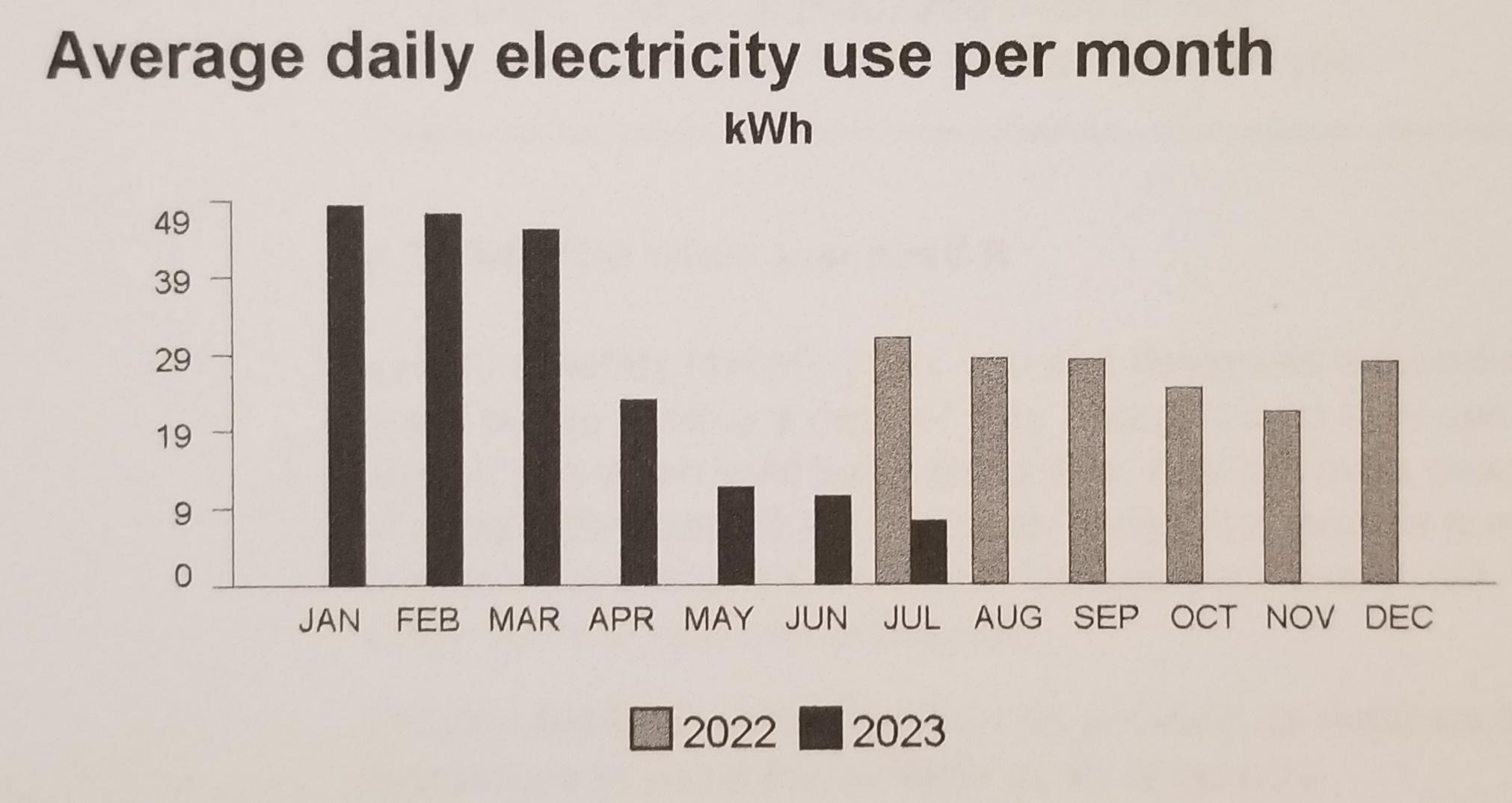
Does Vermont realize this must be done? (1st pic) Does it realize that the subject scenario will quite rapidly double in intensity in just years? (2nd pic) In May this year, my electricity use already reached the 2025 goal. (3rd pic)
http://yavapaiweathertracks.org/IPCC_SR15_Fig3b.png
Cut carbon footprint by HALF by 2030 (IPCC SR15 [2018])
http://yavapaiweathertracks.org/cfsr_world_t2_day.png
Every year gets hotter, faster. (AR6 SPM)
Average US household electricity use ~21 kWh/day
http://yavapaiweathertracks.org/GISTempDist_1080p30.gif
Global temperatures are not going back… act now or regret it.
Oh, and electric cars are a total red herring.