

Ed. note: This piece was originally published in Spanish in La Jornada, Translated into English by Jane K. Brundage.
If we are facing a crisis of civilization and therefore need a civilizational transformation, a total paradigm shift, then everything that decentralizes, localizes, makes society horizontal and empowers must be disseminated and celebrated.

We are talking about amplifying social power in the face of economic (capital) and political (State) powers, since social power is the only way to overcome the tremendous social and environmental crisis that humanity is suffering today.
Participatory communication is one of the phenomena that has grown exponentially not only in Mexico, but in much of the world. If the Internet has facilitated the spread of all kinds of social networks, then the appearance of community radio has meant the creation of an alternative means of communication against the monopoly of public and commercial radio — with an additional feature of enormous importance. Community radio stations implement specialized communication exercises, that is, communications linked to specific territories, where processes of resistance, emancipation and innovation can take place unnoticed.
As small-scale stations whose airwaves spread over short distances, community radio stations deal with local issues and problems, while at the same time they examine the multiple threads that exist between nature and culture. In general, community radio stations also emerge as emancipatory initiatives. Participatory communication is thus tied up with participatory democracy, with ways of electing authorities directly and without political parties.

50 Years
The Campesina Voice
Wikipedia
In Mexico, the first community radio stations were founded in 1965, almost six decades ago. They are Radio Huayococotla and Radio Teocelo, both remain fully active. Then came a period of the spread of indigenous radio stations advanced by state institutions dedicated to the affairs of native peoples. Currently, there are about twenty of them.

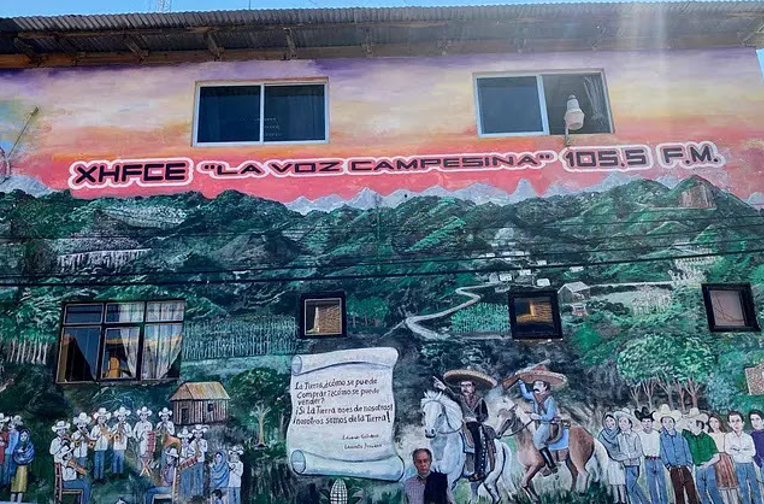
XEYTM-AM (1490 AM, “Radio Teocelo”) is a radio station in Teocelo, Veracruz, Mexico. Formerly known as XEYT-AM, the station is Mexico’s oldest community radio station, a title it shares with XHFCE-FM in Huayacocotla.
In recent decades, community radio stations have multiplied spectacularly. Without an exact figure, we estimate that today there are more than 300, as reflected by their most important event:
the three congresses organized in 2020, 2021 and 2022 by the Faculty of Communication Sciences of the Meritorious Autonomous University of Puebla (BUAP), in coordination with the State Council of Science and Technology of the State and the Community Parliament for the Rights of Nature.
In 2021, the congress brought together 276 radio stations; by 2022 the number had grown to 354, coming from most of the federal entities and some 20 countries in Latin America and the Caribbean. With assistance, between nine hundred and a thousand congresspeople attended. The congress is a strategic forum for discussion and reflection on the progress made by all community radio, not simply rural or indigenous, but urban, university and student as well. These congresses have succeeded in bringing radio representatives together with academics and specialists.
Of particular importance are the community radio networks created for specific purposes on either a temporary or permanent basis. One example is the live program that aired last year on Aire Libre 105.3 FM with the participation of four community radio stations. It was named Tequio Radiofónico — an allusion to the forms of collective work and mutual collaboration that people use in their day-to-day activities. The live program was supported by
> Radio Totopo, from Juchitán, Oaxaca;
> Radio Tsinaka, from Tzinacapan, Cuetzalan, Sierra Norte de Puebla;
> Radio Teocelo from Veracruz, and
> Radio P’iani from Carapan, Michoacán.
In a similar manner, the Community Parliament for the Rights of Nature maintains a network of 28 community radio stations that broadcast and share coordinated programs from the organization throughout the main regions of the state of Puebla. For its part, the Institute of Social Research of the National Autonomous University of Mexico [UNAM] also organized a discussion on the strengths and limitations of Community Radio in Mexico (https://rb.gy/ciogd).
The role that these alternative radio stations play in the maintenance of local and regional cultures — the defense of territories and their resources, human rights, the strengthening of indigenous languages, the claims of women and youth, and self-management, self-government and self-defence — makes them a crucial instrument for social empowerment. They are, in short, a powerful force that must grow and consolidate.
Teaser photo: XHFCE-FM is an indigenous community radio station based in Huayacocotla, a community of some 4000 inhabitants in the mountainous north of the Mexican state of Veracruz. It began broadcasting on a short wave frequency, on August 15, 1965 as XEJN-OC, using a 500 W transmitter.





Comments
We changed commenting systems on September 10, 2026 as part of a site-wide functionality and security upgrade. Your past comments have not disappeared, and you can still log in with your old Disqus account credentials if you wish. Contact us with any questions.