


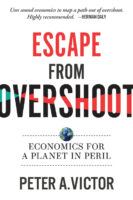
 Excerpted with permission from Escape from Overshoot: Economics for a Planet in Peril, Peter Victor (April 2023, New Society Publishers.
Fourteen Propositions for Planning an Escape from Overshoot
- There is compelling evidence that humanity is living in an era of global overshoot.
- A reduction in the physical scale of the human enterprise is essential to escape from overshoot.
- The historical and current causes and consequences of overshoot are extremely unequal within and among countries.
- Limits on material and energy throughput and land transformation are critical to an escape from overshoot.
- Contraction and convergence is an appropriate ethical principle for building an escape plan.
- A planned escape from overshoot requires a common sense of purpose such as has been seen in times of war and pandemics.
- A common sense of purpose should be founded on principles of justice, otherwise the escape plan will be compromised by people and institutions seeking their own self-interest rather than working towards shared objectives. These principles of justice should encompass non-human life as well as human.
- A common sense of purpose is more likely to emerge from forms of democracy that combine representation and participation, and which are based on the principle of subsidiarity-that social, political, and environmental issues are best dealt with at the most immediate level consistent with their resolution.
- Reductions in population should be welcomed, planned for, and encouraged through increased measures such as: accessibility to education especially for girls, increased availability of contraception, provision of a basic income and wealth, and better support for the elderly.
- Finance should facilitate the escape from overshoot rather than exacerbate it. To this end, money creation by commercial banks should be curtailed. The financialization of nature and the implication that it exists solely to serve human interests, should be halted and reversed.
- Technology does not exist in isolation. It is embodied in materials and requires energy for its production and use. Technologies often have unintended consequences which can be positive and negative. Whether and how technology contributes to the escape from overshoot depends on who owns it and what they seek to obtain from that ownership.
- Knowledge and ideas should be shared as much as possible given that they are non-rival. Exclusion of potential users through intellectual property rights should be discouraged, especially where it impedes the flow of information, products, and services to low-income countries as happened, for example, during the COVID-19 pandemic.
- Capitalism presents serious obstacles to an escape from overshoot. It serves the interests of the owners of capital, who, through increasingly powerful corporations, are constantly looking for ways to extend their reach, increasing overshoot, and only incidentally serving the interests of other members of society. Experience with Socialism has a mixed record in relation to overshoot, having focused on growth almost as much as in capitalism, and it has shown the shortcomings of central planning.
- Overshoot will transform economic and political systems. It is better to choose the transformations we want rather than have them forced upon us by circumstances beyond our control.
Ed. note: You can hear the author talking about the book at this in-person and livestreamed event on April 12. Go here to register and find out more.
Teaser photo credit: By Tuxyso – Own work, CC BY-SA 3.0, https://commons.wikimedia.org/w/index.php?curid=28845100. Greater Los Angeles lies on a coastal mediterranean savannah with a small watershed that is able to support at most one million people on its own water; as of 2015, the area has a population of over 18 million. Researchers predict that similar cases of resource scarcity will grow more common as the world population increases.[20]




Comments
We changed commenting systems on September 10, 2026 as part of a site-wide functionality and security upgrade. Your past comments have not disappeared, and you can still log in with your old Disqus account credentials if you wish. Contact us with any questions.
It was a good list, though. but you’re right–you can’t tell whether there’s more to the book than that list, with each point greatly expanded, telling us things we already know.
Yes, but the list is OK, though brief. Point 9 has some contradiction in it, though. The idea seems to be to get the birth rate down but it also includes better support for the elderly, which counteracts a lower birth rate. I’d be a beneficiary of better support for the elderly but I can’t help thinking that lowering birth rates would have detrimental consequences (at the extreme, a zero birth rate means extinction, but lower rates have demographic implications). Maybe the only reasonable approach is to lower life expectancy, probably by removing most health services except pain relief and palliative care. Very few would vote for that, though.
I was disappointed to find only a bullet item list, and not some prose from the book. I find bullet item lists of this kind uninspiring.
With writing like this, I always wonder whose perspective this is taking or who is the intended audience? It always feels as if it’s the perspective of a benevolent but absolute ruler of the entire world, or a humanity with a hivemind, able to act in absolute unison, who already all agree what the problem and the solution is.
While I agree with much of this, I see overpopulation of humans, along wit rampant consumer capitalism at the expense of the rest of nature as central to the problem. The idea of a basic income for all is counterproductive to natural law. In reality, we are all workers, and until we adapt to the premise of reciprocity–that we need to give back, I see the basic income as a capitalist obfuscation which has a major purpose of denying individual responsibility, while expanding the system itself. Which comes first–the redistribution of wealth, or the tossing of a few tidbits to those who aren’t willing or able to give back anything? How do we get to a new pie, which has as its center: “From each according to their abilities, and to each according to there actual needs–one for all, all for one? And how does it take into account the ecological premise that all beings are connected and interdependent?
It’s with great trepidation that I’m inclined to agree