


Introduction
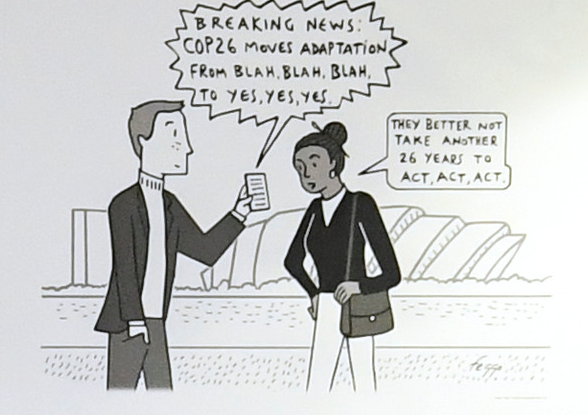
As COP 26 began, Greta Thunberg summed up the whole thing quite succinctly using just one word, three times: Blah blah blah.
And as it ended two weeks later, she tweeted:
The #COP26 is over. Here’s a brief summary: Blah, blah, blah. But the real work continues outside these halls. And we will never give up, ever [emphasis added].
And indeed, COP 26 was an epic fail, even by the dismal standards of the 25 COPs that preceded it, but at the same time, the global climate justice movement made some much needed forward progress.
Source: Flickr
Why this COP was an epic fail
The process leading up to the COP was a blatant act of climate injustice
Starting with the process leading up till COP 26, we might well ask why was it held at all, under the conditions of COVID?
Large numbers of delegates and civil society, in its attempts to presence the world’s people, could not get to this summit, and this is beyond the usual exclusiveness of all COPs due to ordinary people and activists not having the means to travel, to be lodged, to miss work and income, and so on. This was built in by the ineptitude and lack of sincerity of the UK hosts, who had promised to make vaccines and entry requirements doable for those who wished to attend. So this can be called the COVID COP, to connect two of the many global crises that beset us.
Or we might call it the apartheid COP, to connect the climate crisis to the existing cultures of violence the world suffers, from local policing to national-level militarism (both led by the U.S., of course, the undisputed world number one in military spending and murderous police forces).
Asad Rehman, former climate spokesperson for Friends of the Earth International and current Director of War on Want, derided the “shabbiest organizing” he’s seen in 15 years of attending U.N. climate conferences, while others called it the whitest, richest, most restricted and exclusionary COP ever.
Under these conditions, it would have been better to postpone, yet again, or have less formal meetings and conversations open to the people of the world through Zoom.
Nicaragua calls it like it is at the opening plenary
Perhaps Nicaragua said it best that day [and here I am bracketing for a moment the dismal situation that has been wreaked on the country by its president, Daniel Ortega, most recently in the November 7 elections, i.e. the day before the country’s negotiator made the speech]. According to Third World Network’s excellent daily updates:
Nicaragua said that the root of the climate problem is driven by the large capitalist economies through the destructive models of production and consumption. It said that the 10 largest emitting countries represent 83% of global emissions, while the 100 countries with the lowest emissions represent only 3%. It said that the group did not agree with reaching carbon neutrality in the second half of the century, adding that this represents a huge step backwards from the 2°C and 1.5°C targets, as the 2050 target is too late.
It added that it is imperative that countries of the world adopt a model of civilisation that defends Mother Earth, and where nature and human beings are a totality – and the totality of Mother Earth to replace the anthropocentric model … in which subject[s] nature at the service of humans. Concrete results from the COP26 must be based on the CBDR principle [Common But Differentiated Responsibilities, a pillar of the UN Framework Convention on Climate Change since its inception in 1992], and that illegal unilateral coercive measures must cease immediately. It also emphasised that loss and damage must be raised to equal importance as mitigation and adaptation. The commodification of mother earth must be avoided through the so-called cooperative approaches of Article 6, which includes establishing carbon markets…
The good, the bad, and the ugly
The elephants in the room: The U.S. and China made empty promises and delivered nothing. U.S. President Joe Biden turned up for an inspirational opening speech, against the backdrop of the legislative death of a Green New Deal in the U.S. Congress. President Xi of China failed to show up at all, later issuing a bilateral pledge with the U.S. while doing nothing to halt or slow the emissions from coal that make China number one in the emissions standings for another year.
Fossils of the Day awards: Many countries fought for the medals meted out for doing the biggest wrong things each day by Climate Action Now International’s newsletter ECO. These hotly contested awards went successively (on some days there was more than one winner) to:
- Norway: “not a single Norwegian climate target has ever been met, the petroleum industry is the largest source of domestic emissions and exported emissions of Norway’s petroleum industry are around ten times higher than national emissions. Mind boggling.”
- the U.S.: “United States President Joe Biden, supported by the UK Government and others, launched the new ‘AIM for Climate’ (AIM4C) initiative at the World Leaders Summit innovation event. Did Joe think we’d be stuck in the line too long to notice that this is a sneaky scheme to reframe industrial agriculture and disruptive technologies as climate action? Come on Joe, we’re not confused by lines, just frustrated. So it’s crystal clear that it’s the opposite and goes against any principles of justice, sustainable development and food security.”
Toward the end of the COP, the U.S. again took the prize:
“As fossil fuel enabler-in-chief his administration has even outdone Trump by approving over 3,000 new drilling permits on public lands. Joe has refused to stop the Line 3 pipeline, expected to transport 760,000 barrels per day, and is keeping the fossil fuel lobby happy with sweet whispers of carbon capture storage and hydrogen. And the cherry on this carbon cake – the US shunned a global pact to commit to a coal end date.”
- France: “word has reached us from AFP that all may not be as it seems. Apparently, they’re pushing for the integration of fossil gas and nuclear as ‘sustainable’ energies in the EU taxonomy.”
- the U.K.: “the UK presidency insisted that COP26 was going ahead and was prepared to welcome the global community to ‘the most inclusive COP ever’… This spirit of inclusivity has showcased what the Brits do best – the art of queuing for hours in some cases.”
- Poland: “The Polish ministry of climate and environment decided that, despite being the 23rd largest global economy, (forecast to grow further in the coming years, according to the World Bank) and with ambitions to join the G20, to put the country in the ‘poorer’ category.”
- Brazil: “despicable behaviour is well documented in Brazil; invasions of Indigenous lands have skyrocketed; wildcat gold mining is polluting waterways, intimidation is rife and they have a vice-president who justified denying freshwater to COVID-hit villages because ‘the Indians drink from the rivers’. We could go on to talk about rainforests and deforestation but think you get the idea.” On earning its second award, “Unfortunately, they … confirm the Brazilian Government’s illogical, and very dangerous, rationale. These sobering figures and comments make us wish we had a time machine to send Bolsanaro’s government back to the prehistoric age, where their ideas and policies belong.”
- Saudi Arabia: “Saudi Arabia gets their first Fossil for manipulating the rushed and restrictive decision making process, to keep the words ‘human’ and ‘rights’ out of the final text.”
- Mexico: “Mexico has worked hard to earn its Fossil of the Day award. Ranked as the 13th largest emitter of CO2 in the world, it’s not exactly spearheading energy transition. Its government is pumping more, not less, money into the fossil fuel industry, building oil refineries and delaying policies aimed at carbon emissions reductions.”
- The Czech Republic: “When the Czech Prime Minister Andrej Babiš used the COP26 World Leaders’ Forum to brand the EU Green Deal ‘ideology, not a deal’, it appeared he had mistaken the Glasgow event for a climate change deniers’ conference.”
- There was even a shout-out to New Zealand, which typically gets praise for its global policies: “We nearly fell off our chair when Mr. Shaw (who also chairs the transparency negotiations and is co-leader of the NZ Green Party btw) quite literally said that just because a refreshing of the NDC [Nationally Determined Contribution, or pledge for emissions reductions made at Paris in 2015] has been asked of countries ‘it doesn’t mean we have to.’ This comes from a country that gives off the ‘greener than thou’ vibe at the drop of a hobbit’s hat.”
- Australia: Australia actually won the award on no less than five different days, and took the overall gold for “No new policies to reduce emissions or phase out fossil fuels; Failing to deliver ambitious NDCs; Approving three new coal projects in the last months; Ruling out signing the Global Methane Pledge; An ‘inaction plan’ for EVs in favour of gas guzzling cars; Rolling out the red carpet for gas-giant Santos in their COP pavilion; Inviting consultation on ten new areas for offshore petroleum exploration; [and] Not updating the 2030 target.”
Somewhat surprisingly, Russia was not a contender for the awards at this COP. Putin wouldn’t have been there in person in any case should they have gotten a nomination. The same goes for Narendra Modi of India, who did attend, to little effect.
The climate justice stalwarts, on the other hand, were represented, as always, by a few delegations: AOSIS, the forty-plus nations of the Alliance of Small Island States, including the Maldives, with Mohamed Nasheed, climate hero of COP 15 in Copenhagen in 2009 speaking for that country, Bolivia, and maybe Costa Rica … but who else?
The People vs. the COP

Source: Flickr
Meanwhile, most of the Global South was simply excluded and largely invisible, first and foremost, Africa, which might be called the frontline continent of the climate crisis. This is not to mention all the peoples of the world, the indigenous, the frontlines, youth, students, workers, women, …
Youth clearly understood that they were being lied to. Brendan Montague reported for The Ecologist:
Cora, 15, from Edinburgh, said: “We need to really change how politics looks in our society. Having that one leader that makes all the calls even when they are not specifically educated in climate change? We need people who have had the experience of climate change impacts, say if they are from the Global South, in power. Having people who didn’t all go to Cambridge in government in a massive superpower would be beneficial for ordinary people, working class people, and people in the Global South, so we can have better policies.”
She added: “We all know that COP is just a theatre run by capitalists. We know that when COP is finished we will just have empty promises and false solutions. We can expect that again and again. We are letting those people who are putting profit over the people and the planet run it, letting them be in charge. We’re letting them get the photo op and drink the fancy wine. They know they can get away with it.
“Letting that kind of capitalist theatre run every COP, we are never going to see the change that we need now. It will come back to doing stuff without that kind of world negotiation. It has to come back to individual countries, they need to start adopting their own policies. We know that COP is never going to work. The capitalists cannot do it.”
She concluded: “We need system change. We need the massive companies taxed, and taxed properly. The just transition is going to cost a lot of money … to get that change we have to start taxing the top one hundred companies that are actually responsible for emissions. I am vegan but that alone does not create that change that we need to see.”
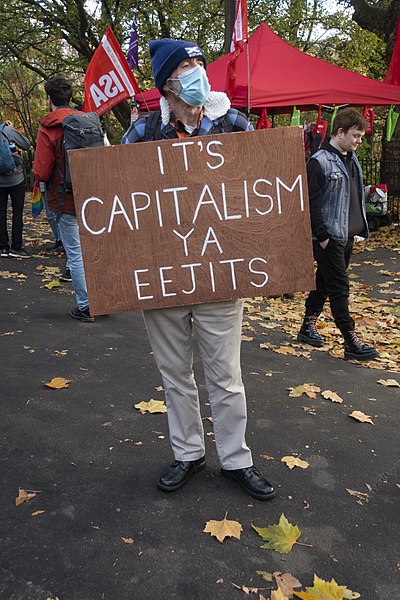
Photo by francis mckee. Source: Wikimedia
Outcomes: The winners and losers
Here’s the official line on the outcome, in the words of Patricia Espinosa, Executive Secretary of the UNFCCC, drawing extensively on the metaphor of a bridge:
At COP26, Parties built a bridge between good intentions and measurable actions to lower emissions, increase resilience and provide much needed finance.
A bridge leading to the historic transformation we must make to achieve rapid reductions this decade and ultimately towards the 1.5C goal.
A bridge between the admirable promises made six years ago in Paris to the concrete measures that the scientific evidence calls for and societies around the world demand.
Then she had the audacity, the shamelessness, really, to go further:
This was clear outside the formal process as well….
We heard from the activists who marched in peace and plead for you to listen to their cries for climate leadership.
We heard from women, from youth, from cities, from regions, from businesses large and small, from academics, scientists and countless others….
The tone of defeat is easy to read between these lines, which are sad to take at face value, and tragically devastating to contemplate.
As Asad Rehman said on Democacy Now!, “we should not call it a Glasgow pact, we should call it the Glasgow suicide pact for the poorest in the world, because it does not keep us below the 1.5 degree guard rail…. They’re ramming through so many loopholes that it makes a mockery of these climate negotiations.”
The winners of COP 26 were the indefatigable voices of civil society, whose actions were loud and clear: on the final Friday, many, many organizations walked out of the COP in protest, reminded me of the walkout I witnessed and took part in at COP 19 in Warsaw in 2013.
The COP 26 Coalition of dozens of groups from everywhere issued an inspiring and damning document called the People’s Declaration, a set of ten demands that laid out what we actually dream of seeing from the next COP:
- Global North countries pay their climate debt:
- Deliver a Global Goal for Adaptation:
- Address climate injustice and pay up for Loss and Damage:
- Urgently deliver your fair share of action:
- Reject False Solutions:
- No trade off of Human Rights:
- Big Polluters removed from this Process:
- Deliver Just Transitions:
- Co-operation and Solidarity:
- Do not exclude the People.
In an echo of Greta Thunberg’s succinct condemnation of the COP, the preamble concludes that
“People are tired of waiting for governments to prioritize people and the planet over profits while so many lives are being impacted and lost. We are out of time and out of patience.”
So, what now, then, for climate justice?
That is the real question that we should be discussing, and which we will be discussing, in the days and months to come.
This is the perennial challenge at the heart of the global network of movements for climate justice, a lace made of an almost uncountable number of groups, some prominent and many more well under the radar.
For my part, and in this conversation among climate justice radicals, I work and advocate for confronting the climate crisis in two fundamental and complementary ways:
That we continue building the global climate justice movement together, and
That we put our hands, hearts, and heads to creating systemic alternatives in our communities.
The strategy for achieving both of these is the network model, the creation of increasingly fruitful, mutually supportive connections among groups, movements, NGOs, and individuals.
One of the visions I hold is for an intersectional ecosocialism, inclusive of all folks in the 90 percent, all races and ethnicities, all gender identities, that is multigenerational, flexible, open, and vibrant.
The only way forward for Northern ecosocialists is to learn about and embrace “intersectional ecosocialism” or an “ecosocialism of the global South” (understanding that there is a South in the North consisting of communities marginalized by all the axes of power we are talking about here).
Doing so might be of benefit to the global climate justice movement as a whole, while just possibly making our struggles equal to the pressing crises that beset us.




Comments
We changed commenting systems on September 10, 2026 as part of a site-wide functionality and security upgrade. Your past comments have not disappeared, and you can still log in with your old Disqus account credentials if you wish. Contact us with any questions.
Why bother? Grow your own food instead.
I’m sure the 8 m inhabitants of London and NYC (and elsewhere) would be happy to oblige
Grow your own food TOO.
So, this is the new environmentalism “intersectional ecocsocialism”? Woke environmentalism is not environmentalism it is political environmentalism. It is a religion not science. Let’s be clear about these things. This environmentalism is not only in denial it is anti-science. Science for science’s sake is not science. Woke is a political religion that should not be mixed with environmentalism. It is a vehicle for hijacking by the globalist elites. One needs only see how woke is optional for the elites. They are not only exempt from woke policy they are exempt from covid mandates and consumption caps. This is one big lie and what could be a meaningful and effective environmental movement is just noise.
A new environmentalism must first be based on science. The science is pretty good on the indicators for general ecosystem decline and localized failure. We know the causes. Carbon waste streams, land use changes, and excessive resource extractions are primary causes. What is not talked about is big cities and the part they play in this. The elites are the problem but not really their consumption profile. They are too small a population to matter. What is the issue with the elite is the lies they put in place to allow them to protect and preserve their wealth and power? This means to maintain their small impact they need to maintain a big impact by those further down. This is the nature of economies of scale. You don’t have elites like we have today if the world is downsized. They will not be able to fly their private jets to COPout events in a downsized world. A fake downsizing will still allow 400 jets to fly COPout.
This is why their will be no meaningful action. The only action will be camouflaged carbon-based growth strategies like green new deals. They want to do a massive buildout of renewables to address carbon. The amount of carbon needed to do this is so large that it is likely a greater impact on the carbon budget than just doing the status quo. This is a rinse and repeat carbon build out with a massive waste stream. You don’t recycle this much equipment. Carbon scrubbing is a downcycle joke. The brownfields that result is far worse than just doing status quo. The new MMT policy of massive spending with only debt is not science either. There is a scientific part of economics along with human nature. MMT is pure human nature with no science. There is reality to actual productive application of resources and nonproductive results. It is bad enough more growth-based policies are being applied but add to that they will be little more than a waste stream from irrational development. This includes the phony woke part of this spending which is little more than wealth transfer which is disenfranchisement.
A proper environmentalism focuses on science. The science behind the causes is sound. The science behind the solutions is a lie. The solutions are phony political environmentalism with woke and techno. They are focused on making cities bigger and smarter. This is just more tech and efficiency for the sake of techno efficient affluence. There is no sacrifice only the lies you can have your cake and eat it. It is about sustainable development which is just more development. There is nothing sustainable about development with a population in overshoot of population levels and consumption. More tech when tech is the problem is another lie. Letting the elite globalist lead this effort with their status exempt and their participation optional should be a clear indicator of a lie. They want a reset where you own nothing and they tell you that you will be happy. They will control you like the Chinese CCP. They will continue to prosper you will lose your dignity.
A proper environmentalism sees what is needed. It must be back to the land in permaculture. Cities must be depopulated. Cities are vital for the power down process because they produce the products that will be needed to go local and permaculture. Yea, we destroyed viable small farms and towns they orbit over a century. These will have to be rebuilt. This is a dramatic transformation that will be the last growth impulse of modern man because this will destroy globalism. It will destroy the capacity of techno economics with its value chains stretching across the globe. It will destroy transhumanism and delocalization which are the sacraments of Scientism. This evil mechanization will be sacrificed on the alter to the web of life. Real environmentalism is environmentalism not deception and lies. The priests of scientism will never allow this heresy so do it on your own individually and in small groups. Realgreenadaptation.blog
Foran’s lists his suggestions for “confronting” the climate crisis:
That we continue building the global climate justice movement together, and
That we put our hands, hearts, and heads to creating systemic alternatives in our communities.
These plans are internally contradictory-
First, anything with global reach, such as a “global climate justice movement”, depends on a globalized civilization, the very thing that is destroying the climate. For example, having the ability to communicate with someone on the other side of the world faster than a letter can travel on a sailing ship means that the climate is being destroyed. The ability to even put on a COP means that the climate is being destroyed. If you can add “global” as a qualifier to any human activity, even justice, the climate is being destroyed.
Second, almost all communities in modern countries have no “systemic alternatives”. There is no way to produce an alternative that keeps people in those communities alive and thereby keep the community intact without destroying the climate. Truly alternative, and much smaller, new communities may be created in the future, but only after existing modern communities are gone.
I guess this is just a long-winded way of seconding Walter Haugen’s action plan, “Grow your own food”. If you can’t do that, you are automatically destroying the climate.
Joe Clarkson –
If we cared to, we could use whatever remains of our high energy, high materials inputs material cultures around the world — while shrinking these to a far more reasonable scale of throughputs — to rapidly, radically and decisively transform that very material culture and its materials and energy intensity. There are no material obstacles to this, only social and cultural ones. So, for the time being, we could use the internet, radio, broadcast media and the like in service to the repair and care of life and living systems. Nothing material obstructs this as a collective option. We collectively have the knowledge (though it remains less than well distributed) to do this.
However, for this to happen at the necessary scale and pace we’d have to have a planetary scaled non-violent revolution. It would not need to be an insurrectionary non-violent movement. There is no need to use force against force. It would necessarily have to center on education, media, schools, universities… and any and all of the institutions of society and culture which shape culture — for ours is a cultural crisis more than anything else. And culture is ‘reproduced’ through cultural institutions.
Yes, using technologies which are ultimately destructive when in wide use in a world overflowing with nearly eight billion people would have an internal contradiction on one level of analysis. But if we look more closely, we see that some of these technologies are presently necessary to any possibility of a globalized but mostly localized and regionalized revolutionary movement being successful in reshaping society and culture. The perfect ought not be the enemy of the good in this case. These technologies presently exist, and they are what we have at hand to unfold the necessary revolution.
It’s now obvious to most everyone who is paying profound attention that nothing short of a revolution (non-violent, non-insurrectionary) is necessary to the scale of the crisis. Anything less than a revolution would fall far, far short of adequacy at this late date in the crisis of ecology and climate. But too many of us are afraid, or feel awkward, in speaking of revolution as “necessary”. This should begin to change very soon, as COP-26 has so thoroughly revealed what the powers are — and who they are — which have obstructed the possibility of using these UN conferences — or governments more generally — to shift the direction of “civilization”.
I believe the time has arrived in which open discussion of revolution is — has long already been — called for. But ours is not yet a culture or society in which such revolutionary movement building is possible. It’s our task now to make it increasingly more possible, more courageous, less ‘underground’, more blatant and visible.
All else is pissing in the wind.
I’m speaking here of a very specific sort of what is known as non-violent direct action, which is explained by the late great David Graeber in his White Review interview of a few years back. In this interview, Graeber says that direct action isn’t really about protest. Or calling upon government to do things governments have never done and can never be expected to do. He identifies direct action as the direct creation of the sort of world we actually want to live in — in the thousands of myriad particular ways we want it to be. If we want it to be a society or culture which cares for the climate and ecosystems and biodiversity, we have the collective know-how to do this — though it is not yet well distributed. That distribution problem is an educational problem and that’s the primary task of our revolution.
You can say “It is not possible”. And that may be so. But we cannot really know how possible it may be if we never even give it an honest try.
Are you ready? I am!
Thanks to all who read my essay and left comments here!
A few reflections and replies:
Shoal, I have no disagreement about basing our climate movements on science. Who could disagree with that?
Joe Clarkson, the two kinds of movements for confronting the climate crisis are not “contradictory” although it is true that there are diverse opinions both in the CJ movements and among communities that are building their own alternatives. Given all the diversity everywhere — Pluriverse is a good introduction to that — it would be more correct to say that there are thousands of ways to confront the crisis, which fall into two mutually supportive broad groups — stopping the bad and creating the good in its place. This hardly seems controversial. I think readers of Resilience.org, supporters of the Post-Carbon Institute, and the US and global Transition Town movements would agree with you that “There is no way to produce an alternative that keeps people in those communities alive and thereby keep the community intact without destroying the climate”!
Get your free copy of the book Pluriverse here:
https://radicalecologicaldemocracy.org/wp-content/uploads/2020/09/Pluriverse-full-printable-version-July-2019.pdf
That link didn’t work for me. But I was able to find this. https://www.radicalecologicaldemocracy.org/pluriverse/
I urge you to consider that things like the internet are the fruit of a high-energy, high-tech modernity and cannot be preserved while winding down other aspects of over-development. We don’t get to pick and choose which aspects of modernity we wish to keep while transitioning to a low-impact life. It’s an all-or-nothing package deal.
Consider modern communications: radio, television and the internet (and even plain old telephone lines) all depend on electricity to function. They therefore depend on a functioning electric grid, which depends on electric generation stations, which depend on mining and manufacturing, and so on, all of which depend on a highly skilled labor force that must be supported by other systems for food, housing and transportation. Lose industrialism and every modern thing is gone.
We both know that modern urbanism is doomed. Jason Bradford has clearly shown why The Future is Rural in his publications for Post Carbon Institute. In re-reading your exchanges with him a couple of years ago it looks to me like you agreed. The problem is in making the transition from urban modernity to low-energy agrarianism, for which no one has developed a convincing plan (at least to me).
I think it is very likely that it is actually impossible to gradually wind back the clock on modernity to an earlier, simpler society. The future will indeed be rural, but only after modernity collapses chaotically. With everything about modernity so complex and interconnected, I suspect that the collapse may be sooner than most people expect. There will be no revolution needed; modernity will go away all by itself.
I completely disagree.
A revolution is necessary and possible.
Urgently necessary. And just barely possible.
It should be non-violent and non-insurrectionary, as those old models of revolution only lead to more violence, more control, domination, oppression….
BECAUSE we currently have internet, mail, radio, etc., we should use these as best we can in service to our revolution. Our long term aim would be to phase them out … yes PHASE. Gradually. If we can get folks not to fly all over the world, to use bicycles a lot more, and to walk… and maybe use trains… and use passive solar heating where possible, and passive cooling where possible, and re-localized their food supply, etc…, using the internet and radio and such to inform, inspire and coordinate our revolutionary activities will be a justified use for the time being.
Those who insist that such a revolution is impossible may in fact be correct. It is surely unlikely. But it sure as hell beats the alternative, which is just more of the same. And we know how well that’s doing.
You might want to head on down to the Bloomsbury second-hand bookshops and pick up as many J. G. Ballard books as you can find.