

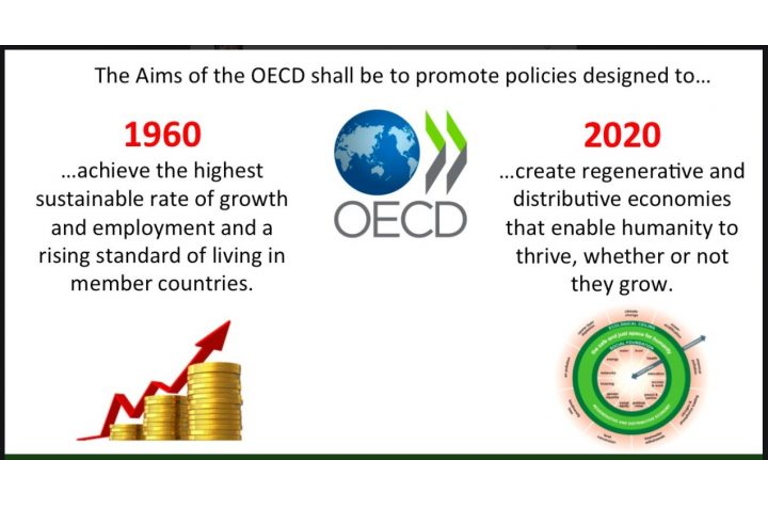
I spent a day at the OECD in Paris earlier this week, and had fascinating discussions there. They had asked me to be provocative so I proposed they rewrite Article 1a of the OECD’s founding constitution – and I later tweeted it like this:

That tweet caught the attention of Branko Milanovic, who is one of the world’s leading economists in analysing global income inequality trends, and whose work I hugely admire (and cite in Doughnut Economics, of course).
Branko had a visceral reaction against my suggestion, prompting him to write a fiery blog on why economic growth is an inevitable necessity in all countries, no matter how rich they already are.
What fascinated me in reading Branko’s blog was the deep difference in the fundamentals underlying the worldviews that he and I hold – differences that implicitly underpin many public debates today.
So I have done my best to summarise the crux of Branko’s position in just five bullet points – and then to write down, in equally stark terms, a five-point summary of my own, very different, worldview (spelt out more fully here).

I absolutely understand why Branko might find my assumptions and beliefs untenable – just as I hope he would understand why I think his are equally so.
Here I’m not interested in twitter spats or bloggers’ boxing matches – they are ten-a-penny online and there are far more fruitful ways to engage.
I sincerely believe we – humanity – are at a critical juncture in determining our chances of having a flourishing planet on which we all can thrive this century. And the economic worldview that we use will significantly shape that. So there is much to be gained by engaging respectfully with those who disagree with us.
Hence I’m taking this opportunity to step back and acknowledge that both of our visions of the future include strong beliefs about human nature versus human nurture, big uncertainties about how economic variables may respond, deep assumptions about how much change is possible, and lots of hope about how the future might be different from the past.
Neither route is easy. Neither is proven. And a lot depends upon the choices we make.
Listening respectfully to those who disagree with us is a fascinating (and still too rare) thing to do.
So thanks for the opportunity, Branko.





Comments
We changed commenting systems on September 10, 2026 as part of a site-wide functionality and security upgrade. Your past comments have not disappeared, and you can still log in with your old Disqus account credentials if you wish. Contact us with any questions.