Click on the headline (link) for the full text.
Many more articles are available through the Energy Bulletin homepage
NOAA: Greenhouse gases drove near-record U.S. warmth in 2006
Joseph Romm, Gristmill
El Niño was not the cause of 2006 warming patterns in the U.S.
—
A new study by NOAA’s Earth System Research Lab finds:
Greenhouse gases likely accounted for more than half of the widespread warmth across the continental United States last year … [T]he probability of U.S. temperatures breaking a record in 2006 had increased 15-fold compared to pre-industrial times because of greenhouse gas increases in Earth’s atmosphere.
How did they come to this conclusion?
[T]he NOAA team analyzed 42 simulations of Earth’s climate from 18 climate models provided for the latest assessment by the Intergovernmental Panel on Climate Change … The results of the analysis showed that greenhouse gases produced warmth over the entire United States in the model projections, much like the warming pattern that was observed last year across the country.

The warming pattern did not match that of El Niño, which the study found typically cools the country slightly:
For a final check, the scientists compared the observed 2006 pattern of abnormal surface temperatures to the projected effects of greenhouse-gas warming and El Niño temperature responses. The U.S. temperature pattern of widespread warming was completely inconsistent with the pattern expected from El Niño, but it closely matched the expected effects of greenhouse warming.
When even NOAA scientists attribute recent warming to greenhouse gases, you know it’s time to take action. Let’s see if the media give this important study the same attention they gave to the recent trivial revision in NASA’s U.S. land-based temperature data record.
This post was created for ClimateProgress.org, a project of the Center for American Progress Action Fund.
(29 August 2007)
Swiss Town Guards Itself Against Climate Hazard
Emily Harris, All Things Considered (NPR)
In Switzerland, one town saw global warming coming and built a dam to stop it.
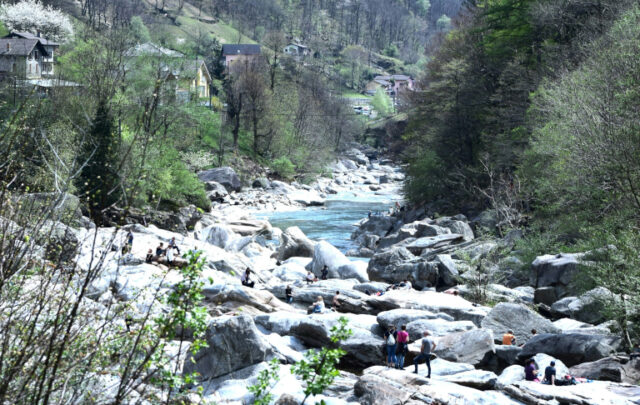
The Swiss resort of Pontresina, near the Italian border, is 5,900 feet above sea level, which is on the high end – even in Switzerland. But higher still, right above the town, is a mass of warming permafrost.
Permafrost expert Felix Keller estimates that the ice in the earth is holding together enough rock and debris to fill 100 or so houses.
…Flooding and an increasing number of rock falls – some deadly – have heightened awareness in Switzerland about the natural hazards this country faces as the earth warms. Pontresina is often described as the first town in this well-organized country to do something proactive to protect itself against the effects of climate change.
…Towns in this valley are worried the effects of global warming could slow tourism, so they are actively trying to promote themselves as doing something to fight climate change. The neighboring luxury resort of St. Moritz has put together a “clean energy tour” – showing off solar panels on ski lifts and a hotel heated using water from a freezing cold lake.
“St. Moritz is used to (setting) trends,” says Hans Peter Danuser, tourism board president. “The Range Rover was launched here worldwide, the Audi Quarto was launched here worldwide. So, we also want to launch ecological trends. It means alternatives are chic and sexy.”
After all, he says, the natural environment is ultimately all the area has to sell.
(27 August 2007)
Connecting the dots… tourists from around the world jet or drive to Switzerland. Greenhouse gases from their vehicles exacerbate global warming. Global warming melts snow, glaciers and causes landslides, threatening Switzerland’s status as a tourist destination. -BA
The great global coal rush puts us on the fast track to irreversible disaster
John Harris, The Guardian
The dirtiest fossil fuel of all is on the resurgent, dressed in climate-friendly garb. We’d be wise not to flirt with it.
—
…one much-overlooked story surely deserves a lot more attention: what may soon be known as the new coal rush, and developments so at odds with the imperatives of climate change that they suggest a fast track towards irreversible disaster.
…no end of faith is focused on the coal industry’s shiniest silver bullet: carbon capture and storage (CCS), whereby billions upon billions of tones of CO2 will one day be pumped underground.
Talk to the advocates of CCS and you soon bump up against a weird kind of public relations that somehow combines evangelistic hype with all kinds of qualifications. They cite a handful of pilot schemes (which, just to soothe green hearts, often aim at using CO2 to release untapped oil and gas reserves), though the volumes involved are for now trifling. Even on the most optimistic projections, CCS won’t become viable on any convincing scale until well after 2030, and how much additional energy would be required to put the technique into worldwide practice remains a mystery. Whether it will be economically workable is another matter, not least for the countries whose room for manoeuvre is far less than that of the industrialised west. One UN study has estimated that obliging the coal-fired power industry to embrace CCS could push up the cost of the electricity it produces by anything between 40% and 90%.
…The essential point is this. Carbon capture might have some appeal as a means of managing the emissions of a coal industry that could thereby be slowly scaled down, but it is currently being transformed into the justification for a hair-raising level of expansion. Besides, as things stand, the vast majority of the world’s coal-fired newbuild – including those power stations due to be constructed in the US – will not even be CCS compatible.
So, faced by a world apparently gone coal-mad, what to do?
(29 August 2007)
Hot winds force fire bans – in winter
Penelope Debelle, The Age
SOUTH Australian authorities have declared what is thought to be the state’s first winter fire bans as the combination of potentially record high August temperatures and gusty winds forced emergency fire services onto full alert.
Fire bans starting from midnight last night were declared in four areas, including the Adelaide Hills, which were ravaged in the 1983 bushfires, and areas of Eyre Peninsula, where in 2005 eight people lost their lives.
…Mr Watts said soil dryness and drought combined with an unusual summer-style front contributed to the decision.
He said there were no records to determine whether this was the first time fire bans had been declared in winter, but it was the first he knew of. “It is certainly a very rare event.”
If the forecast temperature in Adelaide today of 28 degrees is exceeded by more than one degree, it would break the city’s August record of 29 recorded in 1911, Bureau of Meteorology senior duty forecaster Allan Beattie said.
The system moving from South Australia and into Victoria is expected to bring winds ranging from 50 to 70 km/h, with some wind gusts reaching gale-force speeds of 120 km/h, which could spread spot fires or reignite burn-offs that were allowed at this time of the year.
…The underlying problem of drought also raised the risk of more severe bushfires as heavier fuel such as tree trunks, thick scrub and logs burnt more readily because they had dried out.
(30 August 2007)
Contributor SP writes:
Just another one of those incidents that by itself can not be attributed to climate change… 😉