


Click on the headline (link) for the full text.
Many more articles are available through the Energy Bulletin homepage
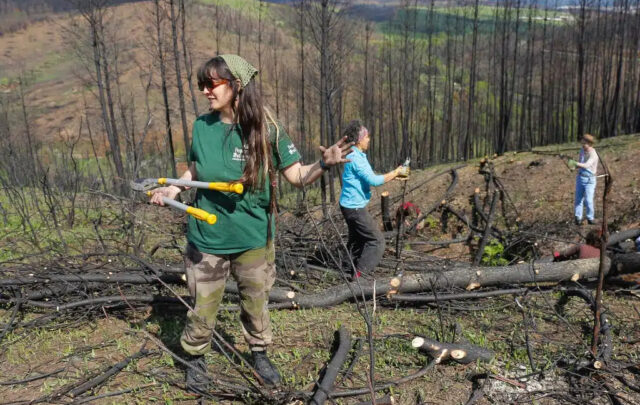
UN: Climate making forest fires bigger
Nicole Winfield, Associated Press
ROME – Climate change is making forest fires around the world bigger and more intense, increasing the threat to people and the environment and costing countries millions in damage and firefighting expenses, the United Nations said Thursday.
With estimates of firefighting costs ranging from $450 million to $900 million per fire season, some countries – such as Canada – may no longer be able to afford to fight fires with the vigor that they currently do, cautioned the report from the U.N. Food and Agriculture Organization.
In a global assessment of forest fires, the Rome-based agency found that 865 million acres of vegetation were affected by fires in 2000 alone – most of it in sub-Saharan Africa.
(31 May 2007)
Earth nears tipping point on climate change
Peter N. Spotts, Christian Science Monitor
A rise of 1 degree Celsius could be enough to trigger ‘dangerous’ warming, scientists warn.
—-
Dangerous climate change has not yet arrived, but the tipping point may not be far off. And it may be reached with a smaller temperature rise than recent studies suggest.
Those are among the conclusions from an international team of climate scientists in a study this month, which they say bolsters the case for an alternative strategy to combat climate change. The main idea: focus intensely on cutting greenhouse-gas emissions other than carbon dioxide in the short term, giving the world a little leeway in dealing with the trickier issue of CO2.
Most climate scientists point to rising carbon-dioxide levels from burning coal, oil, and gas as the main driver behind global warming. But the international team says that fighting ozone, soot, and other pollutants, which also can warm the atmosphere, could allow CO2 levels to rise a little higher without reaching the tipping point.
“This is good news,” notes Gavin Schmidt, a member of the research team and a scientist at NASA’s Goddard Institute for Space Studies (GISS), in an e-mail. “There is scope for effective action, even though it will fall short of stopping human-caused climate change completely.”
Yet this more comprehensive approach to curbing emissions is unlikely to remain an option for too long, according to James Hansen, a climate scientist also at GISS and lead author of the study. If global CO2 emissions continue on their current “business as usual” path for another 10 years, he notes, “it becomes impractical to achieve the alternative scenario.” The business-as-usual approach allows too many fossil-fuel intensive power plants and factories to be built – investments designed to last for decades, he adds.
(30 May 2007)
I Was On the Global Warming Gravy Train
David Evans, Mises
I devoted six years to carbon accounting, building models for the Australian government to estimate carbon emissions from land use change and forestry. When I started that job in 1999 the evidence that carbon emissions caused global warming seemed pretty conclusive, but since then new evidence has weakened that case. I am now skeptical. ..
None of the new evidence actually says that carbon emissions are definitely not the cause of global warming, there are lots of good science jobs potentially at stake, and if the scientific message wavers then it might be difficult to later recapture the attention of the political system. What has happened is that most research efforts since 1990 have assumed that carbon emissions were the cause, and the alternatives get much less research or political attention. ..
The integrity of the scientific community will win out in the end, following the evidence wherever it leads. But in the meantime, the effect of the political climate is that most people are overestimating the evidence that carbon emissions are the main cause of global warming.
I recently bet $6,000 that the rate of global warming would slow in the next two decades. Carbon emissions might be the dominant cause of global warming, but I reckon that probability to be 20% rather than the 90% the IPCC estimates. …
David Evans, a mathematician, and a computer and electrical engineer, is head of Science Speak.
(28 May 2007)
Contributor Rod Campbell-Ross writes: The best article I have seen questioning global warming. His conclusion seems to say that it could be carbon – we do not know, which is at odds with the position of the IPCC. As of right now he is emphatic that there is no link between carbon and warming. He also points out that this is a scientific issue – the science will win out, irrespective of the political posturing, but it has not done so yet.
See also discussion on Mises, criticism from James Annan and response to latter from David Evans.
BA: Not convinced. There are scientific controversies worth following, but I don’t think climate skepticism is one of them.
G-8 to take up climate change
Brad Knickerbocker, Christian Science Monitor
Europe, Japan, US, and developing nations are divided over how to handle greenhouse-gas emissions.
—-
The international squabble over climate change – who’s to blame and how to deal with it – is coming to a boil as many of the major players prepare to meet in Germany next week.
In essence, Europe and Japan want stricter controls on greenhouse gases and a faster timetable for reducing them. Major developing countries, China and India, say advanced Western industrialized nations need to make the first cuts; and the United States increasingly looks like the Lone Ranger as it resists diplomatic efforts to join in a coordinated plan to battle global warming.
The differences became apparent earlier this week when the environmental group Greenpeace leaked documents “showing the United States has raised serious new objections to a proposed global warming declaration” for next week’s Group of Eight summit, according to the French press service AFP.
(31 May 2007)
The most interesting story in the lead-up to the G8 conference is the leaked report that: Russia may be questioning the dogma of limitless economic growth (Reuters, also at EB) -BA
Carbon credits are ‘wrong’ says Benn
Nell Boase, Guardian Unlimited
Tony Benn has spoken out against a proposal for individual carbon allowances put forward by the environment secretary, David Miliband, last December, stating that “carbon credits are absolutely wrong.”
Speaking to the Guardian at the Hay festival today, the political diarist and former secretary of state for energy drew an analogy with the food rationing policies in place during the second world war. “In the war it was a criminal offence for me to sell my ration book to somebody else, because the purpose of the rationing was to see that everybody had a fair share,” he said. “If we need to ration [carbon expenditure] that’s one thing, but fair distribution is the key to it. If the world is short of resources we have to ration them, which is different from selling them.”
The idea of a personal carbon allowance was first devised by the environmental writer and former chairman of the Soil Association, David Fleming, in1996, and was floated again in a speech by Miliband in July of last year. Since then, the idea of ‘carbon credits’, under which everyone would receive an annual allowance of the carbon to ‘spend’ on products such as food, energy and travel, has been gaining currency. A feasibility study commissioned by Miliband and carried out by the Centre for Sustainable Energy for the Department for Environment, Food and Rural Affairs, recommended in December that the scheme could come into operation within the next five years.
A key element of the proposal, however, is that individuals would be free to trade their credits, selling any surplus carbon to others, or buying more if their requirements exceeded their allowance. It is this aspect of the scheme which Benn disapproves of, objecting to “the idea that a rich person can buy credits from a poor person so that he can go on driving his Chelsea tractor”. Rather, he advocates an approach of personal responsibility, suggesting that “there is undoubtedly a lot to be done locally – you can use those low-power light bulbs or insulate your house.”
(31 May 2007)


Comments
We changed commenting systems on September 10, 2026 as part of a site-wide functionality and security upgrade. Your past comments have not disappeared, and you can still log in with your old Disqus account credentials if you wish. Contact us with any questions.