

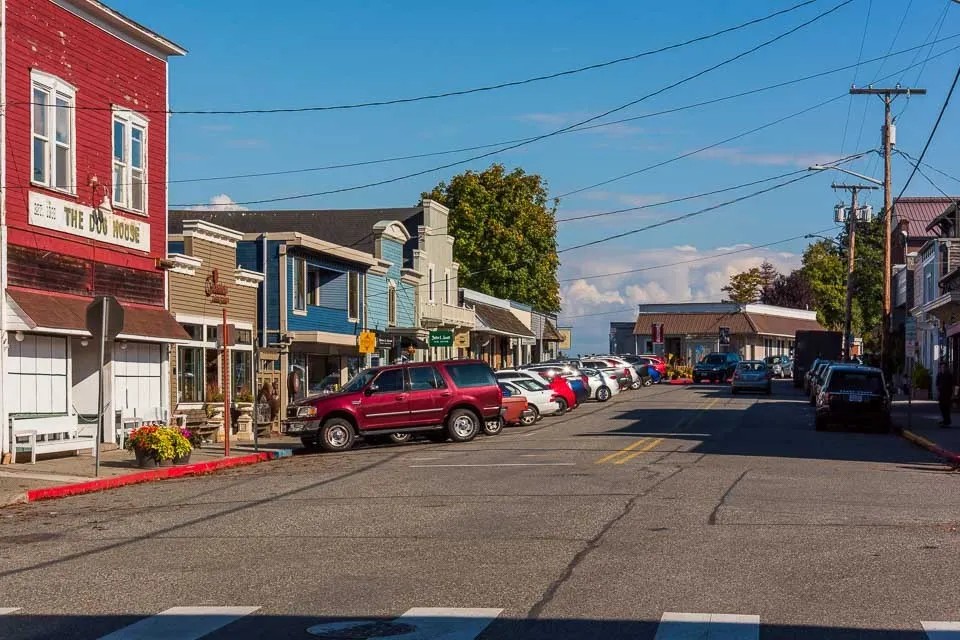
All villages are somewhere.
A hundred years ago that was obvious. Not now.
Online isn’t somewhere; it’s the illusion of somewhere, but it’s nowhere to be found.
My virtual villages
Every morning I gather on Zoom with my writing group. We meditate, write, chat and then the host closes the room,i and it all evaporates and I’m in my house, with my cat and the duties of the day.
I hosted a podcast for three years, What Could Possibly Go Right? It gave me a rarefied experience of being part of a global web of the crème de la crème of thinkers about the future of life on earth. In reality, I was in my house, with the cat and the duties of the day.
Through Libby, I borrow books without ever going to the library.
We read the news online, and stumble into endless talking heads on Reels or Instagram, making some good faith effort to catch up on the global village gossip.
Conferences and workshops are like tent cities – temporary structures that give the feeling of being part of something larger than self. But we go home to our four walls and whatever creatures we care for – pets, family and plants.
Community theater
When I was younger, I fell in love with theater. I wrote, directed, and acted in plays, and I was accepted into a prestigious graduate school to study the craft and make it my life. Besides the art, what I loved as the community of the theater, the show-must-go-on group of artists who would do anything at any hour for our collective creation. But oh, the closing night, the cast party and then the strange and devastating evaporation of the group. Was it theater I loved… or community?
The office
For better or worse, I gave up that dream to move in with my best friend/lover/mate. I fumbled about finding work and a career after failing to launch in New York theater. For quite some time, I felt like an outsider, flunking capitalism. Everyone seemed to get up, get dressed and get on the subway. Everyone seemed to belong to the river or normal. Only later did I realize how lonely so many workers are.
Communal living
For two decades I lived in a sprawling house with nine people who shared the work of caring for the world – but had a firm barrier between us and the outside world. We had a philosophy of life that governed how we lived, and eventually we felt like missionaries to the outside world, not participants in it, sharing the good news of a life of love and service. I belonged, but still stayed inside four walls with an us; others were them, audiences, or structures we tried to change.
Global movements
To share the good news I believed Your Money or Your Life (the bestseller I wrote to express the truths we believed and lived) offered, I traveled the world. By some estimates, nearly 2 million copies have been sold in a couple dozen languages. I met global leaders and had a tad of influence on big conversations. I helped form a network of authors and activists promoting simplicity. We felt we had some answers to the chilly land of capitalism. It was heady and thrilling, but my colleagues weren’t a village; we were a movement. Lives changed, and funding ran out, and now we wave – on email – from time to time.
The global online “village” is nowhere to be found and everywhere available. Our lives are richer, our minds expanded, in this nowhere place. But something deep inside, the feeling of being situated, is flimsy or fragile or absent.
The loneliness of the long-distance life
Cancer then grew in my gut, which I soon recognized as the unprocessed sadness and loneliness of a life lived in the shadow of my public persona, who ran my life as an activist and creator, ran being the operative word. I was running from the empty gaps between projects when my sadness and loneliness grabbed hold again. Inside, I was dis-placed. I’d been leaving my life to get away from some noonday demon for forty years.
After I healed, in part through Western medicine, in part through my grueling inner work of facing and shedding the cost of these patterns to me, I was fortunate to move to a village. Nothing more compelling than intuition drew me there. A great sigh came through me. I was no longer a person generating belonging through a relationship, a group, or a movement. I was somewhere that existed for over 150 years before I got there and would live on after I died. I did not have to generate belonging every day. Belonging was finally a landscape that could hold me. I’ve woven my life on the loom of this place, the village on an island in the Salish Sea along the Northwest Coast of the United States but also in Cascadia, an ecological “nation” born of the Cascade Mountains and the waters that run into the sea. Here, I can “village” – participate – and come up the hill to my house and cat and gardens and my computer, where my virtual communities await.
Somewhere
Local is a core feature of a village that thrives. You are somewhere. It is not a place where you can migrate and thrive unless you participate in village-making, adopt a generational mindset, and see where you live as part of a larger whole. You cannot move to a thriving village and consume thriving, though now, with climate migration, thousands are trying to do just that. Bring in enough of them, and a village ceases to thrive. The working class are excluded, as with Jackson Hole or Aspen.
We are built to belong
The first time I heard an Indigenous person speak, they introduced themselves by tribe, clan, family, and name, given once their elders recognized their qualities. They also spoke of their sacred mountain, river, forest or animal that gave them food. It bewildered me, as my introduction would be the issues I cared about and the projects I’d done. Who was more free?
As Indigenous peoples were separated from their land, they were dis-oriented, they were less able to find themselves or their traditions. Their place on earth was their compass for life.
Touching the sorrow of all such displaced peoples around the world, their lands taken from them, brings an ache throughout my veins. Displacing people gives the conqueror power – the current between the land and their hearts is broken, and they are easier to break.
Given the changing climate, where a melting glacier can calve off a chunk as big as a city and wipe out thousands in minutes, and long spells of temperatures over 100 degrees Fahrenheit, the sense of danger is growing. People are voting with their feet, trying to find safety, but once-generous borders are tightening again. It is simply too much to absorb.
Borders between states in the United States, however, are open, and internal migration may accelerate in years to come.
The wealthy saw the writing on the wall and had resources to migrate. They’ve moved north, taking over the real estate, squeezing out the working class.
Unfortunately, my island is a target. Our single source aquifer is a limiting factor and we are getting hot under the collar about second homes and empty houses and vacation rentals gutting our village feel. Perhaps they will bypass us due to the limitation of the ferry and head up to Alaska which is one of the climate refugee hot spots.
A quick search for where to move to avoid climate change revealed headlines like these, with some quick excerpts:
15 Safest US Cities for Climate Change in 2025
The Pacific Northwest shines as a climate-resilient region. Seattle, Portland, and Spokane lead the pack as the top three cities ready for climate change adaptation.
The “Resilient 10”: American Cities Experts Predict Will Thrive Despite …
The cities that make this list combine favorable geography, stable weather patterns, and strong social and economic systems to offer relative safety, livability, and long-term resilience in a warming world.
To village is a verb
A village that thrives is a collective creation. People, place, landscape, traditions, celebrations, elders, participation, creativity, inclusion are the ingredients – then baked over time.
This means that a village that thrives can be a neighborhood, a church, a crossroads, an island, a school, a plaza – and that’s the good climate disruption news.
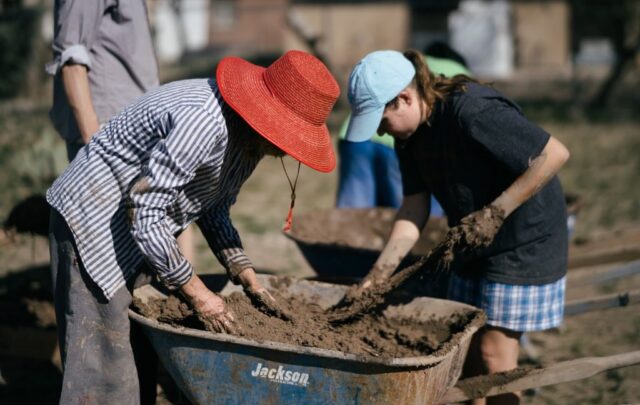
You don’t have to move to participate in a village that thrives. You participate where you are, noticing, encouraging, nurturing and creating the elements of thriving. You go to church, you open a coffee shop, you volunteer, you sponsor youth sports, you invest, you trade, you restore old places, you protect, you initiate.
More good news: this is what peoples do under stress, and stresses are coming. People tend and befriend. In a capitalist system, that muscle is weak. We consume places rather than make them.
Villages aren’t holy places. They are crossroads and settlements. Villages can be regressive, exclusive, oblivious, contentious, boring. Mine is all of that as well as all of great features. But villaging as a verb can be everybody’s business.
- In what ways is where you live a village that thrives? How do you participate? Tell us more.
- What can you do today to make where you are a thriving village?




Comments
We changed commenting systems on September 10, 2026 as part of a site-wide functionality and security upgrade. Your past comments have not disappeared, and you can still log in with your old Disqus account credentials if you wish. Contact us with any questions.