

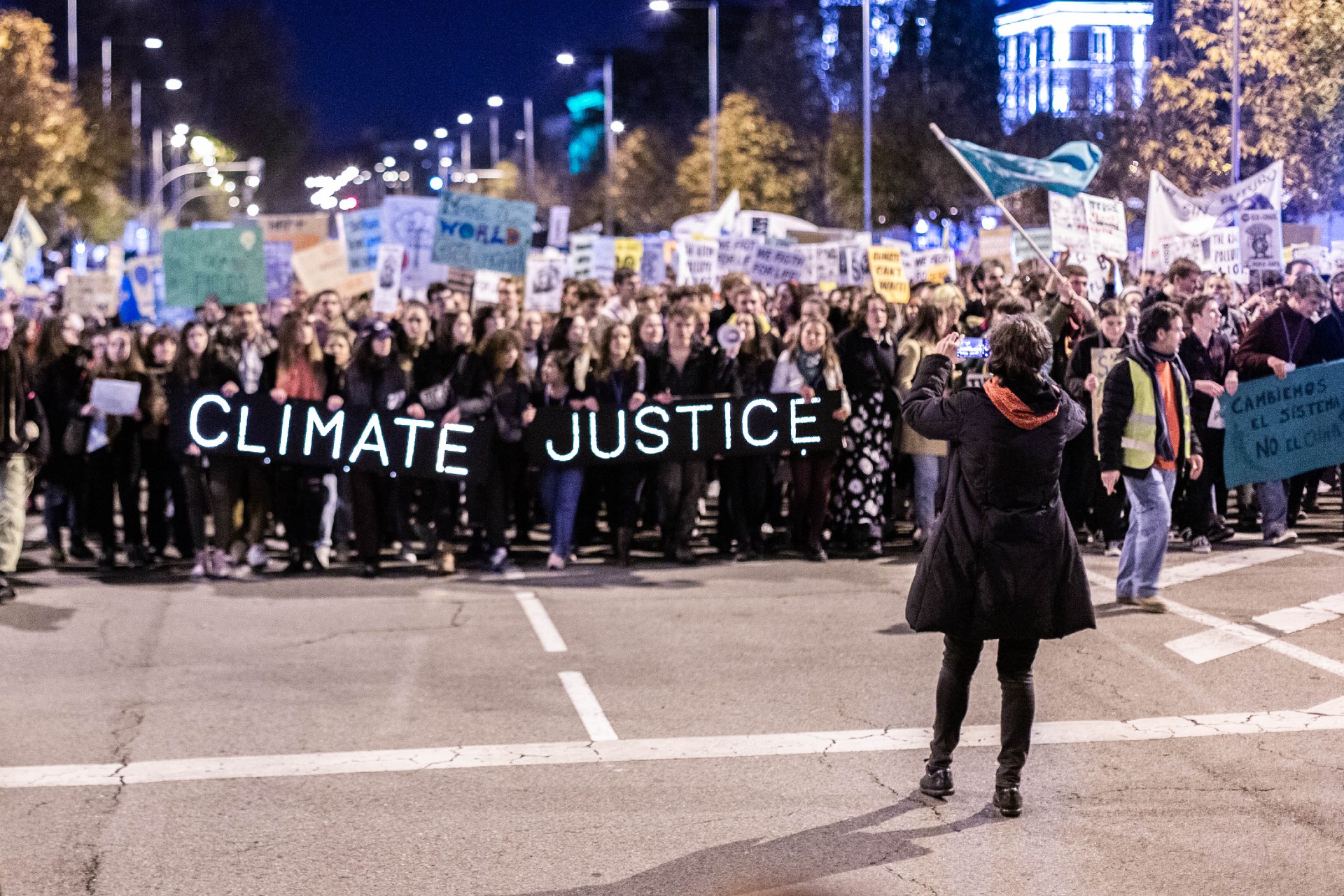
Tadzio Müller is a climate justice and queer rights activist in Berlin and a political scientist. For 30 years, he has been involved in struggles against neoliberal globalization, nuclear waste, and coal, and more recently in what he sees as an anti-fascist struggle. Climate activist and professor Adam Aron spoke with Müller about his years of activism and whether the climate movement can still forge a meaningful path forward amid accelerating ecological and political crises.
This is the second piece in a two-part series. You can read the first half of the interview here.
Adam Aron: I get your idea of a loose network of motivated people ready to step up during catastrophes. But what are they doing in between? What kinds of projects could such a movement pursue—food sovereignty, building local resilience?
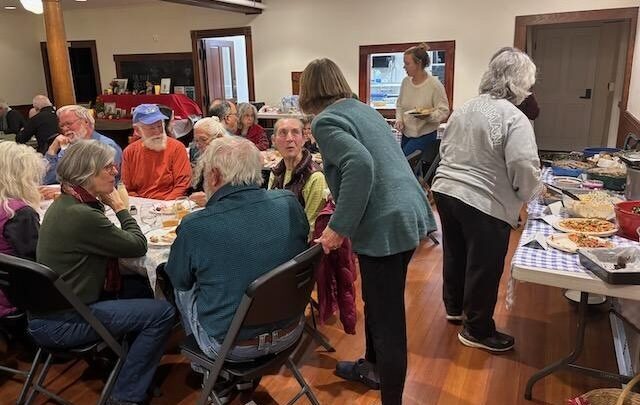
Tadzio Müller: Let’s call it solidarity prepping right now. Solidarity prepping is different from individualistic prepping in that it focuses on social relations. And this is not just a bunch of anarchists saying that. A general in the Swedish military said exactly the same thing: in a catastrophe, the most important thing is social relations. So anything that builds resilient social relations is a step towards having agency in a catastrophe.
I’ll stick with my example of being HIV positive. Right now I don’t have a problem, my medication gets delivered when I need it. But cutbacks are plausible, and in Germany these would probably first be applied to folks without German passports. So intensifying connections between sectors of the HIV-positive community, between those who do and don’t have a German passport, would be an important step towards having agency when the enemy or a supply disruption strikes.
I’m not much of a neighborhood activist guy. I’m somewhat too abrasive and impatient for community activism. But I understand that I have to make some changes. Like I want to get to know the people who live in this house. In Berlin, I mostly meet my neighbors when we pick up parcels from each other. The mailman brought this, hi, bye. But that’s not enough. I want to know who needs what and who can do what in a crisis. There’s an old lady living a few floors above you and it’s 38 degrees Celsius, maybe she can’t walk to the store. Figure out what she needs, and create the dynamic where she is fine saying, Hey, would you go shopping for me? Intensifying relations this way is not easy for activists who come from event activism—big demos, big actions—but it’s the absolute core of prepping together.
Beyond that, anything that increases community autonomy, whether around food or energy, is a good step towards that future. Struggles for communalization of energy or food sovereignty have been going on for a long time. They should continue, but it’s important to recognize the context and have a story about collapse in those struggles so we don’t just keep doing the same thing as before.
Maybe a good way to think about it is this: if you’re setting up a political or social project, even if it’s not specifically related to “collapse” or “catastrophe,” ask three questions. First, does it increase collective agency in a catastrophic situation? A community replacing a big fossil-fuel power plant with locally controlled renewables, for example, has more energy autonomy and more agency in a blackout. Second, does it increase the density of social relations? This is a central principle of “prepping together”: relationships come before supplies, whatever the catastrophe. And third, the climate and disaster justice question: does it increase not just your own agency or that of your immediate community, but the agency of marginalized folks who are likely to suffer most in any catastrophe, much more than those who caused it?
AA: So I’m involved in a struggle here in Southern California to take the electric grid from an investor-owned utility and put it under not-for-profit public ownership. For you, does that make sense if it’s also about resilience—local generation instead of long-distance power lines through wildfire territory, and a less centralized system vulnerable to cyber-attacks?
TM: For sure.
AA: Here and in other parts of the US, there is much local organizing to try to defend our black and brown neighbors from being snatched off the streets. And that fits some of your criteria. But I see a challenge which is that those spaces may have little climate or ecological consciousness. People are focused on everyday issues. How do we make people cognizant of what collapse means in the wider ecological sense?
TM: One of the catastrophes I’m very focused on is the way fascists are increasingly closing spaces for queers and trans people—for the latter in particular. And when I look at what I’ve been calling for in organizing queer self-defense, it’s very much inspired by how folks acted in LA and later in Minneapolis in the face of the ICE attacks. Now, how do you add the story about ecological collapse to that? On some level you probably won’t have a major opening until the next heat wave strikes. But then you have to use that opening. That’s basic political organizing: you have to use windows of opportunity. Germany and Europe experienced five huge heat waves this summer, and between 30 and 40,000 people died prematurely. And that is still kind of rocking around in social common sense and public discussions.
This is all, as we say in German, music for the future. I don’t know if the story we’re telling about this collapse movement will resonate. I hope it will. I think it’s the important next step for many progressive movements.
My comparison in the book is when Marx in the 1850s was looking at factories in England and saying they are going to shape life in a really powerful way. Do you know how many factories there were in the world at that time? A vanishingly small number, employing a vanishingly small proportion of global labor power. But Marx said that’s where the future is going to be made. And my argument is to look at the moment of catastrophe, which we’ve traditionally ignored as political movements: you call FEMA, you call the cops, and then you resume your political work once normality is restored. And I’m saying no. We have to turn this around. Catastrophe is going to be the new normality. We have to understand catastrophe as a political space with pitfalls, stakes, allies, enemies, levers. And once we’ve done that, we can create a new type of progressive movement that starts out in catastrophe and says: this is our new normality.
AA: So we’re up against capitalism’s expansionary compulsion, pushing us deeper into ecological overshoot, of which carbon pollution is just one part, while also fueling neofascism. As Naomi Klein says, fascism is a protection racket for capital. We’re probably not going to have a revolution tomorrow, storming anything. So I’m interested in your PhD work on eroding capitalism from within by building alternatives in its cracks—akin to Erik Olin Wright’s interstitial strategy. Do you still believe in that approach?
TM: For my dissertation the question was: how do we fight capital in a way that’s effective? And the first thing I understood was that you can’t imagine some sort of revolution happening. As you said, there is no Winter Palace to storm. Where would you even go? Goldman Sachs? The White House? And if you were there, do you control global capitalism? No. There’s no switch-off point for capitalism, no one place we can occupy to turn it off.
That leads to the next possibility: slowly building alternative modes of living in the cracks left by capitalism. Then, when an existential crisis comes together with a powerful movement, we might topple capitalism and live in those expanded interstitial spaces. That was all well and good as long as we had infinite time. Martin Luther King: the moral arc of the universe is long and bends towards justice. We rely on time being infinite to make sense of our defeats. You’re defeated today, but you know you’re gonna win tomorrow.
But once you start looking at ecological collapse, the timeline changes. Things are going to get worse very quickly. And you pointed to Naomi Klein, her line about the protection racket. I would go a step further. Fascism is a liberation movement. And what does it liberate you from? From ethics, from reality, and from other people. In a world that’s going to shit, ignoring reality is quite a powerful suggestion. You can ignore other people, ignore reality, and do whatever the fuck you want, because you’re a white cis dude and you’ve always been allowed to do whatever you want.
So I think the more privileged the part of the world you live in, the more likely it is to become fascist. Because fascism is a defense of the privileged, not just of capitalists. This is where I think Naomi is a little unclear. You and I, and most of our friends, are part of that privileged set. So I don’t expect any majority to come our way in our struggle against capital.
And as the world gets uglier, we’re going to turn away from it and become essentially dumber societies. We’ve been seeing that. The US is obviously an outlier and leader in that project. But Germany is hard on its heels, and let’s not call that race yet—we still might catch the crown for biggest assholes on the planet again.
So we don’t have the time and leisure to build these alternative spaces. We’ve been running that strategy for decades, since the late 60s. If somebody suggests a strategy we’ve been pushing for decades, I’m gonna say, well, maybe it hasn’t worked. At that point, the interstitial spaces discourse becomes another type of hopium, another type of magical thinking—ultimately no different from emissions trading saying, let’s create a weird little market and it’s gonna solve fossil capitalism.
AA: But interstitial spaces—workers’ cooperatives, commons projects, eco-villages—these still fit your overall approach, provided they’re reframed as preparation for unfolding catastrophes, building the social solidarity we’ll need, correct?
TM: Exactly. These spaces are still what it’s about. Temporary Autonomous Zones. It was very popular in the 90s. That’s still what we’re talking about. I’m just not assuming they’ll come together like an archipelago that grows into a continent and displaces capitalism. I’m imagining, at best, an archipelago of solidaristic spaces you can hop between without your foot touching fascist ground. Spaces where life can still be lived the way it should be lived, in solidarity and freely. It’s the same strategy, but with a different goal. That requires adjusting our expectations to the new reality.
AA: I want to get to a comment you’ve made that how we organize has to fit the society we actually live in. What do you mean by that today?
TM: So left social movements have always organized in ways that almost mirror our opponent. When capitalism organized itself in big factories with huge production lines, the mass union and large-scale Social Democratic Party became possible. Later, with neoliberalism enclosing more and more parts of the world, social movements shifted from the point of production to defending those spaces against enclosure. Our strategies have to match the social processes around us, or they’ll be irrelevant. And I’m saying the new central dynamic is collapse, which I define as the end of the world of more.
I grew up politically in the anti-globalization movement. One thing we said was: one no, many yeses. You don’t have to coordinate between struggles; everybody fights where they are, and together we have an anti-neoliberal, anti-capitalist effect. Now I think we need to adjust to a reality where we don’t have the luxury of not coordinating or making decisions. We need to triage. More and more huge fucking problems are gonna come down the line. Fascism is gonna become more powerful, environmental problems are gonna escalate. We need ways of organizing where we can actually talk to each other and say, hey, we’ve got these resources to fight the fascists, you’ve got those resources to prepare for catastrophe. Which catastrophe is more likely? Which will cause more injustice? Let’s put our resources there.
I don’t know what type of organization will emerge. I do know that the modes of organization we’ve used for decades were appropriate to another age, an age that has ended.
AA: I could imagine there’s probably a sector of the mainstream climate movement that might see you as defeatist, with your language of the climate ship has sailed?
TM: Well, basically, I don’t think we have any real points of leverage to keep fossil fuels in the ground. The last few decades have shown that. But this is not about giving up. It’s about continuing the struggle. The less your strategies are adjusted to reality, the more they’re based on magical thinking, the less useful you are—and the more bullshit you’re gonna do and the more frustrated you’ll become with people doing the real hard work.
If you think you just need to point a pane of glass at the sun and everything will be fine, you might not be my ally. But if you believe the most important thing we can do now is create powerful, resilient communities that aren’t in hock to the fossil fuel industry, then let’s talk.
AA: You’ve presented a vision that is both very dark about what is happening to the world, especially the rich countries, and also very inspiring about the social action we can and should now do. What kind of evidence would change your mind about collapse, climate majorities in the Global North, and so on?
TM: If I saw a genuine decoupling of economic activity from ecological destruction, I might change my mind about capitalism. If I saw real pushback in rich societies against fascism—not just turning out for the odd rally, but the ‘silent majority’ actually standing up for those the fascists target. If I saw US society responding to ICE killings before they started killing white people like Renee Good and Alex Pretti—if I knew the names not only of the white folks killed by ICE, but all of them. If I saw governments around the world coming together to press pause on a whole bunch of insane, destructive processes.
AA: Talk about your feelings and how coming to terms with your feelings was critical to arrive at these new insights and to move forward with your new plan.
TM: When I realized the things I’ve just said—that we were defeated, the climate movement was defeated, the climate catastrophe was coming—I fell into a deep, deep depression. And in that sense, it’s a warning to people. The path I’m suggesting has its pitfalls. Confronting the reality of how shit things are can really bowl you over. And one important point is: do that with other people.
I’ll tell you when the turning point came for me, when I found meaning in catastrophe. It was in the autumn of 2000, when at a Pride March, a steward was attacked and beaten to death by a right-wing assailant. That was a deeply shocking moment. And out of that came this idea that, okay, no matter how catastrophic things are, if the fascists are attacking my community, I want to organize the self-defense of my community. Fighting Nazis to defend my community is not an idea that gives me happiness or joy, but it gives me meaning and a function. It tells me who I’m gonna be when that shit happens. It isn’t the sense that we’re gonna win all these struggles, but that in these struggles I know who I will be, or who I want to be, and with whom I will be there.




Comments
We changed commenting systems on September 10, 2026 as part of a site-wide functionality and security upgrade. Your past comments have not disappeared, and you can still log in with your old Disqus account credentials if you wish. Contact us with any questions.