It is moments before midnight on New Year’s Eve, and we are folding the last of a dozen paper boats, each carrying a wish written inside. Hope lingers in our candlelit communal kitchen, despite the state of the world. It is only a few minutes’ walk to the Saale River from our co-living space, where we release our paper boats and watch as they float along, carrying our wishes into the next year. While we can only wish for a perfect world, this hope inspired us to create one beginning with our small community.
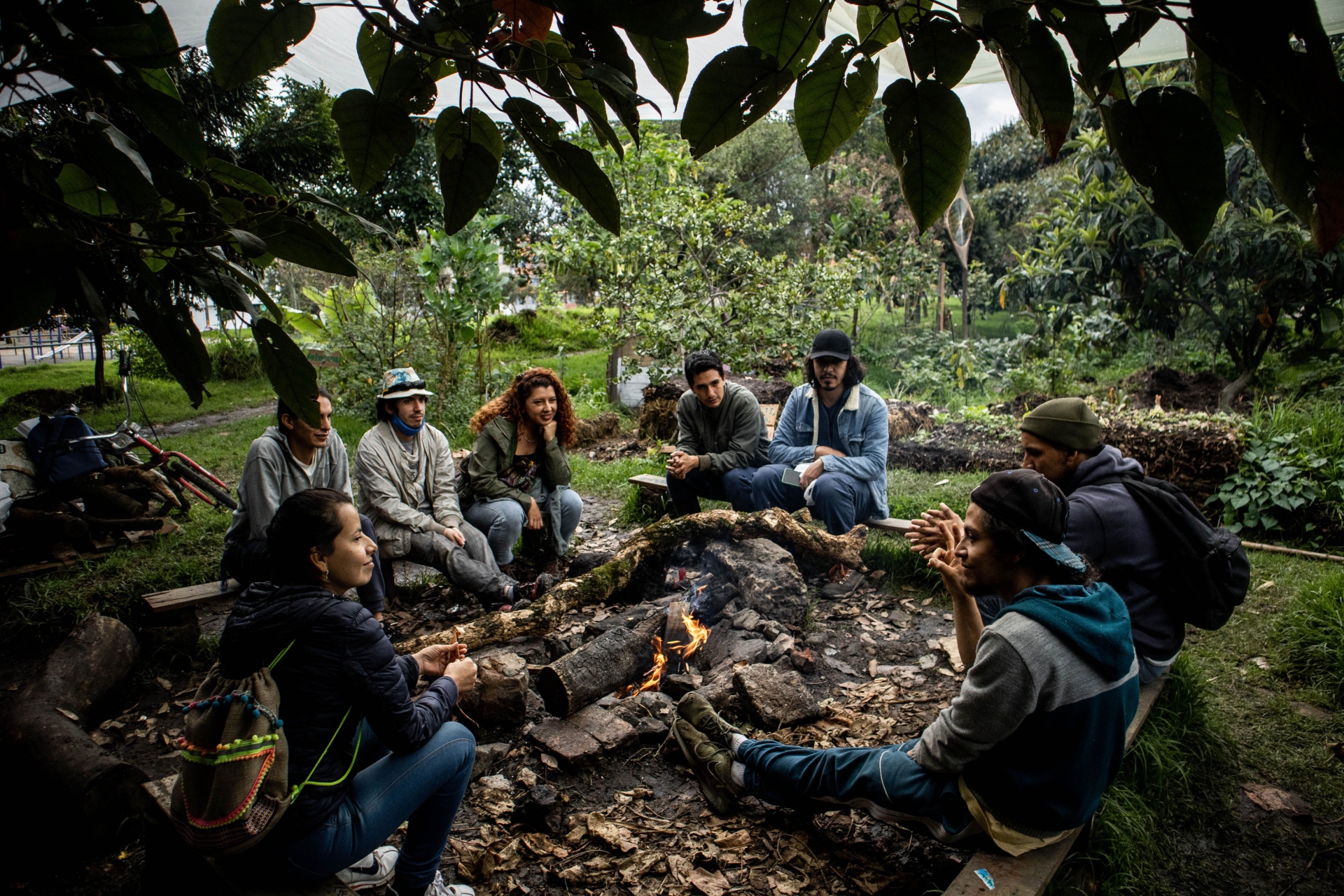
GutAlaune, our co-living and commoning space near Halle, Germany, is a “real utopia,” as sociologist Erik Olin Wright might say: one of those places—usually on the margins of society—where tomorrow’s solutions are already being lived today.
Ten years ago, a group of friends bought a piece of land in Eastern Germany at a bargain price, later adding several circus wagons and yurts. In the forest garden on the hillside, green kale and winter onions grow under chestnut and lime trees—trees that will hopefully still hold water and produce edible fruit in the next eighty years.
For coauthor Gerriet Schwen, GutAlaune became the starting point for research into the challenges facing self-organized groups. The eco-villages, open workshops, and community-supported agriculture initiatives he studied all sought to address problems confronting modern societies around the world, from loneliness and crop failure to the need for crisis-resilient eco-architecture. Yet similar challenges continue to hamper “real utopias” that attempt to organize themselves outside the mainstream.
After several years of utopian research, Gerriet became disillusioned. “At some point, I no longer believed myself that the solutions we are trying out here will grow faster than the [climate] disasters will catch up.”
What is sometimes called “The Great Unraveling” should, by any reasonable measure, be enough to set off alarms: in the media, in politics, or at least by some form of artificial intelligence. Yet a scan of headlines across German-speaking countries offers little acknowledgment of our clear trajectory toward collapse and instead remains irrationally optimistic.
As part of a research project supported by Leibniz University and Hanover University of Applied Sciences, our team examined local examples of climate communications and identified three ways of understanding this “apocalypse blindness.” We concluded that German-speaking climate discourse remains so optimistic because we have distorted basic assumptions about how we talk about crisis. We have not learned how to feel. And we have not learned how to fail.
We invited scientists, journalists, and activists to join us in discussions about how realistic climate communication can more effectively motivate action, alerting us to the scale of the mounting disaster while also inspiring us to respond in ways that may make the catastrophe less catastrophic.
We want to fall together
Larry Faust, a member of our research team, noted that the word ‘collapse’ comes from the Latin collabi, ‘to collapse,’ which in German can be translated as “zusammensinken“. Only one breath, one space, away from “zusammen sinken“, which means, fittingly, ‘to sink together.’”
Community-building is how we sink together.
As headlines about Elon Musk’s terraforming ambitions, billionaires building luxury bunkers for the end of the world, and the best survival books to keep around abound, where are the stories about how we can move toward each other, navigate an uncertain future together, or love and care for one another?
If we want to fail more beautifully, to make our predicament less ugly, we need to learn what it means to face it together. If catastrophe is inevitable, as writer and activist Andrew Boyd suggests, then the question becomes how we choose to meet it. We are not interested in making a profit or securing advantages for ourselves. We do not want to survive at the expense of others or alone in a bunker. We would rather have too little together. If we fall, we want to prepare and fall together.
Preparing for an uncertain future has a massive image problem: “prepper” has taken on negative connotations, associated with a paranoid sect of fringe groups. This is a problem because if we don’t include the preparation necessary for disasters alongside stories of solidarity, we leave this discourse to violent and right-wing extremist voices.
While researching her book on climate adaptation, German activist and entrepreneur Milena Glimbovski spoke with authorities, emergency services, and people affected by extreme weather conditions. Very few had seen the catastrophe coming.
“It’s important to me that we understand that preparedness—prepping—is a social act,” says Glimbovski. “If I can take care of myself, I take the pressure off public emergency services, the Red Cross, or the firefighters, who can then take care of others who are more in need of help.”
Solidarity is also based on preparation, because in an emergency, we can only help others if we have things to share—food, water, filters, candles, information from a battery-powered radio, skills such as outdoor navigation, knowledge of wild herbs, and first aid.
Now is also the time to reorganize infrastructure together, through energy cooperatives, community-supported agriculture, and initiatives that operate independently from the market.
Being prepared in solidarity also means learning now how to make good group decisions—even under pressure, how to understand needs and de-escalate tensions quickly. We need to learn how to collectively hold spaces, create rituals for grief, mourning and feeling.
We haven’t learned how to feel
Emotions still have no place in science communication. This is despite the fact that many climate researchers themselves suffer from climate anxiety, as The Guardian revealed in a survey among 380 world-renowned researchers.
In our event series, we noticed that it is not only what we communicate and how we communicate it, but also to whom. Is the person we are talking to really willing to learn and accept new information? Dealing with catastrophic prospects requires emotional capacity.
It is much easier to repress difficult feelings. We experienced this, for example, at a conference in Oldenburg, where we were invited to present our findings. The projector casts a hopeful blue light on the wall; coffee cups clatter. The title of the conference: “WE ARE DOOMED,” a message that really doesn’t need to be emphasized in capital letters. Everyone is here to talk about the end of the world as we know it—but this end remains abstract. Terms such as “sustainable, non-sustainability,” “dystopia, capability,” and “post-liberal, Anthropocene” appear in the academic presentations.
No one really wants to delve into the emotional state at the edge of an era. Yet these feelings could create genuine connection between those present. For our panel, we focused on a question that Boyd came up with for a grief ritual at the COP21 climate conference in Paris in 2015: “What do you love and hope to never lose to climate chaos?”
Some of the answers shared by participants after three minutes of silence: “The old beech tree next to the house where I grew up.” “Having lots of time without plans.” “The city of Bremen.” “Winter as a distinct season.” “My understanding of politics.” “The hope that my children can lead healthy lives.”
It is reassuring to know that these community-building practices have already been tried and tested in countless places, even if they are not reported on the news. Emancipatory free spaces and self-organized, solidarity-based, and resilient supply structures will play an even greater role in an uncertain future.
So, at the end of our research journey, we have redefined what “successful” climate communication means. We are far from having found all the answers, but we have found many new questions—for example: How can we maintain a thriving relationship with a world that is falling apart?
One thing is clear: it will be a relationship that requires us to allow ourselves to be touched by both beauty and terror.
As we sit by the Saale River that New Year’s in the darkness of the evening, our thoughts drift to the suffering that awaits us and that is happening to others at that very moment. Nevertheless—or precisely because of this—we make our wishes and hold onto hope. On the bow of a folded paper boat, the words “Sacred Sex” can be seen upside down, and on the other side, “Octavia Butler.” (Yes, damn it: it’s time for good novels!) As we all drift towards precarity, there is no better time than now for closeness, for grounding, and for a new understanding of the sacred. For more attempts at building real utopias. For it is in the trying that we can create a better catastrophe, together.