I trained for years in the ancient practice of Byzantine-Russian iconography, under a master iconographer from Russia, learning to apply gold leaf and pigments from ground-up semi-precious stones in the same way artists have for over a thousand years. Icons are traditionally understood as windows to the divine – images of saints and holy figures meant not simply to be looked at, but contemplated, until something in the viewer opens.
For a long time, I made these icons in the traditional way. And then I began to realize: Though nature is the foundation of the icon, in its materials and symbolically, in its early stages, it was relegated to the background of these depictions of holy figures. I felt deeply that Nature needed to occupy center stage, especially given how it is treated as crass matter in most all of our deliberations. Didn’t the honeybee deserve the same recognition? The grey wolf, the monarch butterfly, the Florida panther – all of them disappearing, all of them irreplaceable – were also windows to the divine.
A Ceremony and a Revelation
My first inklings of an ecological spirituality came in a rare encounter. In 1986 I was invited to witness a Sundance on the Southern Ute reservation, a five-day ceremony of fasting and prayer for the healing of the people and the Earth. What struck me most was both the ritual itself and the humility it demanded: a complete self-emptying before the elements and forces of nature. I learned of the Great Law of the Iroquois Confederacy, which requires leaders to consider the welfare of the seventh generation to come in every decision. How different that is from our shortsighted focus on the next financial quarter, or the next election.
Around the same time, I encountered James Lovelock’s Gaia hypothesis – that the Earth itself is a living being, maintaining its own balance the way our own bodies maintain their temperature. It was a kind of Eureka moment. It’s all alive. And then I came across the accounts of the Apollo astronauts who saw the Earth from space and described the experience as mystical, even ecstatic. As the astronaut Alan Bean put it, “I don’t think we were thrown out of the Garden of Eden. Just look around. We’re still in it.”
We are indeed still in it. And we are, I believe, in the process of destroying it – not out of malice, but out of a kind of spiritual forgetting.
A Promethean Struggle
We are living through a Promethean struggle for the future of this planet: one path driven by a vision of human dominance, where we continue to exploit the Earth with ever more violent means of extraction; the other, which Thomas Berry called the Ecozoic era – an age of mutually enhancing wellbeing for both humans and the Earth community as a whole.
The schism is glaringly apparent here in the UK. On the one hand, there are 178 marine protected areas in English waters. On the other hand, seabed trawling continues to destroy all life within these rich habitats – 92% of the UK’s marine protected areas do not have full protection from destructive fishing. The recent announcement that £62 million will be allocated towards saving endangered species in Britain is encouraging, but according to the late evolutionary biologist E. O. Wilson, despite government regulations and the valiant efforts of conservation organisations worldwide, the extinction rate – now one thousand times the normal rate – has only been reduced by 20%. The science dictates that to maintain ecosystem function and avoid total collapse, we must conserve half the planet’s land and sea.
Across the Atlantic, the situation is equally alarming. The Endangered Species Act has been gutted; the definition of “harm” to a species no longer includes the destruction of habitat. Drilling near national parks has been authorized, and construction of a border wall between Mexico and the US continues, obstructing migration corridors and destroying habitat for hundreds of critically endangered and vulnerable species. As Ernst Friedrich Schumacher wrote,
“Modern man talks of a battle with nature, forgetting that, if he won the battle, he would find himself on the losing side.”
The Failure of Fear
This is where I think the conversation about biodiversity loss has lost sight of a critical opportunity. We are told the statistics. We are shown the graphs. We are reminded, correctly, that we are in the sixth mass extinction. Yet many look away. Not because we don’t care, but because fear and grief can often lead to numbness. Delivered without anywhere to go, they can produce paralysis rather than action.
Though it is necessary to sound the alarm in response to any crisis, the magnitude of the problem can lead to shutdown and a sense of powerlessness. But I experience a power that resides in each of us that is greater and more fundamental than fear: Love. Love of this Earth and the beings we share this planet with. The devotional kind of love that comes from really looking at another being and recognising it as sacred, unique, and a gift. We might expand the adage, “Love thy neighbor as thyself” to Love the Earth as you love yourself.
Pope Francis, in his encyclical Laudato Si’, wrote of integral ecology – the recognition that the plight of the Earth and the plight of vulnerable human communities are inseparable. When biodiversity flourishes, human life flourishes. Underlying is the recognition, as Thomas Aquinas wrote, “Because the divine could not image itself forth in any one being, it created the great diversity of things, so that what was lacking on one would be supplied by the other and the whole universe together would participate in and manifest the divine more than any single being whatsoever”. This too is my perception. Each species is a unique expression of the divine creativity woven into the fabric of life. To lose one is, as Berry put it, to silence a divine voice forever.
An Ecological Conversion
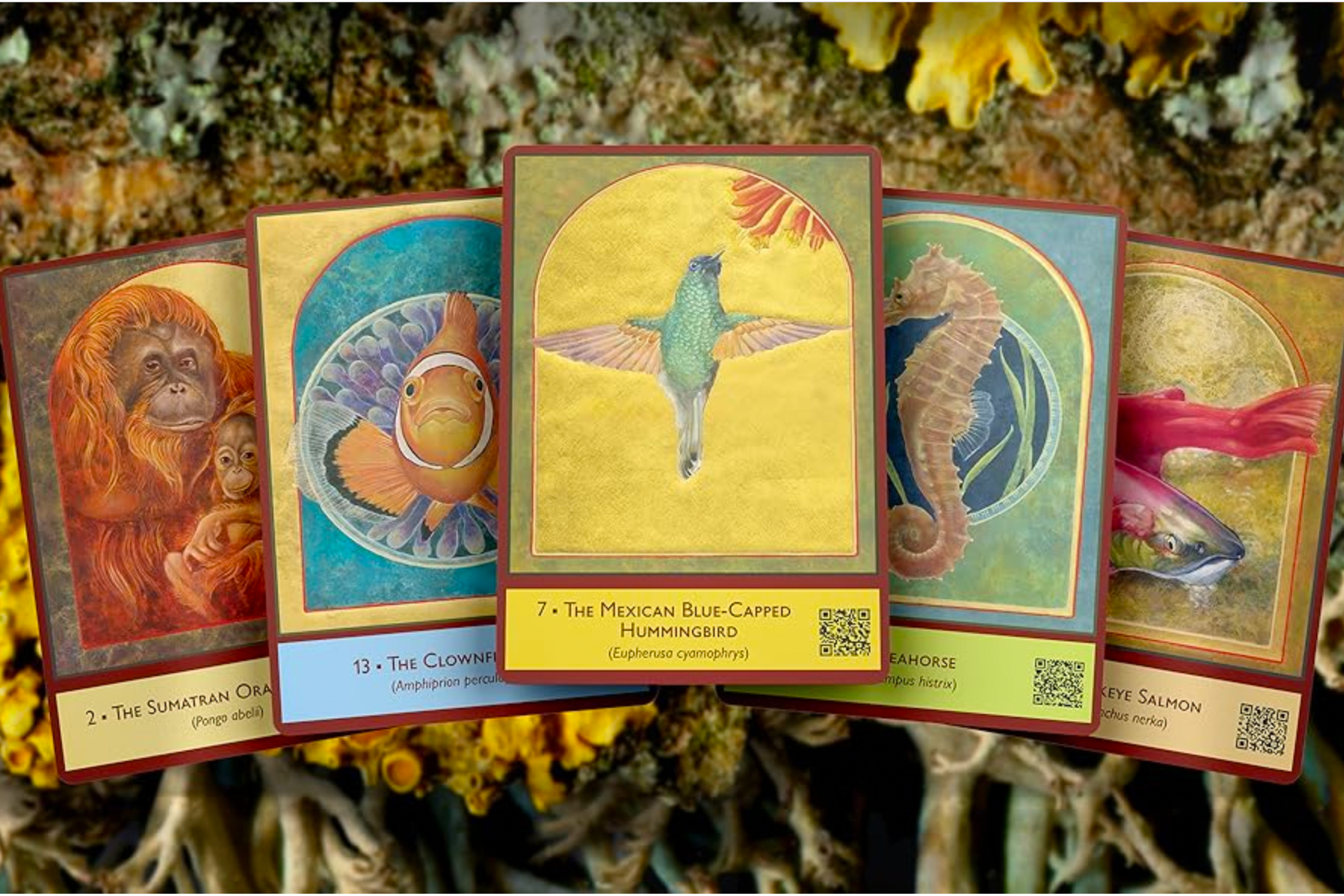
So I started painting endangered species the way I once painted saints and angels. Each one researched carefully – its habitat, its role in its ecosystem, the specific threats it faces, the way its fate is bound up with our own. In the complex miracle of pollination, for instance, honey bees, wild bees, and other pollinators are responsible for pollinating more than 250,000 species of the world’s flowering plants. Without them, our food systems would collapse. The giant kelp forests, which have halved in fifty years, are estimated to sequester about 5.4 million tons of carbon dioxide annually. Each painting became a kind of prayer – and an appeal to our capacity to widen our love and awaken our conscience.
What I am attempting is nothing less than an ecological conversion which can occur in an instant, like a revelation or a slow turning, the kind that happens when you regard something close enough and long enough that you no longer regard it as a mere object. It has a radiance, intrinsic value and a right to exist, to inhabit, and to fulfill its sacred role within the great community of being, just as humans do.
After I completed 36 icons representing every category of life, from insects to plants to fish, mammals, birds, reptiles, amphibians and other invertebrates, The Sacred Biodiversity Oracle came into being, where the artworks have been published as a deck of large-format cards with a 160-page guidebook. The guidebook provides vital context for understanding the biodiversity crisis, its challenges, and the hope that lies in the emerging biocentric, eco-spiritual worldview evidenced within its pages. Importantly, it stresses not only the threats to particular species, but the associated threats to human life, because the two cannot be separated.
My guidebook opens with the prophetic words of Jane Goodall, “We are moving towards the ultimate destiny of our species – a state of compassion and love.” That is what I believe too. That is what I am working toward. That is why I paint.
In my vocation as an artist, activist and educator, it was not enough to inform and evoke emotions. It was necessary to provide an outlet for action. Each card carries a QR code linked to specially created landing pages of one of eighteen conservation and anti-wildlife trafficking organisations from around the world – from the United States, Philippines, Netherlands, Ecuador, United Kingdom and Australia – working to protect, preserve, rescue, rehabilitate, advocate and lobby for these species and their habitats.
The antidote to despair, to “well-informed futility,” as biologist Sandra Steingraber puts it, is meaningful action. The deck is designed to be used individually or in a group setting, where the synergistic effect of shared experience fosters new connections and enthusiasm to work together for the life of this world.
These artworks have travelled throughout the northeastern United States, recently premiered in Northern Scotland, and will continue on an international tour. To make the work and the worldview behind it more accessible, the portable deck allows people to have the imagery close at hand – to interact in a deep and meaningful way with the written and visual material wherever they are.
The rise of the Rights of Nature and the Rewilding movements are signs of an emerging ecocentric paradigm. There are, as Paul Hawken has estimated, at least two million organisations actively working toward ecological sustainability and social justice. But underneath the politics, legislation, and science, I believe the deepest driver of change is also growing: a re-enchantment with the living world. A recovery of kinship. A willingness to feel what is at stake, and to act from that feeling. The momentum is real. To quote Dr. Jane Goodall, we must continue to “swell the ranks.”