

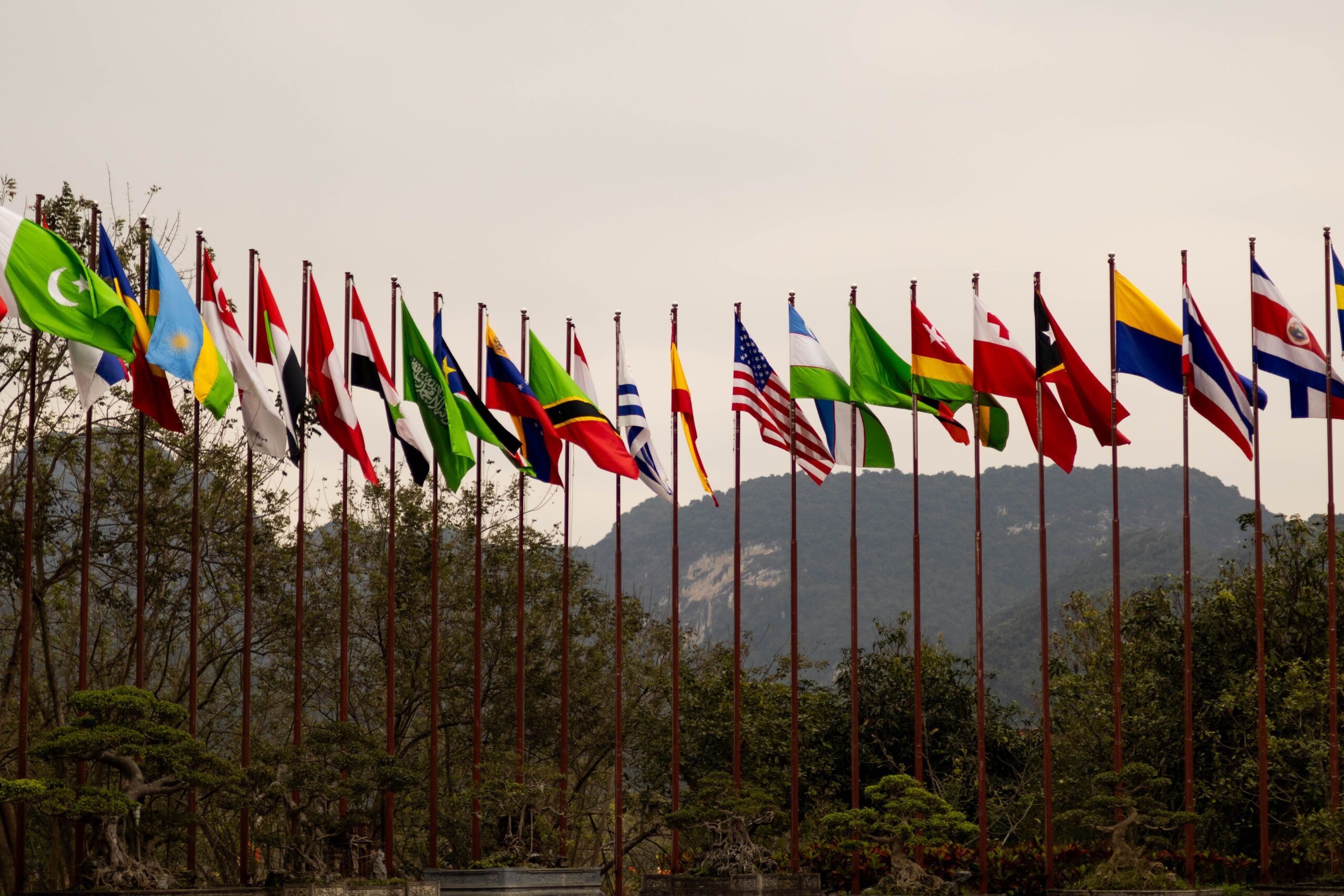
The theory of a multipolar world is one where geopolitical control is divided amongst three or more centres of geopolitical power, each exerting regional spheres of influence and/or control—think of the old Russian Empire, which, outside the Russian-speaking heartlands, encompassed lands up to its ‘natural’ boundaries, like the Carpathian Mountains, Mongolian deserts, the Amur River, and so on. This is different to a unipolar world, where a single hegemon is recognised as the foremost global power, regardless of boundaries—and this has only happened once, with the US ‘world policeman’ status of the 90s and early 2000s. For most of history, a collection of large, territorial empires ruled the majority of the world’s population (if not the majority of its actual landmass), and so most of history could be fairly characterised as multipolar.
For quite some time now, there has been a growing awareness that we are shifting from our first sojourn in a unipolar world, where small nations proliferate under the dominating umbrella of the US and its Pax Americana, back towards a multipolar one, where smaller states are dominated by their respective regional hegemons, such as China and Russia.
Some critics of multipolarity (as a theory to describe current affairs) say that the US is nowhere near losing its hegemonic position, but the fact that the global system is radically changing is not in dispute. At least in the hearts of the world’s people, the US is no longer the semi-benevolent global policeman it once was. Canadian Prime Minister Mark Carney’s Davos speech was a watershed moment. He gently admonished the middle powers that, for so long, had sat comfortably (and a little complacently) under the US unipolar system, but now had to wake up and face a world without a defined centre around which to align. This speech came as a somewhat outdated revelation to many in the BRICS (an international organization originally comprising Brazil, Russia, India, China, and South Africa), who had long been trying to pry themselves away from this old order. And lest we think this is merely rhetoric, much of Europe is re-arming as it realises, rather belatedly, that the US security umbrella is not eternal.
There’s a polycrisis – hadn’t you heard? And all the myriad threads which held the old unipolar system together are pulling apart like a great, fading tapestry. We are shifting to an older, default state, and only a quirk of historical coincidence and technological superiority allowed the unipolar world to so briefly spark. So the theory goes.
But now that almost everyone is on board with the theory of multipolarity, I want to propose a contrarian point of view: there is no multipolar world, because there are no poles anymore.
It’s hard to be a pole
The theory of multipolarity was for the longest time kept aflame by Alexander Dugin, the weirdo court philosopher of Putin’s Russia. In his “cheerful and optimistic view of [the] future,” as outlined in The Theory of a Multipolar World, “old artificial borders will be dissolved and new natural divisions installed”. One such unnatural division is cutting the natural continuity from the Volga to the Carpathians—otherwise known as the border between Russia and Ukraine.
Yet, as we reach the dawn of this ‘optimistic future’, the world’s first overtly multipolar correction—the Russian invasion of Ukraine—seems to be faltering. This isn’t to reach Telegraph-level bullishness on Ukraine, but to point out that the war is not going as well as expected for Russia. Russia has a larger population, greater military resources, greater economic power, and more raw materials to draw on. Yet it’s not winning on the battlefield and now seems incapable of keeping its critical infrastructure safe from Ukrainian drones—with something like a third of Russian refining capacity knocked out of operation by Ukrainian strikes.
The theory of multipolarity, in the Duginist view, is necessarily atavistic. The blood of peoples is tied to their lands, to the ancient soils and old Ur-cultures that lie, mantle-like, below the fractured cultural continents atop. But can these ancient forces overcome the new age of drones, robots, and AI killing machines? Unless the sheer weight of blood and attrition wins this war, it really does seem that Russia will struggle to restore its natural sphere — even its Central Asian neighbours, long presumed junior partners and satellites, are smelling blood and pushing harder in their relations with a wounded Russia. It reminded me, in reverse, of a poem by G.K. Chesterton (a writer I have distinctly mixed feelings on):
You sing of the young gods easily
In the days when you are young;
But I go smelling yew and sods,
And I know there are gods behind the gods,
Gods that are best unsung.— G.K. Chesterton
Maybe we shouldn’t be surprised. As international relations scholar Seva Gunitsky points out, Russia is simultaneously a strong and a weak state, riven by contradictions that make its abilities wildly lopsided. It has always been treated by the international community as a quasi-great power—greatly fallen from the days of the USSR. Big and powerful for a single nation, yes, but never serious enough for actual superpower status: “A gas station masquerading as a country”.
But what about those real superpowers? Even China, treated in many circles as a new rising hegemon, has a distinctly mixed record in carving out its own multipolar sphere. In the South China Sea, it is steadily increasing its reach and has impressive hybrid naval capabilities. In mainland Southeast Asia, too, it is bringing nations closer into its economic and security umbrella. Some, like Laos, willingly. Some, like Thailand, with a little more kicking and screaming.
But now look at Myanmar. Not only probably the most ideologically aligned state in Asia Tenggara, but also absolutely vital in geostrategic terms. China is engaged in a long-running plan to use the nation’s access to the Bay of Bengal to circumvent its own vulnerability to the Strait of Malacca, through which a critical share of its energy supplies must pass — a prescient move when Malaysian politicians only recently suggested tolling the strait, taking a leaf out of the Hormuz playbook. The overland oil pipeline that does exist, already insufficient to overcome the Malacca energy chokepoint, has proven vulnerable to Myanmar’s civil strife.
Alongside this, China has significant interests in the mountainous border zone between the nations, both for its abundant supplies of rare earth metals and because it threatens the stability of China’s southwestern flank. Industrial-scale scamming operations based in Myanmar’s lawless borderlands, for example, frequently kidnap and enslave Chinese citizens. Securing its control over, and the eventual settlement of, the raging Burmese civil war is of obvious geostrategic advantage to China.
Yet for all this, China’s approach has had distinctly mixed results.
The mercenary company China Sword Group is active across much of Burma, supporting Chinese business and, one suspects, state interests, but otherwise failing to exert any strong regional control. Beijing maintains a skittish relationship with the Junta, exerting far less influence over its course than would be expected given the vast power asymmetry. The Tatmadaw is supported by China, as are rebel groups on the border when deemed strategically necessary. Even with increasing dependence on Chinese military support, the Burmese Junta (which controls under 21% of the country) is able to maintain some distance to avoid de facto vassalisation. The Tatmadaw has gone as far as mobilising monk-led protests against the Chinese embassy, its leaders provocatively (and somewhat comically) declaring:
“China, you have been meddling in the internal affairs of Myanmar. Don’t try to exploit us. We [the] people are gonna beat you up.”
With such an unreliable and, arguably, incompetent partner, China has repeatedly been forced to support different sides in the border regions when its previous accords have broken down. In the end, they have resorted to managed chaos, able to curb the worst impacts of border instability while being unable to exert any decisive control over events—excepting, that is, the weird ethno-narco Wa State and its long-running autonomous (though heavily Sino-leaning) government.
The theory of polypolarity
And this leads to the wider point. If the two potential rivals to ailing US hegemony, China and Russia, cannot reliably exert multipolar spheres of influence, who can? Saudi Arabia is often called a hegemon around the Gulf and Horn of Africa, yet it shows little sign of decisively winning in its proxy war with the UAE, which spreads across Yemen, Sudan, and beyond.
Is the world simply too complicated and overdetermined to overtly dominate regional spheres? Have the dematerialisation and internationalisation of the economy blunted the benefit of geographic proximity? Has the shift in military technology — from favouring organised, conventional armies to small, ‘entrepreneurial’ combat operations such as drone warfare — reduced the big-power advantage? Iran’s military defeat of the US is surely a sign of this. Yet I’m not sure, in such a complex, interdependent world, it’s possible to point to any single factor explaining the inability of multipolarity to reinstate itself.
Rather than Dugin’s dream of a revitalised Russian Empire in Eastern Europe, the future looks more like Afghanistan: states breaking away from global or regional systems, not strongly drawn to any regional centres of power. Able to pursue state structures and strategies completely at odds with their regional neighbours. Or take a look at the aforementioned Wa state, a quasi-ethnic enclave squatting in the tattered borderlands of an increasingly defunct Burmese state. Maybe we could even, in the most positive imaginings, conceive of Mark Carney’s ‘middle powers’ forming the bedrock of a new global system, safe from multipolar domination and their strategic autonomy maxxed out, forming and dissolving coalitions of the willing as geopolitical circumstance demands. Regardless, this is a vision of an anarchic global system, without clear spheres of influence, a true patchwork.
Adam Tooze, populariser of the term polycrisis, might also be the one to close the chapter on it—and his reasoning is instructive here. A crisis, defined in the traditional Greek sense, is the moment of peak illness, when either recovery or irreversible decline begins. In that sense, are we still in the polycrisis if the new path has already been taken? I suspect multipolarity was, in a sense, unconsciously perceived as the “healthy” outcome on the other side of the (poly)crisis of unipolarity. It is, after all, more palatable than interstate anarchy, and it seems more logical — and arguably more just — that China, such a great manufacturer, should emerge independently from the US hegemonic cocoon. The Trump administration’s turn inwards, however well that actually went, was premised on the acceptance that a multipolar world was not wholly negative, but that greater influence over a shrunken sphere promised new benefits. But what if this multipolar world is, now, rather than emerging, failing to form? The combined weight of technological, economic, and climatological changes is forming a centrifugal force much stronger than the multipolar contenders had intended. They sowed the wind, and now have to reap the hurricane.
This may be simply an unstable period of realignment. A relatively coherent Multipolarity could still arise. But the signs do not point to this being a foregone conclusion. Multipolarity has been, for some states, an active project of breaking the unipolar one. But breaking things is relatively easy. That part’s done; now comes the harder work: reshaping the world to come.
An earlier version of this article was published in The Geopolitical Climate.





Comments
We changed commenting systems on September 10, 2026 as part of a site-wide functionality and security upgrade. Your past comments have not disappeared, and you can still log in with your old Disqus account credentials if you wish. Contact us with any questions.