

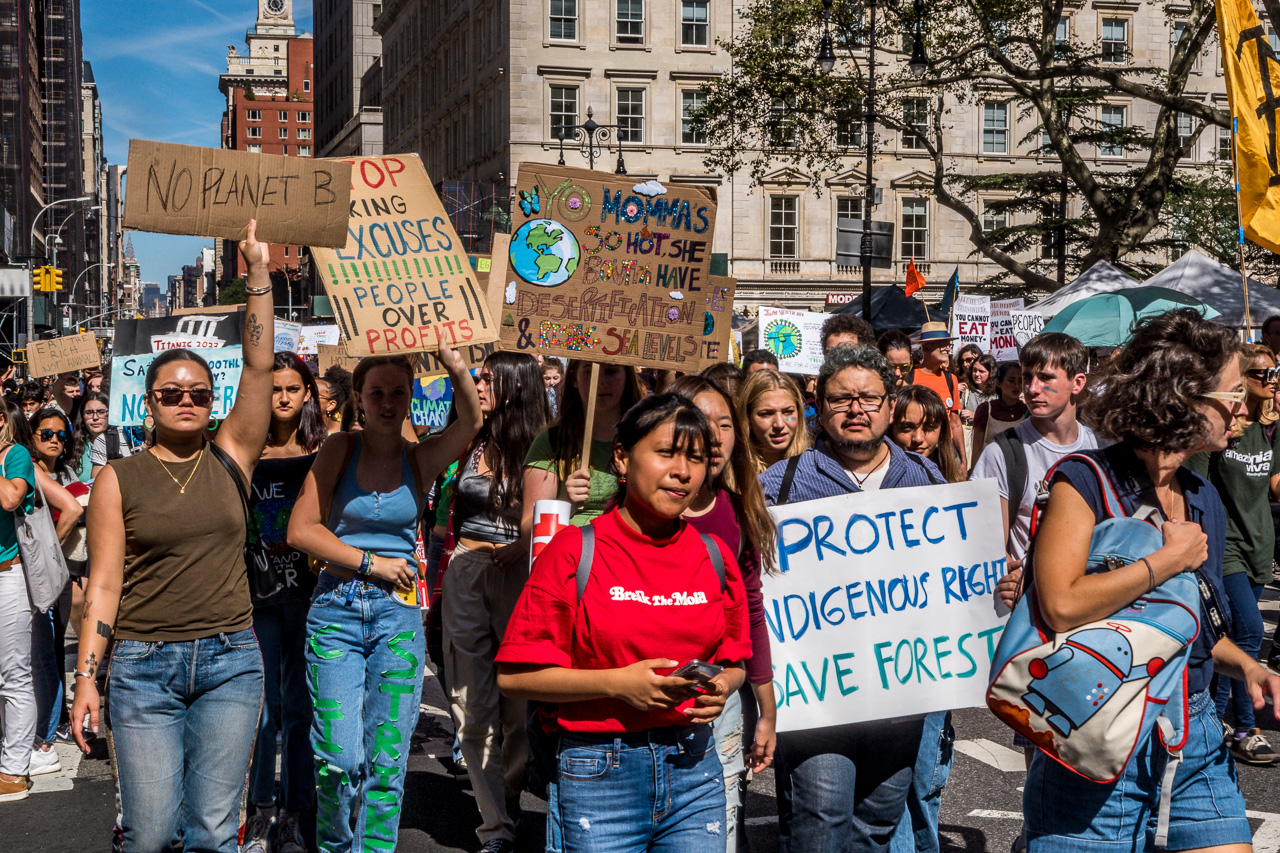
“People are scared,” remarks the executive director of a grassroots environmental group in Southern California. Her group, like many others, engaged in self-reflection following the Black Lives Matter movement in 2020. They made substantial changes through diversity, equity, and inclusion (DEI) efforts and developed new partnerships with community leaders. Recently, a longtime volunteer approached the executive director to urge that she stop talking about their organizational DEI work. While her organization isn’t pulling back on such work, she told us about other organizations who have removed DEI work from websites or learned that grants for such work have been cancelled.
The Trump administration has gone after environmental justice as doggedly as they have attacked DEI. One of Donald Trump’s first acts upon reelection was to rescind all prior executive orders and memorandums around environmental justice. He canceled federal environmental justice grants and eliminated the Environmental Protection Agency’s Office of Environmental Justice. In the wake of these attacks on environmental justice, environmental groups face pressure to walk back their commitments to racial justice, Indigenous sovereignty, and other forms of DEI work.
At the same time, unprecedented assaults on public lands, including mass firings, conservation rollbacks, and proposed public lands selloffs, fuel a sense of existential crisis among environmentalists and public lands advocates. These attacks on long-established environmental priorities further encourage environmental groups to scale back progressive initiatives as they try to regain some amount of control in a tumultuous political environment.
Forsaking DEI won’t save public lands. It will only splinter our movements and weaken our work to build just futures for all. This article is a call to resist reactionary responses to Trump’s attacks on public lands, environmental justice, and DEI. Here are six concrete steps you (or your organization) can take to continue to stand for inclusive and intersectional environmentalism.
- Continue supporting Indigenous sovereignty, Land Back, Treaty Rights, and co-management efforts
All U.S. public lands are stolen Indigenous lands, and they continue to be Indigenous lands, despite settler colonial claims to them. This is a foundational premise and a non-negotiable starting point for public lands advocacy. Far from “untouched” wilderness, the landscapes that would become public lands have been carefully stewarded or managed by Indigenous communities for thousands of generations. As David Treuer (Ojibwe) reminds us, many public lands were created only after Indigenous people were “removed, forcibly, sometimes by an invading army and other times following a treaty we’d signed under duress.” As a result, Indigenous communities have been largely excluded from public lands management decisions, an injustice that continues today. Treaties signed between sovereign Indigenous nations and the United States guarantee Indigenous self-determination in many of these places, and yet Tribal nations are routinely required to pursue legal intervention to enforce treaties.
Co-stewardship initiatives introduced between 2021-2025 under the first Indigenous Secretary of the Interior, Deb Haaland (Laguna Pueblo), and the first Indigenous National Park Service Director, Charles Sams III (Cayuse and Walla Walla), mark recent wins for Indigenous communities. These wins, however, are always subject to the whims of the federal government, which has a grim record of forsaking its treaty commitments to Tribal nations. Sustained advocacy for Tribal sovereignty and Land Back and supporting the enforcement of Treaty Rights and co-stewardship arrangements are crucial avenues for the continued protection of these lands.
The return of 47,000 acres to the Yurok Tribe in 2025 for the restoration of critical salmon habitats, achieved in partnership with the Western Rivers Conservancy, the California Wildlife Conservation Board, and the California State Coastal Conservancy, offers a promising example. These successes come from building relationships with Tribal communities and centering Tribal sovereignty in public lands advocacy.
- Demand honest storytelling on public lands
One of the simplest ways to resist censorship is by refusing to let marginalized stories be erased. In his second term, Trump has launched efforts to vanish “narratives or other information (content) that inappropriately disparages Americans past or living” on public lands. The order required the Department of the Interior to remove histories of Indigenous dispossession that might distract from “the beauty, abundance, or grandeur” of public lands sites. The government also removed an exhibit about George Washington’s role as an enslaver at his Philadelphia home, erased references to trans histories at Stonewall National Monument, and dismantled signs about climate change at Acadia National Park. A week after Trump reduced the Bears Ears National Monument by over 90%, signage beyond the new boundaries has already been taken down, and the seals of the five Tribal Nations removed.
Don’t passively accept these changes. Don’t erase Indigenous histories, presence, and futures. Call attention to the Indigenous displacement that created and sustains public lands. Refuse to overwrite Indigenous place names with settler place names (it’s Denali, not Mt. McKinley!). Understand how both the National Parks Service and the resource extraction it aims to protect parklands from are tied to colonization. Make room for the complexities of uncensored history. And maintain records of this uncensored history. Participate in efforts to record interpretive materials before they are taken down—like the Save Our Signs Archive, which is working to record signage that would be targeted by the Trump Administration. Share resources like Native Land Digital, read Black environmental stories, raise pride flags where they are lowered, and participate in efforts to preserve information in languages beyond English, including Indigenous languages.
- Mind your “our” and watch your “we”
“Protect our public lands.” “A win for our public lands.” “The president stole your land.” The idea that every American is a public lands owner pervades environmental advocacy in the United States. However, deeming these places our public lands overlooks the relationships that Indigenous peoples have had with these places since time immemorial.
Because public lands are Indigenous lands, our obligations towards these places include responsibility to the peoples they were stolen from. Caring for the land includes participating in the Land Back movement, defending Tribal sovereignty, and encouraging co-management efforts. In everyday practice, this includes amplifying Indigenous people and organizations who are working to restore Indigenous relationships to and sovereignty over land, like Indigenous Women Hike, FireGeneration Collaborative, and Indigenous Climate Action. Structurally, it involves placing Tribal representatives on organizational and governmental boards in compensated roles, doing careful work to build non-performative relationships with Native nations, and centering Indigenous sovereignty in organizing efforts.
Deeming them our public lands also carries implications of ownership and commodification. Reducing these places to property flattens possible relationships between people and land into a language of possession—a dynamic that the resource extraction industry exploits. Many of us feel motivated to protect these places through respect for the creatures that live in them and the stories that are held within them. Our language should reflect that. Moving beyond the idea of our public lands creates space for more relational models, where the land doesn’t belong to us, but we instead belong to the land.
It’s also important to think carefully about what we mean. Who is included? Who is left out? Extinction Rebellion America founder Jonathan Logan once infamously said: “We don’t have time to argue about social justice.” This rhetoric ignores the fact that racism, settler colonialism, and patriarchy shape how billions of people on the planet experience climate change right now.
Each of us has our own relationship to the environment. We must be careful not to generalize our experiences and also to show up for each other. Métis scholar Max Liboiron writes:
“The absence of We and the acknowledgement of many we’s (including those to which you/I/we do not belong) is imperative for good relations in solidarity against ongoing colonialism.”
Each relationship includes its own set of obligations. Some of us are obligated to make material reparations to Black and Indigenous peoples. Some of us are obligated to show up to protests and put our bodies on the line to protect others. Some of us are obligated to share histories, and all of us are obligated to tell our own stories.
Whatever your relationship to the environment is, you are uniquely equipped to fulfill your responsibilities to people and planet. What talents do you have to offer? What knowledge do you have to share? What do you lack that you could learn from others? What could you make happen by working in community?
- Avoid ecofascist narratives
We are in a moment of rising authoritarianism. United States Immigration and Customs Enforcement (ICE) is abducting our community members into concentration camps; the executive branch is blatantly defying court orders; the Department of Justice is engaged in political retribution, and much more. Fascism emerges as a populist movement in times of uncertainty or collapse (economic, political, environmental) that shifts blame from the true causes (rapid wealth expansion, extractive economies) to marginalized scapegoats in order to consolidate power, extend authoritarian rule, and justify dehumanization and violence against marginalized populations. As Alexander Ross Reid shows, fascist concepts can creep into progressive circles, including environmentalist ones, without the storytellers and audiences being aware that they are spreading fascist ideas.
Consequently, environmentalists who oppose fascism and dehumanization need to be careful not to unintentionally spread ecofascist ideas. This means that environmental groups need to avoid blaming marginalized groups for environmental harms. One common example is the idea that high birth rates in the Global South or among racialized groups in the US cause ecological destruction through overconsumption. There is an implicit assumption in such arguments that babies born into whiteness, wealth, the West, or other forms of privilege have more value than other babies. There is an assumption that people of the global majority are inherently polluting or harming the environment; that their very existence is an environmental problem.
Those perpetuating overpopulation fears often ignore or undersell the ecological impact of the consumption rates across the Global North and wealthier communities around the world. They ignore the ecological devastation of colonialist extraction like mining and drilling and the ecological devastation of border walls, bombs, and other forms of militarization. Focusing on the birthrates of certain nations or communities distracts us from more significant drivers of global greenhouse emissions, particularly the wealthiest 10% of the global population who mostly live in “developed” countries. While just 12% of all emissions come from the poorest 50%, the wealthiest 10% contribute nearly 50% of all emissions.
Ecofascism relies on stories and memes that suggest queer, trans, im/migrant, Indigenous, Black, brown, and other peoples are expendable, unnatural, contagious, or otherwise threaten the health or wellbeing of nature, privileged groups, or the nation. This leads to mass murder, such as recent shootings in Christchurch, New Zealand, El Paso, Texas, and Buffalo. New York. Yet it also shows up as complaints about migrants littering border ecosystems or Black youth being noisy in green spaces, as well as conspiracy theories that environmental pollution turns people queer or trans. The Anti-Creep Climate Collective has been at the forefront of exposing the racism and transphobia embedded in ecofascist ideas to lessen their cultural power.
To counter ecofascist falsehoods, we can create, celebrate, and amplify stories of Black and brown environmental joy, such as the #BlackMenFrolicking TikTok trend. We can amplify Black and brown environmental knowledge holders like self-described “Queer Black Troublemaker, Black Feminist Love Evangelist” and writer Alexis Pauline Gumbs, Chicana feminist scholar and birdwatcher Priscilla Solis Ybarra, and food justice and food sovereignty activist Leah Penniman. We can elevate the environmental leadership of queer and trans writers, performers, and advocates such as Patricia Ononiwu Kaishian, Pinar and So Sinopoulos-Lloyd, Dean Jackson, and Asha Carter.
- Invest in coalitions and community
It is easy in moments of crisis to take shortcuts. Fueled by a sense of urgency, it is easy to skip over democracy and transparency to meet deadlines. In moments like this, some (often activists with some privilege) begin to walk back a focus on social justice issues such as racism, sexism, and more, framing them as distractions amidst an emergency. Others do so more unintentionally by falling back onto rhetoric or practices that are not aligned with their values. This happens because it feels safer, more “universal,” or simply because it is the unconscious “common sense” that comes out when we aren’t paying attention.
These are not pathways to building strong, resilient, powerful, and effective movements to address climate change and other environmental issues. Alternative approaches require that we shift our thinking, in part by challenging the panic and sense of emergency they often invoke. How can we use such moments to listen to each other and deepen our relationships with one another?
We need to deepen our coalitions and shift the way we care for each other within and across communities, even though these strategies take longer to enact. To be clear, this doesn’t mean putting off calls for immediate changes or refusing to fight imminent harm. This isn’t about accepting incremental change and dulling the blade of radical movements. It is recognizing that we are not winning if we are reinvesting in environmental inequity. We reject the line of thinking that devalues both human and non-human life as merely the cost of doing business.
Communities of color are not inconvenient afterthoughts to climate and other (ecological) crises. Polls have repeatedly shown that Black communities, Latinx communities, and Asian American communities (as well as queer and trans people) care more about environmental protection and are more concerned about the environment and climate change than white communities. Such communities know that they are more vulnerable to ecological harms and often lack the resources to weather storms as efficiently as more privileged communities.
Moreover, these communities often draw on alternative forms of environmental ethics, knowledge, and connections to the more-than-human world that inform their care.
Organizations like Firefighters United for Safety, Ethics, and Ecology (FUSEE) and FireGeneration Collaborative inspire us. FUSEE, an organization promoting ecological fire management, has repeatedly announced that “Fire melts ICE” and “Fire and ICE don’t mix,” opposing the detention and deportation of wildland firefighters. Alongside FireGeneration Collaborative, they have organized to support Brian “Hakiym” Simpson, a Black firefighter imprisoned as the result of defending himself during a racially motivated assault. They continue to amplify calls for Tribal sovereignty and support Indigenous cultural burning practices. This includes the impressive work of FireGeneration Collaborative, which aims to transform fire culture by centering Indigenous leadership and diverse young people.
In one of their social media posts, FUSEE writes, “All members of the fire community, especially our BIPOC and migrant community members, deserve safety and liberty.” Like FireGeneration, FUSEE recognizes Black, Indigenous, queer, and immigrant firefighters as a core and valued part of fire communities. They are not expendable or sacrificial. They are a beloved part of the “we” and “our” that make up our movements.
- Recognize the invaluable skills, knowledge, and leadership Indigenous communities, Black communities, other communities of color, migrant communities, and trans/queer communities have
Headlines and emails regularly announce plans for old growth clearcutting across Western Oregon, sulfide-ore copper mining along Boundary Waters Canoe Area Wilderness in Minnesota, repeated attempts at a widespread sell-off of public lands, and more. Dread, grief, and rage fill us each day as we read the news. It is overwhelming.
Yet, it is counterproductive to make individual and organizational decisions in reactive haste to the particular horrors of this moment. It is worth remembering that others have experienced realities that are just as (and often more) atrocious as what faces us (as public lands advocates) in the present.
Climate writer Mary Annaïse Heglar contends that for many communities, particularly Black and brown communities, the climate crisis is not their first existential crisis. Environmental philosopher Kyle Powys Whyte (Citizen Potawatomi Nation) positions climate change not as something new but as an extension of ongoing colonial disruptions to Indigenous ecological kinship relations. He is already living in his ancestors’ dystopic future.
We can learn much from the way such communities have responded to horrifying experiences of the past in finding our way in the present. Building strong, resilient communities, caring for youth, and engaging in mutual aid are proven strategies.
Movement strategists like Adrienne Maree Brown remind us that we are all connected. Each of us has a role to play, and the small ways we work to shift the system matter. brown further advises that we cultivate our imaginations and creativity. Many of us remain trapped in the limitations of the stories society tells, those which render migrants as threats, climate change as a hoax, and create falsehoods of racial superiority. Cultivating imagination allows us to find new ways to build societal relations and focus our attention on the world we want rather than becoming paralyzed with guilt, hopelessness, and dread for the world as it is.
Scholars of climate anxiety and climate grief also have much to teach us here. As Sarah Ray tells us in A Field Guide to Climate Anxiety, we can become more emotionally intelligent and engage in the hard work of healing from trauma, oppression, and the understandable ways we respond emotionally to the current political situation. This kind of work helps us contribute long-term to movements that must outlast this current political moment. We can focus on being less right and more in relation, which builds community and trust.
While we are in a moment that must include reactive organizing on all scales, we (those of us committed to social, racial, economic, and environmental justice) should not allow ourselves to switch only into a defensive posture. We need multi-faceted and diverse environmental movements to meet this moment.
This is not the moment to pull back on our calls for Land Back, co-management, racial justice, migrant rights, and queer and trans flourishing. Take care of each other within movements, and stand by your values. Continue to amplify the voices of individuals and communities who have survived and are surviving existential threats. Look past this immediate moment to invest in the worlds we are building together, the relationships we are cultivating, and the alliances we want for the future we are creating.
Ava Guihama Olson and Madison Fowler are PhD students at the University of Oregon. Sarah D. Wald and Ashley Cordes (Coquille/KōKwel) are professors at the University of Oregon. Their research addresses the relationship between public lands, outdoor recreation, and environmental justice. Their opinions are their own and do not reflect official positions or policies of the University of Oregon.



Comments
Welcome to the new Resillience commenting system!
We have moved from the former Disqus commenting system to a new system as of September 10, 2026.
We made this change because of privacy concerns regarding Disqus. It's also part of a set of changes to bring more services to the Resilience community under a single login: commenting, (coming September 2026), and online courses (coming 2027). Unfortunately, your old Disqus comments may not reliably link to your account in this new system. Please contact us if you have any questions or concerns.