

Show notes
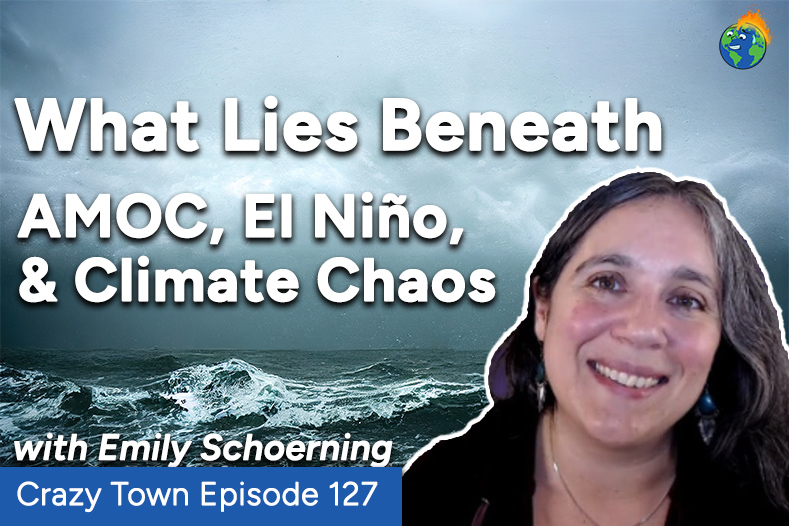
It’d be easy, with the clusterf**k of crazy-making economic, geopolitical, and democracy-in-decline news dominating the scene, to forget that the unraveling of environmental systems waits for no person. That’s why we’ve asked Emily Schoerning to return to Crazy Town. Asher and Emily sit down together (uh, virtually) to discuss the oceanic dynamics – from worrisome to downright apocalyptic – that could make the Strait of Hormuz disruption look like a five-minute wait at the Starbucks drive-thru. In this episode they discuss the possibility of a 2026-2027 Super El Niño, the growing risks of an AMOC collapse, and how each of us can approach near- and longer-term resilience.
Originally recorded on 5/20/26.
Crazy Town Hall 2026
The Town Hall is your chance to hang out with Jason, Rob, and Asher – and your fellow Crazy Townies – as we continue our arduous journey to the center of a collapsing techno-industrial, politically incompetent civilization.
Sources & links
- American Resiliency
- Links to graphs/resources that Emily mentioned:
- NOAA ENSO Update (see page 23)
- Columbia El Nino Update
- Climate Reanalyzer (to visualize average SST changes as a graph)
- Zach Labe’s visualizations (to visualize currently non-apocalyptic Antarctic sea ice)
- Copernicus (to visualize SST anomalies on world map)
- Atlantic meridional overturning circulation slowdown modulates atmospheric rivers in a warmer climate by Mimi, M. S., Liu, W., Ma, W., & Chen, G. Nature Communications, 2026
- Articles/papers related to AMOC and El Nino:
- Observational constraints project a ~50% AMOC weakening by the end of this century by Portmann, V., Swingedouw, D., Khattab, O., & Chavent, M. Science Advances, 2026
- Critical Atlantic current significantly more likely to collapse than thought by Carrington, D. The Guardian, April 15, 2026
- El Niño/Southern Oscillation (Enso) Diagnostic Discussion, Climate Prediction Center, 14 May 2026
- A ‘super El Niño?‘ The Conversation, May 14, 2026
Related episodes
Credits
Production and editing by Alex Leff. Editorial assistance and transcripts by Taylor Antal.
Theme music is “Way Huge” and “Don’t Give Up” by Midnight Shipwrecks, used with permission.
Thanks to all the Crazy Townies, our listeners who are trying to understand humanity’s overshoot predicament and do something about it.
Transcript
Rob Dietz:
I am Rob Dietz.


Jason Bradford:
I'm Jason Bradford.


Asher Miller:
And I'm Asher Miller. Welcome to Crazy Town where we'd rather get choked out by a UFC fighter on the White House lawn than think about the state of our oceans.


Rob Dietz:
It'd be easy with the cluster frick of crazy making economic, geopolitical and democracy and decline news dominating the scene to forget that the unraveling of environmental systems waits for no person. That's why we've asked Emily Schoerning to return to Crazy Town. Asher and Emily sit down together virtually to discuss the oceanic dynamics from worrisome to downright apocalyptic that could make the Straight of Hormuz disruption look like a five minute wait at the Starbucks drive through.


Asher Miller:
Hey, Rob and Jason. It's nice to see you guys. Though I guess I'm glad that we're not actually physically in the same room together.


Jason Bradford:
What?


Asher Miller:
We're doing this virtually


Jason Bradford:
Why?


Asher Miller:
Because my head might explode and that would be messy. If my head explodes and then somebody's got to wipe off my monitor or whatever. But I don't think your wife would like that, Jason. It'd get all over the yoga mat and stuff.


Jason Bradford:
Exactly.


Rob Dietz:
I've got a waterproof jacket so I can be like one of those people who watches the Shamu show at SeaWorld.


Asher Miller:
And here's why I wanted to get together because this whole fucking UFC fight on the lawn of the White House -


Jason Bradford:
You have issues.


Asher Miller:
I feel like we were in idiocracy before and somehow we've lapped it. We've gone past Idiocracy into some other world. I'm not sure what it is. It's even dumber than idiocracy was. And yeah, I'm struggling with that a bit. I've got to say.


Rob Dietz:
I don't see how you could possibly be struggling with lawn fighting at the White House. I mean, what better use of governmental acreage could you come up with?


Jason Bradford:
It's an octagon. It's not a lawn. It's an octagon.


Rob Dietz:
Can we put Trump and Putin inside the octagon for one of the fights?


Asher Miller:
Well, there was a conversation - I think Zuckerberg and Elon Musk were going to have it out at one point. I think we should get all the tech bros doing this. That should be the only fight that we would permit on the lawn of the White House. They own the place anyway, right?


Rob Dietz:
Like one of those old royal rumbles. You put 'em all in the cage at once and see who's left.


Asher Miller:
Exactly. But the reason I'm losing my mind about this, well, one of the many reasons I'm losing my mind about this is there's some serious shit going on in the world, right?


Jason Bradford:
Yeah.


Asher Miller:
Let's just talk about what's actually happening in the oceans right now. And it feels like all of our attention is going to these stupid, stupid distractions. Some of them are very serious things that are happening in the world. But things like this capturing our attention is just masking what is really happening out there that we should be worried about or paying attention to, and we're just not because of this stupid crap.


Jason Bradford:
But we barely paid attention to this stuff when there wasn't this complete political badness going on. I mean -


Asher Miller:
I guess that's true.


Jason Bradford:
It was always page 10, almost always page 10 anyway. But you're right. Now it's just swamped. And I feel bad because the oceans have given us grace. The oceans have given us some time.


Asher Miller:
We came from the oceans.


Jason Bradford:
We slithered out from the oceans, but they gave us time. They absorbed all this early heat.


Asher Miller:
Oh, with climate change? Yeah.


Jason Bradford:
Yeah, yeah. They've been this wonderful buffer. And now I think you're right. I think that era where the oceans are this, thankfully they're taking the hit for us. I think that's over.


Rob Dietz:
Well, you guys are lamenting that we're distracted by all this stuff and we're not paying attention to the oceans. I'm thinking a lot about the oceans. In fact, not only are they building that octagon at the White House lawn, but they're redoing the whole reflecting pool. We could make that a wave pool with surfing.


Asher Miller:
Oh, good idea.


Jason Bradford:
Yeah.


Rob Dietz:
Then I could be doing that rather than sitting here podcasting and lamenting about ocean circulation shutdowns and buffers and grace periods.


Jason Bradford:
Oh my gosh. The whole mall could be like an amusement park.


Asher Miller:
Right!


Jason Bradford:
Okay. You're absolutely right. I was in Budapest, Hungary and the city park in the middle of the city had a wave pool. That's what D.C.'s missing, stuff like that. But we just keep going on and on.


Rob Dietz:
This is the sequel. It's Mall of America Part Two


Jason Bradford:
And Washington Monument can be a zipline from the top all the way to the Lincoln Memorial. You could zipline that baby.


Rob Dietz:
And you just crash into one of those columns at the bottom of the zip line. It'll be awesome.


Jason Bradford:
Oh my God. Oh, oh, oh, oh. The Vietnam War Memorial Skate Park. Okay? I mean, it'd be perfect. Oh, Rob.


Asher Miller:
You jest, but just you wait, right? I mean, we're not far from that, but bringing it back to the oceans.


Jason Bradford:
I feel better now. Oh, don't be a downer. Come on.


Asher Miller:
Bern, in Switzerland, which I think is the capital of Switzerland, they have these bears that it's named after bears, and they have these bears. They're basically in the center of town, like this outdoor exhibit or whatever with these bears. So since the oceans are becoming basically too warm, right?


Jason Bradford:
Yeah.


Asher Miller:
Maybe we need to just create a huge outdoor exhibit of sea life and we could just put those on display at the mall in the capitol as well.


Jason Bradford:
We could have it as one of those river rides where you get in a big circular kind of floaty, and you can have a whole party on it, like eight people, and it kind of goes down and along the mall. And then every once in a while a shark comes up and just chomps.


Asher Miller:
They have those beer - Have you seen those things where people are peddling and they're drinking beer together? It's like they're sitting at a bar and they've got pedals. So you can do that too. You could be drinking to your heart’s delight, and you're peddling basically down the lazy river at the mall.


Jason Bradford:
Yeah. And then a giant squid tentacle just yanks you out.


Rob Dietz:
So I think you actually talked to somebody who has something intelligent to say, rather than us planning the next iteration of DC.


Asher Miller:
I think that Emily, so we're talking about Emily Schoerning, who's a great climate communicator. She runs an organization called American Resiliency. We've actually had her on the podcast before. And it's true/ I wanted to sit down and have a real adult conversation with her about what's actually happening in the oceans


Jason Bradford:
Not with us.


Asher Miller:
I'm sure she'll really appreciate the way that we set this up for her because there's no greater transition than us talking back about having an amusement park - The Mall of America now is now the Mall of DC.


Rob Dietz:
Part Two. It's a sequel.


Asher Miller:
Part Two. Yeah. Well, let's take it from there. Here comes Emily.
Alright, Emily is so nice to see you again. Thanks for coming back onto Crazy Town. I know that I am not as handsome as Jason, but at least I won't bore you with talk about birds and geeking out about biology, although maybe you prefer that. I'm not sure.


Emily Schoerning:
Yeah, I am feeling a sense of outrage at the fact that we're not going to talk about birds, but I'll be able to handle it. I'll be okay.


Asher Miller:
I appreciate that. I can just spot colors, basically. I'm below novice in the birding world. Well, I wanted to bring you back on the podcast because to me, in the midst of all the craziness that's happening in the world between the war in Iran, and the energy crisis, and rising costs, and politics, and AI running a rough shot over everyone, I don't feel like a lot of attention is being paid right now to the climate crisis. And I wanted to actually, because there's so much that's happening in that space, and you are one of the go-to climate communicators I can think of out there. I wanted to kind of cover that ground with you a little bit, but maybe keep it slightly more narrow because there's a lot we could talk about. And maybe we'll just focus on what's happening in the oceans, if that's okay. And so I want to talk about two dynamics. One is developing more slowly, but could be completely world changing, and the other is right at our doorstep. So let's start with a nearer term one, which is this possibility that we might enter into a Super El Nino. And maybe just to begin, for those who are not super well-versed, maybe just explain what an El Nino is for folks.


Emily Schoerning:
It is sort of difficult. The El Nino, La Nina, and neutral cycles.


Asher Miller:
Yes.


Emily Schoerning:
These are global patterns, global weather patterns that can have unpredictable impacts from year to year. When we're talking about moving into an El Nino, which it's timely, we're recording on May 26th and we just got an ENSO update today. We're talking about a pattern that is fundamentally caused by warmer than usual sea surface temperatures. So in an El Nino cycle, we get this warm water moving into the atmosphere, changing global weather patterns. La Nina is sort of the cool associated cycle where we're not having as much heat moving out of the oceans. And I really like your idea of focusing on oceans as we take a moment and look at where we are in climate because changes in ocean behavior are really the place to watch as we want to predict what's going to happen in the next five years, next ten years.


Asher Miller:
So yeah, maybe talk about what is happening in the Pacific right now and why are, I mean El Ninos, like you were just saying, we've got these patterns, right, of these things happening. So El Ninos are not particularly rare, but what's happening right now in the Pacific, why are people talking about the possibility of a Super El Nino or more extreme version of that?


Emily Schoerning:
So sea surface temperatures are really high right now. We've tipped back to all time highs a couple of times here in 2026. We're moving into an El Nino, very likely moving into an El Nino in the next couple of months. And it's not just that we're talking about these extremely high temperatures emerging in the Pacific, as you alluded to. I think it's worth noting that the world temperatures, the world daily sea surface temperature average is also high. So of course it's correct that people are concerned about these extreme high temperatures in the Pacific. There's concerns we're going to have another of the blob style heat wave that will be devastating to marine ecosystems off the West coast. But that heat is in the context of global heat.


Asher Miller:
Yeah, it's not just happening in that one zone. And what are some of the predictions or concerns that we're hearing if this El Nino comes to pass and it turns into a super El Nino? What are some of the predictions and concerns? And also maybe just talk a little bit about disclaimers or caveats. Because I know that it's not a certainty. It seems like high probability, at least from what I'm hearing, but maybe talk a little bit about where the certainty is right now.


Emily Schoerning:
So this is the new official NOAA ENSO update where we're not in El Nino right now. I think it's very important to ground ourselves in the fact that this hasn't happened yet, but May, June, July, we're looking at a greater than 80% chance according to the official NOAA ENSO update, and we're looking at high 90% chance of being in El Nino as we move towards the end of summer. It's always nice to look at multiple sources for these sorts of predictions. I think that the Columbia Climate School always is an interesting place to also check. They're saying that we're at a 98 chance -


Asher Miller:
Whoa.


Emily Schoerning:
Of entering El Nino in May, June. So we're talking about something that hasn't happened yet. El Nino hasn't been declared yet, but it really looks like it's coming, and that's a separate question from this question of is it going to be a super El Nino or not?


Asher Miller:
Sure. Yeah.


Emily Schoerning:
When we were looking at entering the 23-24 El Nino, which I think is very relevant for any people who are watching the climate data come in, right? The 23-24 El Nino season, everyone was very concerned because sea surface temperatures globally were also behaving very strangely. There's one thing that is different as we're coming into this potential El Nino system, and that is that Antarctic sea ice is not behaving as abnormally. 2023 was a record low year for Antarctic sea ice and that we're not seeing the same level of anomalous behavior in 2026 with Antarctic sea ice as we did in 2023. So although -


Asher Miller:
So it's better news. Is that fair to say? It's better news.


Emily Schoerning:
I'm not trying to be like, oh, this sandwich is fine because it only has 12 bugs on it and our last sandwich had 15 bugs on it, right? But we're looking at somewhat more normal behavior in some other earth systems. It helps me stay on the ledge around how intense is this El Nino going to be? It makes me not really want to speculate too much on if we're going to have this super El Nino or not. Like the 1877 style super El Nino. That's definitely possible. A lot of people were very concerned that we were going into an 1877 style El Nino in 23-24. They were concerned it was going to be a two year El Nino, but it ended up being relatively short. We transitioned to La Nina pretty hard and fast.


Asher Miller:
Now you say 1877, what was that? What was that like? Why are people worried about it being like that year?


Emily Schoerning:
So you can imagine that we don't have the same quality of Earth systems information from 1877 that we do now, but people were observing these El Nino/La Nina cycles way back in history. If we look at pre-Columbian history, there's awareness in South America and Central America where we see such profound impacts of these cycles going back thousands of years. 1877 was an observed El Nino and it drove serious crop failure across the world. Some estimates that it may have killed by famine 3% of the world's population at that time. So this is millions of people. And you can imagine that anyone who follows supply chain and ag-industry news right now is not happy about the possibility of an El Nino further whacking these systems, right?


Asher Miller:
Yeah, yeah. We're talking about the shocks that are happening because of fertilizer shortages, the blockage basically of oil and natural gas and other products moving through the Straight of Hormuz just triggering a bunch of stuff in the energy sector and the economy.


Emily Schoerning:
Yes. And with the fertilizer impacts of the Hormuz closure, we're talking about a third of the world's fertilizer supply that did not make it into the hands of farmers worldwide. When we look at potential impacts in the U.S., I think that many of us in the U.S., we have a tendency to center the tragedy in ourselves, right? When we look at who is more likely to actually face food shortages this year, most of what I'm reading suggests poorer parts of Europe and poorer parts of Southeast Asia are where we're looking at really serious food shortages this year, not the U.S.


Asher Miller:
And that again, if we see impacts of an El Nino, maybe talk about that. So we don't have to catastrophize and say it's going to be 1877, but in a typical El Nino, or what we experienced in 23-24, what kinds of impacts are we seeing around the globe as a result of that?


Emily Schoerning:
See, this is really interesting because I think we have to separate out a little bit typical El Nino impacts and what happened in 23-24.


Asher Miller:
Ok.


Emily Schoerning:
Everything has been coming so fast and furious. I think that many of us have not really had time to postmortem the 23-24 El Nino. We were just glad we got out of that, right? So a typical El Nino, you're going to see an impact to the monsoon cycle. You can get some challenges with monsoon cycle timing in Southeast Asia, meaning that where we were already seeing supply chain impacts for Southeast Asia and fertilizer impacts to Southeast Asia, we may see more heat, we may see delay of the monsoon and any additional heat waves across Asia, they're already dealing with such intense heat. I'm sure you've seen how intense the heat has been in India already this year. If we take it home, if we look at the U.S., often in an El Nino year, you see more moisture to the Southwest. Which if we think about that as a potential impact, I think that many of us with our eyes on the Southwest are like, that would be okay.
That would be good. To the Pacific Northwest, we see more heat, maybe a little bit drier, which the drought is already substantial in much of the Northwest, so that's concerning. And typically we see less hurricane formation in the Gulf in an El Nino year. I've had a number of AR community members in Florida be like, "Yeah, we're going for two!" Because last year was a very uninteresting year in terms of Florida impacts from Gulf storms. But here's where I want to look a little bit at the 23-24 El Nino as an unusual El Nino. Acknowledged by the climate community as in some ways unpredictable El Nino, it turned off faster than projected. The shift to La Nina was faster than projected. And '23 and '24 were two unusually active hurricane years where we saw a lot of severe hurricanes including Idalia, Milton and Helene follow unusual inland tracks causing devastation in many communities across the southeast. I mean, anyone who has forgotten what Helene did across the Carolinas, across Georgia, we need to be aware that these more inland hurricane tracks are part of the projections for how hurricanes will move differently in our warming world. So when we consider what are the at-home impacts of this potential El Nino system, unfortunately this is another place where we have to embrace uncertainty because El Ninos are maybe not behaving in the same way as they used to.


Asher Miller:
Yeah. What typically happens after an El Nino?And I know you just said we can't bank on these patterns from the past occurring again, but do things just snap back? You said the 2023/2024 kind of ended really quickly, moved into La Nina. What happens with sea temperatures? I mean, do they return back to quote unquote a "normal" level? Are things just continuing to elevate and so we come to sort of a new normal and that becomes a new baseline?


Emily Schoerning:
I think that this is another then and now question. El Ninos and La Nina, this cycle always has a lot of variation. Usually you get some return to neutral, to ENSO neutral where the sea surface temperature in that relevant area in the Pacific is neither anomalously high nor anomalously low. We're just hanging out. We're having a normal year, not a La Nina year, not an El Nino year. When we look at the 23-24 El Nino, and when we look at the substantial El Nino that peaked in 2016, and we look at global air surface temperatures, we don't see a return to normal. People are talking about this more with the 23-24 El Nino where we moved from about 1.2 C over pre-industrial baseline up to near 1.5 C over pre-industrial baseline. 0.3 degrees in a year, and then we haven't really gone back down. That's not good. When you look at the data graphically year by year, you see a similar rise and failure to return to baseline on the global level with the 2016 El Nino.
And I think that for anyone who is concerned about this potential for rapid warming temperature. increase that's going to go outside of models, this sort of El Nino step up pattern is really disturbing. It's concerning to see. And I feel like it's worth picking out those impacts from 2016 and from 23-24 as we look at what could happen with this El Nino. Super El Nino or not, if we pick another 0.2 degrees up, which Hanson has been quoted as saying he thinks this could push global averages to 1.4. Or if we picked up another 0.3 like what happened with the non-super El Nino that we had from 23-24, that puts us to 1.8.


Asher Miller:
And just to remind viewers and listeners, the global community set 1.5 as kind of the target for warming. That was the Paris Accords.


Emily Schoerning:
Yeah, that's where we wanted to limit the impacts of warming.


Asher Miller:
So we're already basically there and now we're talking about shooting past that potentially much more quickly as far as I understand than would've been modeled previously.


Emily Schoerning:
Yeah, I often have people who tell me that when they think about what they were taught to expect with global warming, they're like, it's happening now. I'm seeing it now. For most of us who were given an education as to projected impacts, they were the impacts of a 1.5 world. And we are in it now. Anyone who's talking about this notion that we're going to somehow limit warming to 1.5 at this time, I think that they need to look at where we are now and that we are beyond that point. We're beyond limiting to 1.5. We've breached that threshold and we need to talk about what we can do to build resilience for a 2 C world. Because this window that we're in, the window between 1.5 C and 2 C has long been held by policymakers and adaptation specialists as the critical window for action. That everything is going to get harder after 2 C. And if we want infrastructure that's going to be able to handle 2 C+, this is the time. This is the moment for us to act.


Rob Dietz:
Hi, this is Rob. I've gotten a lot of joy, friendship, and insight from hanging out with Jason and Asher here in Crazy Town, even when they're laughing at me instead of with me. I love doing the show, getting the chance to process the insanity of modern techno- industrial society and coming up with ideas for how we can do something different like repair ecosystems and make our communities more resilient. If you'd like a chance to interact with the three of us and share some stories and laughs, we've got a special event for you. It's the Crazy Town Hall. Come join us for this live online event on June 23rd, 2026 at 5:00 PM US Pacific time, 8:00 PM Eastern. It is a fundraiser, so you will need to make a donation to the Post Carbon Institute to get a ticket to this clown show. Sorry, town hall. In all seriousness, we love our Crazy Town listeners and I hope you'll join us at the town hall. To register, please visit resilience.org/crazytownhall. That's resilience.org/crazytownhall. One more time, resilience.org/crazytownhall. See you there.


Asher Miller:
I actually want to step back and talk about another pattern, another concern that we're seeing in the oceans right now, which is longer term. It's not something that people are anticipating happening this summer this year. And that is the AMOC, right? Which some of our viewers and listeners, people certainly who follow you are probably familiar with. But let's just give people a little bit of context for folks who aren't as familiar. So AMOC stands for the Atlantic Meridional Overturning Circulation. I'm going to describe my understanding of it, but correct me if I'm wrong. So it basically moves warm water from the very southern part of the Atlantic all the way up to the North Atlantic, and it helps essentially to maintain a mild climate in Western and Northern Europe. And it also helps to regulate the entire global climate system. It's a massive force out there and people have been warning us that it is one of the major tipping points in the climate system that we need to be concerned about, and that's essentially the collapse of that system. That pump of circulating water might collapse.


Emily Schoerning:
Yes. What you've said is information that is good. I'd like to add another piece of information.


Asher Miller:
Yeah. Please.


Emily Schoerning:
Which is, you're talking about this being like a pump, like a heat pump. I think it's important for our understanding to know what drives that pump, what's making it work. And it's saline gradients. It's that water that is warmer or cooler is going to be associated with the salinity of that water. And so the density of the water based on how much salt it has in it is driving the movement of that pump. And AMOC is the best described of these loops, but there are other heat pump systems in earth's oceans and those are very fundamental to our climate system. There are many pockets of unusually warm and unusually cool water that we're moving through the Gulf Stream in April that we're seeing more and more high anomaly behavior in the surface temperature of water moving through the Gulf Stream. In the last few months, we've also seen evidence of the Gulf Stream shifting, moving on the north/south axis, which there is paleoclimate evidence that that sort of movement precludes current collapse. This is a current where if it hits collapse, if it gets turned from on to an off position, it's not like game over.This pump is never going to work again. It will eventually, as earth's climate system changes, turn back on again. Most paleoclimate scientists believe that it has. Believe that the evidence suggests that it has turned on and off. Which is not super comforting as mammals with an 80 year lifespan.


Asher Miller:
In our lifespan, yeah.


Emily Schoerning:
Yeah, because it's not turning back on in our lifetimes. If it goes down while we're alive, it's not coming back up for us to say hey again. The salt part of this is important because I think many people who care about climate, they're aware that we have a lot of melt coming off of Greenland. More and faster melt than anticipated, and so there's no salt in that water, right?


Asher Miller:
Yeah. I mean I do think Donald Trump has a solution for that. I mean, I've heard him talk about turning the taps in Canada to get water down to us, so I think that's why he wants to invade Greenland, right? He just wants to tap that water, keep it from going into the Atlantic and sending it to the AI data centers. I'm thinking, right?


Emily Schoerning:
There's some impractical layers to this plan you're laying out.


Asher Miller:
Really? I thought he figured it all out. I assumed just, okay - Sorry, I interrupted you. Okay.


Emily Schoerning:
You're okay. You're okay. I mean, these problems are so crazy and connected. I know that we have our eyes on Greenland from a couple of perspectives. Hopefully the sovereignty of the indigenous people of Greenland stays the predominant perspective in those conversations.


Asher Miller:
That would be nice.


Emily Schoerning:
And as they're experiencing this rapid melt, it's causing a lifeway impact. The ice season is changing. The types of ice that they interact with are changing. If we're getting a bunch of fresh water dumped into the northern side of AMOC, that's exactly what's going to mess up the saline gradients that drive the pump.


Asher Miller:
Right? Yeah. And so we're talking about a system you just said, if it turns off, it could turn back on, but we're talking about a timescale very far from what we're just saying with El Nino cycles, and we're talking very long periods of time. But in terms of the risk of AMOC shutting down, what is the timeframe that people are thinking about? What's the probability that they're looking at? And how much have people become more and more concerned about that over time, just since you've been kind of studying these things?


Emily Schoerning:
When I founded American Resiliency in 2021, the consensus of the climate science community was that we were unlikely to see AMOC collapse before 2100 because we weren't observing signs that would indicate the system was doing anything that weird. But since 2021, it's doing weird stuff. We're getting observational data coming in where we're like, whoa, what is going on with you AMOC? There have been more and more papers, started coming out really in 2023 was where there started to be a real lot of AMOC related evidence papers, not just modeling papers. Showing that it is likely that it will collapse by 2025. I'm sorry, by 2050 where we were looking at a range. I know, I know I did run. We were looking at a range from 2025 then to 2050, which is a range that is hopefully within our lifetimes. And many sovereign nations are seeing these changes being pointed out by the oceanographic and climate communities, and they want to respond to change. Iceland was the first to my knowledge to start to look at this as a sovereignty issue and engage in national level planning for AMOC collapse. The UK Emergency Forum also had a strong AMOC response thread because when we look at projected change impacts based on both modeling and on paleoclimate evidence, we would expect the northern UK to see severe impacts from AMOC collapse


Asher Miller:
Like an Ice Age kind of territory? What are we talking about here? I mean, if it collapses, these areas are going to become much cooler, I assume, right? Because they're artificially warmed by the cycles of the circulation of these waters, yeah?


Emily Schoerning:
Right. If the Gulf Stream were to stop bringing warm water over to the UK, we would expect sea ice to persist in the winter all the way down to the coast of the Northern UK, which is a big change from today. And we would be looking at temperatures in the UK as cold as the temperatures at my house. Eastern Iowa is an excellent climate analog for the winters that would be faced by the UK. So it's not quite an ice age. I live here, I can report back. No mammoth sightings. But it is a significant level of cold and the infrastructure isn't built for it. If you've got a lot of uninsulated pipes, anyone who is Minnesota adjacent is going to be like, oh, hey there. There's a problem.


Asher Miller:
And it's going to not just impact the UK, right? I mean, we're talking about all over the world on some level.


Emily Schoerning:
If we look at the biggest probable impact points for AMOC collapse, it's Northern Europe, Amazonia, Panama, those are where we see big water cycle changes projected. It's off the coast of Panama, and there's a point where there has been a lot of flooding in Brazil where we would expect a lot of flooding to occur. There are substantial concerns that AMOC collapse will cause very serious instability in the monsoon cycle for Southeast Asia. So we're talking about major ecosystems, Amazon Rainforest, looking at negative impacts. We're talking about major food systems and human lifeways in Southeast Asia, and we're talking about very extreme stress on food systems, lifeways, and built environment in large parts of Northern Europe as primary impact sites. If you're doing triage, those are the nations that need to get to the front of the line.


Asher Miller:
And I would just say we're also only talking about the impacts of one particular climate system, environmental system, and you could think about that in the context of a static world, but we're not dealing with static conditions. We were just talking about the fact that if El Nino conditions hit in places like South Asia right now, that's compounding on top of, I mean, this is all manmade or human made on some level, but directly caused by shortages of things as a result of the war in Iran. So to assume that everything else will be hunky dory and stable if an AMOC system collapses is probably not accurate either. So we're looking at lots of instability.


Emily Schoerning:
Yeah. We haven't shown good global behavior. We haven't shown a good ability to respond to change together. I'd like to take a second if it's okay with you, and look back at El Nino and AMOC and this fear of the super El Nino. Right?


Asher Miller:
Okay. Yeah.


Emily Schoerning:
If we're concerned about a super El Nino that's going to last a long time, I think it's worth noting that that is going to drive freshwater melt in the north right off of Greenland and probably push AMOC shutdown forward. It's worth noting that as we kind have this push pull where the AMOC system is getting a little wobbly, that drives a cold trend in the Northern Hemisphere. I think that a probable outcome in our basket of uncertainty is that we'll be looking at an overall very warm winter this winter, the 26-27 winter because of the high probability of this El Nino. But that it could directly push us towards a cold winter next winter because of this contribution to AMOC instability. And for anyone who loves living things, that sort of whiplash pattern where you get unusual heat and then unusual cold the following year, that's very challenging. That's a big resilience challenge on the ground to see what can handle both conditions. And my inclination is not to look straight at probability of a multi-year super El Nino, but to maintain an all hazards approach and accept this probability that the El Nino could drive a year, two years, three years down the road, more AMOC down type winter behavior, which is going to be cold from a northern hemisphere perspective.


Asher Miller:
Yeah, I think you're getting to one of the huge challenges, I think psychologically and practically, which is we're dealing with complex adaptive systems here and they interact with one another, and there are many variables that lead to change, and so trying to predict within those systems is really difficult. But even just thinking about it, I'll use myself as an example, trying to make decisions as a person based upon trying to understand what's happening and anticipating what might come. Right? So I moved to Oregon from Northern California. We went through severe drought, a couple cycles of very, very severe drought when we were living in California. And I was really concerned about water shortages, fire risks. I had a son with asthma, and we were looking at like, well, where might we move if this area is going to become very dry? And people talked about sort of a perpetual drought there.
Well, we've actually seen, and I will say, and I didn't predict this, but just months after we left a fire did tear through, the Tubbs fire tore through Santa Rosa where we were living just months before. But in the years since, what we've actually seen are unprecedented snowfalls in the Sierra. They've seen actually more extremes including more precipitation than the normal some years. And so it's like, I wouldn't have predicted that, right? I thought the future is just going to be dry in this part of the world, and instead what we're seeing is lots of oscillation. And that makes it just really, really hard to know how to prepare. So maybe you talk about both maybe the difficulty in having certainty or predicting what the future's going to look like and how you think about building resilience in the context of all those different possible scenarios.


Emily Schoerning:
It is psychologically difficult. Very psychologically difficult. When I was engaging in study, trying to get a clearer picture of what was projected. I think that what we've taken for granted for so long in earth's climate systems is what is normal. We think about a typical summer day or a typical May day in our minds, and we can picture that, but in the projections, we're looking at a future that's like all edges. It's less middle, more edges. If you can think about an unusually cold day that you experienced in your memory in the summer as well as the heatwave day, as well as the day that all of a sudden it started hailing for some reason. It's all those wild parts. All those edges are what is going to become our new normal, and that's why I think an all hazards approach is really important. In parts of California, Southern California especially, there is a conserved cross model drought trend. However, there's also a prediction, and very fascinatingly, I sent you this research link. There's modeling based evidence that atmospheric rivers will increase both in a standard warming pathway and an AMOC collapsed pathway.
So rven though you're dealing with this drought trend, you could get totally hosed by atmospheric rivers every two or three years, right? Drought trend, landscape change due to aridity, plus giant volume of water dumped on you irregularly. And that is just not something we have the cultural knowledge to hold. When we think about this future where a darout deluge trend, an absence of your gentle reins, your gentle sustaining reins, is sort of the way it looks like it's heading everywhere. I think that the most resilient response I can think of is that we have to prepare to be that middle. We have to create what normalcy, what averages we would like to create at a landscape level. Where if water is coming in, in a drought deluge pattern, thinking about water storage and water distribution is how we create that middle, how we create that normal.


Asher Miller:
Yeah, I mean, it is a challenge when you think about food production though, right? Because you talked about aridity and then just deluge of water, and it's great to store that water if you can for those periods where things are dry, but crops fail when they get absolutely pummeled with heavy precipitation as well. It's a real challenge to think about how you steal for those kinds of conditions.


Emily Schoerning:
An area that I think is very promising is perennial crops. Perennial Promise is the name of one of the organizations that I admire in that space.


Asher Miller:
Yeah.


Emily Schoerning:
You talk about deluge driven crop failure, a lot of that time is when the plants are hit by deluge at a critical life stage. A seedling life stage, for example, is going to get totally washed out in a deluge. If you're dealing with perennial crops, and there are very interesting things being done in perennial green crops, oil crops, and protein crops.You can be talking about a plant that is on a much longer timeline, say a five year timeline, where your periods of vulnerability are going to be much smaller to any particular weather event.


Asher Miller:
In our office, we have a great photo of West Jackson, who's a friend of Post Carbon Institute. He used to be a fellow of ours. With a photo of one of his colleagues actually holding kernza, which is this perennial grain that they've been creating.


Emily Schoerning:
The first perennial kernza that I had heard of being planted in Iowa was from a female land worker at La Jolla Farms, and it just looks like grass.


Asher Miller:
Right.


Emily Schoerning:
Yeah. It doesn't look like it's the future, but you can look over this field that could be crab grass if you didn't know what was going on, and it's like that does look tough. That green does look tough, and the farm is successfully producing it as a market crop. You can buy it on their online store.


Asher Miller:
Well, is there any other weirdness that's happening in our oceans that we need to be aware of because we haven't scared people enough? Is there anything else that you just want to flag before we talk a little bit about what resiliency looks like in the face of this?


Emily Schoerning:
When we think about the ocean, I think that it's very important for our understanding of climate to know that the ocean is holding more heat than the land. The ocean has absorbed more heat. I think that it is reasonable to say that the ocean is pissed off. We've done enough to the ocean at this time. When we think about climate change, most of us of course think about land-based impacts because we do not live in the ocean. But when we think about ocean impacts and ocean ecosystems, many people are not aware of how close to the brink we are in many ocean ecosystems. That ocean acidification is impacting reproduction and ocean ecosystems today. It's a today problem. And so if you're a person who's trying to build resilience on the coast, you should not assume that you're going to be interacting with the same ocean 20 years from now that your community may have for centuries. You shouldn't assume that the ocean is going to yield the same foods and other goods that you might use from the ocean. You should assume that your relationship with the ocean is going to change. I think that for all of us, knowing that ocean-based change is going to continue to be the leading change edge is critical for our understanding. I hope that that is a helpful, big concept for people.


Asher Miller:
Yeah, I appreciate that. And that's not even talking about the impacts of plastics or other things that we're doing, overfishing, all the other things that we're doing to the oceans right now. So talk a little bit about resilience and maybe specifically if you have any thoughts about this as it relates to some of these patterns or possibilities that we've been talking about with El Nino, Super El Nino. AMOC collapse. How should people who are listening or watching this be thinking about building resilience in that context?


Emily Schoerning:
Strongly recommend thinking about action rather than seeking out information in a compulsive loop. Because if you wanted to read articles about the possibility of a super El Nino, you could definitely do that forever in our current age of slopification. When we look at the likely impacts of this El Nino for the second half of this year, we're talking two C today. We're talking that this could be our two C August. It wouldn't be completely beyond belief. If we hit global surface averages at least temporarily at the two C marker. I'm not saying year on year starting this year. I'm not saying monthly average. We could hit it for days for weeks at this El Nino. We know what the high end heat projections are, what the hot season increased projections are for two C here in the U.S. And there's resources at American Resiliency where everyone can review those projections for themselves at the county level. Having a plan to deal with projected heat of that intensity, possibly in the context of utility instability, would be an action based way to respond to this reality at the household and community level. If you know that there's a possibility you're going to be dealing with a week of additional temps over 105, you should have a plan for where in your house you could go to stay cool. Or if you live in an apartment where there's no underground space, there's no sun sheltered space, you should know what location you would want to go to and what you would bring. If you're in an area where you're concerned about instability in the power grid, which NERC declared a level three warning that we're looking at power grid instability and they're working on patching the problem. Their declaration of that alert is not, "Freak out!" It's like, oh, good. They're doing their job. They're trying to stop this from happening. But if we're dealing with potential for grid instability, having a plan for backup power is a good idea. And your plan can be dumb. Your plan doesn't have to totally solve the problem. You can have a plan that is better than having no plan at all, and that'll help your family. Don't let the fact that you can't store a month's worth of water stop you from storing three days worth of water.
Don't let the fact that you don't want to or can't afford to buy a generator stop you from buying some of those space blankets that cost $1.50, which you can tape in your windows to reflect the light and heat back out to help your home stay cool. I'm a big proponent of janky solutions versus no solutions, and I think that that kind of mindset where you're like, how can I work this problem with what I have? It doesn't need to go on Instagram. It doesn't need to be perfect, but I have some semblance of a plan before the power goes off and it's 112 degrees outside. Because you're not going to think so good then. You're going to have to rely on your past self. It is known that human beings get more stupid and more irritable when we're hot. So when we're talking about heat related emergencies -


Asher Miller:
I guess I'm hot all the time. Geez. I didn't realize.


Emily Schoerning:
It's a scale, right? It's a spectrum. I mean, I'm just telling you about how I love janky plans. Playing this smart is not the only way to play it.


Asher Miller:
That's good. You're setting the bar right where I live,


Emily Schoerning:
Who amongst us is not overwhelmed and really in a place where it's very hard to focus on the good for the perfect because of the images and the content we're fed all the time. It's okay for us to do the best we can to solve a problem rather than continue to critique what efforts we can make in the right direction.


Asher Miller:
Yeah. I deal with this every weekend when I'm at the farm trying to weed and realizing that I'm letting the perfect be the enemy of the good here, trying to get every last little weed out. You can't do that all the time. What about longer term for folks? So I think you gave some concrete examples of preparing at least a little bit for heat to maybe disruption to electricity systems. But longer term, what would you say to people if we're looking at an ongoing likelihood of greater instability, greater fluctuations, more extremes, living at the edges, like you said. What do you tell people to do if they're taking a more of a medium term perspective in terms of their timeframe?


Emily Schoerning:
I think we need to prioritize protection of soil and water where we are, and that can be done through civic involvement at many levels, and we need to prioritize local food systems where we are. Wherever you live, there's probably community supported agriculture. Buying a share in a CSA is a practical investment towards your future and it's going to make you cook weird food. That's an important part of learning to live within a local food system. When I first got a CSA Box, I was living in Arizona. I first started doing CSAs when I was a graduate student. And for two months all I got were wheat berries and green chilies, and I was like -


Asher Miller:
What am I going to do with this?


Emily Schoerning:
I dunno how to handle this. I'm from Chicago! But I was a poor grad student, so that was what I ate, right? It was wheat berry and chili based food for two months.


Asher Miller:
Yeah. You're going to have to share your recipes.


Emily Schoerning:
I don't know if they're worth it. We're talking about making a go of it, not making a beautiful quiche of it. But when we connect with the local food system and we start to eat differently, we start to learn what the patterns are where we live, what can be produced where we live. Contributing to that financially matters. You don't have to grow all your own food, and as someone who grows a reasonable percentage of her family's own food, I grow a lot of our own fresh produce. My desire to have to grow our own staple calories is zero because I wouldn't be able to do anything else. We need to support farmers and our community so that they can be the local food system we need. In my area, we're very fortunate. There are many small to midsize dairy and beef operations and dairy farmers across America have had a terrible epidemic of suicide. Their working conditions are very hard. Many of them, they operate on super tight margins or losses. There's no next generation. It's a labor of love. It's the persistence and the resilience of those small and midsize operations that is allowing our local food system to scale up in a big way over the last couple of years as people from across political and information spectrums start thinking about these supply chain issues and they want to know what local food they can get.


Asher Miller:
Yeah, I think you're right. Growing if you can, or learning how to grow, is valuable and there are lots of ways that people can do that. Supporting local farmers is another way to do it, for sure. I also think acting politically, I mean, you talked about soil and water and a lot of communities are now dealing with, and we were talking about electricity. They're dealing with a lot of instability and issues as a result of data centers coming into their communities in some places that frankly don't make a lot of sense from a water perspective. So I think it's hard because we can all feel scattered trying to engage in all these different levels. But I think the point here is that there's lots of need for people to step forward and be active on some level. So that could be growing your own food. It could be supporting local farmers. It could be acting politically to support your community.


Emily Schoerning:
When we talk about acting politically on water, like with data center opposition, this area where I've worked to share out resources through AR. Because coming together on the ground matters for our resilience. We need to be able to work together for our communities. And people from across the ideological spectrum are often able to come together in unexpected and powerful ways on water. I think that thinking about this as community action, thinking about it as standing up in the interests of your community together. We could work towards the kind of unity that we need on the ground to advocate for our interests in a time of change. Because all of us in our communities do have shared interests in being able to drink and being able to eat. And when we're able to break bread together, when we're able to have these deep connections together, it can unlock more problem solving capability. Because we're dealing with problems that are so big, we need everyone at the table. And so fighting ways to build that community now is more important than ever.


Asher Miller:
And there's lots of evidence for people who are concerned about polarization that's happening. There's lots of evidence of actually working collectively with people who are different than you on projects, not just having conversations to learn from each other and understand each other, which is also valuable. But actually working together on projects is in some ways the best way to overcome polarization in communities. So I think that that makes a ton of sense for so many reasons to be focused on working collaboratively with others in our communities. So I want to thank you, Emily, for taking the time to update listeners on what's happening out there. I encourage folks to check out American Resiliency, both the website but also your YouTube channel. And I'll keep tuning in myself to just get updates as these systems keep changing and we have more of a sense of what's actually happening out there, including what's happening with the prospects of an El Nino this year. So thank you.


Emily Schoerning:
I'm always excited to talk with you, and I will be keeping the El Nino coverage going on AR. We're going to have coverage when El Nino is declared, and we're going to continue to watch what's happening, not just with sea surface temperatures, but with other earth systems, especially other Earth Ocean systems. Because looking at uncertainty, but even as we accept that, I think we want to know what we can know in this time of change, right?


Asher Miller:
Totally.


Emily Schoerning:
So we'll keep looking forward and we'll keep looking for what edges do you want to try and hold as we look towards an El Nino summer. I think that if you want to get ready for August, September, and look at hot season projections at 2 C, you've got yourself this path towards practical action that could be really useful at the household and community level.


Melody Travers:
That's our show. Thanks for listening. If you like what you heard and you want others to consider these issues, then please share Crazy Town with your friends. Hit that share button in your podcast app or just tell them face to face. Maybe you can start some much needed conversations and do some things together to get us out of Crazy Town. Thanks again for listening and sharing.




Comments
We changed commenting systems on September 10, 2026 as part of a site-wide functionality and security upgrade. Your past comments have not disappeared, and you can still log in with your old Disqus account credentials if you wish. Contact us with any questions.
Wadhams pointed out years ago the Odden Ice Tongue (Arctic) disappeared a decade or more ago. The massive freshwater descending chimney from that was a main driver for the AMOC. Much of this key information seems to be falling prey to AI (?) scraping/burial/removal.
ECMWF and Copernicus are good sources.
Difficult to spend much time on her podcast – format is too dilute, although I realize it is a podcast (not a scientific presentation).