

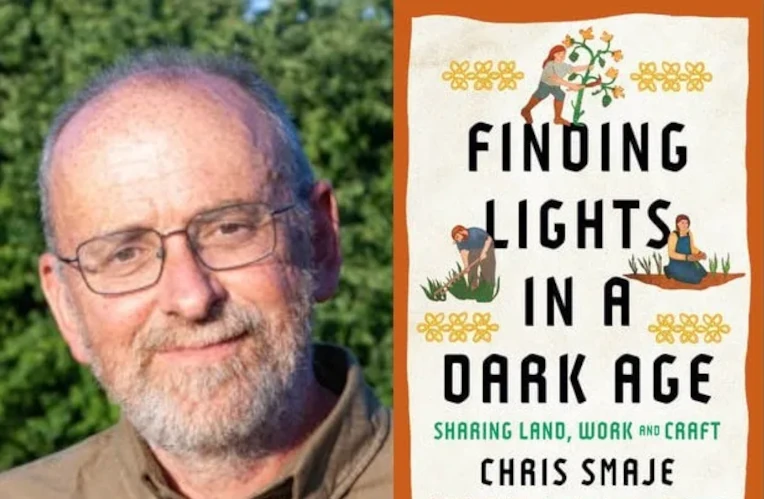
 The following is an excerpt from Chris Smaje’s book Finding Lights in a Dark Age: Sharing Land, Work and Craft (£19.95 Chelsea Green 2025) and is printed with permission from the publisher.
Afterword
The Distributist Movement
I’ve argued that the world we’ve inherited and the one we inhabit is effectively a Viking world, based on an accumulativeness born of predatory violence. That world is coming to an end from its own contradictions, pollutions and excess accumulation. It can’t be patched up by any of its existing mainstream technologies – political technologies, economic technologies and material or engineering ones.
So, we have to try building a new world. If we fail, we face the axe-age and wolf-age described in ‘The Seeress’s Prophecy’, hinting at the dawn of the Viking era, that I quoted in the preface. But hopefully we’ll succeed and, like her, will be able to foresee another green Earth rising from the sea.
The future that I portrayed in chapter 12 was neither an axe-age nor a green Earth. It had the potential to devolve to devolve to either. ‘London’ had become a remnant of the current British multi-nation ‘sun’ state that was turning into a weaker ‘corporate quasi-state’ of the kind described by political scientist Michael Albert in his future ‘neofeudal’ pathway. Bristol had become in turn a city state of secular, civic republican form, semi-independent from London, and with Frome a smaller satellite in its sphere.
Within this new political landscape, attempts to create what Albert calls ‘feudalized rentier capitalists and warlords’ hadn’t really got off the ground. It remained a longer-term possibility, perhaps even a likelihood, but – as I suggested in the last chapter, and elsewhere in the book – feudalized capitalism or warlordism isn’t some natural state of affairs to which societies automatically gravitate. It’s an outcome that requires a lot of political work. Just as with past low-energy agrarian societies in Britain and elsewhere, where the dominance of the many by the few is ‘surprisingly difficult to explain’, so in our low-energy agrarian future will warlordism or feudalized capitalism be one among several possible outcomes whose realisation is not foreordained.
My focus in chapter 12 instead was on what Albert called ‘communities of surplus populations left to develop their own survival strategies’. One of these was the village near Glastonbury where my protagonist walked to, which was trying to generate a self-reliant local society bottom up – and where a tension existed between kin-based and more rational/republican or village assembly kind of approaches. Another was the religious nomads at Avebury – a historical brew-up of medieval-style mendicants and modern New Age or ‘Aquarian’ people. In the future I portrayed, various new religious forms were beginning to coalesce – the church in the village, the nomads in Avebury – but weren’t yet fully formed, because this takes time.
Another ‘surplus population’ I mentioned in chapter 12 was built around the stranger kingship discussed in chapter 11 – or, in this case, stranger queenship. I don’t think humanity has superseded such apparently strange and mystical forms of politics. In fact, our totalising modern view of political sovereignty seems rather less sophisticated. As the grip of liberal-modernism weakens, more plural political forms that play more inventively with the idea of sovereignty seem likely to emerge.
The republicanism of Bristol and Frome I portrayed in the future continues a strand of their present politics in the new ‘dark-age’ circumstances. In this future, their outward reach into their hinterlands was patchy. They were trying to draw outlying people into their networks, using sticks but also the carrot of their access to residual prosperity and resources bequeathed from the present. The populations of their now more heavily peopled rural hinterlands were tempted, but they were also suspicious and were guarding their autonomy. In this world, the further away from an urban power centre you are, and/or the weaker the power centre, the easier it is to evade central power and do your own thing – one version of the ‘solar system’ or galactic model discussed in chapter 2.
I portrayed a future involving what I see as almost inevitable hard times ahead, but nevertheless ones with some possibility to lead onward into a merrier dark age or even a green Earth rising from the sea, perhaps with eagles over fells and salmon thronging in British rivers again, teaching us how we should treat them. If we and our descendants succeed in realising this new green Earth, I think it will result from ordinary people sharing and distributing what they need locally to generate renewable communities oriented to practical livelihood. And it will result from doing the sharing in the kind of considered, structured ways I’ve discussed in earlier chapters, drawing broadly on distributism and similar traditions.
To a large extent, it will also result from improvisation – from people of goodwill figuring things out on the ground in difficult circumstances as they go along, without necessarily fully recognizing what they’re doing. It will not be achieved by people implementing grand plans to save humanity or seizing the reins of existing power to deliver ‘solutions’.



Comments
We changed commenting systems on September 10, 2026 as part of a site-wide functionality and security upgrade. Your past comments have not disappeared, and you can still log in with your old Disqus account credentials if you wish. Contact us with any questions.