

Now we turn to one of the more perplexing aspects of materialism: one that prevents many from abandoning dualist beliefs. How can sentient living beings possibly arise from matter alone? Dualism asserts a sharp ontological divide between animate and inanimate (mind and matter as a parallel aspect), categorically prohibiting animate beings from being wholly composed of inanimate matter. The last post addressed the flaw in characterizing matter as being “inert” in the first place.
But even once past this barrier, our inability to connect all the dots from atoms to conscious experience (which no one has managed to do, and likely never will), strongly tempts us to declare—assuming phantasmic authority—that no such route even could exist, or that failure to map it means it may as well be declared non-existent (a reaction worthy of the Ravenous Bugblatter Beast). Where’s the adventure in that?
As an aside, allusion to “phantasmic authority” above may elicit the reflexive charge that advocating materialist monism is an equivalent assertion devoid of authority. Not so fast. Materialist monism amounts to being satisfied that matter/interactions can plausibly form the entire basis of reality even if we don’t understand how. It is in claiming materialism to be insufficient—without evidence—that meat-brains seize more authority than they are due. Materialist monism cedes authority to the universe as we find it, rather than presuming to fabricate comforting alternatives.
Anyway, lacking a complete map, how does materialism deal with our experience as sentient beings, or other sentient life? We find a significant clue in the etymology of sentient. The root word is “sense.”
Sensing
Microbes sense and react to the conditions they encounter, as do spores, sperm cells, seeds, plants, fungi, and animals. Many technological devices we manufacture—as pathetic as they are compared to living beings—have no trouble accomplishing these feats either, in their clumsy ways. By comparison, when it comes to building sensors, Life frequently far surpasses technological efforts in terms of elegance, complexity, efficiency, and compactness. Clunkiness aside, sensing-and-reacting, then, is not the hard part.
All Life—or all matter for that matter—is empowered to act and react in this world in ways that necessarily effect change in the world beyond themselves via copious channels of interaction. But what is the nature of this empowerment? Well, the actual process might involve mobility or material exchange or other mechanisms, and these mechanisms can (sometimes) be traced to fundamentals given enough patience. But how is sensing connected to action? In microbes it might be that sensed conditions trigger generation of certain proteins whose presence compels a particular action, like motion. Already beyond Rube-Goldberg complexity in microbes, the chain of events in more sophisticated organisms heaps on even more interdependent layers. The situation becomes virtually impossible to trace, yet continues to be based on incremental material interaction at every stage—one building off the last like a series of levers might do (a woefully inadequate metaphor, to be clear).
But how does the organism know what to do, so that it executes good/adaptive decisions? That’s the magic of evolution: it keeps organisms that are configured to respond appropriately, and terminates those who aren’t. So, even a random choice will be “good” in some circumstances, and that choice—together with the mechanisms leading to it—has the opportunity to get locked in. Life, in a sense, is a scheme for locking in adaptively beneficial interactions in contextually relevant scenarios. This is the power of feedback in the presence of self-replication. Those organisms that “self-wire” to make advantageous decisions pass the blueprints for that wiring along—whatever the complexity. It’s a fantastically clever utilization of available physics (and chemistry, etc.) to accomplish something remarkable given the tools at hand and unimaginable patience over deep time paired with random trial. And the great thing is: the mechanism has no choice but to emerge of its own accord once self-replication is in practice. Nothing can stop it!
Now, I consider (assume) microbes to be sentient problem-solvers (able to judge good and bad—valenced—scenarios and respond accordingly), so I’m satisfied with sentience already at the microbial stage, even if the details far exceed my/our capacity to fully track. But if we want to crawl our way toward beetles or fish or parrots or dogs, we would need to pile on far more complexity than our brains can handle, never in the process being forced to resort to interactions outside of physics. Not having the whole picture ourselves does not at all mean the picture can’t be painted by the universe itself over billions of years of trial and error in feedback. To declare it impossible seems a hasty, arrogant, and evidence-free assertion that says far more about our own cognitive limitations and emotional needs than it does about how the universe actually works.
Our imaginations are no match to the deep wisdom emerging out of the eons. Mental models formed in brains have the luxury of skipping over vast tracts of complexity and interaction, but actual Life has no choice but to operate in the full context of everything at once, all the time. More power to it! Indeed, Life’s power will outlast our own.
What’s it’s Like?
Now let’s try returning to the perennial question that confounds contemplation of consciousness. What is it like to be conscious? The experience is private and presumably unique to an individual. Every experience feels like something. The key question is whether anything in materialist monism would somehow prevent distinct sensations (and on what basis)?
Pause for a second to ask what it would mean if sensory experiences did not have a unique feeling. Would they even register? Could they even be called a sense? How would the organism even know he or she (or it, or ki) is having the experience if they couldn’t feel it in some manner and differentiate it from other feelings?
Let’s take a moment to acknowledge that the presence of certain chemicals (atomic arrangements) in the brain influence how we feel. Dopamine, adrenaline, oxytocin, and serotonin are among the cocktails released in our brains/bodies to alter how we feel. Likewise, narcotics produce their own feelings, and anesthesia feels like absolutely nothing (a non-experience). Matter—even in tiny amounts—changes what it’s like to experience life.
Meanwhile, hot water on the hand feels different from seeing the color blue. If it didn’t, how would we (or any organism) know which we’re experiencing? And how is an organism to survive if unable to differentiate and react differently to dissimilar stimuli? If an experience didn’t feel like something, could we even claim to have sensed it? By “we,” I mean all Life, including microbes or even a completely inactive spore waiting to feel (sense/differentiate) the right conditions to “hatch” after millions of years of complete dormancy.
For human anatomy, conscious awareness involves representation in the brain (presumably largely transpiring in the prefrontal cortex, which is explicitly wired to access activities across the brain). What would be the benefit of experiencing something and keeping the brain in the dark? How could one act on or learn from the experience if not privy to the uniqueness of how it feels? It seems highly relevant, and would be very strange for evolution to have gone out of its way to exclude any form of awareness of the sensation, when said awareness carries obvious adaptive advantage.
Feeling involves sensing (for emotions, too, as complex multi-layered feelings). Discriminatory sensing means feeling/experiencing differently (able to tell sensations apart). How would existence be if every sensation or experience produced either no feeling or the exact same feeling?
A group of neurons that fire when presented with the color blue surely won’t be indistinguishable from the neurons that fire at the experience of being licked by a cat’s tongue. The hardware produces different firing patterns in space and time, which are thus detectable as being different, each producing a unique signature (feeling). Even when imagining the color blue (e.g., with eyes closed, bypassing ocular input), some of the same neurons are activated in the chain of identification as when visually exposed to the same color—not surprisingly.
The hardware is really important, here. What does it feel like to be in an electric field of 10 volts per meter vs. 100 V/m? Nothing, to humans. We don’t have sensors for that. What does it feel like to sense a 3D world via echolocation? No idea: we are not so-equipped. To answer Thomas Nagel’s question of “What’s it like to be a bat,” we could only know by being a bat, with 100% bat hardware and 0% human hardware. Modern dualist languages again become problematic, because “we” assumes some non-corporeal aspect that conceivably could inhabit some other material construction. So the contemplation fails to make any sense in a materialist framing. There is no “we” apart from our specific material construction, so that talk of “us” inhabiting a bat is just Freaky Friday gibberish.
But it’s pretty certain that to a bat it’s like something to be a bat, otherwise what’s all that hardware even doing if not generating distinguishable states or signals on which to act accordingly? For those of us utilizing brains, the complexity of the brain speaks volumes, so that what it’s like depends on what the brain can do in partnership with the body. A cricket won’t be able to perceive the world as humans do (and vice versa). In our case, a prefrontal cortex explicitly links to many other regions of the brain to monitor activity and “direct traffic” for potentially competing urges. It stands to reason that our self-aware window is largely situated in this part of the brain that is explicitly (in hardware/”wiring”) tasked with metacognition: modeling what (parts of) our own brain is doing.
To avoid the charge of neuro-supremacy, the experience of any organism that can sense and react (thus, all of them) must feel like something. Even without brains, chemicals and proteins alter the state of plants and microbial organisms in ways that are obviously differentiable, and thus “feel” different, even if we can’t imagine how indeed it feels different. Behaviors suggest that something is discernibly different. An amoeba in the presence of food or a toxin will manifest (presumably) chemical or protein states unique to those situations, producing different modalities and sensory feelings and thus reactions.
Machine Objection
Having fleshed out more on how sentience can conceivably emerge from sensory mechanisms, we can return to the “machine” question initiated in the last post. For many, the suggestion that our experiences are “nothing more” than mechanics is deeply distasteful: we are clearly not mere machines.
There’s so much to say here, it’s hard to know how to order it.
- The term “machine” is loaded and generally construed narrowly via comparisons to our pathetic technological kludges.
- One could elect to expand the term “machine” to mean any arrangement of matter that performs some function. Stars are then machines, as are sticks and hurricanes and alligators. If humans are not fundamentally/strictly mechanical/material in origin, we’re back to dualism or idealism.
- Our inability to create machines even remotely as sophisticated as an amoeba or even a novel protein in no way sets a limit on what the universe can cook up over billions of years accessing matter and its interactions.
- The complexity of nature’s “machines” is through the roof: far too much for our brains to track. We’ll never build anything even close to the sophistication of living beings (at best, some will mimic a tiny slice of what Life does, by parlor-trick “cheats”).
- “It can’t be so” is harder to defend than the more honest “I don’t want it to be so” or “I can’t comprehend how it could be so.”
- The universe needn’t alter its foundations according to our tastes or distastes or limited cognitive capacities.
- Where does the objection come from, deep down? Is it fundamentally from a sense of superiority (better than a machine) or tenacious dualism?
- A general sense might be that having mechanistic origins somehow degrades us (from what imagined status, exactly?), the implications of which are worrisome.
Molecular Machines
Let’s take a moment to appreciate the fact that living beings form all sorts of micro-machines to carry out basic operations. Below is an example of a flagellum motor that is—for biology—uncharacteristically dumb and simple enough for our constrained cognition to recognize as resembling our own clumsy machine designs. Most biological machines are too sophisticated to remind us of our geometrically-idealized Lego inventions.
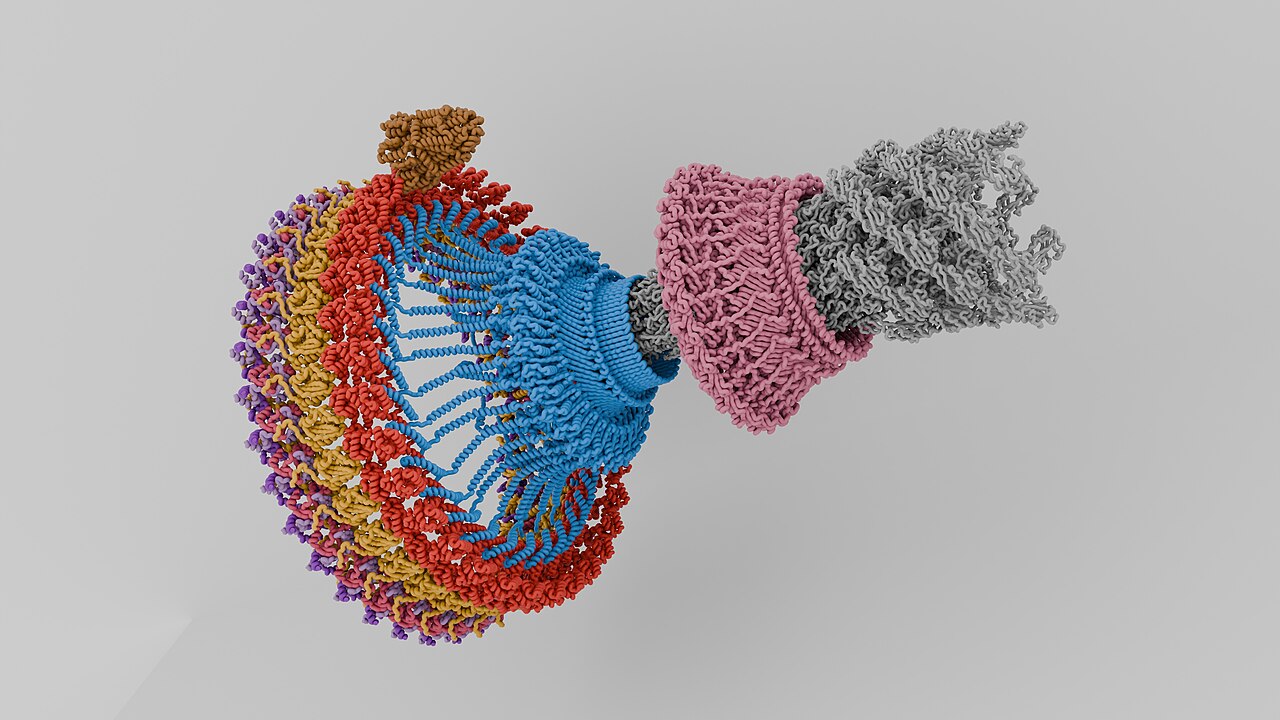
Rotary motor for a flagellum, made of atoms. Most of life’s inventions are more subtle, making them harder to recognize as machines as direct and transparent as our inventions, but this one is almost as dumb as our technology. From Wikimedia Commons.
Although highly idealized for visual clarity (reality is far messier and fails to provide such clean views), the following 3-minute video offers astounding depictions of clever biological machines at work in living cells.
The next 3-minute video provides an overview of the mechanics involved in protein synthesis from DNA—again stylized to aid meat-brain comprehension.
The point is that incredibly intricate “machines” abound in biological contexts. If it all seems too outrageously sophisticated, that’s exactly right. But that’s because billions of years of trial and error under the relentless eye of selective feedback can far outperform our synaptic struggles to understand. All these myriad mechanisms contribute to sentience: the ability to sense and react to conditions in service of survival. It’s no small feat, and too insanely complex for us to have any expectation of fully internalizing in mental form. That’s our problem, not nature’s.
That Elusive Spark
I watched a recent video of brilliant polymath Roger Penrose musing on consciousness. It is apparent to many that artificial intelligence (AI) is not at all the same thing as our experience of understanding the world as sentient beings. Large-language-model AI is an impressive, brute force parlor trick that projects a simulacrum of “thinking” (in the limited way we often define thinking) by stringing together words (or pixels in the case of images) in ways that are similar to what humans are accustomed to encountering and producing.
Penrose suspects that some key is missing that makes our thinking non-computational, suggesting perhaps the collapse of the wave function as a phenomenon in physics that cannot be algorithmically represented in a computer. In other words, life has some “spark” that can’t possibly be captured in a computer.
I completely agree, but for wholly different reasons. Digital computers lack the nuance, rich sensory umwelt, architectural sophistication, and ecological pressure/shaping to remotely compete with surviving analog tangles of insane complexity. I would not expect the gulf between computers and humans—a legitimate and quite substantial gulf—to be bridged by a single tidy idea like wave function collapse. To be clear, by calling it “gulf,” I don’t mean an ontological gap that cannot even in principle be crossed, but a distancing that is nonetheless connected in ways we don’t directly see—much like distant and dissimilar islands separated by an unseen but no-less-substantial ocean floor made of rock. The universe indeed may have found a circuitous route to construct Life out of atoms over billions of years of effort. But suspecting that a single tidy idea can solve the mystery is where we often go wrong. We try to reduce the insanely complex phenomenology to a single trick—which our brains are more prepared and eager to accept and handle than incomprehensible complexity.
Yet, it doesn’t have to be one trick. Differences between computers as we build/program them and animal cognition abound. Living beings are intimately immersed in incredible sensory input, thus connected to an experiential world in ways that computers very much are not. Living beings are shaped by stringent requirements to “think” well enough (on average) to survive at a species level, in whatever complicated interactions they might expect to navigate—up to and including social and political “calculations.” We also rest heavily on a billion-plus-year heritage in shaping complex responses to complex stimuli. Living beings learn not by imitating training sets, but through repeated cycles of experience and consequence. The first 25 minutes or so of this video exposes a stark divergence in algorithmic vs. biological thinking styles. Guess which guy I trust more? The contrast is almost embarrassing. Sutton uses a squirrel in his example, but I might even argue that an amoeba is closer to human experience than is AI (after all, we share a third of an amoeba’s genes, and 0% of a computer’s).
So, it seems that the machine-aversion fallacy (and preference for a singular defining “spark”) is borne out of an incapacity or impatience to consider that a huge—but exquisitely-arranged—collection of mundane yet highly-interactive matter can contrive (through painstaking trial and error under selective feedback and constant sensory connection to an immense and rich world) to produce behaviors far beyond the ken of pathetically narrow, recent, and profoundly isolated digital computing machines.
In other words, accounting for the enormous gulf between living sentience and industrial machines need not be some ethereal “substance” or mind-blowing quantum phenomenon. The universe is quite practiced at piling up the mundane to make something spectacular. If a mundane—but exceedingly complex—explanation is possible (in principle, even if too woolly for primates to actually pull off), why not go with it? More to the point, what stands in the way of the universe from taking that readily-available path whether it suits our preferences or not.
Redefining Machine…
By dropping the unnecessary restriction that any use of the word “machine” refers only to a technological device of human design and fabrication, one might more broadly use the term to describe any arrangement of matter adhering to the rules of physics (i.e., “mechanistic”). Set aside for now our inability to fully comprehend the degree of complexity that might emerge. We needn’t demand full understanding to believe that an interactive material basis applies.
Moral implications need not ride in with the term: a name does not impact the actual entity to which it might attach… a rose by any other name and all that. Only our narrow mental models carry these associations, unnecessarily. Language constrains and twists apprehension.
For those who are still uncomfortable associating humans or other animals with the term “machine,” is it fundamentally because you believe animals (and plants and fungi and microbes) do not ultimately derive from matter interacting via physics?
It’s fine if that’s where you are: no one can lay claim to Truth. But just recognize that such a view is probably dualism—unless you believe matter to be a construct of mind (idealism, then). If you deem matter to be real, while believing in some immaterial aspect of Life that can’t be represented by matter in interaction (via standard physics, for instance, and not some undetectable added aspect like a conscious quantum as in panpsychism), then I’d be fully justified in calling it dualism: vanilla physics plus the special sauce (dual ingredients). For a materialist monist, the special sauce doesn’t enter from an immaterial domain, but is made from “normal” (material) ingredients just like everything else: no transcendent infusions.
Some dualists likely reject the dualism label in part because of where DayKart (my term of disrespect)—and plenty of others in modernity—have gone with this view. For a dualist who believes in a “higher” plane, to call animals “machines” is to denigrate them, implicitly removing any barriers to cruel treatment. Please see that this machine-averse reaction is itself an expression of dualism: that if the animals truly are “nothing more than” matter in complex interaction, then they are not special any more—like humans presumably still are. In the dualist framing, something “special” (immaterial) is required to prevent cruelty, since it is (in this framing) impossible to be cruel to a mere machine (“inanimate” collection of matter).
This needn’t be so. As a materialist monist, it is possible to greatly appreciate the “miracle” of Life as a purely mechanistic phenomenon, which makes it not one bit less amazing and worthy of respect. Ask the newts who live around me if I treat them with respect and adoration—taking pains to protect them from modernity’s ills. For me, in fact, the prospect of Life establishing its amazingness on a material foundation only enhances my level of awe. We could never replace anything so amazing by our own handiwork, therefore are not justified in its abuse or destruction. Life is beyond our crude capabilities to fully understand or “design,” and all the more amazing for figuring out how to be in this world utilizing the matter and interactions provided on the minimalist menu.
Panpsychism as Inclusive Dualism
To repeat, believing that we possess both “inanimate” matter (wrongly assigned “inert” status) and a spark of animate consciousness (mind, soul, whatever) that is not explainable by plain materialism is to be a dualist. I view panpsychism as a sort of closeted dualism in that it rejects (under dubious authority) the notion that matter and standard physics alone can get the job done, instead requiring a companion aspect of matter—eluding any physical measurement, note—that collectively builds consciousness out of infinitesimal contributions from fundamental particles. It respects physics to a point, indeed trying to mimic the ground-up construction and emergence of something fabulous—just not by means of the physics we measure and confirm, or by any coherent set of proposed rules (no falsifiable theory). They might fool others and themselves into believing it’s not a twist on dualism, but fundamentally it requires something parallel to materialism in order to accomplish Life and consciousness, wedging an ontological divorce between “mere” matter and “life-defining” consciousness. I count two aspects, there: “Yes, material/physics is real—but we can’t make out that it’s enough and want another undetected dimension of reality to account for what we can’t understand.”
To be clear, and as mentioned in the introduction, the “authority” situation is not symmetric, as materialist monists do not assert that matter/interaction is all there possibly can be—rather asking why it isn’t enough for us, if we lack any strong case for why it can’t do the job. Who are we to reject the provided menu and “order” something more? Authority, for materialist monists, issues from the universe as directly accessed, assuming matter is real (rather than imagined, as in idealism). Materialist monists do not presume that we know better: that the universe is incapable of producing all that we experience based on the constituents and interactions on full display.
The key for panpsychists and other dualists is the dissatisfaction of ignorance. They would rather conjure/invent unbidden schemes lacking any evidence than accept limitations in our ability to track complexity using proven matter and interaction. Wanting more than materialism places affinity over economy, and comes across as an impatient grasp for a tidy explanation that satisfies the left hemisphere’s hunger for mental-model certainty. All that complexity is such an untidy headache!
Now, modern brands of dualism like panpsychism might be far more inclusive than DayKart was—extending membership to chimps, dogs, pigs, rats, birds, frogs, snakes, fish, worms, fleas, plants, fungi, tardigrades, amoebas, and bacteria, for instance. Well done, there. If the result is to curtail cruelty to life and end modernity’s human-supremacist reign, I can’t complain too loudly. Indeed, such groundings might offer a viable path for people so inclined to drop modernity, human supremacism, and any sense of separateness. Except minds are still special…
My residual concern is that such a view is still fundamentally supremacist: erecting artificial barriers to form “the club.” The “spark” that separates us from mere matter is some transcendent quality that presumably comes with privileges. By placing so much value on consciousness that it must require a special “substance” to instantiate, dualist views also tend to preserve a hierarchy of degree of this obviously precious phenomenon called consciousness that happens to place humans at the top of the (imagined) scale. This feels like the opposite of humility, and has a difficult time squaring with animistic reverence for “inanimate” arrangements of mindless matter like rocks and rivers and mountains. All the same, it may be one of several useful bridges to get us toward a better place.
In the next installment, I’ll address the “reductionist” charge often leveled against materialism.




Comments