

Someone asked, What is the meaning of life?
Here’s my reply.
Usually, when we hear questions concerning “the meaning of life,” we tend to assume two things about the question.
1. “life” refers to human life taken generally and broadly, rather than narrowly focused upon a particular human. So we don’t tend to think it is a question about life, generally, in the biological sense of “life”
2. We tend to assume that “meaning” refers to sense 3 here, not the other senses: https://www.merriam-webster.com/dictionary/meaning So asking about “meaning” is asking about purpose and significance to human life, generally. It’s also a value question, usually. “What is the value of human life?” or “What does it mean to lead a good life?” or “How can I live a life with value?” or “How can I find value in existing?”
So this will be my approach to answering this question.
I tend to consider the notion of the meaning of words, events, etc., and “the meaning of life” as together comprising a sense of the meaning of “meaning”. Meaning can be understood in this combined sense, and when people ask “What is the meaning of life, they tend to be asking about both senses together. This, too, will be my approach to answering this question.
I believe the question is stated wrongly, or, more precisely — unhelpfully. When we ask What is the meaning of life I (emphasis on the) we are asking for but one single meaning, or meaningfulness, to life. So a much, much better question to ask is “What are some of the meanings of life?” — because “the meaning of life” cannot be helpfully or usefully constrained to a single “meaning”. Life’s meaningfulness isn’t singular but multipicitous. It is not merely multiplicitious, it is multiplicitious in the extreme, in that the meaning of life is found in myriad particulars, not a very few.
Even when we understand that asking about the meaning of life is a misdirected question, because meaning in life is multiplicitious, we’re only at the beginning of transforming our question on the basis of it being poorly stated at the outset.
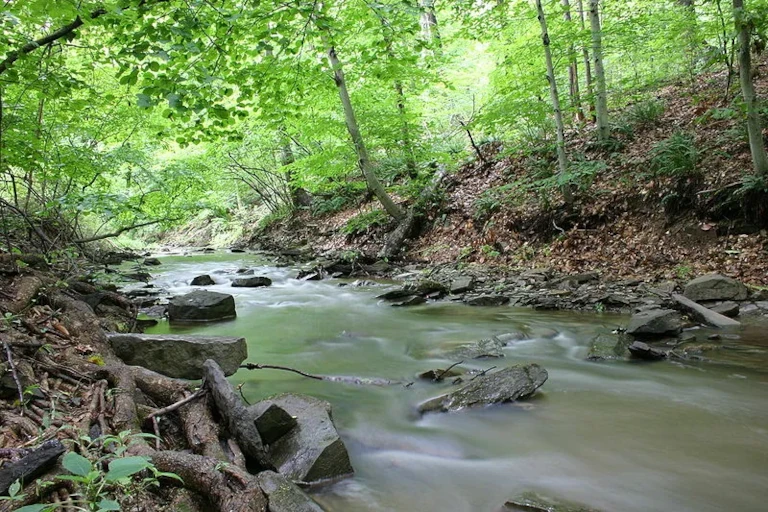
Let me begin to explain. Suppose I were to ask you “What is the meaning of a forest?” How would you respond? You might ask, “But which forest?” And that would be good! Not that there’s anything wrong with wondering about the meaning of forests in general, but forests in general are an idea, whereas forests in particular are comprised of actual trees, ferns, fish, worms, soil, bacteria, creeks (brooks), etc. I ended my list short. I could list what is found in forests all day long, for forests are comprised of almost infinite things and beings.
So part of the meaningfulness of a forest is its near infinity of things. But all of those things are intricately, and intimately, related — intertwined, interwoven. And when you are in the forest are you also intertwined with and interwoven with the forest? If you are — and you are! — are you aware that you are intertwined and interwoven with the forest? Just how aware are you of this intertwinedness? If you are deeply, profoundly aware of this intertwinedness, this experience of intertwinedness is itself a very large portion of the meaningfulness of forests, or of a particular forest.
I can tell you from experience that it’s possible to “fall in love” with a forest, for this very reason. The sense of being separate from the forest is the invitation a forest offers on account of it having the nature of a forest: interwovenness, intertwinedness, near infinitude. A forest — a true forest, not a tree farm — is (in part) an invitation to fall in love. Whether we accept this invitation is up to us. So part of the meaningfulness of a forest is this invitation. Can we perceive this invitation? Does it become palpable and real for us? If we cannot perceive or receive the invitation, it has still been sent, as we are now in a forest and have been invited to fall in love whether we know it or not.
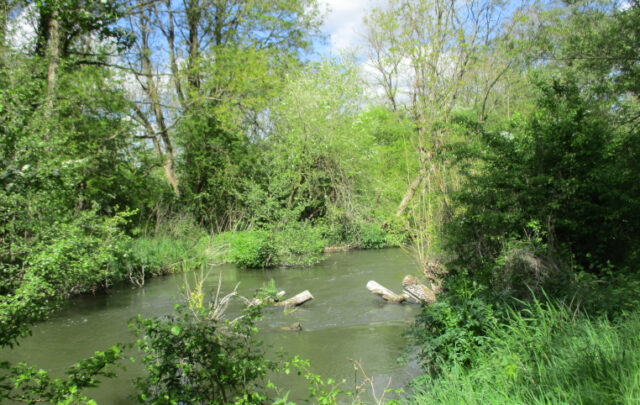
What I said about a forest can be said about a lake, a pond, a river, a creek, an island… any place where there is aliveness. It is the aliveness of a place which invites us to fall in love. So part of the meaning of life is found in the fact that we, as beings of place, are perpetually being called to love the places which are worthy of such love.
Meanwhile, there may be people in the places where we find ourselves. These, too (and two) are invitations to fall (or rise) in love, as are the animals and plants, etc., which inhabit these places.
Love, too is about as infinite as a forest. That is, we can learn as much about a person as we can learn about a forest, a river, a mountain. And our relationship with a person can intertwine with our relationship with a forest, a mountain, a river. So the multiplicitious complexity compounds, because all are interwined. So it isn’t possible to arrive at a final comprehensive understanding, since we’re being drawn deeper into love as we’re being drawn deeper into discovery, learning and appreciation — including the growing of our capacity for appreciation and understanding. There can be no end to this process, as it is near infinite.
So part of the multiplicitous meaning of life is that life is ultimately incomprehensible, in the sense of being able to apprehend it, to grasp it in its totality, as it is too multiplicitous for such grasping. Rather than despairing of the ultimate incomprehensibility of life, life extends us an opportunity to appreciate this vastness of scope, this intricacy and multiplicitous profundity. Not being able to grasp the totality of life is a wonder, and wonder is an invitation to love.
When we love life, this love provides ample meaningfulness. More than ample. Meaningfulness overflows. It cannot be contained. It is … well, infinite. In all other instances of my reference to infinity, I said “near infinite,” because technically that’s true. There are not infinite things and beings in a forest, nor infinite perspectives on these, but there is certainly near infinite variety there. But love itself is actually infinite in its potential of scope. It has no containing limits. So it is infinite.
The meaning of life, for me, is its invitation to infinite love of life. That invitation is always being offered by this very world in which we dwell. And so part of the meaning of life is to listen for the invitation, and be present to the invitation. But it is not always a passive listening. Sometimes we have to meet the invitation with a trip to a forest, or to move our home from the city to the forest. Who knows what might happen to us as we turn and meet the invitation? We cannot know. But we can turn and meet the invitation, as best we can.
Love has both a receptive and an active aspect. The receptive aspect of love is mostly just a matter of appreciation. We appreciate what we love. But there is also an active aspect of love, which manifests as care — caring for, nurturing, protecting, seeking to be of benefit to. Each has their place and time. Sometimes it’s good to just bask in appreciation. At other times we must fiercely protect that which we love.
There is no the meaning of life. Life is bigger by far than that! It’s meaningfulness is infinite!


Comments
We changed commenting systems on September 10, 2026 as part of a site-wide functionality and security upgrade. Your past comments have not disappeared, and you can still log in with your old Disqus account credentials if you wish. Contact us with any questions.
When we approach the “meaning of life” from an ecological perspective, the question becomes much simpler. For all life, humans included, the meaning of life could be expressed as the prime directive: survive and reproduce. But, human beings have a way of complicating things. For example, the “value” of life, both human and other. In other non-human life forms, the value of life is the prime directive. There is a fundamental unity of the how (action) and why (perception) of living. But for humans a schism has developed between the prime directive and the value of life. This separation is rooted in the infamous mind-body duality and the complexity of human language. For most humans living in the industrial growth society this schism has shattered the unity with the natural world. The value of life has become an abstract, thinking exercise all about concepts and words quite separate from “values” as expressed in the way we make a living in the ecological sense. How we meet the needs of survival; food, shelter, safety and community necessary to reproduce and hopefully thrive. The value of life is expressed not in hollow words but in actions – how we live and what is important to us.
PattiMichelle & Danielle –
While all of the sciences originated out of a common ancestry in philosophy, philosophical inquiry is a little different in shape and form than scientific inquiry. It makes use of a broader spectra of means of inquiry, I’d say, and often uses more of our faculties of understanding, often in integration with one another — e.g., reason/logic, intuition, feeling, sensing, etc.
Because (in my opinion) philosophy has traditionally had an open door for the more poetic sensibilities of feeling and intuition, and an open door to sensing vis-a-vis feeling and intuition, it can make sense to invoke the human experience of love (or loving-kindness) and of belongingness (etc.) in our inquiry into “meaning”. But this parts way with traditional scientific inquiry in modernity. And that’s just fine with me. Philosophy, like language generally, often makes use of evocation and invocation as a means at pointing at experiences which a scientific sensibility, as traditionally understood in modern science, isn’t usually given much scope for.
I mentioned the notion of “the meaning of a forest” (and I’m a deep lover of forests and rivers), to hint at how love and loving can provide an experience of meaningfulness in life which is admissible in the arts, in poetry, and in philosophy — and one day may gain a bit more traction in the sciences, which are always rooted in philosophy, anyway.
Does science have “meaning”. I think it does. It has value and purpose … and also poetry and love. But you’ll be hard pressed to get some scientists to say so publicly!