


Hansen’s warning
June 23 is a significant date in history, when climate scientist James Hansen went up on Capitol Hill to warn us human-caused climate disruption had arrived. That was 1988. Fossil fuel executives, who knew it was true because their own scientists had told them so, instead swung into a full-scale disinformation campaign that blocked climate action on the scale that would have been required to avert climate catastrophe. (Inside Climate News Editor David Sassoon tells of how whistleblower Daniel Ellsberg, who just passed away, spurred the investigation that uncovered that story.) Thirty-five years later, the oceans are boiling, a heat dome is searing Mexico and Texas, a monster El Niño is growing in the Pacific, and floods and fires are breaking out all over the world. We should have listened to Hansen and not the oil company criminals.
It appears we are heading for the fourth super-El Nino in 40 years, the condition in which the eastern tropical Pacific heats up and transmits extreme weather effects around the world. Both 1983 and 1998 were 2.2 degrees C anomalies. 2015 was 2.5 degrees C. The 2023 El Niño is projected at a monster 3.2 degrees. Says Eliot Jacobson,” The Australian Bureau of Meteorology has had both the most extreme and most accurate forecasts of the developing El Niño. But this forecast, just released, is so extreme it’s hard to believe I’m seeing it.”

I wrote an article for Sierra Magazine back in 1998 connecting the two super-El Ninos in 1983 and 1998 to global heating. It was used to inform Al Gore’s 1998 press conference on the record heating that year. What I learned then was that the western Pacific is the world’s great solar collector. Most incoming solar heat is absorbed in the oceans and the western Pacific is the biggest absorber. El Niño is the discharge mechanism. So it’s logical. The more heat, the hotter the El Niños. A 3.2 degree anomaly is catastrophic. It will ramify around the world in intensified droughts and wildfires in some places, and deeper drenchings and floods in others.
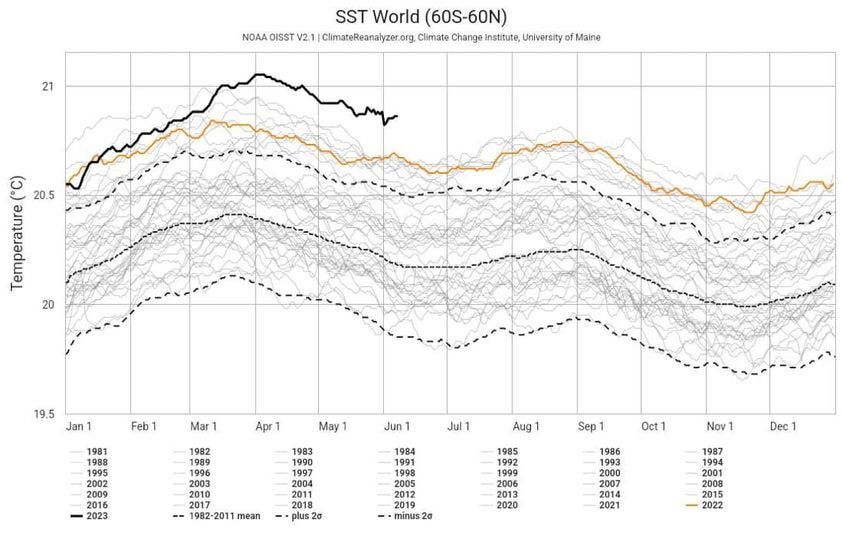
Even as El Niño emerges, oceans around the world are witnessing record sea surface temperatures (SSTs) as the chart below from the National Oceanic and Atmospheric Administration shows. This is no surprise, as around 90% of the energy imbalance about which Jim Hansen continues to warns us accumulates in the oceans. It will eventually make its way into the atmosphere.
Who Dunnit? It all comes home
It’s pretty clear who is most responsible, as this graphic from the United Nations Environment Program demonstrates.
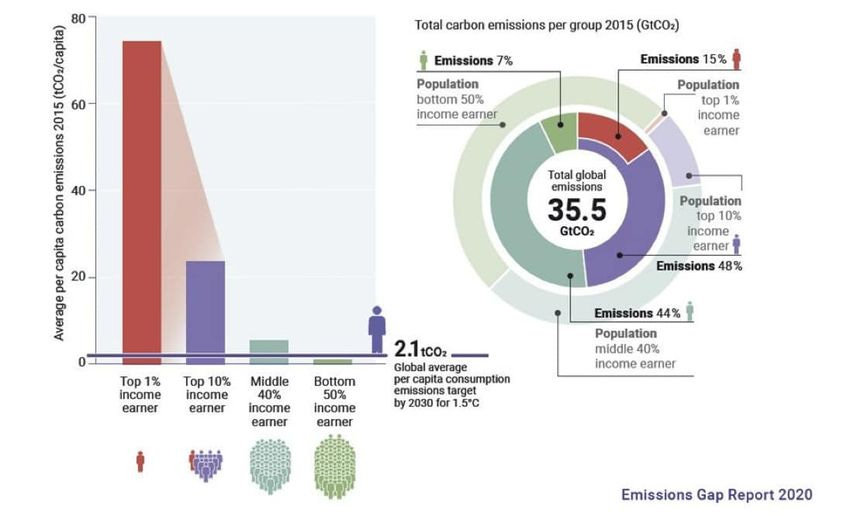
The people who did the least to cause the problem will be the ones who most suffer. Even so, it eventually comes home to the centers, as this shot from the recent smoke event on the East Coast shows.
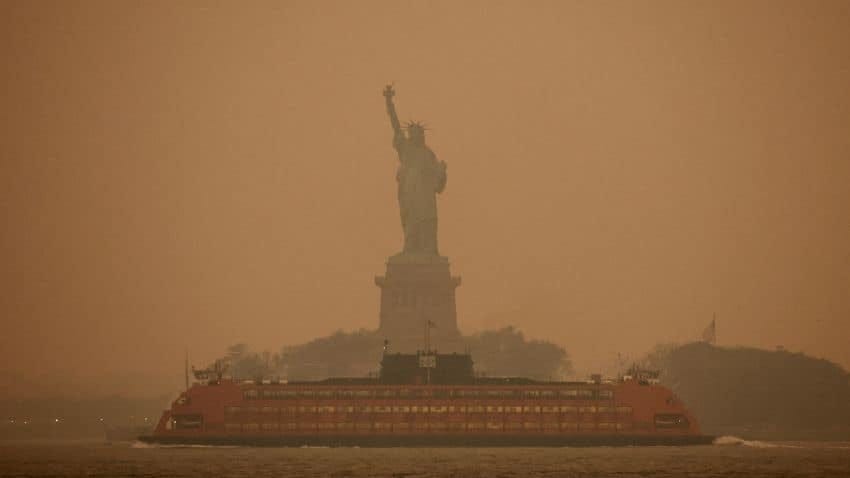
Yearning to breathe free. Credit: Quebec Canada Wildfire Smoke Consumes New Jersey and New York City June 7 2023 by Anthony Quintano is licensed under CC BY 2.0 / Flickr
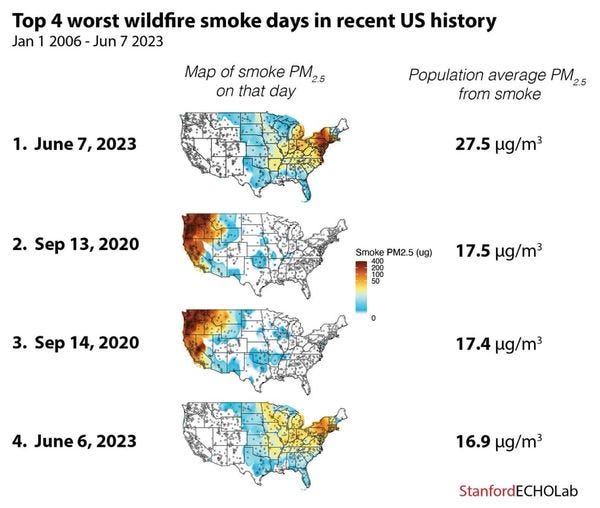
The event generated the first and fourth worst wildfire smoke days in recent U.S. history in terms of severity and population affected, as this graphic from a Stanford study reveals. I lived through #2 and #3, so I know what that’s like.
Meanwhile, scientists are issuing more warnings.
“It is now too late to save summer Arctic sea ice, research has shown, and scientists say preparations need to be made for the increased extreme weather across the northern hemisphere that is likely to occur as a result,” The Guardian recently reported.
“Analysis shows that even if greenhouse gas emissions are sharply reduced, the Arctic will be ice-free in September in coming decades. The study also shows that if emissions decline slowly or continue to rise, the first ice-free summer could be in the 2030s, a decade earlier than previous projections.”
Ultimately, the result of failing to act at the scale and scope necessary could plunge the planet into chaos.
“The impact of human activity on the Earth system could result in unpredictable chaos from which there is no return, physicists have calculated,” Science Alert reported.
“Using a theory conceived to model superconductivity, a team of physicists led by Alex Bernadini of the University of Porto in Portugal showed that, after a certain point, we will not be able to restore equilibrium to Earth’s climate.
“A finite amount of human activity could result in a Hothouse Earth from which there is no return. They detailed their work in a paper made available in April 2022 on the preprint server arXiv that remains to be peer-reviewed.
“‘The implications of climate change are well known (droughts, heat waves, extreme phenomena, etc.),’ physicist Orfeu Bertolami told Live Science last year.
“’If the Earth System gets into the region of chaotic behavior, we will lose all hope of somehow fixing the problem.’”
Are we getting it? Time to consider alternatives
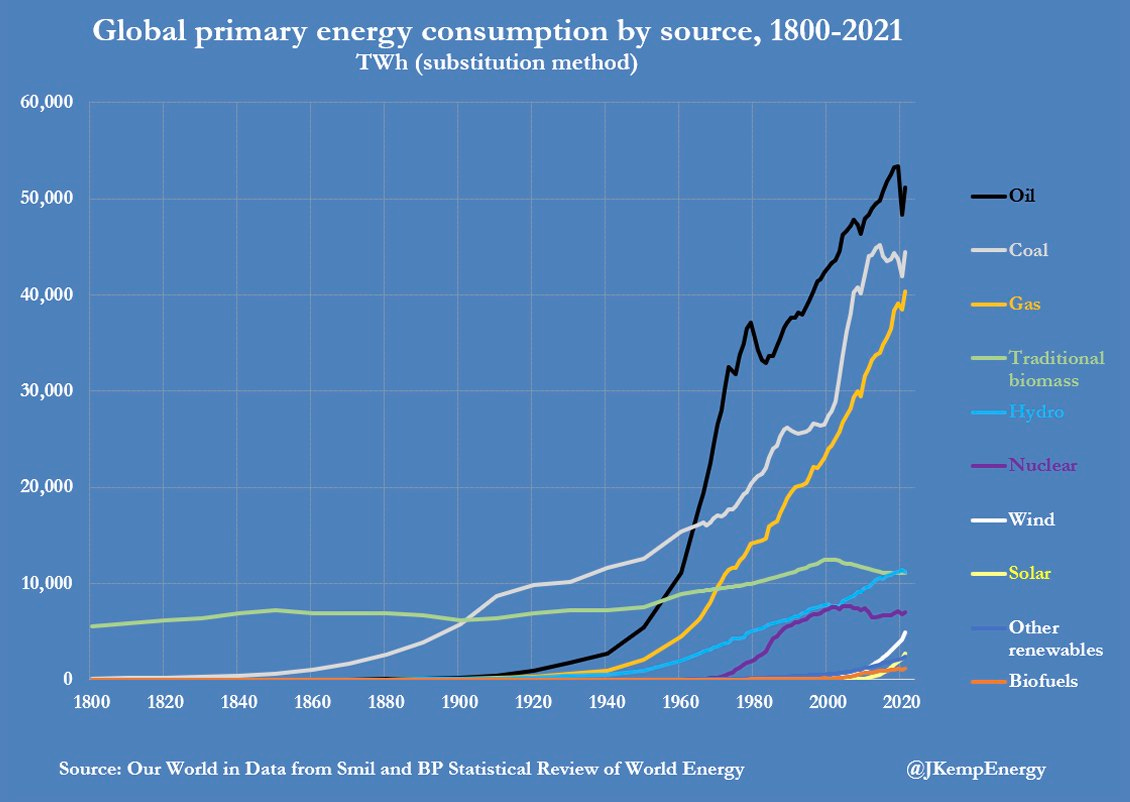
It is hard to say that as a world we are really serious about doing anything about climate pollution. At best renewables have marginally slowed the growth of fossil use. But India and China are still building coal plants like mad, jetliners and conventional internal combustion vehicles continue to be mass produced and will remain in service for many years, and global building space and materials use continues to explode. In my so-called climate leader state of Washington highways are being expanded and a new international airport is being promoted.
This is why degrowth advocates such as Richard Heinberg tell us we need to consider fundamental economic assumptions. It isn’t just the climate, but the unraveling of ecosystems around the world. Heinberg and fellow author Asher Miller offer an analysis and path forward in their new report from Post Carbon Institute, Welcome to the Great Unraveling: Navigating the Polycrisis of Environmental and Social Breakdown.
“Strategies that seemed to make sense before the polycrisis, such as efforts to grow economies, will need to be replaced by different ones, such as efforts to build resilience,” Heinberg writes. “Fortifying resilience at the community level will be especially important: as global supply chains grow brittle and shatter, humanity will depend more upon local economies for survival and opportunities to thrive. Cooperative strategies to ration scarce resources and reduce inequality will also be required so as to defuse conflict and ensure optimal outcomes for as many as possible.”
I confess, as someone who has been writing about climate disruption almost since Jim Hansen went up on Capitol Hill, and who has worked to bring on climate solutions much of recent decades, I have been skeptical of degrowth. It has been hard to see how it can be reached through the practical politics of the day. But decades of seeing the problem only become worse while actions to address it have hardly made a dent drive me to believe the only practical solutions are radical. We need to change course as a world, and quickly, or leave a legacy of chaos to our children. We have to consider degrowth.





Comments
Welcome to the new Resillience commenting system!
We have moved from the former Disqus commenting system to a new system as of September 10, 2026.
We made this change because of privacy concerns regarding Disqus. It's also part of a set of changes to bring more services to the Resilience community under a single login: commenting, (coming September 2026), and online courses (coming 2027). Unfortunately, your old Disqus comments may not reliably link to your account in this new system. Please contact us if you have any questions or concerns.
Well, duh.
We should have listened to Meadows, et al.
From the perspective of the West – the race now is between Climate-Breakdown-deaths-induced awakening (of the population), and those who foment civil wars. Which will win? The only chance for what’s left of a soft-landing is the former.
Of course, adopting slogans isn’t much.
PattiMichelle –
I’ve been noticing a tendency, among a number of folks, to be a little harsh with authors and other commentators in here — for some time now. Saying “Well, duh” can be taken as a little harsh, perhaps? It’s true to you and I that the title of this piece declares the obvious, but Patrick is my friend, and I see he’s not getting as much appreciation for his work as it deserves, generally. Sometimes it is necessary to restate the obvious — said George Orwell.
Also, I noticed your name does not appear in the list of contributors to Resilience. Why is that?
James: When you say Patti is not a contributor do you mean she gives no money, or that she is not an author? My estimate is that PattiMichelle Sheaffer contributes a professional informed POV and that is important in itself. People outside Post Carbon Institute connections can still be considered peers and reviewers of Resilience content. Take me for example: I have advanced degrees but live on a retirement income of $800/month because I am a tax protester and dissident who was denied my pensions and recorded a taxable income averaging $7,000/year. Most of my employment was either voluntary or stipend. I am physically disabled and live in a shack. Are my comments then worthless? I’m way ahead of the curve on degrowth and subsistence living. But I don’t want to publish an article and obviously have no disposable income.
Despite the situation that Patti has likely earned a comfortable income from her career I think it is unfair that she be compelled to “join up” to share ideas. Reading just a few of her recent posts has been educational for me though I don’t always agree with her conclusions. She has her personal reasons for not jumping on the bandwagon that she need not explain to us.
As for her “Duh” I take it as editorial and collective, not in disapproval of Patrick Mazza or his writing. There are much stronger expletives that could be properly applied to inaction and ineffective action to stabilize climate. People with wealth, connections and power are mostly to blame, because few governments have any democratic tendencies or public inputs. My blames might differ from yours or Patti’s because of my focus on Anthropology and Political Economy, while your interests are elsewhere. Duh is a colloquial way of expressing regret and disappointment that we all should concur on. I actually think Patrick’s article is a weak summary, but he’s writing for a generic audience. I was reading Dennis and Donella’s work in 1980, though I expect Patti gained her perspective from her multidisciplinary investigations. This is a woman who designs and builds scientific instruments, someone not to be scolded or sneezed at. And if she expects better from any of us, that’s OK with me.