


Since the start of the COVID-19 pandemic, Russia’s invasion of Ukraine, and the resulting disruption of multiple global supply chains, policy think tanks have increasingly adopted the term polycrisis to signify humanity’s destabilized status quo. The World Economic Forum’s 2023 Global Risk Report uses the newish word 13 times in 90 pages. Scholars from a range of disciplines (including Columbia University historian Adam Tooze) have written about the polycrisis, and both Cascade Institute and Omega Institute have published papers and reports on it. The Cascade Institute notes that “a global polycrisis occurs when crises in multiple global systems become causally entangled in ways that significantly degrade humanity’s prospects. These interacting crises produce harms greater than the sum of those the crises would produce in isolation, were their host systems not so deeply interconnected.”
Evidence of polycrisis is usually separated into two buckets—environmental and social. Signs of environmental crisis include climate change, the disappearance of wild nature, relentless resource depletion, the increasing chemical pollution of air and water, soil loss and degradation, and fresh water scarcity. Evidence of social crisis includes increasing economic inequality, poverty, racism and other forms of discrimination, the rise of authoritarianism, and impacts of rapid technological change (such as automation).
Our current set of crises can be described as a polycrisis because self-reinforcing feedbacks between ecological breakdown and social breakdown are strengthening and growing more numerous. For example, climate-driven human migration presents challenges to political systems while also eroding traditional cultural norms that support environmental stewardship. Societies in the midst of social crisis, and ones turning toward authoritarian regimes, are seldom able to muster efforts toward resource conservation, emissions reduction, and habitat preservation; indeed, under such circumstances, past efforts in these directions may be undermined.
All of this is happening in the wake of a couple of decades’ worth of historical studies that show societal collapse to be a normal, predictable, and even inescapable periodic occurrence throughout the past few thousand years. It appears that societies tend to become more complex, develop new technologies, accumulate wealth, and grow more unequal over time. Their leaders start to quarrel with one another, weakening overall social cohesion. Finally, after two or three centuries of this, almost anything can push a society over the brink—a natural disaster, resource depletion, war, insurrection, epidemic, or financial crash. Scholars who engage with the accumulating literature on societal collapse can hardly help noting the relevance for today’s world. We’ve built a global civilization of unparalleled complexity, wealth, and inequality, all based on depleting, polluting fossil fuels. What could go wrong?
An early warning came in 1972 with the publication of The Limits to Growth, a report by MIT system dynamics scientists on their efforts to model the likely future interactions between population growth, consumption growth, and resource depletion. Their computer-based scenarios suggested, under business-as-usual conditions, global industrial society would likely collapse during middle decades of the 21st century.
A new report by Post Carbon Institute (PCI), Welcome to the Great Unraveling: Navigating the Polycrisis of Environmental and Social Breakdown (full disclosure: I’m one of the authors), seeks to build a coherent narrative about the roots of the polycrisis, the signs of its arrival and evolution, and why we should be thinking differently about the future. When confronted with evidence that our collective path is unsustainable, many of us tend to jump to “all-or-nothing” ways of thinking, sometimes framing our future in simplistic terms as “the end of the world” or “apocalypse.” But according to the report’s authors, this tendency is unhelpful. While a complete and sudden end of humanity is theoretically possible via nuclear war, our more likely future will consist of decades of social, economic, political, and ecological turmoil punctuated by periods of rescue and recovery. There is still considerable divergence between best- and worst-case scenarios, and we still have agency to affect outcomes.
According to the PCI report, we should be spending far less effort building upon expectations of a future that looks much like today only with more technology, mobility, and wealth; instead, we should devote our collective brainpower to questions like, How does a civilization downsize gracefully? Or, What have we achieved that our distant descendants would like us to preserve for them?
Maybe we’d be better off avoiding the word “collapse” altogether, since it tends to be disempowering. Nate Hagens, who interviews polycrisis experts on his podcast, terms the era we are entering “The Great Simplification.” Regardless what we call it, this will be a time that calls for new attitudes and behaviors. Strategies that seemed to make sense before the polycrisis, such as efforts to grow national economies, will need to be replaced by different ones, such as efforts to build resilience. Fortifying resilience at the community level will be especially important: as global supply chains grow brittle and shatter, humanity will depend more upon local economies for survival and opportunities to thrive. Cooperative strategies to ration scarce resources and reduce inequality will also be required so as to defuse conflict and ensure optimal outcomes for as many as possible.
If humanity descends into blame and desperate efforts to maintain a status quo that by its very nature cannot persist, the future looks dark indeed. Imagine what a young person a few decades from now, living in a depleted and ravaged world, might feel while looking at surviving images of today’s “influencers” enjoying comfort, convenience, and privilege on an epic scale. However, if we work together now to build a truly sustainable way of life, maybe future generations will have at least some reasons to thank us.
Image credit: Glitch, via pixabay.com.





Comments
We changed commenting systems on September 10, 2026 as part of a site-wide functionality and security upgrade. Your past comments have not disappeared, and you can still log in with your old Disqus account credentials if you wish. Contact us with any questions.
To help people visualize the future, I have attached an image.
The Harvesters by Pieter Brueghel, painted 1565. Apparently it was not all work and no rest in the Middle Ages either, they did have plenty of Holy Days to feast and enjoy themselves.
Up until antibiotics were invented, almost half of all those who died, died from just infections of unknown etiology. Dying was often considered noble – “going beyond the pain” – as in there was nothing medicine could do…
It’s funny – apparently the most important medicine that doctors had before the invention of antibiotics was morphene – the decrease pain, mostly for those dying.
Ergo – medicine may be one of the main things we want to salvage during the collapse. Additionally, nothing like modern medicine has ever existed before. I’m a physicist but I don’t think sciences like the Standard Model of particle physics will be very important during collapse, for instance; whereas the ability to properly diagnose an infection, will.
Subjectively, I agree. Objectively, medicine has been a huge contributor to the exploding human population level. I can’t see that there would be great support for eliminating the medical industry but, it seems to me, that would be the surest way of halting, and reversing, the rise in human population. I wouldn’t want to eliminate knowledge of pain control, though.
Discussions of how and who to kill (the very old and very young, the main beneficiaries of modern medicine) seems really mean (is that the right word?). I consider myself of instrumental character, but even I can’t think about how and who I would kill without my blood freezing.
But the weight of evidence is that the only people in a position to save the future are the top 20%-30% of the Affluent (the consumer-class, if you will). That’s just fact. How we respond is the ongoing experiment we (including PCI) are engaged in, and which our grandchildren will suffer for. Physically, the only option is to shut down the consumption of the top 30%. Period. Known from first-principles physics.* This would halt warming (Rahsmtorf [2022]) – and de-accelerate related issues, like food production decreases, fires, superstorms, etc. But nobody (yet?) knows how to halt the consumption of the top 30% except my major financial catastrophe.
(Note that just perceiving the actual threat realistically is somewhere between an extreme challenge and impossible.)
I feel like PCI’s current recommendation is essentially Roosevelt’s (during the Great Depression) – along the lines of: “…start working, and do what you can, with what you have, where you are.” (one of my first bosses at Hughes Aircraft Company had lived through that and recalled that theme to me, one day – it became a life philosophy to him. Mr. Bill Lent)
——————-
* It’s easily calculated with thermodynamics of dilution (Gibbs’ enthalpy) that it’s impossible to remove CO2 from the air fast enough using available energy and metals resources. The widespread erroneous assumption, used to justify various air-capture schemes, is a belief that “technology” and “engineering” can accomplish what is known impossible to thermodynamics and physics – this is a form of ignorance, willful or not.
Hard to disagree with any of that. However, though I’m not sure which Rahmstorf paper you mean, the only thing that would halt warming is a cessation of all emissions (assuming Hansen’s new paper doesn’t alter current understanding), not just the emissions of the top 20%-30%. Of course, as you note, even that scenario will not happen, without a collapse of economies. Consequently, population will remain part of the predicament. With regard to who lives and who dies, I’m not suggesting such decisions ever need to be made. If nature were left to its own devices, that is, no medical interventions (though I still think pain relief could be argued as OK) except, perhaps, voluntary euthanasia, then nature makes the decisions. I’m not personally in favour of it but, it seems to be the only objective way to reduce population without creating an imbalanced demographic.
I don’t think even people in the 16th century would recognise what would be a sustainable society. Not that it mattered as much then with so few people by comparison with today.
Sure, folks lived in their own feces. They didn’t know what germs were. Often, to drink the water was to die. Europe was exhausted by the 1500’s or thereabouts. Much of Africa and India are like that now…
“… folks lived in their own feces”
Some while back I was researching (secondary) about the history of what is called “daylighting creeks”. That’s when creeks which were buried in pipes and culverts are brought back to the surface again, as happened with Strawberry Creek in Berkeley, California. This is when I learned that the primary reason that folks buried urban creeks in this way, back in the day, was because urban creeks were treated as a sewage disposal system(!). They were buried because the stench was unbearable. When modern water treatment plants and piped sewage emerged it was then possible to consider “daylighting” urban creeks — though too often they had been built atop of, making such activities prohibitively expensive for cities.
I was shocked to learn that folks were flushing their toilets into urban creeks not so very long ago.
That sort of flushing is happening right now to, maybe, 4 billion people or more. Try visiting Mexican coastline towns and see rivulets of raw sewage flowing into the ocean.
Why shocked? Where else is ‘away’ physically, when property-rights curtail?
We still remove human wastes by flushing; ‘down’ and ‘away”. Not so much different, and just as vulnerable if societies collapse to the point they don’t maintain infrastructure.
Shocked because creeks and rivers have always been sacred to me since I was but a wee lad. So flushing our toilets into them seems to me an obvious form of avoidable madness. It was avoidable even when there were no modern wastewater treatment systems, since clearly there are alternatives of myriad kinds, from composting toilets to outhouses and beyond.
That’s the long distant future… after several billion bodies have been buried… The near term future boggles the imagination.
It won’t work that way. The financial system may well be the first casualty; if not it will be a close second. It is predicated on exponential growth, and is already 15 years past any link to real growth – arguably longer.
And without he financial system – what is ‘moneyed’? Their accounting programme just went out the window – and that leaves them friendless, and mostly skill-less.
Not that you and I will be ‘affording’ anything either. We’ll be local-producing, locally-trading, swapping, sharing.
Possibly – let’s hope not. Money has been around for many thousands of years (evidently a large-scale barter system has never actually existed, although inter-polity trading has). Possibly, 5,000 years ago (Epic of Gilgamesh time frame) there was no money? Anyway, a key part of the saving of any “good” from civilization (such as medicine) will be recreating a functional financial system – and a key ingredient is resilience against human “cheating” (a euphemism) – and, of course, the reversion to war/raiding/killing to obtain food/resource.
The farther back we go in history, the lower the proportion of “the economy” was mediated by money. Not so very long ago, overwhelmingly most people met their most basic needs without money being used for exchange. Most economic activity was self-provisioning and outside of the “formal economy”. Money gradually came to mediate more and more exchanges, slowly, over long spans of time. And now we have today — where money mediates almost all exchanges and “economic activity,” especially in “developed” nations.
Money (coinage) was required for amassing large military presences, and so those who wanted to grow vast armies took measures to make more people dependent upon coinage for their existence. (See: The End of the Megamachine – A Brief History of a Failing Civilization. Scheidler, Fabian.)
I don’t think that’s actually true. It’s true that many historians *assume* this – but there apparently isn’t really any evidence for money not being used until, maybe 5,000 years ago there are hints money wasn’t used.
I said nothing about money not being used. Money was used for a long time. It just wasn’t used nearly as much in the long ago (ancient world, or even hundreds of years ago) as it is used now. And that’s because overwhelmingly most people lived in local subsistence agrarian societies where self-provisioning of most necessities was the primary mode of economy. Money wasn’t much needed, so relatively little used. See, for example, https://en.wikipedia.org/wiki/The_Great_Transformation_(book)
Well, see Tainter and Tainter/Patzek – both Egypt and Rome (less is known about the details of the Bronze Age BCE) – vast armies were the order of the day thousands of years ago. There isn’t much history before this – so …??? It’s well-understood that almost 2000 years ago, lack of money (specifically, coins – mainly the inability to pay troops stationed all over Europe, North Africa, etc as well as wage periodic large-scale warfare) was probably the major reason for the fall of Rome about 350-ish CE, although plagues and food shortages were big parts of it, and taxes drove the whole thing because Rome had run out of wealthy accessible nations to conquer/loot (for their gold, etc). So I’m not understanding the argument that money was even slightly less important a long time ago. It may even have been relatively more important than now because there was much less consumerism in the Roman era than now (the prohibitive cost of large-scale transport being cited).
https://youtu.be/G0R09YzyuCI?t=1530
Scholars apparently had been arguing over barter being somehow the pseudo-money in prehistory, but apparently that’s been laid to rest, as the only solid body of evidence appears to be of intergroup trade (as opposed to barter), and there’s a good body of evidence that intergroup trade tends to lead to raiding and resource-war between trading-partner groups.
“So I’m not understanding the argument that money was even slightly less important a long time ago.”
It’s all about the context. For ordinary people in most parts of the world, up until fairly recently in history, most basic needs like food, shelter, water, etc., were accessed within local agrarian subsistence economies participating in community self-provisioning — e.g., growing and foraging food for one’s family and neighbors outside of the “formal” money economy.
So money wasn’t all that important for most ordinary people. It wasn’t so very necessary as it appears to be to us today — for everyday, ordinary people. This was largely so up until the capitalist form of the market economy emerged. (See: e.g., Polanyi, The Great Transformation (1944), The End of the Megamachine, Scheidler (2020).
However, money (coinage) was of crucial importance to the militaries of ancient and premodern empires and colonizing nation-states, mainly, as you say, to pay soldiers and mercenaries. Building and maintaining empires requires a lot of coinage — silver and gold. But, according to Scheidler, it was not so easy to impose reliance upon money among the ordinary people prior to capitalism’s emergent form of market economy … which sought to eliminate subsistence agrarianism in order to enslave people in a money system and its wage system.
recreating?
The system allows people who have never met, to trust that each will honour their offer. Thus you can buy from someone in China.
If that seizes up – and it can’t not, given the reduction in energy reducing the underwrite – you reckon a replacement system could be negotiated? Using an internet nobody is being paid to maintain? Good luck with that.
I think our trading will all of a sudden become very, very local. If we keep numerical tabs on it, fine. t I suspect a lot of us will just give and take in Brownie-point fashion (if that saying works in the US).
Apparently, the major problem with trading is that it encourages raiding. (If you really want something the other tribe has, it’s a lot easier just to take it. Documented techniques are outlined in Keely’s book, below.) There’s firm archeological evidence of this going back at least 8,000 years (that is, before the rise of civilizations) – in the Americas as well as Eurasia – replete with mass graves of obviously slaughtered, scalped women and children. Jared Diamond also cites examples of islanders using war/raiding-killing as a population control when there were critical food/resource shortages.
So the good old days are not desirable.
See Keely (and the recent update to this research) https://en.wikipedia.org/wiki/War_Before_Civilization
There’s a huge theme of this going through almost all PC publications on how we’ll get along kumbaya-ish (or at least tolerate each other) during collapse. There is no evidence at all that this will be the case, for much of the US anyway. The rosy images about relocalization are centered on the wet/lush US East – the dryland, desert midWest and SouthWest don’t have a chance of feeding themselves sans the tech infrastructure of civilization – so raiding could well be the norm w/o the Rule Of Law and sans food-delivery trucks/highways, at least until most of the humans there either become climate/collapse refugees or are killed-off.
This sounds really lousy.
Realistic fixes, anyone? …anyone?
How do you relate your third-last sentence – which I agree with fully – with your previous post? You can’t say population isn’t a factor, while agreeing there will be massed die-off .
Yes, that can be said because it’s a one-way dependency due to the uneven distribution of carbon footprint (consumption). Those driving the polycrisis are the Affluent – the top 20%, so a die-off of the poorest 4 billion humans won’t slow Climate Breakdown at all, so nothing changes. On the other hand, if the top 20%-30% can be stopped from consuming (halting carbon emissions), it will halt warming. And that can only be done by halting consumption (of the Affluent) that is causing breakdown. (i.e., atmospheric carbon drawdown cannot work, mainly because of thermodynamics, even though many are trying hard to sell it… presumably for ideological reasons or to increase their own carbon footprints…)
But it is worth knowing that important things are already far beyond the planetary limits. Shutting down the top 20%-30% would halt most of the destructive flows.
http://yavapaiweathertracks.org/Planetary_Boundaries_2022.png
Note: In the above plot [2020], anything larger in size than the red circle is currently in excess of the planetary limit for Earth.
Also note that these are just statements of measurements – I am not proposing how to accomplish a shut-down of Consumerism, although others have pointed out that eventually planetary catastrophe will shut down civilization, which is de facto shutdown of Consumerism. (Heinberg, Anderson, Meadows, and others have pointed this out.)
So the fundamental question is how to shut down Consumerism (i.e., the wealthy and powerful top 30%) before catastrophe.
I think the problem is overconsumption.
A small part of the earth’s population uses resources at a far greater rate than the rest.
There are many things we can do to break our addiction.
The late Jan Lundberg titled his publication Culture Change and I think that captures what our response should be.
Overpopulation is also a problem. Apparently the most effective response is to improve the status of women.
I think you and I agree on a lot. I assume by improving “the status of women”, you mean education and empowerment to make their own decisions (along with other things), and I agree with that. I also agree that a few consume way too much. But even if we convince the richest 25% to cut their consumption in half, how do we convince the poorest 50% not to want to double their consumption (if they get the chance)? Those two things are not equal, but why should the very poorest be satisfied with just twice as much? I’ll leave the math to others.
I’m as good at “Reduce, Reuse and Recycle” as anyone I know, and think all advances, both social and technical innovation in that direction is important. But any rational person should be able to understand that population cannot grow forever. Most people are in neither the “we can colonize the stars” nor the “…but it’s God’s will” camp. This leaves only the question of when we will stop growing. It will be a painful adjustment but the more people there are, the more pain they will have to endure.
I agree with the idea that fewer human beings would be better for the environment. But i always wonder what is the point of belaboring that fact? Worldwide birth rates have been sinking by about 0.01 child per year for decades now. That is, eventually humanity will stop growing and start shrinking. Is there a way to talk that point into happening sooner? I doubt it.
Sure, but the real steamroller, at least in the US, will be systemic breakdown – things like food and energy shortages amd rapid increases in poverty and crime.
Overconsumption has accelerated the polycrisis but it would have happened anyway in an unsustainable civilisation.
So far as overpopulation is concerned, other species get back to something like a sustainable level by increasing the death rate. That is not something likely to be discussed by humans.
Some species have a die off to reduce population. Other species have different ways to manage population (e.g. reducing birth rates). Humans seem to have had many ways of dealing with the rpoblem.
Currently, we’re reducing birth rates in many countries. The high cost of raising children seems to be a big motivator!
I’m not aware of a species reducing it’s birth rate to manage populations. Overpopulation is characterised by insufficient food for the population. This is bound to result in a rapid die-off until food is sufficient for the population. For very short-lived species I suppose reduced birth rate could be part of the response but die off will be another part.
Reducing birth rates cause further problems in relatively long-lived species as it increases the proportion of older members.
I saw a scientific article on just this subject recently. Can’t find it now unfortunately.
Here’s one : “Our study supports the view that spring reproduction in these [squirrel] species is determined by food supply before breeding.”
https://academic.oup.com/jmammal/article/97/5/1376/2219299
Thanks. Yes, that does suggest some reproduction modifcation due to anticipated supply of food, though it is not so much anticipation (i.e. voluntary) rather than an environmental cue. The fact remains that if humans continue to defy nature through medical technology, a lower birth rate would imbalance the population demographics. I don’t know what the answer is but I’m sure nature will re-assert itself eventually.
Mother Nature bats last. I’m beginning to think we are in the bottom of the eighth and the score is about 90 to 5 in favor of modern man and our technological world. We are still looking good talking about carbon sequestration, maybe some alternative energies (non of which really will bring in any more runs), educating women, and developing efferences. Mother Nature is warming up (pun alert) and is laying down some 120 degree days, fantastic fires, tossing out a few droughts, maybe some dandy floods not to mention making sure we can only find so much fossil energy, or limiting the easy-to-find copper, don’t forget warming the seas and changing the flow patterns. She has a lot on deck so to speak and it is looking like a strong finish. She also seems, of late, to have decreased human intelligence by a number of fold. To top it off, SHE let economist run the world and while they initially hit some home runs early on with coach Friedman, they are about to take a few bean balls. The end of the game is gonna be wild. I wish I could be more than an observer in the grandstand—better yet maybe one in some isolated community well away from the coach Musk and the other cornucopian techno-triumphalist. I never liked baseball that much.
Bart and Yontrop – the overpopulation problem cannot be solved by educating females, the 8 BILLION ARE ALREADY HERE.
And yes, I shouted. Bart, yes, the elite cohort use most of the resources – but at perfect equality just on a ‘now basis’, the whole western world would be using resources at Bangladeshi rates. There’s only one thing would result – societal breakdown. Following that, more than 50% dead within months (how do you feed the urban unskilled-in-anything-useful?).
Then add in the obligation to future generations – even 1-2 billion – and the WHOLE HUMAN SPECIES would have to be living BELOW the consumption-rate of the pre-European Australian Aboriginals (the longest successful culture; 40-50,000 years). Nobody is going to go there willingly – not even those on the bottom 3rd-world rung.
We can do two things; warn until the collapse happens (or the warring outshouts it), and teach future-appropriate skills; food-production, re-use/e-purposing, simple physics things like passive-solar heating.
We in the developed world are the worst enemies of sustainability.
1. We aggressively push the overconsumption lifestyle, through our companies, advertising and mass media.
2. This wasteful lifestyle is widespread in the developed world, but is led by the richest cohort.
3. We waste resources on huge military budgets and foreign interventions.
4. Instead of concenrating on what we can do about our own societies, we avoid the issue by talking about overpopulation.
You miss the point – which Tony Weddle made very well.
You could wipe out everyone in the First World, and it wouldn’t solve the polycrisis; merely slow the trajectory a little (decades, not centuries).
The US military budget – and its foreign interventions, are not wasted from a hegemonic point of view – they are necessities. The trouble is that it doesn’t matter who burns the oil, it’s a one-off resource which we’ll never see the likes of again. Give it to the 3rd world poor, so they can rise out of poverty? (that’s the standard left-wing ignorant-of-physics idea). The question is: What then? Same problem; a couple of billion consumers are going to be looking over the cliff-edge; just a different cohort.
Not for the first time, I wonder at your logic.
“… first take the plank out of your own eye, and then you will see clearly to remove the speck from your brother’s eye.”
We have a job to do – clean up our own society before we lecture other societies.
Religion – all of them – is one of the major problems; essentially dilutes personal responsibility.
Some of us have lived low-impact lives (and could live lower, if it didn’t incur restrictive penalties) by way of demonstration. I don’t lecture other societies – I lecture everyone. Again, I think you fail the logic-test.
Leading a low-impact life is more persuasive than anything we mighy say about population. For that I salute you!
I regret that I have but one upvote to give here.
Treatment protocols, for effectiveness, require accurate and sufficient diagnoses. Overproduction and overconsumption are part of a sufficient diagnosis, but don’t seem to me to get at the very root. The problem is our culture itself — its ethos. That’s the level of analysis and diagnosis I think matters most — how to transform a toxic cultural ethos?
Aye, there’s the rub.
Changing cultural values is important, but it needs to be combined with a damping down of consumer-capitalism and its handmaiden, the media.
There’s no doubt that the media and consumer-capitalism are deeply intertwined. And they do help to shape the ethos of the culture, for sure. But which is the stronger direction of causation here? Ethos or these institutions? It seems to me that the ethos of a culture is the stronger causal factor, and it shapes the institutions of the culture, such as its media. But there is no doubt that causation runs in both directions!
And to change a culture you must change its media and institutions, as well. But what is at the root of an ethos? How can we understand ethos in such a way that we can influence it? This is what keeps me thinking–and feeling, sensing, imagining, wondering…..
I get a little tired how we rich in the developed world are the cause of all the world’s problems. Yes, it is true that we consume twice the energy per-capita of an average European. However, there are 750 million of them. We probably consume 4 or 5 times per-capita that of many of the folks on earth and that would be some 6.5 to 7 billion. My math tells me that we are not the major source of the earth’s pollution as a country, but rather a small one. It is a matter of population. When there is a country, let’s take India, that is one third the size of the US and has 1.4 billion people, there is zero chance for anything to survive or not be consumed even if it is by the shear trampling of human feet.
Yes, we are pathetic but the oceans are not being filled by our plastics and we do make an attempt at controlling our other wastes being dumped in the sea. We are 325 million and we couldn’t match the waste stream of the other 7 billion if we tried—please don’t because we might come close.
I hate to tell you but while it is about consumption to some degree, there is not a single problem we now have that is not being caused by or made worse by excessive human population. Please remember that while the birth rate is going down by some little number there is another one million of us every 4.5 to 5 days and that is not about to change any time soon. Remember Al Bartlett’s talk on the exponential function!
As to other discussions about conflict: In a world of finite resources men cannot live as brothers.
I agree that it is uncomfortable to hear that we in the industrialized West are chiefly responsible for many of the world’s problems.
Unfortunately it is true.
On the plus side, our positive actions can have an oversized effect to improve the situation.
We have the power – political, economic, technological and military – and thus the responsibility.
“Apparently the most effective response is to improve the status of women.”
The fertility rate also seems to have an inverse correlation with standard of living. The status of women and standard of living are often intertwined factors, so I don’t know if they can be statistically teased apart to see which factor has greater effect, but both in combination seems likely to be more effective than either in isolation.
But there is another potentially large factor that we haven’t had a chance to try out yet–a pill for men. There are a couple of non-steroidal approaches–one from Monash University (Australia) which blocks sperm transport and another from Washington State University which wrecks sperm motility–which are fast-acting and fully reversible, and have had high effectiveness in animal trials with no observed adverse effects. (It might even be possible to use them in combination.) But it remains to be seen whether adverse events in human trials will be low enough to get past the demanding standard which only applies to men in this area. Adverse events for drugs are typically evaluated against the best drugs we have now, or where such drugs are lacking the comparison is to the medical risks of not using the drug at all. For women, there can be substantial health risk to getting pregnant, including death, so the standard for adverse events tends to be lax, but there is effectively zero health risk to men if they take no birth control drug–which sets an absurdly high bar for adverse event risk for men. So somehow, we need to overcome system inertia and regulatory ossification to change the standards so that men can take on a larger share of the health risk here, instead of forcing women to carry 100% of the risk and adverse effects.
Is there a pill for reducing consumption?
I think the pill for women has already had that effect–relative to where we would be if no pill had been developed. And I see no reason that a pill for men would not have a similar long-term effect.
I was thinking of a drug likex Antabuse, which causes nausea, headaches, etc. if you drink alcohol.
Perhaps a pill to make people vomit at the thought of buying an SUV.
Love for life — all of life — doesn’t come in pill form. But it does lead to nausea, headaches and other very uncomfortable symptoms when one is over-consuming energy and materials, or otherwise mistreating Gaia.
If it could be made into a pill, it could be distributed everywhere in tap water!
The most common side effect of Wegovy is nausea and stomach cramps.
Wegovy costs about $270/week, so it cuts into the dietary budget.
It’s the most popular weight loss drug on the market today.
Why?
Castor oil would work just as well.
Whilst it’s true that if the wealthiest drastically cut their consumption, emissions would significantly decrease but it would not prevent the polycrisis, only slow its advance. It may give us time to understand that a sustainable way of life is not simply reducing consumption and emissions but civilisation would still need to be utterly transformed to avoid collapse. Likely, collapse would still occur though a bit later. There is no single cause, no single responsibility. Population is definitely part of the problem but reducing population to, say, 2 billion, would not make our civilisation sustainable. That’s not what defines sustainability.
I never said anything about reducing population. In and of itself, that won’t help.
You claim to be a scientist, and I respect that.
But your statement is illogical; mine above, is my challenge to yours.
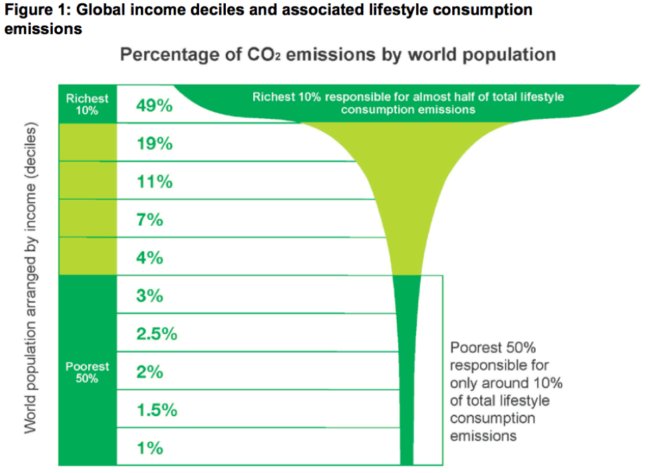
The logic goes like this: if 4 billion of the poorest humans were suddenly gone, runaway Climate Breakdown and the biosphere destruction from the consumerism of the wealthiest 20% would still destroy civilization. This is why only decreasing the population (here, doing away with 4 billion people) won’t change anything and therefore won’t help. (see the graph of who is driving the damage)
The only thing which will help is somehow making the wealthiest 20%-40% of humans stop consuming – which is to say massively decreasing their carbon footprints. That would halt runaway Climate Breakdown and biosphere destruction. Of course, the economic consequences would be massive, but they would probably be worse if civilization just disappears.
But this is just the physics of reality. There isn’t a course of action offered. I have no idea how to get the wealthy to stop consuming in advance of serious Climate Breakdown.
The only hope I can offer is another physical reality: If collapse doesn’t happen first, then when enough families are touched by Climate Breakdown related deaths, the political will may arise. This was evidently observed in the later stages of the covid crisis, wherein even the republicans began to actually deal sanely with the crisis because rising deaths among their constituents forced them to do so.
If the wealthiest stop consuming, that also, of itself, won’t make a difference, just as lowering population. by itself, won’t make a difference. A sustainable population could, hypothetically, be as large as we have, if the total activity didn’t consume resources beyond their renewal rates and didn’t pollute the environment beyond its ability to assimilate those damages. A population of 1 billion could also be in overshoot if it, didn’t consume and pollute as above. Given the human ability to make tools, it seems highly unlikely that any human population level would be sustainable. Humans are a species but a species with a unique tool making ability (in the sophistication of those tools).
I agree “Sustainable” is a great word. But the first couple of sentences are not correct – if the wealthiest stop consuming it would indeed stop the increase of CO2 in the atmosphere and halt runaway Climate Breakdown – In fact, that’s what science knows is required to avoid the worst of Climate Breakdown.
http://yavapaiweathertracks.org/Anderson_CO2_1.5C.png
But our time has pretty much run out in the last decade and right now we’re pretty much facing the end of civilization (outside of possible ‘lifeboats’?) because this graph isn’t happening. That’s a very big deal, making this one of the most important of possible actions.
The author of Limits To Growth has fairly recently talked about what science modeling actually knows about what’s possible.
https://youtu.be/b7lmh5XVRW0
It’s rather unfortunate that Meadows’ models didn’t include what’s now known about the concentration of CO2/consumption being among the world’s affluent 30% or so. (That might be a useful modification to World3.) The result is his overemphasis on population as a thing, which in and of itself is meaningless – it is, rather, the complex relationship between population and consumption that matters. One must bear such factual relationships (and model/scientific-knowledge limitations) in mind.
Trained and careered as a physicist, I think in terms of what’s real (physical reality) so I lean toward thinking like Meadows, as opposed to the ideas/ideologies of various nonprofits’, peoples’, even leaders’ beliefs. Certain things are absolute and unavoidable – these as a group may be called physical facts. Not everyone – even most – don’t think this way. Even many of my scientific colleagues hold ideologies above facts, and this is part of the problem (i.e., Merchants Of Doubt).
Then there’s always the danger of circular thinking with really complex phenomena…
But when you come right down to it – there are many who want war and strife, there are many who want to subjugate women, there are many who want to eradicate those different from themselves, and the list goes on. These might be called the worse angels of our nature. Our 5,000+ years of (known) civilizations can be viewed as (failed) attempts for Sapiens to learn to live. Now we appear to be at the actual Crisis, which came about mostly by ignoring and intentionally suppressing available human wisdom (again, Merchants Of Doubt, and now, a half-insane government in the most powerful polity on the planet). Although, it’s not clear that politics ever reached the sophistication to be able to deal with such a Crisis.
“It’s rather unfortunate that Meadows’ models didn’t include what’s now known about the concentration of CO2/consumption being among the world’s affluent 30% or so. … The result is his overemphasis on population as a thing, … it is, rather, the complex relationship between population and consumption that matters.”
The poor of the world may not be major drivers of energy consumption and CO2 emission, but the increase in the standard of living of the poor is now the major driver for the increase in global energy consumption–which is still outpacing the ability of clean energy to keep up–particularly as large nuclear plants get shut down. I think it was reasonable for him to list population as an independent factor from consumption, energy consumption, and the fraction that comes from fossil fuels. I would have more doubts about the usefulness of treating energy consumption as an independent factor from consumption as factors driving climate change. And he didn’t separate fossil fuel use from fossil fuel emissions, which has been reasonable up to this point, but with emerging high-capture options, that equivalency may have to be revised soon.
And his point that if it wasn’t climate change imposing a limit to growth it would be something else presumes that we would always strive to remain on the path of endless growth. He did understand that many women have more children than they would prefer to have–due to cultural and religious factors–but he seemed to missed poverty as a factor. With more affluence and economic opportunity, most women will reduce the amount of children they would prefer to have. He also missed that there are many men who wind up having more children than they would have preferred to have, and the effect of rising affluence on preferences there as well.
“Trained and careered as a physicist, I think in terms of what’s real (physical reality) … Certain things are absolute and unavoidable – these as a group may be called physical facts.”
The tricky part is separating things which are actual physical facts from things that we mistakenly believe are physical facts. Even people trained in physics have arrived at such mistaken beliefs many times before. And in many cases, their training also led to a supposition that there was very little chance they could be mistaken–even after evidence was already showing up that they were in fact mistaken.
Any release of GHGs will increase the atmospheric load, unless sinks are greater. Getting the worst emitters to stop will definitely slow that rise but it won’t stop it. If feedbacks are net positive, then eventually it won’t make much of a difference that the worst polluters stopped. Of course, it’s a hypothetical discussion. There is no way the top 20% would stop their emissions.
It’s encouraging to know that sirup is over there in Europe also reading the good information PattiMichelle Sheaffer provides.
I would guess if there were a massive dieoff say 7 to 6 billion, the remaining occupants would also be in a world of hurt in one way or another, meaning that there own consumption would also decline massively—they would be in a collapse status themselves. It might be very possible we would be back to simple farming and hunting and gathering. I would maintain, but speculatively, it would give those going through the bottleneck would have a chance.
Great post. But at 2 billion, sustainability gets a whole lot easier to envisage.
🙂
Oreskes and Conway went through the mental exercise of this… I remember a quote from the book… “…and, of course, everyone in Africa just died…” This is what we’re talking about here, the population “going down” (jeezus!) by over 6 billion people, and it freezes my blood.
You’re right – the actual physics was examined and reexamined by Meadows et al., and others, and these are the absolute experts. Meadows himself said maybe 1 billion was sustainable if we had something like the lifestyles of the average westerner of maybe the 1910’s?
https://youtu.be/Dbo6uvJBtZg?t=212
Wow, Patti! Asher and Richard are easy enough to understand but the article Elizabeth G. Boulton (JHU) wrote for the Marine Corps is a conceptual indoctrination in itself. I am empathetic and impressionable so started getting vertigo before I could read the entire thing. Her glossary in the footnotes was insightful, especially the terminology about China as a new specie of Empire.
Yes, I find her ideas so very different as to be challenging to me – but talking to her, she is very down-to-earth… we don’t often hear from the combination of neuroscience, linguistics and philosophy scientists speaking out about (unstoppable) Climate Breakdown. I think it could be very useful that she’s basically constructed nexuses of action, although, again, very different from the (echoing) refrain(s) that we’re used to hearing. But this is exactly the sort of thing everyone (including PCI) has been crying out for – new and authoritative scientific perspective. Nonetheless, if Turchin (Cliodynamics) is correct, it may take an informed military to enact b/c the ruling US Elites certainly cannot grasp the explosive growth of the Hyperthreat. Most of the really powerful ones are significantly less well-educated than even modest intelligentsia.
The causal relationship does go both ways. I think material conditions are far more powerful. Otoh, changes usually show themselves first in the realm of ideas.
Are you familiar with chimney technique in rock climbing, Bart? There’s one method in which the climber lifts herself up with one foot, on one of the facing verticals, pushes herself up and then lifts the other leg to do the same on the opposing verticle. Maybe this is how ‘ideas’ and material conditions are related in social and political transformation?
Thank you for bringing up the Nation State driver of poverty and war. The Welcome paper doesn’t even mention it. The Nation State has to tax to maintain a standing army with a munitions stockpile. In order to tax, it has to suppress subsistence lifestyles. When subsistence lifestyle is made impossible, the State enforces poverty. Poverty is war on the poor. @JRiverMartin:disqus is correct that money has little to no place in a subsistence economy. A vicious cycle ensues when a government requires money to fund its military, and requires a military to defend and enlarge its money. War is the greatest waste of human and natural capital of all. There is not one constructive function of war. Yet since international aggression is still a thing, to wit, Russia vs. Ukraine, every nation state has to be prepared to defend against violence from abroad, despite the toll that defense preparedness takes on its constituency. What’s more, the Nation State system drives the unlimited economic expansion by keeping the players locked in both an economic and military arms race. Any one player must maximize their economic might in order to deter aggressors who will fear that the richer party can translate economic might into military might. Why isn’t the U.S. stomping Russia for invading Ukraine and disrupting the world order? So it can hoard its wealth and military might to remain top dog, no matter how Pyrrhic that victory. No wonder the only voice of sanity in the halls of power comes from the U.N. and no wonder The Right villifies the U.N.
I have no idea for dismantling the system of Nation States, but dismantled it must be in order to enter a sustainable, thriving system. If you believe Lawrence H. Keeley (book: War Before Civilization), a major check on overpopulation in pre-literate societies was brutal warfare.
Many people will die during the Great Unraveling. Who should die and who should live? False question. Nobody gets to decide that. It will play out. Lots and lots of the poor and disadvantaged people whom the colonial powers forced into debt, but perhaps the Marie Antoinettes and Nicholas II’s (Musk? Bezos? Gates?) will get it, too. Soldiers. Airplane passengers and high-rise office denizens. As well as much of the more-than-human world.
I’ve run out of tears.
How about – “and” instead of “or” in that title? Richard, you got me to read Turchin’s recent book – twice. So surely militocracies and democracies will face very different futures… hence, “and.”
… Sadly I have this nagging feeling that most moneyed class will try to ride 99% in their usual way, so instead of free bus/train tickets, less pointless work and more local food we will get more work, less useful money, more debt and usual further degradation in quality of anything we can afford…
Sadly, if a truly sustainable way of life were even possible, without a complete collapse of civilisation, it would take many generations to realise. I’m sure, from your work on the Five Axioms of Sustainability, you know that a sustainable society won’t be recognisable to anyone living in this one.
I must begin with an apology. I am sorry I did not spend my life spreading the gospel. Somewhere in 1971 I woke up and realized I had found enlightenment. Unlike (the unlikely telling) that Buddha was visited by a Hindu god and convinced to “spread the word” despite his feeling that no one would listen and that would make him unhappy; I was, over time, convinced by my own lack of self confidence that no one would listen to me. I was probable right about no one listening, but still, I should have tried.
So here it is. Almost all of the “Polycrisis” comes from one issue, in this article very briefly touched on; there are too many people on this finite planet. There were already too many in 1971. We don’t need to argue that point since it is now mute. Today there are far too many. Why do we have global warming, run away pollution in many parts of the world, an extinction event (seen first in insects) on a scale not seen since (some say) we lost the dinosaurs, social conflict… and mass migration of people? There are just too many people. We are running out of resources and places to dump our waste. And we just feel too crowded.
When ants overpopulate and two colonies in a confined area are forced to compete for resources, they fight until enough of them die to eliminate the problem. Then they eat the casualties. We could find a better way. Maybe birth control, but I see instead we are experimenting with a return to more conventional wars at regular intervals. That might work, but isn’t my first choice (even without the cannibalism). One thing is for sure; no solution that requires us, as an entire species, to become some other loving and peaceful animal, just because some of us want that, is going to work. Birth control and slowly giving up the idea that growth equals progress would have been good in 1971, but it may be too late for “slowly”. Sorry is I sound gloomy, but writhing about this makes me unhappy and I never learned to meditate.
The Eastern half of the US inundated by wildfire smoke. Diverse weather catastrophes. The Pentagon prepares scenarios for AHBL. An important question: how soon will actual food shortages arise? There is only a month or three of stored food in the US these days. Major hospitals (like Cedars Sinai and UCLA Westwood in LA) are struggling, as are critical medicine sources. “Happy faces” hide underlying difficulties. It really couldn’t be clearer, but until catastrophe touches almost all families, there probably won’t be adequate political will for halting growth. (…but it will soon, so be ready…) And then NPR/PBS propaganda machine will have to be revamped or shut down and strong non-growth triage initiated. That’s the soft-landing scenario. Unfortunately, about half of the US government is increasingly rolling loaded crazy-dice on how hard the landing will be. (not actually a “landing,” but you know what I mean…) Suppression/repression are rapidly taking shape.
It’s a red herring to talk about population – it’s only the carbon footprint of the wealthiest ~1.5 billion humans that matters to the accelerating Climate Breakdown we’ve been seeing and science already knows about. Only the wealthy matter and must change immediately. (That includes on the order of half of all Americans, by the way.) And only absolute crazies would nuke 5 billion people for a false ideology, anyway. Thus; a red herring.
As Richard has pointed out, it’s the idea of growth that has to be undone – unfortunately, the financial system would be a core casualty. There are good recent historical examples of what happens when a financial system fails – it must be avoided.
Two general kinds of humans: those who seek to ameliorate problems and those who seek to exploit problems. (Shock Doctrine, for instance, but at all levels, including local Dons and gangs; up to the level of civil war) This also has to be managed to avoid a worst-case scenario. A functional government stands a chance at doing so. (this is an assumption) Tainter and Tainter/Patzek have referred to this as the Byzantine Model (i.e., of collapse), but the world was far, far simpler and smaller then.
First lets look at the “fabric” and “fabrics” that are unravelling and know that Nation Statism is foremost. Most people think of their “country” republic”, democracy” all names for same thing. 195 Nations on the Planet today we will start with U.S.A. and same will hold for the other Nation States {country is probably the most commonly used term and will be used also}. Countries are manufactured entities with unnatural boundaries, demographics, governing bodies none of which are not hardwired by Nature. LBJs’ War on Poverty stared in 1964 ended endemic death to malnutrition in U.S. much at expense of the rest of the world. Johnsons War on Poverty was that every county in the U.S. had to have a welfare office and program under the USFDA. Welfare was going to guarantee an income for any woman had a baby with food housing and 12 yrs. Public Education. All at tremendous expense and ever increasing number of “poor”, rising crime rates, prison population and using the U.S. Military as an adult baby sitting service as Jimmy Carter did to pay political debts. All of this “State Sanctioned Social Justice “and overall population needs lots of oil for one and thus we made ourselves a parasitic oppressor to much of the oil producing world bringing U.S backed oppressive oil oligarchies bringing on Arab Spring and 9-11and more wars. Was anybody surprised that the 9-11 hijackers came from major oil producing region? Nation States area constant source of wars, oppressions, genocides, depressions, revolutions and civil wars. Often over who’s going to utilize the other as a tax base. All of this financed by State administered financing {taxation}. Wars economic imbalances happen but with “the power to draft people and legislation and the power to tax is the power to destroy” and leads to wars ‘ depressions living long past would be their natural expiration dates and boundaries. 3 Day Street Brawls turn into, 30 yrs. Wars, boundary incursions into continental wars and World Wars and long term oppressions. Nation States, Countries etc. is the problem. Without mass production of food you don’t get mass consumption of food, without mass consumption of alcohol and drugs you don’t get mass consumption of alcohol and drugs. “THINK GLOBAL, ACT LOCAL.” We had death due to malnutrition at a very minor %pecentile of the population. Poor people in this country often suffer from what used to be referred to as “Rich Man” diseases alcoholism, drug addiction, diabetes, gout. We have Great Inequities and inequalities across the globe. Make it to 8 yrs. old across much of the Globe is clearing a major hurdle out of poverty. Poverty is our natural inheritance for all; we come into the world bringing nothing “our Birthday suits” ya know. We can start by acknowledging that wealth/poverty etc. is hardwired by nature and “Governments” are not hardwired by Nature and anything forced, manufactured unsustainable {meaning tax funded} Governments won’t work and are the main cause of most if not all our socio-economic problems. For instance I’m anti- abortion {spiritual reasons} but pro-choice {practical reasons} on abortion. Governments tend to be the biggest murderers of all: Nazi Germany, Soviet Bloc. Maos’ China, Killing Fields of Cambodia and all of them through history. Also abortion holds to more sustainable populations. Imagine 63,000,000 more people in U.S. needing “Social Justice”. Poor Old Planet can’t take too much more of American “Social Justice”; we’re going to break the Planets back with iwhat we currently call Social Justice in this country. Nature is chock full of Inequities and inequalities and are best approached through “good orderly direction” {g.o.d.} of Private Sector Total Private Sector.
We have tons of green-sounding slogans and we’re developing some great nouns for our situation. But what we need are highly-instrumental levers we can push in the correct directions.
We also need the political will along with the maintenance of the Rule Of Law (i.e., civilization itself). It’s absolutely clear from contemporary and historical collapses that without the Rule Of Law things get very nasty – that is, the domestic mortality and manslaughter rates increase dramatically, FWIW.
These two documents are worth comparing for instrumentality and Rule Of Law themes:
https://www.postcarbon.org/publications/welcome-to-the-great-unraveling/
https://muse.jhu.edu/article/857233/pdf