

Ed. note: The following is from the text of Rupert Read’s talk at Kairos in London on May 14.
- The climate situation has deteriorated very significantly, even since last year; it is so tragic and gut wrenching. The situation is ‘with’ me almost all the time, now…
- My teacher Joanna Macy once said, “I keep going, even though I’m ancient and things are getting really bad to an extent I had hoped to prevent, so you don’t turn on each other when things get REALLY bad”. . .So I’m really glad we are here tonight practicing the opposite of turning on each other / fighting each other / othering each other.
- But at the same time, the awful deterioration can’t of course be an excuse for no longer thinking clearly. For starters: it’s a logical mismove to think that this deterioration means we ought to be shriller, angrier, more radical. In fact, if anything, to the contrary.
- Why..? ..Because as the situation deteriorates many more people, of diverse kinds with diverse politics and backgrounds (will) want to come on board, some of them quite suddenly – but most of them won’t be able to identify with something they see as shrill or lawless. They want to see it – us – as like them. If we keep moving ‘ahead’ of them, more radical than thou, then they will never find a place with us.
- Moreover, while the Climate Majority Project is obviously riding the radical flank effect for all it is worth, (in the absence largely of the old moderate flank stepping up to do so), the evidence suggests sadly that the radical flank is worth a lot less than it was five years ago. Look out for forthcoming research from the Social change lab which strongly suggests that as the radical flank has radicalised further, the radical flank effect has in important respects dried up and in fact gone into reverse. So it isn’t necessarily both/and, unfortunately. The radical flank by and large isn’t creating or even maintaining room for the likes of us any more. More than ever, then, great care is needed about what actions are undertaken and what image is cultivated. (And, given the paucity of the rad flank’s image at present, any attempted assemblies-based lunge into electoral politics would almost certainly be not just ineffectual, but counter-productive, and would only harm our closest political friends such as Greens, and would harm the new moderate flank, and probably the cause of deliberative democracy itself.)
- There is a really important area however where there is room for something new, in light of the desperate situation: namely, adaptation, disaster-preparedness, resilience-building. Shifting to highlighting the utterly parlous and neglected state of these, and undertaking actual ‘direct action’ on the ground to change that state. Transformative and strategic adaptation is a central priority going forward for the CMP. It would be great to see large chunks of the movement as a whole dropping tragically outdated pretences that we’ll be able to ‘mitigate’ our way out of this – and profiling adaptation centrally instead.
- For…There are almost certainly no short cuts to where we need to get to. No electoral short cut, no revolutionary or radical flank short cut, and no tech fix. We need to do the deep hard work of convincing citizens (as well as elites) and bringing them onside into actual action in millions upon millions, not just thousands. This is a work of cultural transformation, of deep listening, of escaping from one’s ‘ghetto,’ indeed, from the identity of ‘activism’ altogether. When that hard deep work is actually done, (done at scale and over time), then our climate politics and climate policy will significantly improve, and almost certainly not before.
- But we don’t have time I hear some of you cry (feeling the horror and desperation cut deeply). In a sense..You’re absolutely right, of course. But: there simply are no short cuts. And..This yields a further and crucial reason for taking adaptation seriously. Because it is going to be a long time before as a society we take ‘mitigation’ (aka greenhouse gas reduction) seriously enough. So a lot more damage is going to occur. So we need to practice adaptation and preparedness, and we cannot wait for our ‘leaders’ to ‘get’ this. So let’s get started. That is perhaps my key message tonight. The new agenda where we join together could be: centring adaptation. As the most effective way now for us to make ourselves at large safer, and the most effective way to wake more people up. For..When we adapt transformatively to the climate damage that is HERE and the significantly worse climate damage that is coming, and when we do so in a manner that is inviting rather than alienating, then we make this horrific crisis real to people in a manner that merely ‘raising the alarm’ can no longer do…
- Thanks, dear friends and colleagues, past and present. Let’s see what we can do.
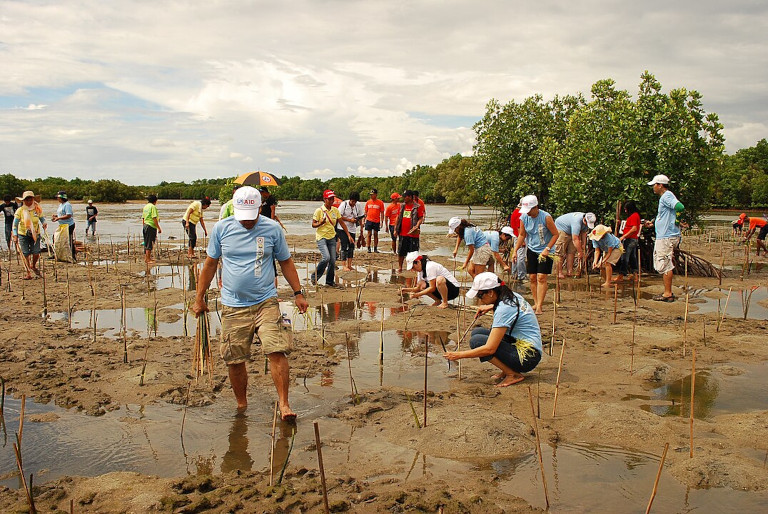
Teaser photo credit; USAID is backing a mangrove planting activity as part of a climate change Adaptation Strategy in the Philippines municipalities of Quilitisan, Calatagan and Batangas. Photo credit: Jessie F. Delos Reyes. By USAID U.S. Agency for International Development – FrontLines/EGAT 2011 Environment Photo Contest Top Entry, Public Domain, https://commons.wikimedia.org/w/index.php?curid=54737538


Comments
We changed commenting systems on September 10, 2026 as part of a site-wide functionality and security upgrade. Your past comments have not disappeared, and you can still log in with your old Disqus account credentials if you wish. Contact us with any questions.
I hope I have not misread this, and I have great respect for Rupert Read’s long commitment to the cause of climate activism, but I take issue with the fundamental premise here – that civil disobedience alienates a mythical moderate majority. Every successful mass movement has utilized tactics that alienate many people. MLK was one of the most hated people in America among the so called silent majority. The anti-Vietnam War movement was profoundly alienating to conservatives and moderates.
Civil disobedience brings moderates into the fold by provoking the ugliness of the militarized police. The civil rights movement grew exponentially via news clips showing peaceful protesters being beaten, attacked by police dogs or sprayed with high pressure hoses. The current protests, on and off campuses, against the US military support for the IDF assault on Gazan civilians, has deeply alienated much of the public, but I believe that Biden will be forced to withdraw US military support, or risk losing much of his electoral base.
The idea that there is a latent moderate constituency ready to jump into the movement once the climate gets so awful that denial is impossible is a misguided fantasy. The climate is already bad enough that any rational person ought to come to their senses. The power of denial, and the propaganda networks funding it will be alive and well no matter how many storms, draughts and fires the summer of 2024 brings us. If the temperature hits 140 in NYC on July 4th, I suspect that a zillion deniers will still post social media comments like, “duh, it’s summer.”
I am also unimpressed. This reads a bit like those infuriating things I used to read about how the Left/environmentalists were losing because we didn’t have good messaging; sometimes this was cast as our being either too moralistic or not moralistic enough, too radical (as here) or not enough. No, we’re losing because the other side has a megaphone a hundred times the size of ours. And we’re losing because we need two things: major policy change, and change in the habits of, essentially, everyone (in the overdeveloped countries). Major policy change is not in the cards no matter how bad it gets (and this piece doesn’t acknowledge that climate is only one piece of what this site calls the Great Unraveling). And most people will not cut back on consumption, or waste, or change their lifestyles until they see the policy change, or see others around them doing so. Most likely when this change finally occurs it will be by necessity, not choice.
I think the idea of groups of people working together at the local level, as volunteers, does make sense and could be inspiring. I’m not sure whatall “working on adaptation” looks like, though. Installing more AC (which will make the problem worse)? Building barricades against a rising sea? Trying to get laws passed that mandate new buildings be on higher ground or on stilts? Or can’t be made of wood? Putting in more community gardens? I also worry that adaptation means helping humans, only, survive what we’re bringing down on ourselves–leaving other species unprepared.
I’m not sure whatall “working on adaptation” looks like
If it is unlikely that mitigation via policy change or a change in mass behavior will happen, then there only two types of “adaptation” possible: 1) typical governmental responses to disasters as they happen, and 2) individual and small community preparations for disasters to come.
Some giant infrastructure projects, like the Dutch dikes and barrier gates, and similar structures in Venice to adapt to rising sea levels, are touted as examples of adaptation, but almost all projects like these are intended to keep modern civilization safe, and all will eventually fail.
The first type of response, ad hoc disaster response, will last only as long as large-scale governments last. Energy and resource depletion will increasingly degrade government capabilities until they disappear. Large swaths of the earth will then become terrible places to live.
The second type of response is independent of the first. Post-disaster governmental responses will continue (until they can’t), but people can prepare for the day when everything about modernity, including government functionality after disasters, fades away, never to return. This is the kind of adaptation that makes the most sense to me.
Governments could facilitate preparation for the day that government disappears, and small communities are left on their own, but they won’t. This means that people should concentrate on pre-adapting their family, neighborhood and village to the polycrisis. Larger civic institutions should be ignored as much as possible. Perhaps a rural county council could help, but asking anything higher up in the political heirarchy to help will be fruitless.