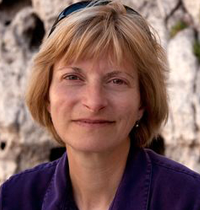
National Geographic Fellow Sandra Postel views the world through a water lens, advocating for all to make simple and easy changes to their everyday lives that will help "Change the Course" of the Earth’s precious supply of freshwater.

Change the Course: Hope for “Troubled Waters”
By Sandra Postel, originally published by National Geographic
August 16, 2013
Sandra Postel
Sandra Postel directs the independent Global Water Policy Project, and lectures, writes and consults on global water issues. In 2010 she was appointed Freshwater Fellow of the National Geographic Society, where she serves as lead water expert for the Society’s freshwater efforts. Sandra is co-creator of Change the Course, the national freshwater conservation and restoration campaign being pioneered by National Geographic and its partners.
During 2000-2008, Sandra was visiting senior lecturer in Environmental Studies at Mount Holyoke College, and late in that term directed the college’s Center for the Environment. From 1988 until 1994, she was vice president for research at the Worldwatch Institute. Sandra is a Pew Scholar in Conservation and the Environment, and in 2002 was named one of the Scientific American 50, an award recognizing contributions to science and technology.
In 1992 Postel authored Last Oasis: Facing Water Scarcity, which now appears in eight languages and was the basis for a PBS documentary that aired in 1997. She is also author of Pillar of Sand: Can the Irrigation Miracle Last? (1999) and co-author of Rivers for Life: Managing Water for People and Nature (2003). Her article “Troubled Waters” was selected for inclusion in the 2001 edition of Best American Science and Nature Writing. Sandra has authored well over 100 articles for popular, scholarly, and news publications, including Science, Scientific American, Foreign Policy, The New York Times, and The Washington Post.
Tags: Water Supplies, Watershed Planning, Watershed Restoration
Related Articles
The Darien Gap and Central America Biological Corridor: critical biodiversity hotspots and local adaptations following mass human migration
By Ryan King, Resilience.org
The Darien is a hub of extraordinary terrestrial and aquatic diversity, a sanctuary of indigenous communities already devoted to protecting local wilderness, and habitat for endangered Apex predators, including the Harpy Eagle. It also, unfortunately, serves as an example of contemporary environmental and societal threats magnified by large-scale geopolitical changes.
February 26, 2026
Agrihouse at the Venice Architecture Biennale: cultivating climate resilience through land, water and collective policy
By Barbara Giorgi, Ecosystem Restoration Communities
When farmers, researchers, designers and policymakers work together, farms and bio districts can become true laboratories of resilience – capable of regenerating ecosystems while shaping fairer and more adaptive governance models.
February 25, 2026
Bus Driver on Mars
To live outside of one’s ecological context—and in fact where no ecology of any relevance exists—would require somehow creating a suitable ecology, or borrowing a sufficiently-complete subset of an existing one that can tolerate a completely novel setting for which the beings are not adapted.
February 25, 2026