Show notes
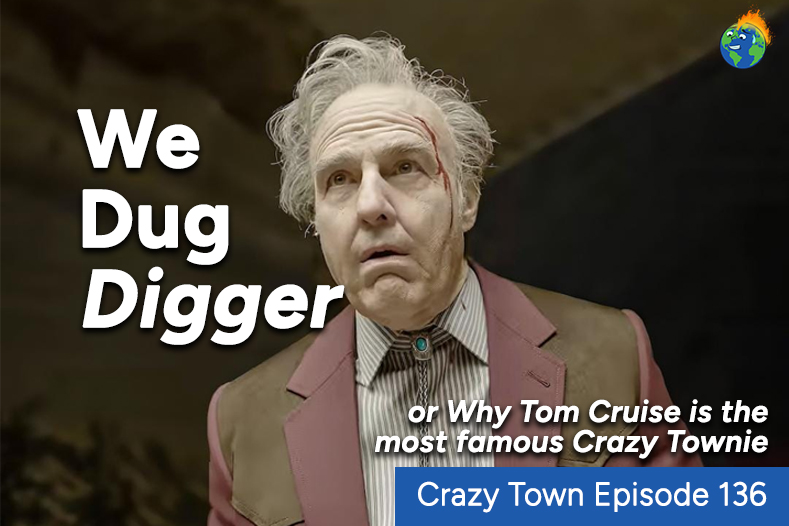
What happens when an A-list director and the biggest Hollywood star of the last 50 years team up to create the perfect Crazy Town movie? It bombs. Intentionally going in cold, Rob, Jason, and Asher met up to watch Digger. And now, without revealing too much about the film, they reflect on the themes, legacy, and most especially how the negative reactions to the film mirror society’s inability to look honestly at our climate predicament, let alone offer any reasonable responses. Don’t worry, the hosts did their best not to spoil the film!
Originally recorded on 10/16/26.
Sources and links
Credits
Production and editing by Alex Leff. Editorial assistance and transcripts by Taylor Antal.
Theme music is “Way Huge” and “Don’t Give Up” by Midnight Shipwrecks, used with permission.
Thanks to all the Crazy Townies, our listeners who are trying to understand humanity’s overshoot predicament and do something about it.
Transcript
Asher Miller:
I'm Asher Miller.


Jason Bradford:
I'm Jason Bradford.


Rob Dietz:
And I'm Rob Dietz. Welcome to Crazy Town, where we always eat the freshest cuts of bluefin tuna on our private jet trips to the recording studio. What happens when an A-list director and the biggest Hollywood star of the last 50 years team up to create the perfect Crazy Town movie? It bombs. Intentionally going in cold, Jason, Asher, and I met up to watch "Digger." And now, without revealing too much about the film, we reflect on the themes, legacy, and most especially how the negative reactions to the film mirror society's inability to look honestly at our climate predicament, let alone offer any reasonable responses. Don't worry, we did our best not to spoil the film. Hey Asher, Jason, good to see you guys again so soon after our date night.


Asher Miller:
Yeah, it's a little too much for me, man. We're moving too fast on the dating.


Jason Bradford:
I think at least I had my wife with me and you did too, Rob.


Rob Dietz:
Yeah. Yeah, it was quite a night. Let me tell our listeners, we were all together having dinner over at Jason's place and we got the bat signal went up from our producer, Alex Leff. He was texting us, emailing us, shouting into the winds.


Asher Miller:
There's a bat signal? Weird.


Rob Dietz:
Yeah. Well, we've got to respond to something. He's like, "Have you guys seen 'Digger'?" And we're like, "No, we have not." And since we were all together, we decided to make a trip to the local theater and watch the movie at his request, at his pushing, his urging. And we all went into it cold. I mean, we knew that Tom Cruise was in it. That was about all we knew. We knew it had something to do with oil and we watched it and we're here to talk about it.


Jason Bradford:
You know what I didn't know, and I kind of want to forget this, is that I didn't know that my wife keeps a stash of movie candy because we hardly go out to the movies, but in our house, she has a stash of movie candy. I don't know where she keeps it, but she brought it.


Rob Dietz:
It's not in your house. She and my wife went shopping and that's why we ended up pounding Whoppers, Junior Mints, and Butterfingers at the theater.


Asher Miller:
Not me. I didn't touch any of that stuff.


Rob Dietz:
What a Crazy Town meal.


Jason Bradford:
I was a little bit sick afterwards, but I had a good time. The Whoppers were my favorite.


Asher Miller:
So we're not going to tell people much about the film at all.


Jason Bradford:
We're trying not to.


Asher Miller:
Because I think we would like to encourage our listeners to see the film if they can, and to try to avoid reading any reviews or reading synopses of the film, because I think it does make a big difference if you go in as cold as you can on it. We did hear that it had been panned or whatever. I did know that, so I was kind of curious. What I will say about the film and why we're bothering to talk about it is that it has arguably probably the biggest star from Hollywood of the last 50 years, Tom Cruise in it, and a really well-regarded director, big budget.


Rob Dietz:
I like him, Alejandro Iñárritu. He's done some really cool stuff.


Asher Miller:
And it does tackle climate change, oil industry stuff, and it's quite a dark picture of the future. I think we could probably leave it there. Yeah?


Jason Bradford:
And what I did afterwards is, because I kind of heard through the grapevine that it didn't get reviewed very well. So then I started searching for reviews and I got to read them and it was pretty fascinating to do it after the fact as opposed to beforehand. So I encourage others to, if you haven't read reviews, don't read reviews. But what's interesting to me is that the reviews are incredibly split. The New York Times has dueling reviews, positive or negative. Grist has dueling reviews. And then if you go on Rotten Tomatoes and read the reviews, it's like four to five stars or one or two stars. There's almost nobody in between. And it's bombing at the box office.


Asher Miller:
Yeah, I mean it bombed. Totally bombed.


Jason Bradford:
So there's not enough of the people that love it going to see it, people like that. Now here's what I also found fascinating. The negative reviews are almost all about the style of the movie. They don't like the way the movie is put together stylistically, and almost none of them talk about substance or what they do talk about substance is kind of dismissive. If you're going to talk about this, you could do it a better way, this kind of thing.


Rob Dietz:
Yeah. If you're going to talk about climate change, do it like the IPCC instead of a Tom Cruise movie.


Jason Bradford:
Yeah, I just found that fascinating. And so we are going to do actually a better job than any review I've seen about what the film says without revealing this, without spoilers, without spoilers. We're going to try to actually do a better job because the reviews generally, even the positive ones kind of suck a little bit about the depth and the detail of what it says, a message.


Rob Dietz:
Jason, I think it's cool that you went and read reviews out of places like the New York Times. I went after the movie and read the IMDB trivia, and I wanted to share with you guys the first trivia bullet point on IMDB was that it took like six hours to get Tom Cruise fully made up into his character the first time that he did it. And so what he did from then on, he got a stopwatch and he timed each bit of makeup that a makeup artist applied. He got them to be as efficient as possible and got it down to an hour. It totally reminded me of our episode that we did. Remember Asher, you led that episode on Frederick Winslow Taylor and the stopwatch of Doom on scientific management. So Tom Cruise, maybe it's his Scientology training. He's got scientific management somehow into this movie about the climate apocalypse.


Asher Miller:
I'm sure he was very enthusiastic about getting the makeup artist to go faster and faster.


Jason Bradford:
Oh my gosh. Six hours is ridiculous.


Asher Miller:
He probably taught himself how to do ma.keup in order to do that.


Rob Dietz:
Right. He was doing it himself by the end while jumping out of an airplane.


Asher Miller:
I actually think it's interesting. I think that they might have made a mistake in marketing the film because there were ads running. I think they did invest in doing some real advertising and marketing stuff and they really led with Tom Cruise and you'd think that that would make a lot of sense. Here's probably the biggest name in Hollywood in forever. But the problem, and I don't know if you guys had this reaction, but seeing him playing a character that's much older and obese or whatever, having lost a lot of hair, made me immediately think of his character in "Tropic Thunder." And it's like, do you want to see that character for an entire movie?
And I think a lot of people, that's their reaction, was like, no.


Rob Dietz:
Yeah. It does seem almost like a stunt. You know what's really weird too is Tom Cruise is playing a character where the makeup ages him a bunch, but the character's age is about what Tom Cruise's actual age is.


Asher Miller:
Right. It's true.


Rob Dietz:
It's a really strange -


Asher Miller:
Well, and if you really want to peel back the onion, he's probably had a lot of work done on his face. So where's the real Tom Cruise beneath all that makeup, right? It's the makeup and facial work or whatever.


Rob Dietz:
Well, so as usual, I sent us down strange digressing rabbit holes. Jason, back to your reviews. I mean, how do you make sense of that, that the New York Times is going to publish something that says, "I hated this movie because the style was bad." And the other one's like, "No, this is actually really important stuff."


Jason Bradford:
Well, I mean, part of me thinks about your reaction a little bit in that the style was off-putting for you, right? You thought it was a little, I call it a little bit of a cringe movie, but I like those sort of things. I like the tension of the uncomfortable moments that are being built. And I laugh in relief at these things. I laugh at the absurdity.


Rob Dietz:
It is true. When we left the movie, I felt like I liked it less than you two, but it's weird. I was not in the camp of not liking it and I wasn't in the camp of loving it. I was like, "Well, that was certainly interesting, made me think." But I had trouble, I guess, fully enjoying the movie. But then again, I like stuff like Roadhouse and Stepbrothers, so maybe that says something more about me.


Jason Bradford:
Yeah, but you don't like, what's the actor you don't like again that I really like? "Meet the Fockers."


Rob Dietz:
Oh, Ben Stiller. I like Ben Stiller.


Jason Bradford:
Ben Stiller.


Rob Dietz:
But yeah, I can't stand that movie Meet the Falkers.


Jason Bradford:
And I love "Meet the Falkers," all the uncomfortable situations. So there could be some true, people couldn't get past that. Maybe that's some of it. I feel like the squirming, the discomfort is part of it. We should be squirmy and uncomfortable about the reality of the situation. So my personal reaction was, "Well, shut up. This is the point. The director is putting you through this ringer because holy shit, look what's going on." And there's the idea of these hyper objects, climate change is a hyper object, this thing that's so great, so huge that you can't wrap your brain around it. And so I felt like the film was kind of mirroring a hyper object. How do you as an artist in two and a half hours in a movie or whatever it is, how do you get that hyper objectness across? And that's what I think the film was doing really well. But for some people it's like, "I don't want this."


Asher Miller:
I actually think it's interesting you bring up the hyper object thing and the difficulty of really wrapping your head around something that's so big because it feels like a lot of the discussion about the film and the reaction to the film is much more about style than the substance of it. So in a sense, it's also a form of avoidance on the actual content, the picture of this possible climate future. And I find that fascinating. The other thing I find fascinating, I did say to you, I think coming out of the film that I think it might be one of those films that is not just a cult classic later. You have these films that come out and either people just don't go and so they turn out a box off a success or people have a negative reaction to them, but then over time it shifts, people's thinking and reflection on the film changes and then it becomes like a cult hit.
I think there's a chance, and again, it sort of depends on how the future plays out, that this might be viewed as a masterpiece of some kind. And part of it, and I'm trying not to spoil things, part of it's a layering that's in there of these various different truths that are being uncovered through the film. And that is, I think, quite true to the sort of climate reality that we're facing or why we find ourselves in the climate predicament we're in, because it is also multifaceted.


Jason Bradford:
There's a lot of yes and, and I think a lot of climate activists don't do the yes and very well. So not to give away too much, but there's not a very sympathetic character. Tom Cruise doesn't play a very sympathetic character. He's sort of a boogeyman, but he says some things that are very crazy towny. Tom Cruise is obviously the most famous Crazy Town follower we have.


Asher Miller:
Oh yeah. I'm sure he listens all the time to us.


Jason Bradford:
But he says these things that because it's him saying it, people are just like, "No." I mean, but I think if anyone tried to say it, honestly. And so it's this thing where he basically saying, "Look, it's all of us actually." So I think it's true. The climate tycoons, sorry, the oil tycoons are to blame. But I mean, come on, wouldn't you say that the average American consumer is to blame too? It goes both ways a bit. And this is some of the detailed, the nuance that this film gets across or tries to. I don't know how well it comes across for everybody, but for me, I saw that right away. This is a legitimate point.


Rob Dietz:
Well, it was funny when we were walking out from the movie and talking in the parking lot, you did say that Asher. You're like, "I think in, whatever, a couple decades, this could be a masterpiece." And I sat with that a little bit because like I said, I certainly didn't have a good time with the movie. There's some dark humor that I could appreciate, but what I really did appreciate is how masterfully put together the movie was. And I often judge movies by what I'd call stickiness. So if the next day I'm thinking about it and the day after that I've got some scenes in my head and there's a lot of stickiness to "Digger." And some of those scenes, they're not pleasant, but they are staying in my mind and I'm thinking about them. So I'm not going to go out on as big a limb as you went out, Asher, and say, "I think this might be a masterpiece," but I do think it could give people something to talk about for a long time to come if indeed anybody goes and sees it.


Asher Miller:
It's interesting thinking about what's sticky about the film. The thing that really struck me the most was the very, very, very end of it. Literally the last minutes.


Jason Bradford:
Yeah.


Asher Miller:
90 seconds, or whatever it was. I don't know. There are a couple turns in the film where I think, and this is part of why we're trying to encourage people not to read or learn too much about the film before they go. There are a couple turns, I guess you can call them plot twists, and that was a little bit of a plot twist, but the way that it was delivered so subtly, do you know what I mean? And then of course, I had my Crazy Town type of reaction, which is part of what I loved about this film. Maybe you called it cringe, Jason and Rob, there's parts of it that you didn't enjoy, but it felt very akin to our humor in Crazy Town. Just it was just basically acting out the absurdity of the world. It was portraying the absurdity of the world that we're constantly reacting to, and I think some of our audience also feels, and I really enjoyed that.
And at the same time, there's parts of it at the very end, and actually some other plot things in there that I was like, wait a second, that couldn't happen in the future. Do you know what I mean? So even there, there's still assumptions about the future that I might disagree with.


Rob Dietz:
And there's things the film is trying to do that we try to do, which is to, we know that really heavy things are going on out there, and yet we still get together and we joke about it and we laugh. It's a way of processing it. And I think the folks who listen to us regularly are right on board. They want to have a good time, even though things are kind of getting chaotic out there, in some cases going to shit. It's like there's a real important role for laughter, dark humor, satire. And I think the movie is trying to make that point too.


Jason Bradford:
Yes, it is. It's essentially making the point that because Tom Cruise's favorite podcast is Crazy Town, he's saying, "You need to be laughing at this stuff too." And so I really appreciate that, Tom. Thanks a lot. It's really great to have you as a listener. Now, I wonder, so here's what I'm going to wonder. Do you think that the writers and producers have our worldview or do you think we're reading beyond it, in a sense? There's a lot of subtleties and depths of meaning that I took that I'm going, you could take it each way, right? There's a famous speech that he gives and that speech, I think you can read two different ways. I read that this is a Crazy Town aware speech, but I don't know. Some people, you don't have to read it that way. You know what I mean?


Rob Dietz:
Look, who knows whether the actors have the Crazy Town -


Jason Bradford:
I mean the writer.


Rob Dietz:
I'm a hundred percent sure that the director who also played a big role in writing it, Alejandro Iñárritu, he's got that worldview. I'm pretty sure of that. I can't imagine - I mean, this movie is right in step with the things we point out and the attempt to bring humor to.


Asher Miller:
It's definitely the most Crazy Town film about climate that I can think of. People talk about "Don't Look Up," but this feels much more Crazy Town-ish, I think, than that. Although I know you love Adam McKay, Rob.


Rob Dietz:
Yeah, but "Don't Look Up" is nowhere near my favorite movie of his. I mean, "The Big Short" and "Step Brothers," but "Don't Look Up" is also a little more, I don't know, kind of obvious, I guess. It's not as layered as "Digger" is.


Asher Miller:
You're saying that the director might have our worldview on some level. Hopefully that's true, although I feel bad for him, but there's something about the film that I took away that was actually a challenge, I think for me a bit, which is sort of this making this case, it's storytelling, how important storytelling is in sensemaking. We at Post Carbon Institute and resilience.org, we spend a lot of time and focus on educating people and providing people with facts and information and all that. And the truth is that the way that people really, at least the way that they've internalized or carry forward with things is often through storytelling and sensemaking in that way. And we probably need more of that when it comes to the narrative or the conversations that we're having about whether it's a climate changed future or sometimes we use the term polycrisis. There's a lot of shit going on and it's important to help people make sense and understand it in terms of, especially in a post-fact world, grounding in reality. And at the same time, I think we do have to help people with story making and sensemaking as well. And I think the film tried to do that.


Rob Dietz:
Well, I appreciate that. I came away with a similar recognition, but maybe also a little bit of a fear that we are so addicted to story that when we hear a story that confirms the biases we already have, we'll just go with that. And that's why people in power, like the main character in this movie, people like that are able to spin facts into whatever story they actually want to tell. And then I also was thinking, you know how many times I've seen movies or read books, or whatever, that have that same old hero's journey story? You know all the beats, and yet I still watch it every damn time. And I think it's part of why a movie like "The Odyssey" is just kicking “Digger's” ass all over the place because that is the hero's journey story.


Asher Miller:
It's Joseph Campbell. I mean, he talks about it being deeply, deeply embedded in culture. And that makes sense because think about it, right? How did communities of humans who've gone through unbelievable calamities in the past, how did they transfer knowledge? How did they communicate what was important for people to understand? It was through stories, right? It wasn't like charts and fact books. It was through storytelling.


Rob Dietz:
Well, I wanted to let you guys hear a little story I wrote. It's not the three little pigs, it's the three little podcast hosts. So three little podcast hosts went to a movie, ate too many whoppers, got sick, enjoyed the movie though, came home, recommended it and recorded a podcast about it. That's the best story I've ever written.


Asher Miller:
That's an incredible story.


Jason Bradford:
What an arc. What an arc.


Asher Miller:
I think the real takeaway out of all of this is that of course, the most Crazy Town type of film you can make about climate would totally bomb, right? Makes perfect sense.


Rob Dietz:
And we're sad about it and so are our three listeners that are listening to this bombing podcast.


Asher Miller:
Exactly.


Rob Dietz:
It's time for a mailbag, and let me tell you why. Life is getting difficult for us Crazy Townies. We have to deal with everyday stuff like environmental atrocities, malignant narcissists who run corporations and governments, and fairy tales about infinite economic growth. With all this going on, it's easy to spot two incongruent things. One, the polycrisis seems to be coming at us from all directions. And two, people seem oblivious, continuing to drive monster trucks, buy plastic crap from around the globe, and distract themselves with the latest brain numbing material on Netflix and social media. If you're feeling it, we want to hear from you. What's got you the most worried or feeling crazy or actually hopeful these days? How do you talk with family and friends about the state of the world? Please send your thoughts and questions to [email protected]. Hit pause on this episode, go to your email app, and let us know what's on your mind. That's [email protected]. We Crazy Townies need to stick together, so write us at [email protected].


Melody Travers:
That's our show. Thanks for listening. If you like what you heard and you want others to consider these issues, then please share Crazy Town with your friends. Hit that share button in your podcast app or just tell them face to face. Maybe you can start some much needed conversations and do some things together to get us out of Crazy Town. Thanks again for listening and sharing.