

“Do you know Rose Friedman?” I asked the stranger I’d just met at a convention in Manhattan. We had just discovered we were two Vermonters in a cavernous convention center bustling with 40,000 people in a city of 8.6 million.
“Rose Friedman?” He shook his head.
We’d done what anyone does when meeting someone from home: we played “do you know…?” Though Vermont is a small state, it’s a long shot. At Manhattan’s density, all 645,000 of us would fit in about nine square miles. Instead, we’re spread across more than 9,000 square miles. I live in Halifax, population 792, at the state’s southern edge. He and his daughter live in Hardwick, a town of 2,900, two hours north.
This normally wouldn’t be a winning hand in the game of connections, but I knew something about Hardwick. I watched the man turn to his daughter, who looked about eight. “Do you know Rose Friedman?” Then, he realized something. “Wait. Isn’t she the woman directing the play you’re in?”
She nodded. He furrowed his brow and turned back to me. “But how do you know her?”
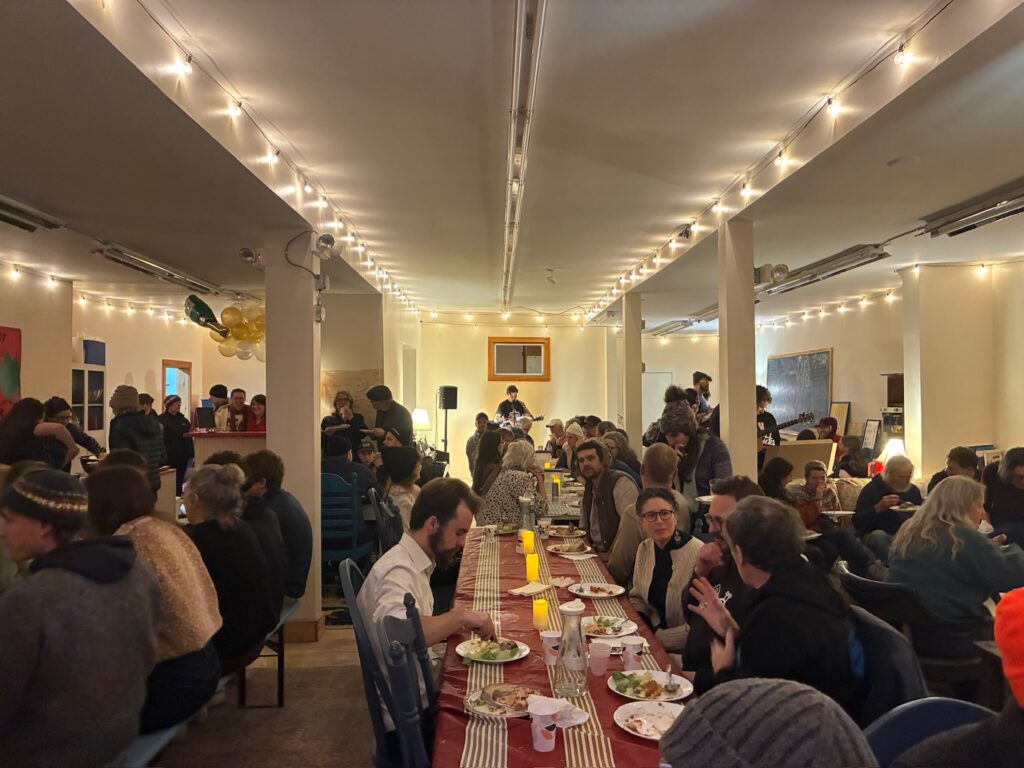
I knew something about Hardwick. I knew that it is home to the Civic Standard, a community center with an oddly newspaper-like name. The Civic runs a weekly town-wide dinner party, while hosting a space that functions as both a public living room and a collaborative art project.
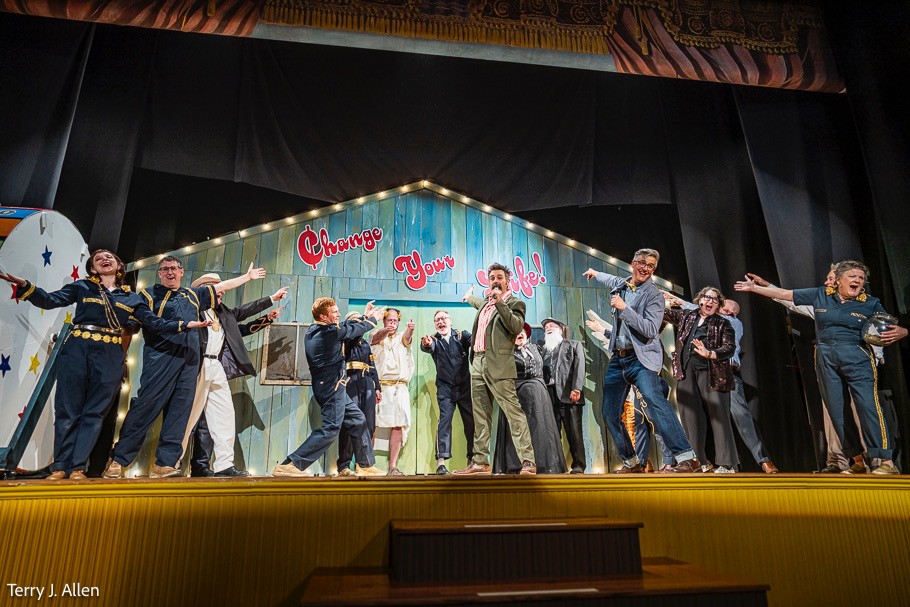
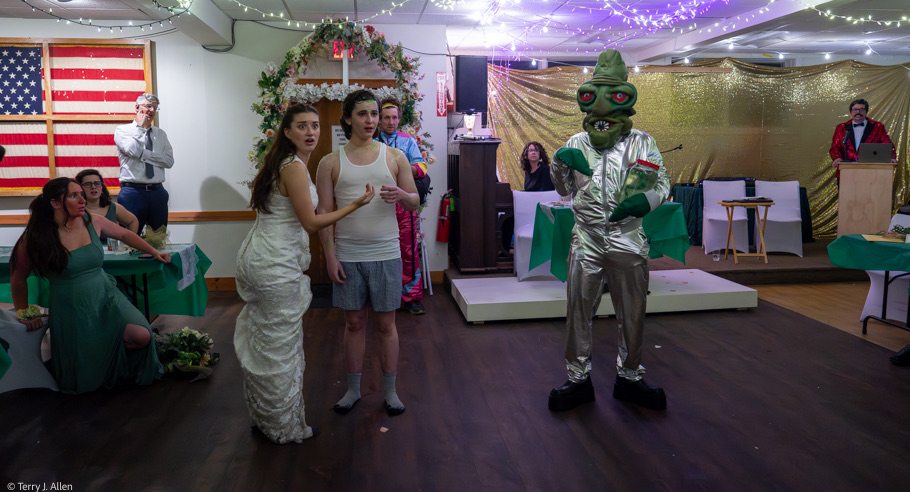
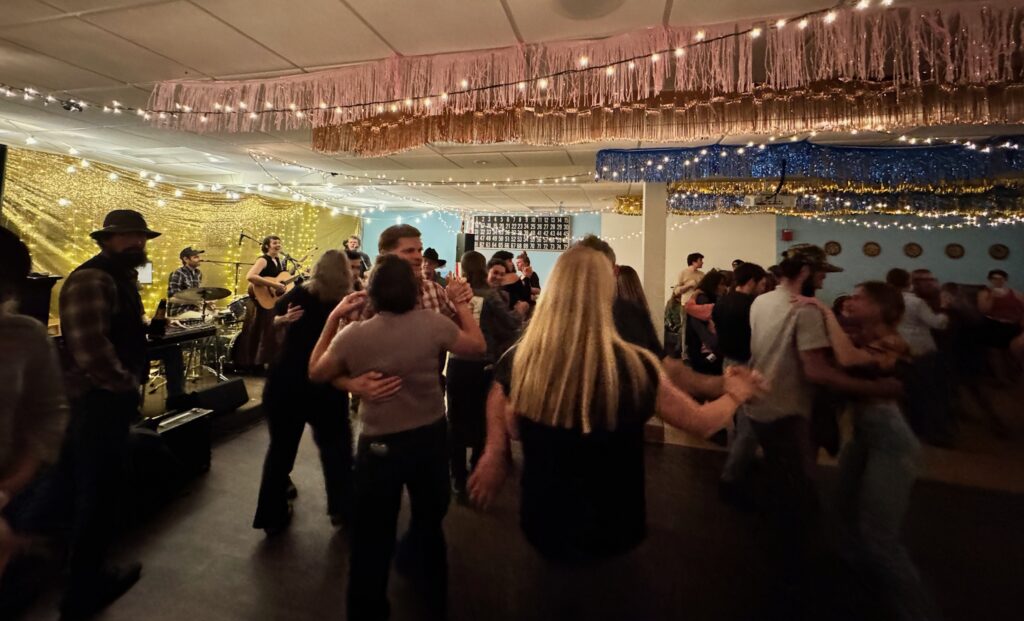
The Civic regularly puts on plays, but unlike conventional community theater, Civic productions are written by, for, and about Hardwick. The group describes this fall’s production, “The Wedding Tale,” as an “immersive soap opera” written in-house and acted by 28 locals.
I knew about all this because I’d interviewed Friedman months earlier for an article series on community resilience, after following her work from a distance for a couple of years. I’m not the only one. The Civic Standard, which opened in 2022, has been covered by The New Yorker and the Rumble Strip podcast. The Yankee magazine once called it “The Hardwick Blueprint”, arguing that towns like mine should copy it.
I’d approached Friedman with skepticism that I tried to channel into curiosity. From the ups and downs of organizing dinner groups and community functions in my town, I knew that keeping the spark of community alive doesn’t just happen. Even as I was reading the glowing stories about the Civic, I was filled with questions. How do they sustain the effort? How do they fund it? I emailed the organization to see if someone would talk to me and soon heard back from Friedman, the full-time executive director of an organization with four part-time staff.
Friedman told me that her approach is people-focused. “Some of them are years-long projects, like understanding why this person doesn’t think they should come to the community meal. Others are immediate: I just need to get that kid to come in so they can have a place to be after school.”
The Civic recently moved cross-street from the ramshackle former Hardwick Gazette building into newer digs at 39 South Main, out of the federally designated floodway. A capital campaign raised over $260,000 of its $400,000 goal in weeks, volunteers pitched in to make the move, and the calendar of events looks both fun and original. The “Craft Collective” invites anyone to come the first and third Sundays of the month from 2 to 5 to “sit around making stuff, chatting with friends while eating yummy snacks.”
Given how the Civic has been lauded, I found in Friedman someone who is candid about not seeking to be measured, modeled, and replicated. “There’s no way to measure our success,” she told me when I asked her what her version of success looked like.
It’s not that Friedman’s not measuring, but her sense of Hardwick defies bulleted points. She told me she’s monitoring what she calls “the leveling off.” That moment when a community project stops being cozy and has to push beyond the friend group that started it.
“The energy that picks up at the beginning—which is so heartfelt and in the right place, good organizing energy, good love, good togetherness—is often coming from a group of friends. But then the issue becomes: those shared values are the thing holding the culture of the space. So how do you push against that great energy and say that’s not enough?”
The Civic hosts trivia at the diner, murder mystery dinners at the Legion, and free Wednesday suppers. In the search for a “blueprint” to save small towns, I asked Friedman what we should copy. To avoid organizer burnout, how do they decide what events to sink their energy into?
Friedman says she’s guided by a “practice of listening.” Easier said than done. Someone mentions the school doesn’t have a place to hold their bake sale. Reflexive response: “We’ll host the bake sale.” But that’s not often the thing you’re actually supposed to listen to, says Friedman. “The thing that’s really hard about listening is that your own thoughts and desires crowd in really quickly and you jump to conclusions without even realizing you’re doing that.”
Friedman listens for what she calls the “spark of life.” The difference between the theoretical need for a teen center and the actual needs of three teenagers standing in front of her right now.
“Why would you focus on individual people when those teenagers are going to finish high school and not be teenagers anymore? The universal is in the specific.”
A 16-year-old starts showing up to watch theater rehearsals. Not to act. Just to watch. She comes back, she tells Friedman: “I get it now. How totally fun. How fun to see people both being so goofy and taking it so seriously.”
“The success for me is not ‘Oh, now she’s interested in theater,’” says Friedman. “Just that a door, a window in her mind has opened.” A window opened for the actors too. They know she exists; she might need a ride home; she’s in on the joke. “It just expands everybody’s consciousness.”
When Hardwick had federal American Rescue Plan Act (ARPA) funds to distribute, Friedman pitched Hardwick’s Selectboard. They said no. She still went to the meeting.
“You’re looking at most of the pitches and they’re like, ‘We have this old building and it’s a beautiful gem in the community and it needs money,’” Friedman told me. What she told the Selectboard: “If you want these pieces of real estate to have a reason to exist or have a life, you got to fund something like this.”
Friedman, a Bread and Puppet alum and the co-creator with husband Justin Lander of Modern Times Theater, has been doing shows in Hardwick for over 20 years. She could say to a board member: “You were at that event at the Grange. You saw that those people wouldn’t have been inside the Grange building if we hadn’t done that show.” They gave the Civic $40,000, which supported the organization’s first year of programming.
Today, the organization survives on what Friedman calls “endless, endless grants.”
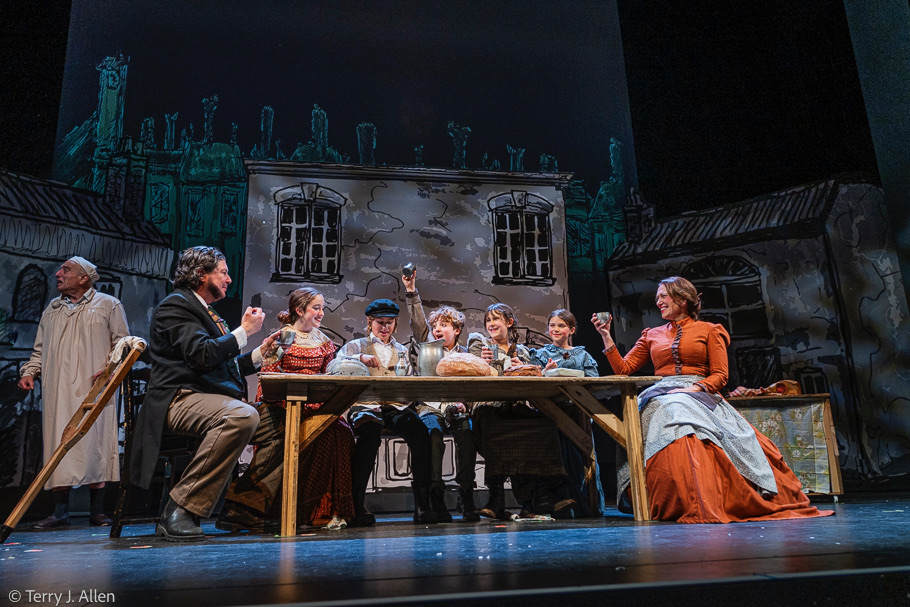
Project grants typically bring in between $1,000 and $10,000. Most of those funds go to the project itself—the sets and the snacks for the play. Like many nonprofits, the organization peels what it can from grants like that to support basic operating costs and staff time, while also landing a handful of operating grants and small donations at events.
The Civic’s role in the 2023 flood response helped spur individual donations, and 20 donors now make monthly sustaining donations totaling about $1,200. “Only recently,” spurred by the building purchase, “have I leaned really hard on learning how to talk to large funders.”
For the first nine months, Friedman worked full-time unpaid. Today she and three part-time staff run the organization, and Friedman acknowledges working well beyond her official hours.
“We want to streamline so we’re not doing the same task over and over again. And at the same time, there’s something about making it really inefficient, impractical, and kind of lumbering that works really well for the mission of the organization.”
People who don’t officially work at the Civic start acting like they do—taking on projects, showing up, shaping the organization’s direction through being there. Friedman welcomes them, and some eventually get hired. “I’m like, oh, you really, really want to be here? That’s great. That is a great reason for you to work here.”
“What can my community learn from ‘the Hardwick blueprint’?”I asked Friedman. “Are you saving Hardwick? Does a teenager having a welcoming after-school spot make them more likely to raise a family here?”
She pauses. “I sometimes have that feeling with specific people and stories.”
One of those stories is the flood. When record rains hit Vermont in July 2023, Hardwick’s town manager called the Civic. The high school needed to become a shelter. Could they help? Within hours, the Civic went into what Friedman calls “community-meal overdrive.” They set up the shelter (which ran for one night), marshaling dozens of volunteers to help with cleanup and home repairs. They delivered free meals daily to affected homes. The Civic didn’t have emergency response protocols. It had the relationships formed by weekly community suppers, dinner theater, and teen D&D meetups.
Here’s another measure of success: “In part because of a play that we did, one woman doesn’t have to do this alone.” A woman who lives alone texted Friedman from the hospital about heart surgery. Someone she’d met in a Civic play helped to organize a meal train. Now she’ll have more company when she gets home. There are also teenagers who know safe adults in the community because they’re always at the Civic. One more person you can turn to when the power’s out, or the road washes away.
“Relationships just make people safer with each other,” Friedman says.
Vermont has that Yankee nativist streak where you often hear a reminder that if you’re not born and raised going back five generations, you’re a “flatlander.” I asked Friedman if, after all the time she’s given her community, she still feels like an outsider. She told me that old-timers have told her about a woman in the 1920s who did “crazy ass parades” in nearby Craftsbury. Someone mentioned a similar project in the ’80s. “I think it’s a very old story that a weird interloper like me shows up with really weird ideas and tries something very experimental. And that’s as important a part of our cultural tradition as the people who keep our houses warm and milk the cows—the people who come in and go, ‘What the f are we doing!?’”
“I’m just a freak,” Friedman told me. “But to be a freak and to get to be yourself and to also be held in love is like the greatest gift that you can be given. And that is such a loving way of being in community with each other rather than having someone say, “you had me fooled. I thought for sure you grew up here.”
The Civic is so thoroughly Hardwick that “blueprint” seems like the wrong word. But I felt it wasn’t any accident that a community play in Vermont was the connection point between two strangers in New York. I felt that Friedman’s questions and her follow-through could be vital to any community.
“Why can’t we help that person? Why can’t they all be in the show? Just ask,” she said. “And when those things are actually felt or said, people’s hearts really open very wide.”
As of this writing, Civic headquarters (and their Pie in the Sky Cafe) are open Tuesday-Friday, 2–5 p.m, and Saturday 10 a.m.–2 p.m. If you visit Hardwick on a Wednesday at 5:30 p.m., all are welcome for a free community supper in the living room on Main Street.


Comments