


It was about two years ago that the global downturn in fertility came onto my radar, as I was trying to reconcile the disconnect between observed population trends suggesting a possible peak before 2050 and UN projections putting it in the 2080s. As made clear in subsequent posts and a video, year after embarrassing year, UN projections kept failing to anticipate tanking fertility around the globe.
The trend really is astounding. Over two-thirds of the world’s population live in countries whose fertility rates have fallen below replacement levels and are generally still declining. In a decade or so, when populations in affluent countries around the world have all peaked and started declining, we’ll realize that we can’t manufacture twenty-something-year-old humans who were never born so that they may pick up the reproductive torch. In this sense, the train has already left the station. Population decline is arriving soon at an affluent country near you. Indeed, it’s already started to decline in dozens of countries, including Japan, China, and Italy.
While these countries are currently buffered by engaging in a still-growing global market, as more join the club there will be nowhere left to hide: the affluent consumer-base will inevitably contract. Add to this an increasing ratio of elder-dependents to working-age people and economies will be circling the drain. Those who worship economic growth are sounding the alarm (e.g., Vance, Musk), justifiable in their panic insofar as money is what matters most. But to the extent that economies wreck ecologies, I’m rooting for the other team—and population decline sounds perfectly peachy, even if the adjustment will be rough.
I can’t tell you how many YouTube videos I’ve watched in an effort to better understand drivers behind these trends. This post was motivated by one such video that seemed worth sharing. The hypothesis involves smartphones, which I had heard before without it making much of an impression: one of many plausible “theories.” Then I saw the data.
What the Videos Say
First, it is worth being clear that I am very selective in what I click to watch. I’m highly skeptical of politically motivated content, which might be biased and contain misinformation that could elude my filters. I also don’t want my YouTube recommendations to become flooded with dubious content, and there’s a lot of pronatal alarmism out there. This means I might dare to click on only one in five (or even ten) videos on the topic. Still, surely I’ve watched a few dozen in the last couple of years.
I largely go for content that is heavily grounded in reporting by people or news agencies that are trying to understand, or at least accurately capture, the phenomenon. At the first (or perhaps second) instance of information I know to be wrong, I’ll often terminate watching. Who knows how much other misinformation I’m not catching as wrong?
As a result, I’ve listened to countless interviews with young people in places like Korea, Japan, Italy, the U.K., and the U.S. about why they are not having as many children. A large number of highly credible factors keep popping up, including:
- Economic stress: hard to make it even without kids
- Housing stress: can’t afford a suitable home for raising kids
- The prospect of competitive child-rearing is stressful and exhausting
- Women want a career and not a man-child plus young kids to raise
- Delays in getting established until it’s too late or too risky to have kids
- Climate change dread: why expose a child to disintegration?
- General existential doubt in modernity’s path
I’m sure I’m leaving some out. The thing is: all these are real, and all operate all at once, together. The phenomenon is multi-faceted. Yet the surprising result is that the trend is eerily similar around the world, despite markedly different cultural values, expectations, support structures, policies, fraction of women in the workforce, educational intensity, etc. It begs the questions: why so universal, and why now? The commonality might suggest other factors such as biological fertility decline—e.g., endocrine disruption from toxins spread around the globe.
Sure, why not. When it comes to this phenomenon, who are we to say “no” to any credible suggestion? The more appropriate response is “Yes—join the club—and what else might be playing a role?”
The New Video
I was intrigued by the 12-minute video titled “Why birth rates are falling everywhere all at once” by the Financial Times. That checks my boxes: a reputable outlet seeking to understand what’s behind the phenomenon. Maybe I wouldn’t learn anything new, but I hoped it might at least be a good synthesis and/or have worthwhile updates on various statistics.
Of all the content I’ve absorbed over the last few years, this one seemed worth sharing as a blog post. It contains lots of graphic data, so I recommend keeping a finger on the pause button to absorb each one before moving along. It was the graphic at around 7:43 that made me sit up straight.
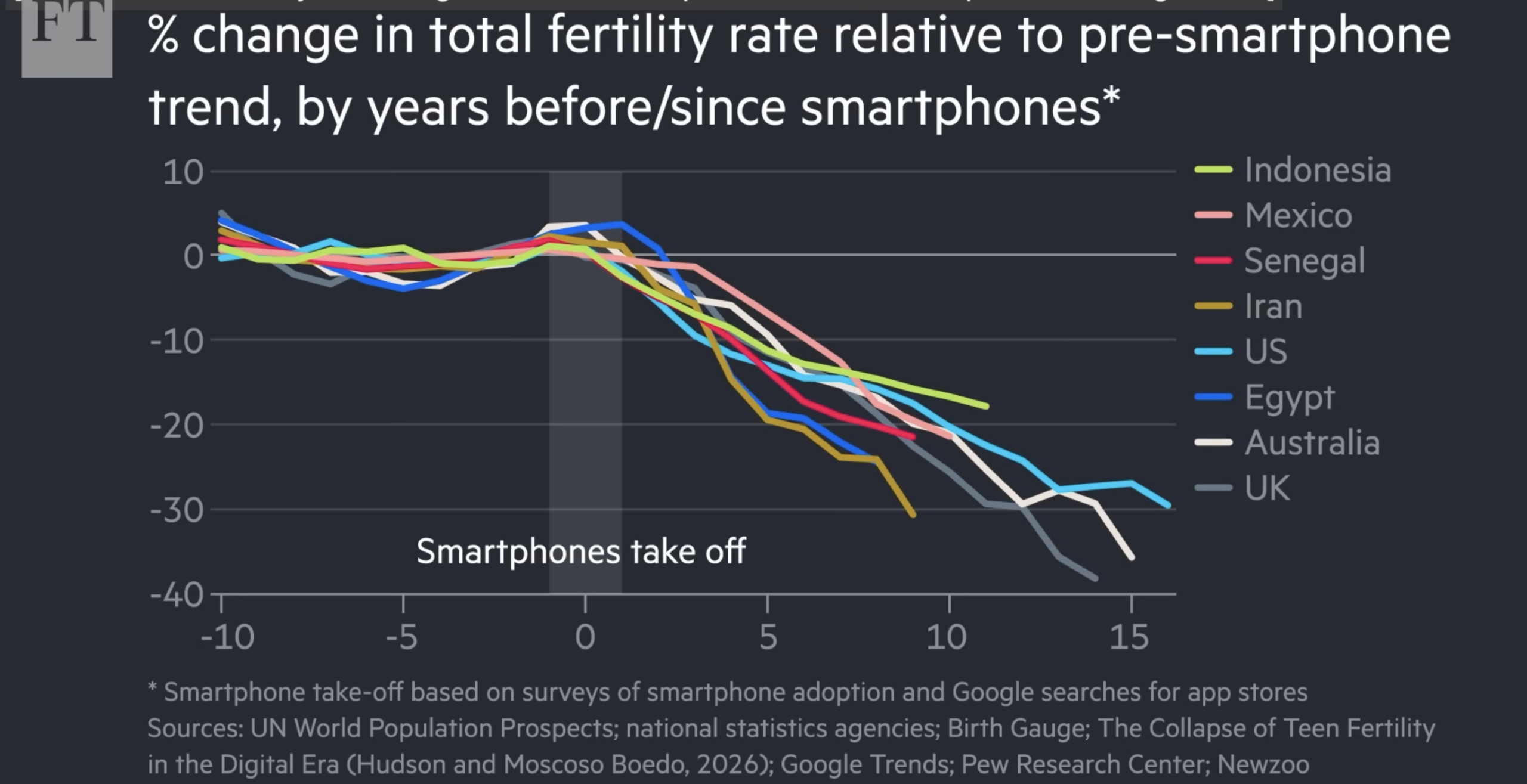
Smartphones broke out at different times in different countries. Affluent countries like the U.S., Australia, and the U.K. were early adopters, while countries like Senegal, Iran, and Egypt were several years later. When aligned with the year of the smartphone breakout, the downward deflection in fertility overlaps astoundingly well.
Admittedly, I have not looked into this personally. How cherry-picked are the countries on the graph? Pedantic reflexes in some people reliably trigger the “correlation is not causation” mantra, which often reminds me of the Vogon guard’s comfort words “resistance is useless” in The Hitchhiker’s Guide to the Galaxy. While caution is warranted, links between the two phenomena are not particularly difficult to spot—as offered in the video.
We all know that smartphone screens grab attention—maybe especially among the young. While it could be argued that dating apps facilitate connection, it is also apparent that smartphones seriously eat into time for personal contact. Moreover, digital profiles are fashioned to provide grossly distorted apparitions of lifestyles, making “real” people (IRL) seem disappointingly dull and pathetic. I could also believe that while dating apps make it possible to swipe through hundreds of potential matches in an evening, the vetting is necessarily both superficial and prone to perfectionism. Anyway, the net effect (at 3:50 in the video) is a decline in the fraction of people who find partners. Fantasize all you want about connective efficacy, but that’s what’s actually happening the world over. Moreover, the correlation is extremely high with declining fertility. And before you ask, I hope you’re able to identify an obvious causative link!
As for cherry-picking countries, I doubt the trend is simply a result of this freedom, because the “downwash” is pretty universal (see plot below), as is the explosion in smartphone adoption around the same time.

Smartphone adoption cuts across cultures, policies, histories, and more in ways that very few “explanations” of such a global trend can account for. Normally, demographic trends reflect slow cultural changes that can be delayed by many decades from one region of the world to another. When Australia and Senegal are on a similar schedule, eyebrows should go up.
Story of the Century
Besides the story-of-the-millennium headline I propose should plaster every newspaper in huge font every day—SIXTH MASS EXTINCTION STILL UNDERWAY!—I believe the fertility drop (and the population decline to follow) is the story of the 21st century. We all know by now that modernity fails, right? But how? Will it be resource limits, climate change, biodiversity collapse, nuclear war, or what?
For most of the last two decades, I believed resource limits would drive the show: peak oil, peak transportation, peak materials, etc. All of this is completely valid over a long enough timescale (still short in ecological terms). But never underestimate modernity’s canny ability to source what it needs by hook or by crook—kicking the can down the road no matter the damage. Sure, it can’t do so indefinitely, but don’t count out squeaking through this century—tolerating even the fallout of climate change.
Ecological collapse certainly has the prerogative (and mandate?) to upend modernity’s grand plans, in ways that I am—and basically every human is—too ignorant to spell out. I mean, if continuing on the current trajectory, the developing sixth mass extinction is going to terminate modernity at some point—yet the how and when is beyond our ken.
But here comes the fertility crunch. It’s basically baked in now, and operates on few-decade timescales. Human population will crest this century, and most likely in the next 10—15 years in the “affluent” (market-driving) two-thirds of the world. Growth-based economies (i.e., all of them) will convulse in a death rattle. Schools will shutter for paucity of kids. Pensions, social security, and medical coverage for the elderly—based on growth models—will evaporate. Supply chains will falter. Institutions will scale down and flicker out in ragged disharmony. Investment in a “bigger” future will dry up. Currencies may go apoplectic, so that precious metal coins see a (temporary) heyday before they also lose value when markets fail more generally (little left to buy; and the spell will be broken, by which we all agree, that metal coins represent value). To the extent that bleak economic prospects or existential concern currently suppress fertility, you ain’t seen nothing yet. The fertility decline seems most likely to exacerbate itself before it turns around.
On the other hand, to the extent that smartphones and screens in general contribute to low fertility, these will fade as personal interactions rise and people are appreciated for their real (as opposed to digitally skewed) qualities. Fertility will eventually rebound. But it will do so in the context of increased death rates and infant mortality as well, when advanced medical access is another inevitable victim of simplification.
In any case, I seriously doubt the music will start back where it left off. The world will be transformed and singing an entirely different tune. Local replaces global. Permanent damage to institutions and infrastructure renders them defunct and obsolete.
Obviously, the picture I paint above is highly speculative, as what’s coming is entirely unprecedented. Still, I would call it fairly plausible. I do believe that a population contraction with no end in sight (over a few-decade time frame) has tremendous power to transform the modern world into something barely recognizable—and quickly, given the volatile, nonlinear dynamics involved. The phenomenon can be far more impactful than resource limits, and faster than ecological disintegration. The lie will be exposed: growth is temporary; economies are fragile; institutions are more hollow than they seem; political arrangements evaporate once faith is shaken; money is a fictional game requiring agreement on the rules. We will never be the same. And it’s basically already happened via the generational deficit planted over the last 10–15 years (and still going strong)—but most people don’t know it yet.





Comments
We changed commenting systems on September 10, 2026 as part of a site-wide functionality and security upgrade. Your past comments have not disappeared, and you can still log in with your old Disqus account credentials if you wish. Contact us with any questions.
Good news, but a few-decades timescale is still very slow to arrest the harms of modernity, which are still going up exponentially. I'm still hoping for other causes to precipitate collapse sooner and more quickly. There are plenty of possibilities.
No need to wait until 2050 or 2080 to see what depopulation looks like. It's already here. Thousands of K-12 schools have closed due to low enrollment. 300 so far this year (6 in CA). Private colleges shuttering. State universities cutting faculty and programs. Deaths exceed births in 15 states. Scores of towns disincorporated from too few citizens.
Lots of towns and cities in Europe hollowing out. Some interviews with remaining residents should offer a preview of post-modernist life.