

In the early 2000s, research carried out by biologist Lynne Sneddon revealed a striking pattern. Rainbow trout injected with a weak acid in their lips rubbed their mouths against the tank, rocked from side to side, and ignored food they would normally snap up. But when the fish were given morphine, they mostly went back to behaving as usual. The finding cracked open a long-standing assumption, both in science and in society, that fish cannot feel pain.
For decades, the logic seemed straightforward: if fish lack the capacity to perceive pain, how could they have any conscious experience of it? They were often treated as reflex-bound creatures, bodies without minds. Yet, study by study, from anatomy labs to behavioural experiments, and in the body of work later popularised by Victoria Braithwaite, mounting evidence to the contrary has emerged.
Today, many researchers argue that the case is strong: fish feel pain. Calling into question the ethics of how we produce seafood. When over a trillion fish are killed each year in farms and fisheries, the issue takes on a moral dimension we can no longer ignore.
To understand why scientific thinking has shifted, it helps to look beneath the scales. Pain in any animal begins at the surface, with specialised nerve endings called nociceptors that detect physically harmful sensations like heat, intense pressure, or corrosive chemicals. For years, skeptics claimed fish didn’t have these cells. Now we know they do. In rainbow trout, for example, nociceptors are present in the lips, snout, and skin. When exposed to vinegar or bee venom, these nerve fibres fire off signals that travel through the nerves into the spinal cord and up to the brain. Put simply, fish have the wiring for detecting harm.
The brain that receives those signals is different from ours, but not dormant. When scientists recorded neural responses in goldfish and trout after exposing them to painful stimuli, the fish’s forebrain responded to injury in ways that suggest more than a simple reflex was at work, and the basic brain chemicals involved in feeling pain are remarkably similar across species.
And the story doesn’t end there. In another experiment, researchers found that when fish are given morphine, a powerful painkiller that acts on their nerve cells, pain-related behaviours diminish. Anesthetics have also been found to reduce pain-related responses in fish much as they do in other vertebrates. Demonstrating that the molecular machinery for feeling pain is deeply embedded in vertebrate evolution, and fish have it.
The cognitive abilities of fish are also much more sophisticated than we once assumed. They can learn from experience, and some species are surprisingly good at telling things apart. Archerfish, for example, can be trained to distinguish human faces. Zebrafish pick up on the distress of others and show signs of social fear spreading through a group. None of this proves that fish feel pain, but it does reveal animals with rich learning abilities and complex social lives. The more we learn about fish intelligence, the less credible the old assumption of reflex-driven creatures becomes.
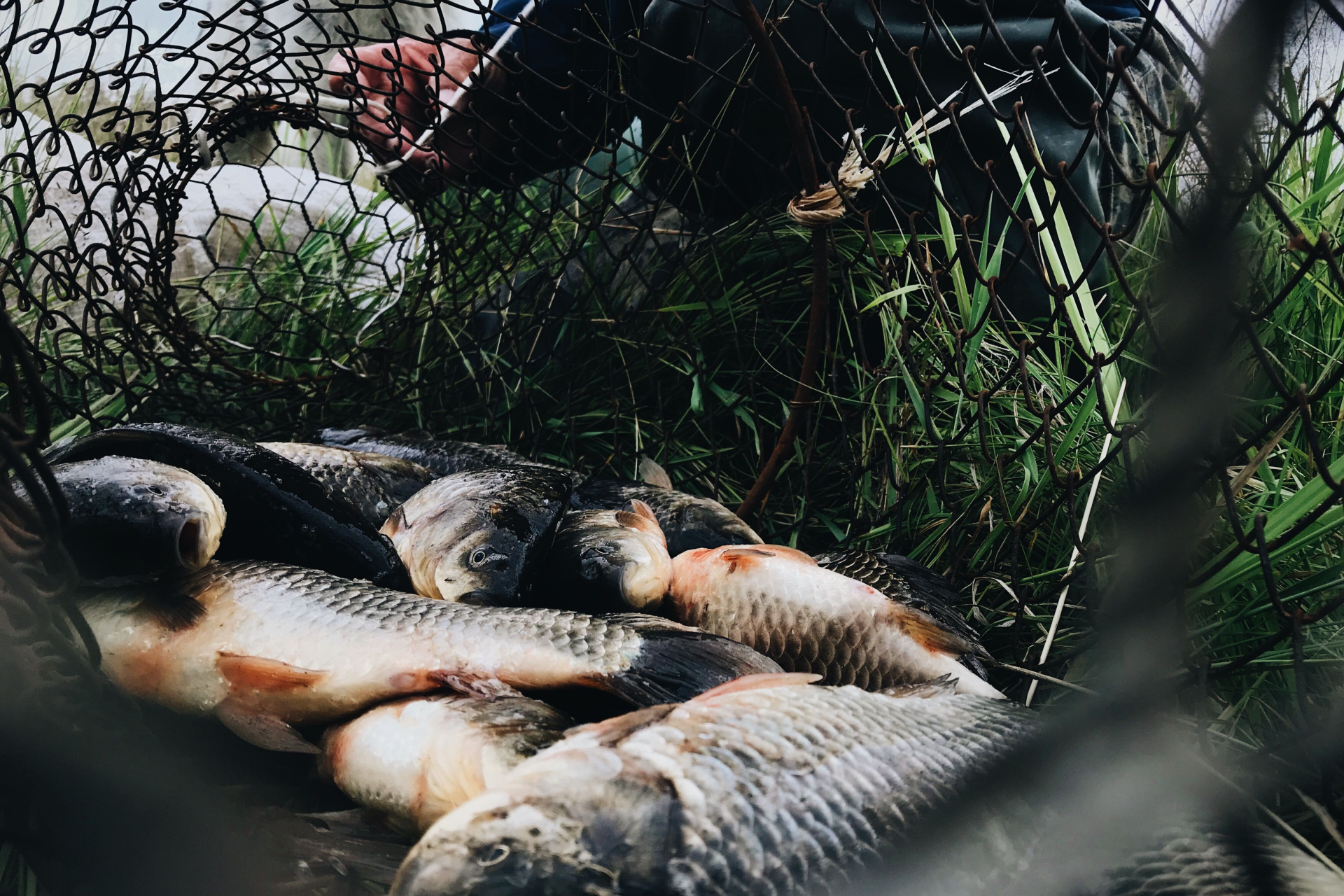
Accepting that fish are sentient reframes the seafood industry. If fish can feel pain, then standard practices in commercial fishing and farming raise serious ethical issues. Predominant slaughter methods can be characterized as highly inhumane. Fish are typically killed by air asphyxiation – pulled from water into open air (or occasionally into ice slurry) and left to suffocate. A rainbow trout removed from water will thrash and gasp before slowly falling still. On average, it takes around 10 minutes for trout to lose consciousness this way, with some individuals enduring more than 20 minutes of moderate to extreme pain before death. Unlike factory-farmed livestock such as cows, pigs, and chickens, fish are rarely rendered unconscious before they are killed.
Slaughter is only the final step in a farmed fish’s experience. The moments leading up to death can also be fraught with suffering. During harvest, fish are usually crowded into nets or pumps and pipes, forced from ponds or sea cages onto boats or into processing facilities. In those moments, fish can collide with each other and with hard surfaces, sometimes causing injury. Oxygen levels in the water can plummet due to crowding, and crowding itself is a well-established stressor that elevates cortisol and other physiological stress markers in fish. By the time a fish actually reaches the point of slaughter, it may already have experienced a prolonged period of panic, injury, and asphyxiating conditions.
Some experts believe that this pre-slaughter phase may cause more suffering than the moment of killing itself. And unlike a cow or chicken, which in many jurisdictions is at least rendered insensible at the point of slaughter, a fish may be conscious and distressed throughout.
Wild-capture fisheries present an even starker welfare picture. Wild fish are caught by the trillions each year, hauled from the ocean in enormous nets that crush and wound them, then dumped onto ship decks to flop and slowly die by the thousand. Trawl nets can add further trauma: when fish are dragged up from depth, the rapid change in pressure can rupture their swim bladders or internal organs.
Unlike farmed animals, wild fish are almost entirely outside the reach of animal welfare laws. There are generally no rules requiring fishermen to handle or kill wild fish humanely. A cod or mackerel pulled from the sea is treated as a flopping piece of meat.
While roughly 70 to 80 billion chickens, pigs, and cows are killed each year globally for food, fish are killed in the hundreds of billions to trillions per year. But the suffering, mostly out of sight offshore and underwater, is vast and largely invisible.
If fish are sentient beings, then the way we produce and harvest them constitutes one of the largest animal welfare issues in history. Seafood consumption has roughly doubled since the 1960s. The average person today eats over 20 kilograms of aquatic animal products per year – more than twice the amount consumed half a century ago. Fish farming now supplies more than half of global aquatic animal production, a monumental shift from a few decades ago, when the vast majority came from wild capture. And the growth in fish harvesting shows no sign of slowing; it’s one of the fastest-growing sectors of food production.
Back in the laboratory, trout given morphine when subjected to pain returned to their normal routine, swimming and feeding. For the scientists working on fish pain, the lesson was clear: fish can feel. For society, the implications of that lesson are still unfolding.
Trillions of fish pass through human hands each year, and the science of their sentience is now substantial. What lags is our willingness to act on that knowledge. We can continue to treat fish as silent, unfeeling resources – to be piled in nets, suffocated, and ignored. Or we can bring our practices into line with our science and ethics, reducing suffering through changes in laws and practices or even reducing our fish consumption.
Where fish are still farmed and caught, some of that suffering is avoidable now. Electrical and percussive stunning can render fish insensible before killing, sparing them the prolonged asphyxiation that standard methods involve, and a growing number of producers and certification schemes have started to require it. Reforms like these don’t settle the deeper question of whether we should be farming sentient animals at all, but they cut measurable suffering for the fish already in the system.
Companies developing fermentation-based seafood, using fungi or algae to create proteins that mimic the texture and flavour of fish, offer alternatives to animal products, while plant-based options are also improving.
No one expects these to replace conventional seafood overnight, but together they broaden the menu. If even a fraction of the world’s seafood can be supplied by non-animal or lower-pain methods, billions of fish could be spared from suffering.
The first step is recognition. The next is responsibility. Fish feel pain. What we do with that knowledge will shape the future of our relationship with the oceans – and the future of our food.
Shrilaxmi Patil is a researcher at Ethical Seafood Research, focused on animal welfare in aquaculture. She has a master’s in physics and has worked in animal welfare across several organisations. She’s particularly interested in improving the sector’s infrastructure, including its talent and funding.





Comments
We changed commenting systems on September 10, 2026 as part of a site-wide functionality and security upgrade. Your past comments have not disappeared, and you can still log in with your old Disqus account credentials if you wish. Contact us with any questions.