

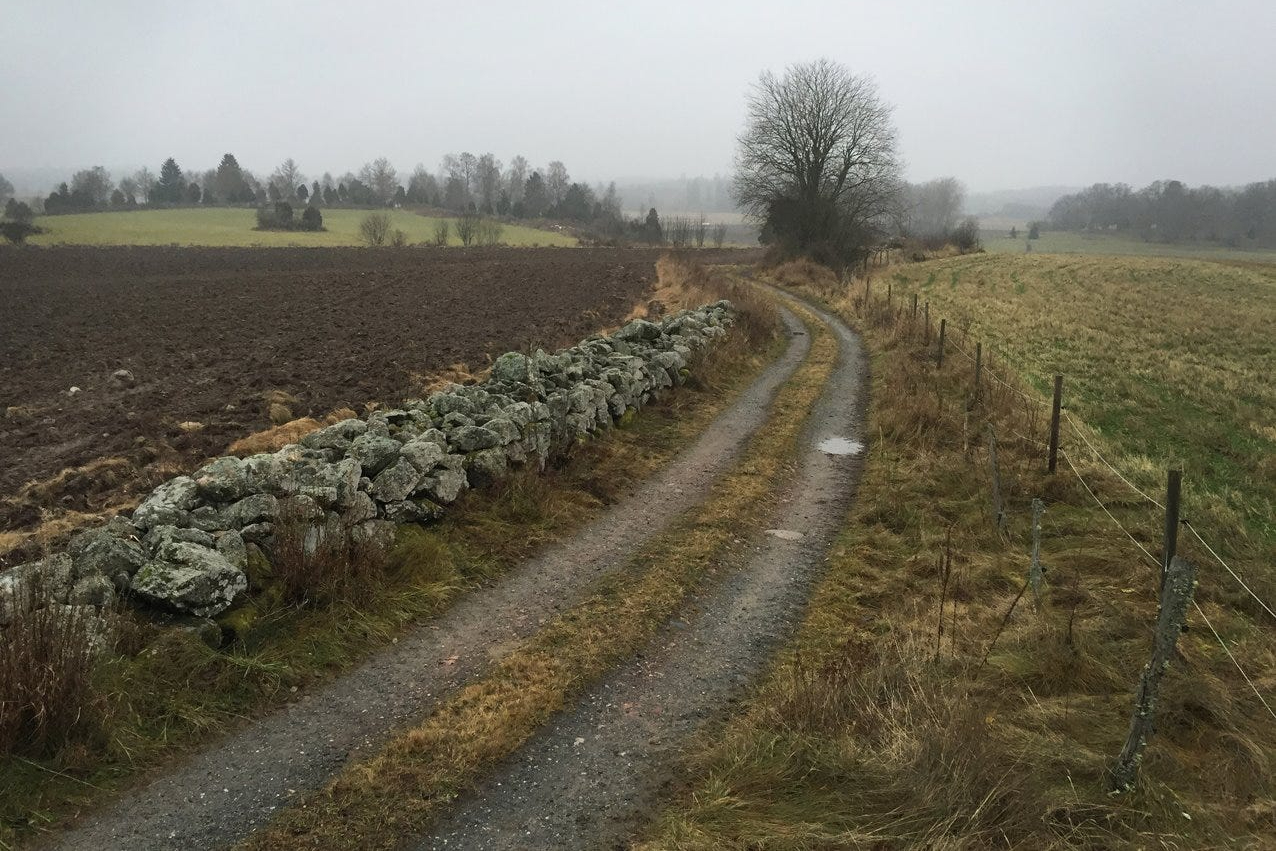
I guess you have heard about Astrid Lindgren. She wrote children’s books, perhaps most famously Pippi Longstocking, an anarchist girl with superpowers. She didn’t only care for children, she also cared for animals and was at times very active in animal welfare issues. So much that the Swedish law for animal welfare of 1987 was presented at her 80th birthday and named Lex Lindgren. That law was, at the time, probably the strictest animal welfare law in the world. Among many other rules, it gave breeding cows the right to graze, i.e. it was prohibited to keep them indoors all year round. It also included a phasing out of cages for hens (which took a lot longer than planned to realize; the first 2003 was the year the ” traditional ” cages were banned).
Since Lex Lindgren, dairy farms have increased in size, management systems have changed (e.g., with robot milking), and the bigger dairy farms are now in the plains where most land is arable, as opposed to earlier when they were predominantly in mosaic landscapes with pastures, cropland, lakes, wetlands, and forests. There is now an intensive lobby to get rid of the right to graze for dairy cows. It is simply not doable for stables with 2,000 cows, the argument goes, and the modern stables are so spacious and well ventilated that it is much better for the cows to be indoors, protected from rain, sun, wind, flies and mosquitoes. The fact that pasture is not rich enough to support a milk yield of 14,000-15,000 litres per year is not so often spoken of, and neither is the fact that it is more work to organise grazing. Interestingly, on neither side of the debate is there much talk about grazing as the most basic cow behaviour. It is not only a matter of ingesting a certain amount of feed, or getting exercise. Grazing is much more; it is more or less the essence of being a cow.
Anyway, to the point. Astrid Lindgren is a red flag for proponents of industrial agriculture, in particular animal agriculture. Apart from Pippi, she also wrote several books where the landscape, people, and animals of her youth, i.e., in the 1920-30s, were central, e.g., four books about the six Bullerby (“the noisy village”) children. In an article in a leading Swedish newspaper, three representatives of industrial agriculture recently referred with scorn to organic farming as Bullerby dreams and claimed that organic was a return to a time when people starved. Obviously, representatives of organic agriculture responded and assured that they were not backward Luddites.
A friend of ours, Tobias Nilsson, called and discussed with my wife, Ann-Helen, whether we should not defend Bullerby farming. Instead of trying to distance us from the farming system 100 years ago, we should point to all its merits – obviously not without also pointing to some weaknesses. Ann-Helen took the lead and the result was published in Aftonbladet with the title (in translation) Industrial farming is a story with no happy ending. The Swedish agricultural system of the 1930s was diverse, and virtually every one of the 400,000 farms had a cow or five, grew potatoes, kept laying hens and grew most of the feed for their animals and most of the food for the people. There were basically no tractors or combine harvesters, but there were many horse- or oxen-driven machines as well as threshers and other stationary machines (powered by electricity) in the farmsteads. Chemical fertilisers were in little use and pesticides even less. Grain yields were considerably lower, but total milk production was actually much higher than today (despite half the population). Butter was exported, and some oilseed cakes were imported, mainly to feed dairy cows. Not only were the farms spread out across the country, but so were dairies, mills, slaughterhouses, and other essential infrastructure. The system was robust and productive, producing sufficient food for the population.
Many children grew up in Bullerby-style conditions, for the better and the worse. Around 40 percent of the workforce was in agriculture, slightly more than in industry. The share of income used for food was obviously a lot higher, and people lived shorter lives, but not because they lacked food. The working conditions were not always so good, neither for the farmers nor the farm labourers.
I believe it is time to call the modernist bluff. It is true that industrial farming produces cheaper agricultural commodities. It is the main thing it is good at. That is at the expense of the environment, health and people. Ultimately, it is also not beneficial for farmers at large and certainly not for the majority of them who have to quit farming; because for every farmer getting bigger, there is one losing her livelihood. On a system’s level, the effect of “efficiency” is just lower prices, which causes the farmer to invest more in order to bring costs down, which causes prices to drop and more farmers to quit, and so the treadmill goes on and on and on.
“For every farmer getting bigger, there is one losing her livelihood.”
Industrial farming will not generate any children’s stories; it will only generate ugliness, destroyed environments and a continued emptying of the farmed landscape.
They know it, which is why they have to portray Bullerby farming, or any equally simple, small-scale farming system, as inefficient and people being worked to death. This is why they portray organic farming as leading to starvation. But small-scale agriculture is no less productive per area unit than bigger-scale. It is obviously a lot less productive per man-hour; the whole project of industrialization of agriculture is to lower labour cost per unit produced and not to produce more per se. Organic agriculture is indeed less productive per area unit than conventional agriculture, but it is less dependent on external inputs and it is much more robust.
Small-scale organic farms can produce food instead of commodities. It allows more people to be engaged in food production. That is the real dividing line. It is a nice story as opposed to the nightmare of industrial agriculture.


Comments
We changed commenting systems on September 10, 2026 as part of a site-wide functionality and security upgrade. Your past comments have not disappeared, and you can still log in with your old Disqus account credentials if you wish. Contact us with any questions.
I loved this, including the information about Astrid Lindgren, and calling Pippi an anarchist–yes! That's exactly what she was! Fictional, but also subversive, as with the neighbor kids Annika and her brother whose name I forget.
I am currently out driving around South Australian countryside delivering Census forms for the Australian Bureau if Statistics. I live on a rural property here but it has been a shock to see first hand the emptying out of the farming landscape. About 50% of farm houses are empty and/or abandoned. The farm having been sold/subsumed to corporate farming. Workeds live in town and drive in and out. Everything is quiet and lifeless. Soulless. Huge broadacre farms with thousands of acres dedicated to monocrops. Countless centre-pivots of huge size drawing water from the aquifer. It has been a very depressing week.