

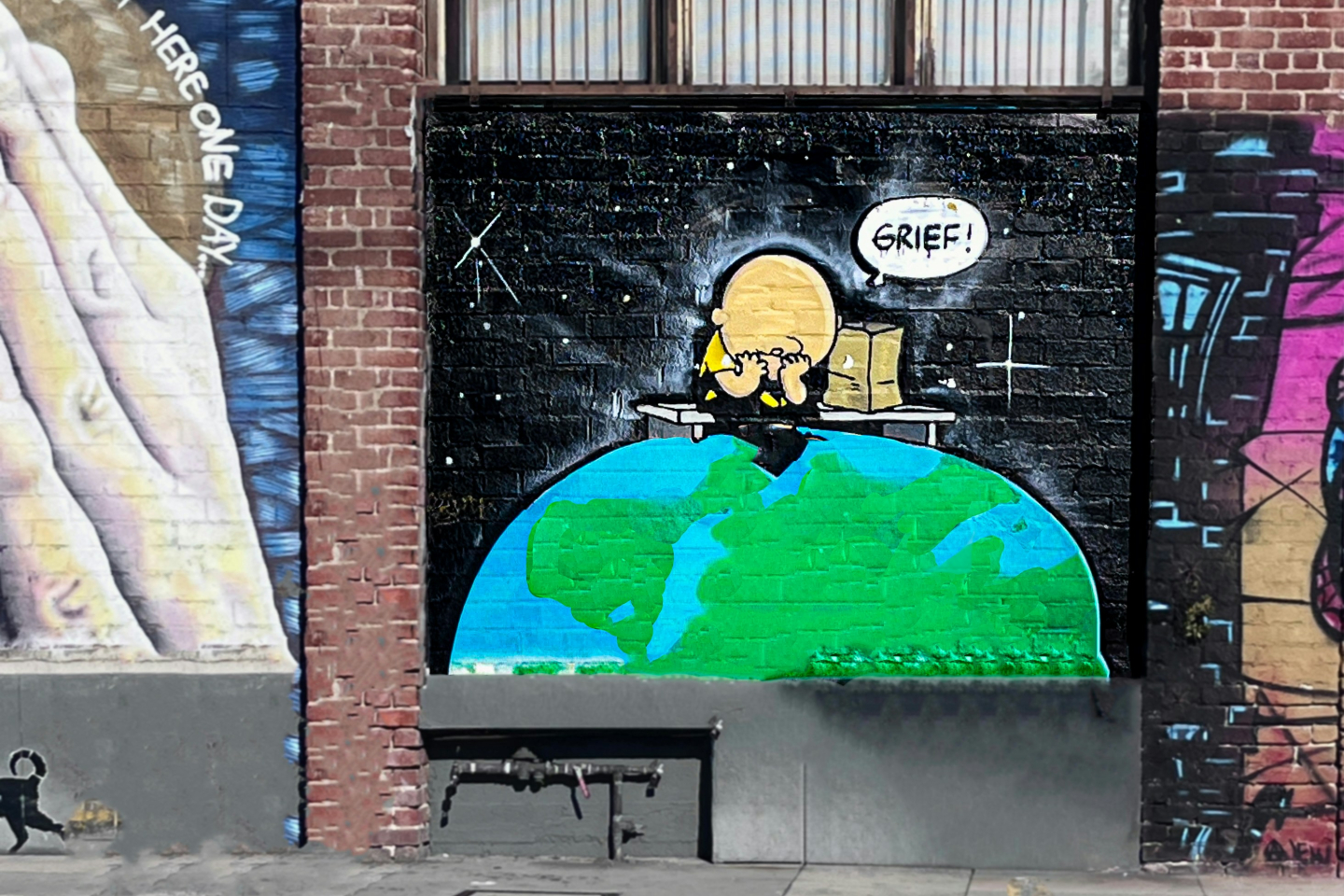
There is a certain kind of sadness that comes with working in the climate space. I know I am not the first to notice. Some have called it “eco-anxiety”, “eco-stress” or even “pre-traumatic stress”. As a climate communicator myself, naming this sadness has always felt right, and yet somehow the terminology has always felt off. Now that I have been studying grief, I am finally able to put my finger on it.
For decades climate professionals and the informed public have been living with the disturbing knowledge of what is coming. And now, as the impacts of climate predictions begin to come true, we live with the devastating reality of what is happening.
This brings profound pain. Pain for the loss of human and other living beings, as well as the destruction of our sentient landscapes. Pain for lives we thought we would lead and cannot. Pain for the damage our descendants and future generations will inherit. And with all this, we carry the anger, shame, and guilt of being unable to change it. We have been informing, reasoning, nudging, pushing, shouting, and howling for as long as we’ve been in this fight. Some of us for a few years, some of us for decades. But we all feel this rage that we haven’t gotten through fast enough or far enough.
All this we carry in our bones, at our very core. Both to our detriment and to our advantage. It hurts us, but it drives us. If it didn’t, we would not be able to do the work day after day, year after year. We know every effort counts; every tenth of a degree of warming avoided saves lives, species, and ecosystems.
And yet, we know what is coming and we feel it deeply. This sorrow deserves a name. But calling it “eco-anxiety” or “pre-traumatic syndrome” does not do it justice. Both of these terms pathologize a very human and natural feeling. They somehow make it akin to PTSD and turn it into a disorder to be treated, rather than a process to be honoured. They deny the humanity behind this sorrow, and loosen its profound link with our shared dignity, compassion, and love for the Earth.
I believe this pain is not a syndrome. It is grief.
When you walk with grief, as all of us do at some point in our lives, you realize that it is the flip side of love. The two cannot be disentangled. When we lose what we love, our heart’s natural response is grief. Grief is the imprint love leaves on our lives.
Recognizing our pain – this Earth Grief, as Francis Weller calls it – as grief, connects us to the love that underpins it. It is not the product of a probable traumatic event in the future, but rather a reflection of our profound connection to the land, to the ecosystems that sustain it, and to the people who inhabit it, past, present, and future.
Of course, Earth Grief is complex, and it does not necessarily fit the familiar shape of grief. When most people (even those working on the climate crisis) hear the word grief, they associate it with the mourning of a personal loss, like the passing of a loved one or the end of a relationship. They do not associate it with the sorrow we carry for the Earth itself. Only a few scholars, activists and climate professionals have recognized and labelled this pain as grief. Earth Grief is not yet mainstream. In fact, it is still very much a disenfranchised grief that is often dismissed, or worse, pathologized and weaponized.
It is both a grief for what has already happened – like the disappearing Pacific Islands, increasing natural disasters, and the mind-boggling inability of world leaders to act urgently and decisively – but also a grieving of what is yet to come. This, too, is grief. Grief is not always a response to a loss; it can also be in anticipation of one. This is called anticipatory grief. It often happens before we lose a loved one – who may be terminally ill, for example – but in this case, it encapsulates exactly what we might be feeling for the Earth.
And it also is grief that is uncertain, because we don’t know exactly what may happen in the future. We understand that the world is shifting and that the data is unequivocal about the direction of travel. But science teaches us to be cautious. This uncertainty freezes us in an agonizing waiting game. This, too, is grief. We know this as ambiguous grief, or the grief that arises when a loss is unclear. Again, it is commonly associated with loved ones who are psychologically absent, but it clearly describes one of the many facets of Earth Grief.
While all this points to the complexity of Earth Grief, the good news is that the simple act of recognizing our pain as grief is already a tremendous step towards processing it.
Calling it Earth Grief and normalizing it as a form of grief gives us much more powerful tools than pathologizing it ever could. The tools we use in grief work honor its complexity, foster healing, and even inspire action. They nurture emotional and creative expression, community support, ritual and ceremony, creating connections with nature, and collective action.
By walking with Earth Grief, rather than treating it, we focus on the process of meaning-making. This not only makes us stronger and more resilient as individuals, but it also strengthens our collective response to future traumatic events. Science tells us that people with strong safety nets and emotional resilience may not only recover more quickly from PTSD, but they are also less likely to suffer from PTSD after a traumatic event. So, by calling this pain grief and creating community around it may even help build the supportive social, cultural and societal context that could combat the very real PTSD that communities around the world are already experiencing and will continue to face, as the impacts of climate change intensify.
Importantly, recognizing our pain as grief allows us to come full circle back to love. If grief and love are two sides of the same coin, then acknowledging the experience of Earth Grief deepens our love. It invites us to cherish every moment with this unique blue planet and recognize its fragility. It calls us to honour our shared humanity and walk boldly together.
Maybe calling our pain grief doesn’t just help us heal today and soften the blows of tomorrow; maybe it also holds a quiet power that reconnects us with our humanity and guides us toward choices that avert the harshest impacts of the climate crisis in the future.
If this resonates, my appeal is that we start normalizing our pain and call it grief in public spaces. If we can honour our grief and share it with one another, we build community, resilience, and connection. Let us learn from our grief and use it to transform not only our attitude towards our pain, but also our apathy towards our own power to influence change. By acknowledging our grief, we acknowledge our love. And love moves mountains.





Comments
We changed commenting systems on September 10, 2026 as part of a site-wide functionality and security upgrade. Your past comments have not disappeared, and you can still log in with your old Disqus account credentials if you wish. Contact us with any questions.