

A YouTube film by Kirsten Dirksen and Nicolás Boullosa for faircompanies, featuring Nicolette Zatarain and Ian Zatarain of The Mojave Center. Released Apr. 26, 2026. Running time: 30:50. Watch on YouTube.
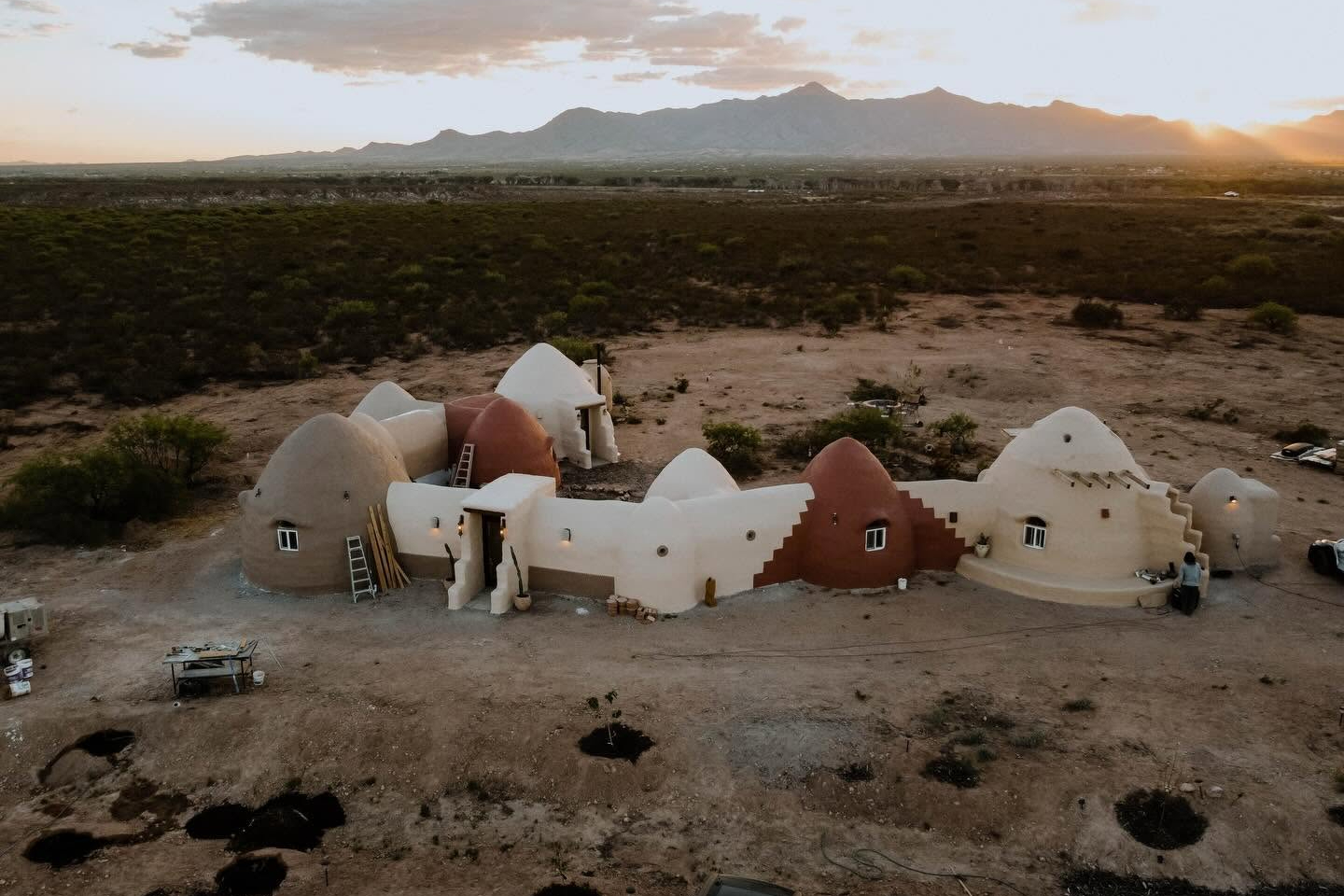
In the Arizona desert, near the U.S.–Mexico border, a small community consisting of a network of interconnected, multicolored earthen domes, courtyards and tunnels built with little more than dirt and sandbags, is quickly taking shape. Founded by Nicolette Zatarain, a former architect, and her partner Ian, the project, known as The Mojave Center, offers an alternative way of life for people in search of eco-friendly — and affordable — living. In an independent documentary produced for YouTube, filmmaking duo Kirsten Dirksen and Nicolás Boullosa offer viewers a walkthrough of the superadobe-built community on their channel.
From a distance, the Mojave Center looks like one of those ball-and-stick models of a molecule we’re all familiar with from school. Nicolette, one of its chief builders, takes Kirsten and Nicolás through the site, offering an inside view of its evolution, design logic, daily rhythms and the construction methods used to make it. In their video titled “Couple builds homestead of 12 earthen domes linked like private village“, Kirsten is both observer and interviewer, while Nicolás films and occasionally provides commentary.
The complex has a dozen domes, each serving a different purpose: there are bedrooms, bathrooms, a kitchen, a laundry room and communal living spaces. Nicolette and Ian built much of it themselves, with help from volunteers and students in workshops they host on the property. They built it using a technique called superadobe, which involves coiling layers of earth-filled bags into domed forms. Walls consist of stacked earthbags, reinforced with barbed wire, and coated with clay plaster and lime stucco. The domes can cost as little as $2,000, which Kirsten notes is far less than the cost of a storage shed. The domes use passive design to stay naturally cool in the hot climate, but they’re also outfitted with modern amenities like plumbing, electricity, appliances and flushing toilets.
The domes also have many unique handmade features. Much of the furniture is sculpted directly into the architecture itself. Benches, counters, shelving and even sofas are formed from earthbags and plaster rather than brought in afterward. Nicolette describes how shelves and other fixtures are attached to the walls through rebar rods that tie directly into the earthbags. She also shows off decorative details like stained-glass inserts that cast colored light into the rooms, built-in lighting designed to resemble movie theater lights, and hand-crafted earthen floors with their distinctive reddish-pink tones.
The shower dome is particularly impressive. Nicolette showcases its cobblestone floor, made of smooth stones collected from the property. She says it drains exceptionally well and is comfortable to walk on. The shower’s interior walls are coated in a traditional Moroccan tadelakt plaster that is both waterproof and aesthetically appealing. Soaps are kept on another of those floating shelves secured directly into an earthbag wall with rebar. The end result feels less like a rustic off-grid bathroom and more like a carefully designed, arty, eco-friendly spa.
Further into the film, we see that building the domes has been an iterative process. Mistakes have been made along the way. A structural berm meant to double as an outside bench ended up too low to the ground for people to sit on comfortably, prompting Nicolette to make future bench berms higher. An early attempt at an earthen floor deteriorated because it was not sealed quickly enough, necessitating a new finish coat. A shower skylight design failed to perform as intended and will have to be patched and reworked. In Nicolette’s words, the house is “kind of alive,” evolving as its builders learn what works and what does not.
The domes often feel less like rooms than like inhabitable sculptures. Their curved walls, low archways and rounded passageways create a sense of enclosure that is difficult to achieve in rectangular modern homes. Nicolette repeatedly describes certain domes as feeling “safe” or cave-like, and indeed the soft contours, filtered light and absence of hard corners give many interiors a strangely calming quality. It is as if the architecture is designed to evoke a particular emotional experience of living.
A big part of what makes this video so compelling is the variety of ways Kirsten and Nicolás find to make it visually interesting and informative. They make excellent use of sweeping aerial shots to show us the exterior, along with intimate handheld footage to guide us through the interiors. They also show us construction footage recorded by Nicolette and her collaborators during the building process, so that as she describes the process to the filmmakers, we’re able to follow along visually as well. Nicolette herself contributes to the film’s visual richness by way of a presentation, projected from her phone onto an interior wall of one of the domes. This presentation has schematics, construction photographs and archival footage that reveal how the domes and connecting passageways gradually took shape over time.
This eagerness to share information is illustrative of how this dome complex is not simply a home but also an educational center. By the film’s end, the domes feel less like a private retreat and more like a living demonstration site designed to inspire and train others interested in superadobe construction and alternative architecture.
Nicolette also tells Kirsten about their future plans for the property. We see schematics showing planned additions, including more domes, expanded gathering areas and a swimming pool built from the excavation pit where much of the dirt for the earthbags was sourced. She describes how they envision the homestead not just as a habitat for humans but as a way of giving back to the Earth. She shows how gray water from sinks, showers, and laundry is redirected through drainage systems to water mesquite and ash trees, which play a crucial role in restoring the barren desert landscape around the domes.
She also talks about the domes’ historical influences. We learn they were largely inspired by the work of architect Nader Khalili, who, in turn, drew on ancient earthen domes and vaulted structures from Iran and Iraq. The domes also bear similarities to the kasbahs of Morocco, with their clustered living spaces, courtyards and winding passageways. We’re reminded that this complex is not merely an eccentric experiment in alternative housing but part of a much longer global tradition of building durable earthen homes.

The film is a bit light on the practical details of how the homestead actually functions on an infrastructural level. We learn that the domes are fully off-grid and equipped with electricity, plumbing, hot water, and modern appliances, with passing references to solar power, septic systems, and gray-water irrigation. But these systems are mostly alluded to. The documentary never fully explains where the property’s water comes from, how its electrical systems are configured or what kinds of technical challenges come with sustaining an off-grid compound of this scale in the desert.
Another thing the film leaves somewhat underexplored is the broader financial reality of living this way over the long term. Nicolette discusses the relatively low cost of individual domes, but the film never fully breaks down the total expense of the entire complex once land, infrastructure, tools, plumbing, solar systems, permits and years of labor are taken into account. We also hear little about the practical difficulties of maintaining earthen structures in changing weather conditions or managing an off-grid property over time. The film briefly acknowledges permitting issues, but it does not examine the legal and logistical obstacles that might prevent many people from attempting something similar themselves.
But overall, this is a great watch: visually beautiful, informative, thoughtful and inspiring. It succeeds both as a tour of a unique building project and as a portrait of people trying to create a different way of living. If you’ve never heard of superadobe building before, it will leave you thinking differently about architecture, space and what a home can be.
Watch the video on YouTube:
Kirsten and Nicolás, known for their intimate, immersive documentaries on experimental housing and off-grid living, founded their independent media project, faircompanies, in 2007, which has since become one of the largest independent video archives of alternative housing and sustainable living worldwide. Their YouTube channel publishes a video almost every week, with recent entries featuring underground maze homes, do-it-yourself food-forest villages and a multi-family homestead built inside a Titan II missile silo.


Comments
We changed commenting systems on September 10, 2026 as part of a site-wide functionality and security upgrade. Your past comments have not disappeared, and you can still log in with your old Disqus account credentials if you wish. Contact us with any questions.