

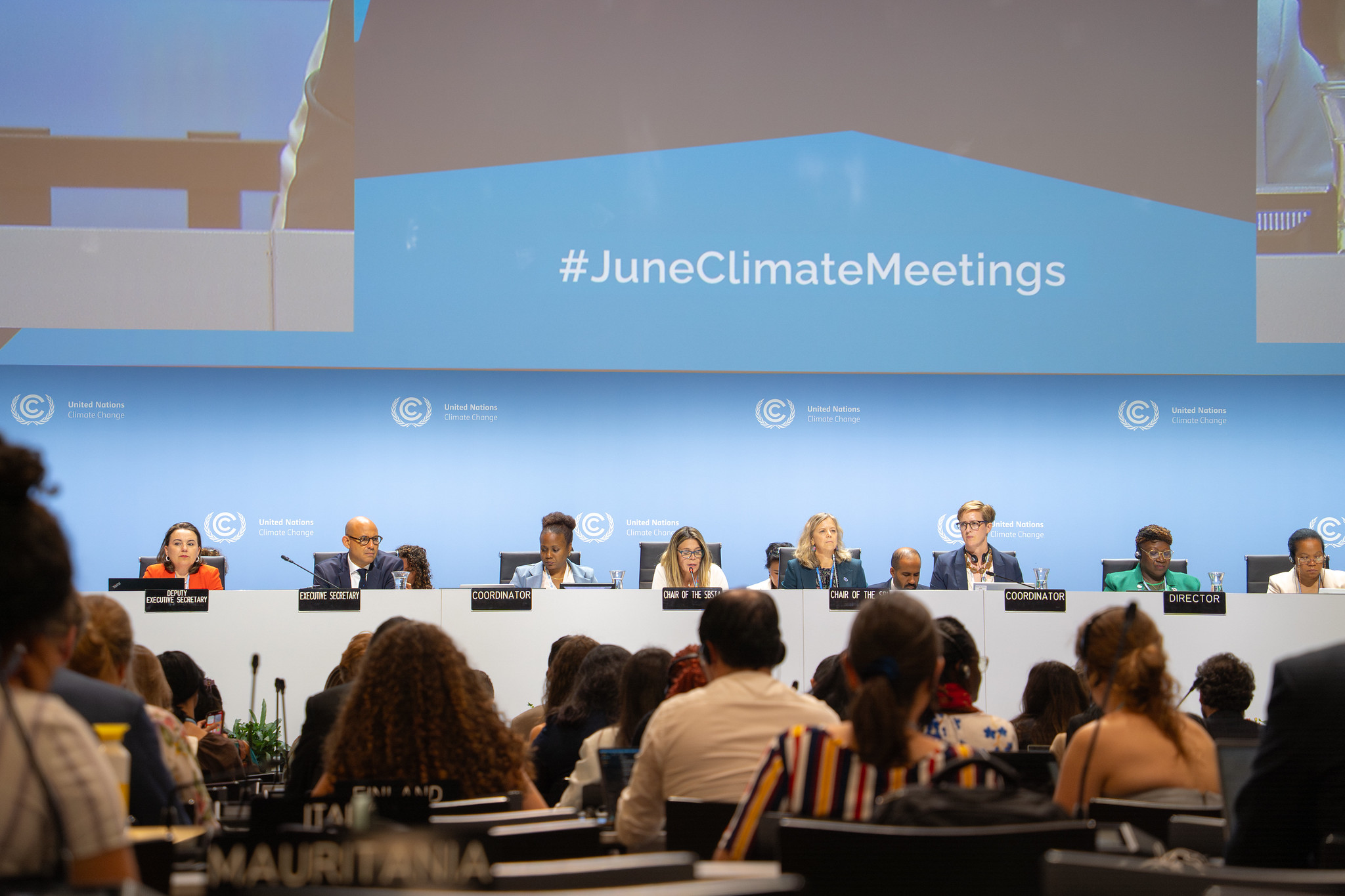
Two weeks of tense UN climate talks in Bonn, Germany (from June 8 to June 18) have produced few tangible outcomes as diplomats faced “gridlock”.
Negotiators failed to find agreement in numerous areas, such as scaling up global emissions cuts and funding for climate adaptation.
In the closing plenary, many diplomats lamented weakened trust in the UN climate process, as it struggled to find its footing in a new geopolitical landscape.
As ever, climate finance was one of the greatest sources of tension between developed and developing countries, influencing the debate around adaptation and trade in the Bonn talks.
Many countries criticised “coordinated attacks” on science by those with “fossil-fuel interests”.
Some delegates saw progress on a “just transition mechanism” to support communities through decarbonisation as a positive outcome, with a package of texts agreed for the COP31 climate summit in Antalya, Turkey.
Reporting from the talks in Bonn, Carbon Brief covers the key outcomes and disputes at the 64th biannual sessions of the UN Framework Convention on Climate Change (UNFCCC) subsidiary bodies (SB64).
Adaptation
Climate adaptation proved one of the most contentious areas of negotiation in Bonn. In particular, parties were unable to agree on text relating to the “global goal on adaptation” (GGA).
Across the two weeks, progress was “stuck, stalled or deferred”, even in the rooms of technical adaptation items, Jeffrey Qi, policy advisor with International Institute for Sustainable Development’s (IISD) resilience program, told Carbon Brief.
In many of the rooms, this was due to a “fault line” over finance, Ana Mulio Alvarez, policy advisor at thinktank E3G told Carbon Brief, as developing countries sought support to help protect themselves from escalating climate hazards.
Last year at COP30, parties had agreed on a new adaptation finance target within the “global mutirão”.
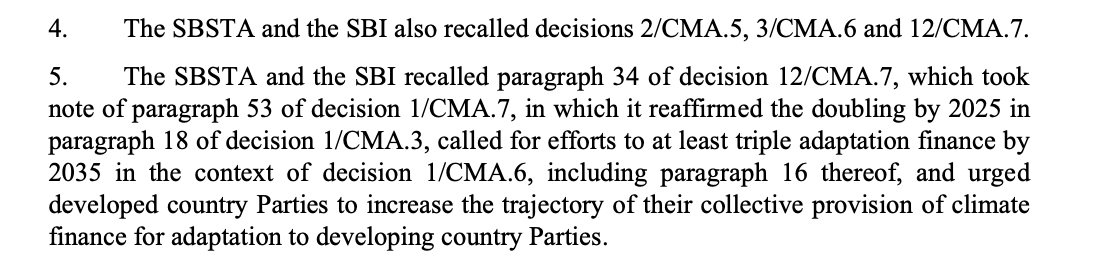
The text “calls for efforts to at least triple adaptation finance” for developing countries by 2035. This is largely expected to come from developed countries, which are obliged to provide climate finance under the Paris Agreement.
While this tripling target agreed in Brazil was broadly welcomed by developing countries, it lacked key details. For example, it did not specify the baseline for tripling, the parties which have to contribute or the types of finance that will be counted under the goal.
(Earlier drafts of the text in Belém had included reference to 2025 as the baseline, the deadline for a $40bn adaptation finance goal set at COP26. This led some parties and civil society organisations to state that the 2035 level ought to be $120bn.)
In Bonn, various parties said that the tripling target should also be included within the text on the GGA. This included the African group, small-island states (AOSIS), least developed countries (LDCs), some Latin American countries (AILAC), as well as the G77 and China.
They said that they would need finance to implement the GGA, especially as adaptation projects often rely on public, grant-based funding rather than private investment.
Canada, Norway and Japan were among those opposing a reference to the tripling target.
A first draft text on the GGA did not include a reference to the finance goal. Many parties again expressed their concern over this omission.
A second draft only included a reference to the tripling of adaptation finance within a bracketed opening paragraph. (Passages of text that are not yet agreed are shown in square brackets.)
A reference to tripling finance remained in the final draft, shown below. The entire text is surrounded by square brackets and is subject to negotiation and agreement at COP31.
Speaking to Carbon Brief, Teresa Anderson, global lead on climate justice for ActionAid International, said:
“It’s been a huge fight to even get a soft acknowledgement of the Belém promise to triple adaptation finance, let alone a proper plan to meet that promise. It seems rich countries want to be able to quietly forget they ever said anything at all.”
Beyond the question of finance, a number of other GGA elements were discussed in Bonn. This included work on the “indicators”, a set of 59 ways to measure progress towards the GGA, which were agreed by parties at COP30.
The adoption of these indicators in Belém had proven difficult, despite experts having worked on them for two years. They were pushed through at the close of COP30 to mixed reactions.
Parties entered negotiations in Bonn amid the uncertainty this created. Alongside the indicators, the final text last year contained plans for a two-year “Belém-Addis vision” to further refine the indicator process.
As part of this, at SB64 parties worked towards creating a taskforce that would establish underlying data and methodologies for the indicators. However, the make-up of this taskforce became fraught, as parties disagreed on whether it should be technical or political.
Speaking to Carbon Brief, Bethan Laughlin, senior policy specialist at the Zoological Society of London, said the negotiators were in “a very Groundhog Day’ situation”, where they were once again looking to experts to refine the indicator package, while struggling with the idea of ceding control of the process.
During negotiations in the second week, Brazil and the EU called for the taskforce to be expert-driven, while Grupo Sur, the like-minded developing countries (LMDCs) and the Arab group supported a party-driven taskforce.
As the talks moved into the final days of negotiations in Bonn, this remained a sticking point.
A final element of the GGA is the Baku adaptation roadmap (BAR), which was launched at COP29 in Azerbaijan. It is designed to help bring coherence across the multiple different adaptation efforts and advance progress towards the GGA.
At workshops during the first week in Bonn, parties focused on how the current adaptation framework supports the GGA and climate finance for adaptation.
In negotiations, the G77 and China called for the BAR to ensure access to finance in accordance with Article 9.1. This is the part of the Paris Agreement that refers to developed countries “providing” climate finance. (See: Climate finance.)
Canada, Japan, the UK and the EU all disagreed with this inclusion, arguing that finance should be addressed under other agenda items.
Ultimately, no agreement could be reached on the GGA. The issue was therefore subject to “rule 16” and passed to COP31 without any agreed text.
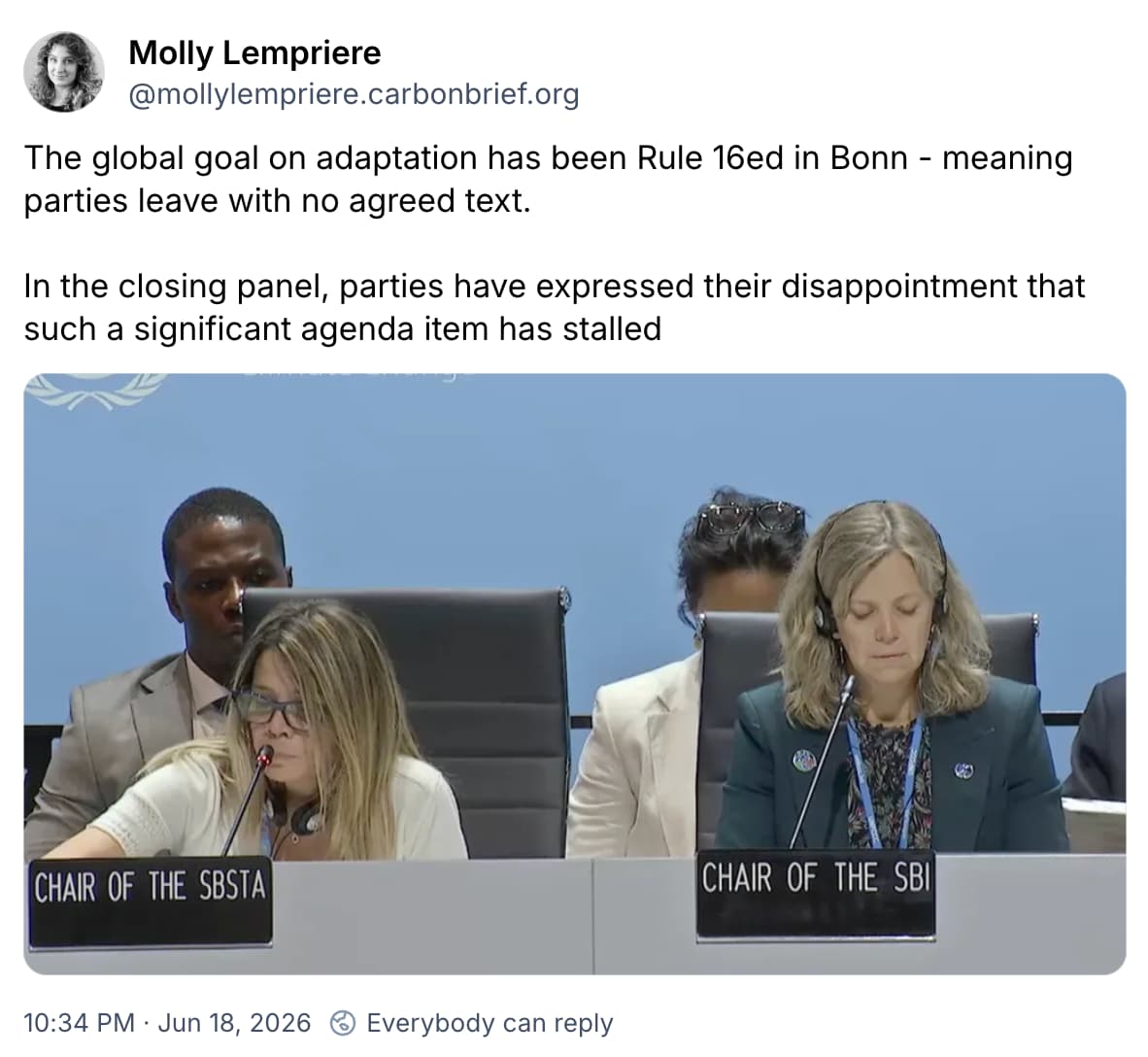
In the closing plenary, parties expressed their disappointment with the situation, with AOSIS noting the outcome was “completely unacceptable”.
In a statement, E3G’s Mulio Alvarez said that amid worsening climate impacts, the “rule 16 is more than a procedural outcome: it is a warning sign”.
Beyond the GGA, the adaptation space also includes numerous other negotiations.
Those around the adaptation fund drew particular focus this year, as it is in the process of transitioning to exclusively serve the Paris Agreement. This will allow it to access 5% of the revenues generated by the agreement’s new carbon market under Article 6.4.
A key challenge was the makeup of the fund’s board, which currently includes members from “Annex I” and “non-Annex I” countries. This refers to the division of countries based on their development status in 1992, when the UNFCCC was established.
The Paris Agreement refers instead simply to “developed” and “developing” countries. The concern, observers told Carbon Brief, is that this could open the door for wealthier developing countries to be defined as “developed” – something that some parties oppose.
Speaking to Carbon Brief, Qi said that the issue would require a head of delegation or higher to push through an agreement. He added:
“This is such a politically charged issue that concerns the fundamental question of the relationship between the convention and the Paris Agreement.”
Parties failed to come to an agreement on this point, instead deciding to continue discussions at COP31.
Fossil fuels
Fossil fuels were not an official part of the negotiating agenda in Bonn, but countries nevertheless discussed them throughout the talks.
At COP30, dozens of nations had backed a “roadmap” to “transition away” from fossil fuels, but ultimately strong opposition meant it did not end up in the formal text.
Instead, countries accepted COP30 president Corrêa do Lago’s compromise offer to develop “roadmaps” outside the formal UN regime, including one for fossil-fuel transition and another on ending deforestation.
So far, 21 countries and negotiating groups have submitted their views to help shape the informal fossil-fuel roadmap. With the exception of Russia, none of the countries that reportedly opposed a formal roadmap at COP30 have had their say.
(There has been a similar call for input from parties for the deforestation roadmap, with 22 submissions so far.)
In the first week of Bonn, the COP30 president hosted a 90-minute session to discuss the fossil-fuel issue in person.
Corrêa do Lago presented progress on developing the roadmap, placing it in the context of implementing the energy-related outcomes from the first global stocktake. (See: Global stocktake.)
Some parties, including small-island nations and Switzerland on behalf of the Environmental Integrity Group (EIG) , expressed interest in carrying the roadmap discussion into the formal process – so it ended up as more than just “a document”.
Meanwhile, groups representing big fossil-fuel producers, such as the Arab group and the LMDCs (Like-Minded Developing Countries), did not speak up at all.
Fossil fuels were also discussed in other parts of SB64, notably in the GST dialogue. Numerous nations pointed to the success of the recent “transitioning away from fossil fuels” conference in Santa Marta, Colombia.
Cosima Cassel, climate diplomacy lead at E3G, told a press conference on this topic that Santa Marta was an example of the climate regime “evolv[ing]”, with “coalitions of the willing” coming forward with solutions to move away from fossil fuels.
This piece has been edited for length. For this piece, Carbon Brief also reported on other major issues raised at this year’s UN climate talks in Bonn, Germany, including just transition, climate finance, climate science and COP reform. Explore these developments in more depth, or to read the original piece in full, you can find the full story on Carbon Brief’s website here.


Comments
We changed commenting systems on September 10, 2026 as part of a site-wide functionality and security upgrade. Your past comments have not disappeared, and you can still log in with your old Disqus account credentials if you wish. Contact us with any questions.