

The most disempowering thesis in history
There may never have been a group that had it so good as the Japanese plutocrats of the 1930s. In that era, the richest one percent of Japanese society captured twenty percent of national income — a third more than the top earners in America command today. Within a decade, however, most of that bounty had vanished. Their share of national income collapsed by more than two-thirds; the value of their estates fell by 98 percent.
What happened? Total war, total defeat, and foreign occupation. Mass mobilization forced the state to intervene in industrial production, double income taxes, restrict dividends, and requisition merchant ships. Inflation and destruction obliterated much of the elite’s remaining wealth. Then the American occupiers finished the job — dissolving family-owned conglomerates, organizing powerful labor unions, and imposing a 90 percent marginal property tax. In a deep irony of history, the wealth leveling policies they imposed on Japan were more radical than those that would later cause the U.S. military to depose leaders in the Global South who attempted redistribution programs of their own.
The ultimate beneficiaries were ordinary Japanese people, who still reside in one of the more egalitarian economies in the developed world. But its path was paved with bloodshed: roughly ten percent of the country’s population killed, its cities firebombed and devastated by atomic explosions.
Japan’s experience is the poster child for historian Walter Scheidel’s thesis in The Great Leveler: that stable times invariably cause elites to accumulate wealth at the expense of ordinary people, and that historically, only cataclysmic shocks — what he calls the Four Horsemen of Leveling: war, revolution, pandemics, and state failure — have ever reversed that accumulation. And even these horsemen only achieve leveling when they are apocalyptic in scale, rupturing society with extraordinary levels of violence, suffering, and misery.
Scheidel’s research is extensive and authoritative. If his thesis is correct, its implications are daunting. As historian Roman Krznaric has written, “no historical thesis could be more disempowering,” because it renders futile all well-intentioned efforts to transform society by peaceful means. It suggests that the only pathway to a transformed, life-affirming future—an ecocivilization—is a blood-soaked one, littered with bodies.
Is apocalypse, then, our only gateway to a better future? Or are there alternative routes that might avert calamitous suffering? To explore that question seriously, we first have to reckon with a dire possibility — that we are not approaching collapse, but are already inside it.
No second chance
In 2018, sustainability professor Jem Bendell published “Deep Adaptation: A Map for Navigating Climate Tragedy,” which was downloaded roughly a million times within a few years. Bendell broke academic taboos by predicting that “we face inevitable near-term societal collapse” and that communities need to prepare for civil unrest, lawlessness, and breakdown of normal life. As climate statistics have continued to worsen beyond most predicted parameters, his arguments have become an increasingly central part of serious conversations about our future.
For Bendell and others who foresee collapse, the silver lining is that civilizational breakdown at least creates the opening for something genuinely new. Inbuilt structures of the dominant system have, for decades, systematically resisted and shut down virtually all attempts at positive transformation. Collapse, in this view, presents an opportunity — perhaps the only one available.
There is a certain cogency to this argument. But further analysis tarnishes even this silver lining. There is a profound difference between the collapse of historical civilizations and that of today’s world system. Previously, no matter how catastrophic it felt to those experiencing it, collapse was geographically bounded. People were closer to the land and could turn to farming, hunting, and gathering. They could rebuild from the ruins while geographically distant societies followed their own trajectories.
Today’s civilization is, in political scientist Thomas Homer-Dixon’s words, “a single, tightly coupled human social-ecological system of planetary scope.” Collapse in the modern era would almost certainly mean the disintegration of the entire global system — shattering the elaborately interconnected latticework of sub-systems such as mining, agriculture, industry, shipping, technology, and communications that keep most people sheltered and fed. Like a colossal house of cards, it would most likely all come crashing down. In its wake, we should anticipate a holocaust beyond anything humanity has ever experienced: billions of deaths from starvation, violence, and disease.
It gets worse. Over the past five thousand years, humankind has already depleted the more easily accessible energy sources and raw materials on Earth. Even in the aftermath of civilizational carnage, it is unlikely that future generations could ever rebuild a society to an advanced level of technological sophistication. As astronomer Fred Hoyle observed, “with coal gone, oil gone, high-grade metallic ores gone, no species however competent can make the long climb from primitive conditions to high-level technology. This is a one-shot affair.”
The stakes could not be higher. If modern civilization collapses, the human race will likely persist — but we might be condemning our descendants for time immemorial to lives bounded by the limitations of agrarian norms, where small, powerful elites perpetually command the energy fodder of enslaved or indentured labor.
This is why there is an overriding moral imperative for those of us alive today, with any capacity to effect change, to find and advance an alternative path — and to do so before the tipping point arrives.
The Adaptive Cycle: Where are we?
From a systems perspective, human society is a particular instance of a larger category of complex, self-organized adaptive systems. Scientists have studied the process of change in such systems extensively, and their insights deserve our closest attention.
An interdisciplinary group of hundreds of scientists has spent decades developing what is known as the Adaptive Cycle model of change, which applies to all kinds of complex systems — from cells to ecosystems — and is equally applicable to human civilization. The Adaptive Cycle describes a life cycle of four phases that virtually every living system passes through.
It begins with a rapid growth phase, in which innovative strategies exploit new opportunities. Gradually, the system settles into a stable conservation phase — a period that can last a long time, in which the future seems predictable, but gradually the system becomes increasingly brittle and resistant to change. At some point, a tipping point triggers what is called the release phase — think of lightning igniting a forest fire, or coral reef bleaching, or civilizational breakdown. Following the collapse, a period of chaos and uncertainty ensues. New opportunities for creativity emerge, which is why the final stage is called the renewal phase. In this period, small chance events can drastically shape the future.
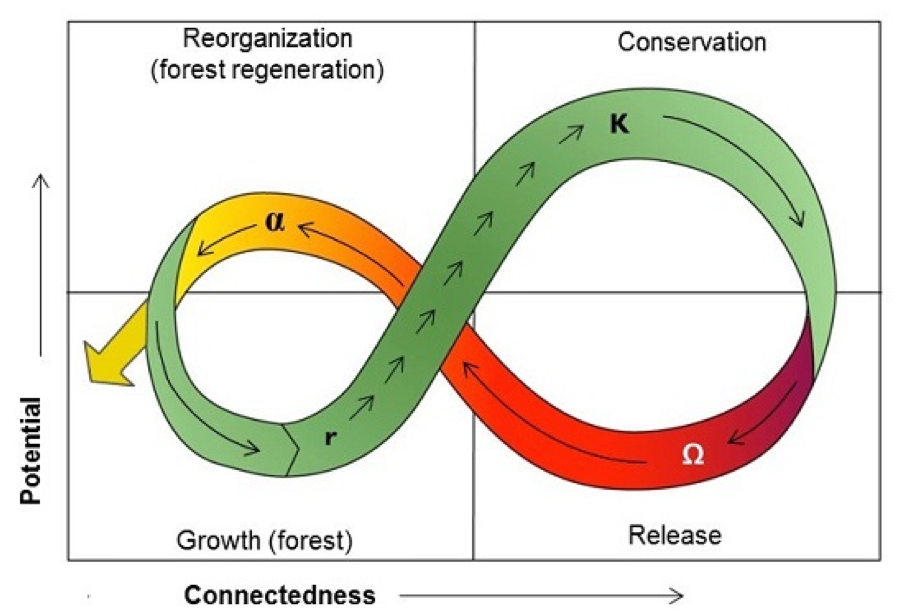
Applying this model to modern civilization, we might place our current era somewhere in the late conservation phase. Ever since colonialism established Western control over the rest of the world, the dominant worldview has generated an interdependent set of legal, financial, and cultural institutions, maintained by technologies and infrastructure that are mutually reinforcing. The increased connectivity of the modern era has further entrenched this system, imposing economic and cultural uniformity, consolidating the power of dominant groups, and making transformative change almost unthinkable. Through cultural hegemony — explored in an earlier piece in this series — the system’s dominant institutions deflect popular attention from its structural defects, while economic inequality insulates elites from the worst effects of the approaching release.
The glaring implication of the Adaptive Cycle model is that we may be sliding, with gathering momentum, toward that release phase. And yet the progression from conservation to release phases warrants more careful attention — because it contains clues to a potential way out.
Far from equilibrium: The window in the chaos
When a system approaches a tipping point, even a small disturbance can have enormous consequences, catalyzing strongly reinforcing feedback effects that are difficult or impossible to reverse. Scientists who study complex systems prior to tipping points have identified certain distinctive phenomena that have significant implications for our present moment.
One is what researchers call “flickering”: conditions begin to fluctuate erratically, swinging from one extreme to another with increasing frequency. Flickering has been observed in changing glacial periods, in epileptic seizures and asthma attacks, in overexploited fish stocks, and in lakes shifting from a clear to a turbid state. Another signal is “critical slowing down”: when the system is disturbed, it takes increasingly longer to return to its former equilibrium. Eventually, that equilibrium is forever lost as the tipping point sends the whole system through a period of chaos — until it reaches the renewal phase.
As our world swings from crisis to crisis, and previously reliable norms shatter with bewildering speed, this far-from-equilibrium state seems to accurately describe the current era. Political theorist Michael J. Albert, in his systems-informed exploration of this century’s possible futures, Navigating the Polycrisis, identifies this as a “far-from-equilibrium crisis” condition — and he argues that outcomes will be contingent on the capacities of activists, intellectuals, and progressive policymakers to formulate compelling narratives that resonate with people during these crises, nudging them toward alternative worldviews.
And it is here — in the deteriorating chaos of our time — that the opportunity may exist to break out of the inevitability trap posed by Scheidel’s Four Horsemen.
Reweaving the fabric
Consider an analogy. You own a rug, but you don’t like the pattern woven into it. Try as you might, the weave is so tightly braided that you can barely isolate a thread, never mind transform its design. Now imagine that, as in a magic fable, the rug begins to unweave itself spontaneously, loosening its knots and randomly releasing its assorted threads. All of a sudden, you have an opportunity to reweave the rug into a different pattern before it entirely unravels.
This corresponds to the potential that the current moment presents to us: to reweave society’s fabric even as it unravels from its own internal contradictions.

Change theorists Richard Heinberg and Asher Miller helpfully identify two typical stages of this unraveling prior to collapse: destabilization and breakdown. In the current era, different components of the world order and different regions are experiencing varying degrees of each. Many political systems are encountering destabilization. The public sphere, overwhelmed by the epistemic chaos of social media, might be characterized as undergoing breakdown. Meanwhile, ordinary people living in Haiti, Gaza, or Sudan are already suffering the full onslaught of collapse, while Indigenous peoples worldwide have endured for generations the aftermath of their own near-annihilation. Overall, we might anticipate a worldwide decades-long lurching decline in material and ethical standards, with some societies collapsing while others struggle on.
This bleak picture nevertheless opens up greater possibilities for a swerve toward an ecocivilization pathway. As the flickering worsens, new generations will increasingly recognize that the system is dying. Many will turn, as they’re already doing, to tribalism and authoritarianism. But as the coherence of the dominant civilization unravels, its cultural hegemony begins to lose its grip. Young people, rejecting the failed narratives of previous generations, are likely to become increasingly open to radically different alternatives — alternatives that offer a life-enhancing future rather than an accelerating descent.
Crisis, movements, ideas: The disruption nexus
Roman Krznaric, in History for Tomorrow, has mapped this critical juncture in a model he calls the Disruption Nexus. Rapid, transformative change occurs only when three elements are simultaneously in place and mutually reinforcing: crisis, movements, and ideas.
Crisis is required to destabilize the system from the equilibrium of its conservation phase. Powerful movements must arise, composed of large numbers of people alienated from the dominant system and willing to challenge those who hold power. And those movements must wield visionary ideas — a coherent and radically alternative set of policies and practices from those that predominated in the old system.
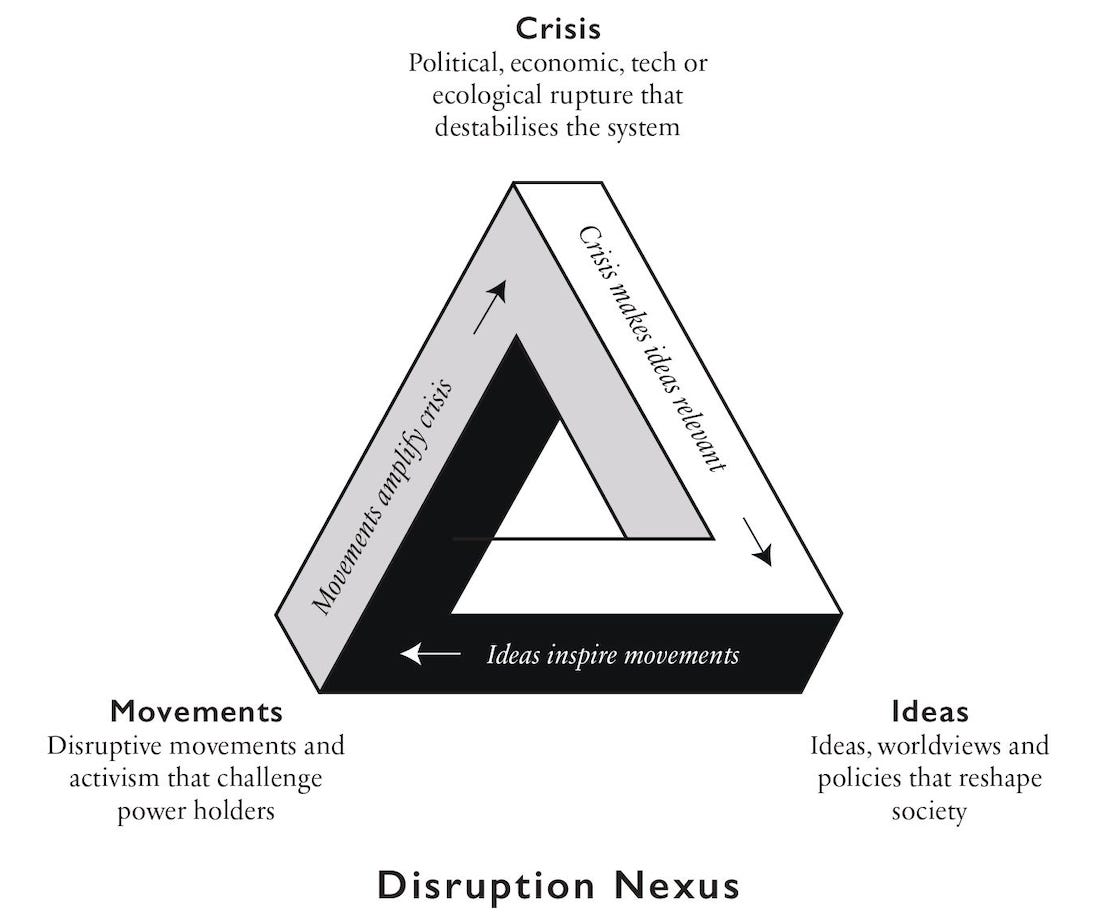
At the moment, we have crisis in abundance. Movements have emerged — Occupy, Black Lives Matter, the climate justice movement — but they have not yet achieved the fervent worldwide adoption with staying power that civilizational transformation requires. And while alternative ideas already exist (as I’ve tried to lay out comprehensively in Ecocivilization), the work of weaving them into a coherent fabric, capable of inspiring mass adoption across many cultures and constituencies, remains largely undone.
Reweaving society’s fabric even as it unravels, through a deft intertwining of movements and ideas, defines the challenge facing all those who desire a better future. The psychic distress caused by social breakdown frequently engenders feelings of panic, fear, and rage — which can lead people further into the sway of authoritarian strongmen who fuel those very emotions. There is no guarantee of success. The window is open, but it will not stay open indefinitely.
Difficult as this task is — and it may be the most difficult task our species has ever faced — it is the calling that our times demand.
In my next couple of pieces, I’ll explore what it actually looks like to answer that calling: the specific strategies, at different scales, that might allow this unraveling and reweaving to become something more than metaphor.




Comments
We changed commenting systems on September 10, 2026 as part of a site-wide functionality and security upgrade. Your past comments have not disappeared, and you can still log in with your old Disqus account credentials if you wish. Contact us with any questions.
I got some arguments. First, the statement that the top 1% had 20% of in come and this is more than America's elite today–I've seen, actually a wide assortment of numbers for this but most assign the top 1% much more than this–although part of that is a matter of calling it "income" rather than wealth. Second is the assumption that "If modern civilization collapses, the human race will likely persist — but we might be condemning our descendants for time immemorial to lives bounded by the limitations of agrarian norms, where small, powerful elites perpetually command the energy fodder of enslaved or indentured labor." Why assume that? Our ancestors prior to modernity mostly lived in egalitarian, largely peaceful tribes. Why shouldn't our descendants? And third is the idea that we could avert this awfulness if we can just get everyone singing from the same hymnbook, with visions of the path we need to take. Unfortunately, this will probably never happen. But what seems more likely to me is that collapse WILL open up possibilities, and people in a million places will choose a hundred different paths, some much better than others; and some of the difference will be due to different ecologies and different local cultural norms, but a lot will be a matter of persuasive individuals and "the ideas that are lying around"…which is to say that each of us has a chance to help guide out own locale in a wholesome direction, and it would probably help to start now.
Oh, one more–the assumption that collapse will be catastrophic and involve billions of deaths. Well it might, certainly, if it unrolls suddenly. But that isn't necessarily how it will work. It might go down one increment at a time, unevenly no doubt with some locales spared for a time. In this scenario, people in many places will have the opportunity to relearn old skills and set up new, more localized arrangements–and learn to do without luxuries they now see as necessities.
I agree with mwildfire's assessment. In addition, reweaving assumes there is any thread left to reweave with. Well, there's very little left of thread, fiber with which to spin thread, or knowledge of how to spin or weave either literally or metaphorically. Stop the grocery store deliveries, and cities and suburbs simply die. The most affluent might be able to leave, but where will they go? Their bunkers? In that scenario, nobody would serve them nor invite them into their community. In my affluent community, even the youth are committed to BAU. My community is toast.
"And while alternative ideas already exist, the work of weaving them into a coherent fabric, capable of inspiring mass adoption across many cultures and constituencies, remains largely undone."
That's actually been the problem all along, namely that the vast majority of people on earth today are largely ignorant of all these issues, and ideologically opposed to doing anything about them to the extent that they are not.
Early civilizations struggling for survival, or for that matter the first Pilgrims who settled Boston, merged church and state into a single institution that commanded absolute obedience, literally on pain of death. This was necessary under the circumstances they lived in, and it will soon be the same for the various clades that survive the demise of the current global world order.
The only question is will any of those clades be dominated by those who have valued, and preserved, some of the better features of today's civilization? Or will those that survive all be descendants of Trumpanzees?
None of those reading (or writing) these words shall ever know the answer to that question.