


This article was originally published on February 17, 2023.
In 2022, I authored two articles [1, 2] expressing doubts about society’s transition from fossil fuels to renewable solar and wind power. In this final article in the series, I’ll explain why my conclusions are based on experience as well as analysis.
This article was produced by Earth | Food | Life, a project of the Independent Media Institute.
My gloomy assessment of the prospects for renewable energy is not motivated by love of fossil fuels. In fact, I’ve spent the past two decades writing books and articles and giving hundreds of talks arguing that our collective adoption of coal, oil, and gas was the biggest mistake in human history. However, I don’t think, as some spokespeople for environmental organizations sometimes seem to do, that any criticism of alternative energy sources is a form of climate denialism.
At the other extreme, I disagree with the few hard-core environmentalists who believe that renewables are a complete dead end. After humanity’s fossil-fueled fever has eventually broken, we will return to renewable energy, one way or another. We’ve relied on renewable energy for untold millennia in terms of food, firewood, wind, and flowing water. It certainly would be preferable if we could partially transition to forms of renewable energy that would enable us to maintain some of the best of what we’ve accomplished over the past few energy-intensive decades—including scientific knowledge and creative works produced in a growing host of media, from sound recording to motion pictures to digital art. Unfortunately, that will be impossible without functioning electricity grids, which are challenging to maintain even in the best of times. If we could use hydro, solar, wind, and geothermal energy to power slimmed-down grids, that would greatly ease the transition away from fossil fuels.
In short, I have no reason to dislike renewable energy. In fact, I love it. And I live with it.
My wife Janet and I have had solar panels on the roof of our house for so long that the first set aged to become antiques; recently, we replaced that still-working initial set—which we donated to a good cause—with a new one that was cheaper and far more efficient. We have a solar hot-water heater, a solar cooker, and a solar food dryer; we heat and cool our home with a solar-powered electric heat pump, and we drive an electric car. We went solar not for the purpose of virtue signaling, but in order to use our household as a laboratory. And the experiments have been not only instructive but also enjoyable. We would never willingly go back to using the fossil fuel-based technologies we ditched.
However, being an early adopter of solar technology has given me personal insight into some of the practical limitations and difficulties of making the energy transition. For example, proponents of the Inflation Reduction Act (President Joe Biden’s main legislative effort to boost the shift toward renewables) point out that the government can’t be expected to pay for the transition entirely on its own; rather, the idea is for government incentives to prime the national economic pump so that companies and households will be incentivized to do the heavy spending that will be necessary to ensure this transition.
But what level of spending on the part of the companies and the public is realistic? I can only cite Janet’s and my own experience: we’ve spent tens of thousands of dollars on our personal energy transition, even though we did things as cheaply as possible, and even though various financial incentives were already being offered by the government. Bigger tax breaks would have helped. But not every household will be installing a new mini split HVAC system or induction stove or replacing its cars (the average U.S. household has two of them) in the next few years. Similarly, not every company will want to replace its fleets of vehicles (including long-haul trucks, ships, and airliners) or abandon its sunken investments in other machinery—possibly including cement kilns and blast furnaces.
In addition to my renewable experiments at home, I also explored the feasibility of transitioning away from fossil fuels while working on the 2016 book Our Renewable Future with David Fridley of the Energy Analysis Program at California’s Lawrence Berkeley National Laboratory. We engaged in researching renewable energy over the course of the previous year, during which time I would propose questions to which Fridley could use technical analysis to answer.
I asked Fridley how the consumer electronics industry can proceed without fossil fuels. I also asked him how our food system can adapt, given the vital importance of nitrogen fertilizers currently made with natural gas. Fridley did the research and math and often came up with sobering answers. We concluded that nearly all the technical problems entailed in making these transitions can be solved at the laboratory scale.
What do I mean by “laboratory scale”? For example, it’s possible to use solar electricity to make synthetic hydrogen-based fuels that can be used to keep airliners flying. However, in many cases, ramping up such solutions to the vast industrial scale, which is necessary to maintain global business-as-usual status, is probably unrealistic. In rich countries like the U.S., the transition will only be feasible if we cut energy usage dramatically, especially for certain transportation modes (aviation) and industrial sectors (concrete and steel), while completely redesigning truly essential sectors (notably, our food system).
[slide-anything id=’3472166′]
One thing Janet and I realized early on in our home energy transition experiment was that most of the fossil fuel energy usage that sustains our household is not under our control. In our house, we don’t do any mining, heavy manufacturing, road construction, or industrial agriculture. We can’t even make the glass for our solar cookers. Other people do those things; and, after carefully monitoring the relevant industries over the past 20 years, I’ve concluded that those other people are taking only tiny steps toward eliminating fossil fuels. The next 20 years may see more vigorous efforts in that direction, but the inertia is enormous.
In my personal view, energy transition planning is now based far too much on abstract computer-based models that fail to include all the relevant factors. It’s relatively easy to project renewable energy growth trends using a spreadsheet; but, beyond the easy phases that Janet and I have undertaken, the actual implementation will imply vast changes in materials supply chains and manufacturing processes—shifts that will be disruptive in the best case, and nearly impossible in the worst.
As I’ve suggested before, we need integrated pilot projects to identify major potential snags in the energy transition process. An ideal project would be to retrofit a medium-sized industrial city so it runs not just its electrical power system on renewables but also its transport and food systems, with sunlight and wind also supplying heat for its homes. The concrete for its roads and buildings would be made using renewable electricity, as would the glass for its windows.
The fact that there are no such pilot projects currently in operation is a clue that there are systemic roadblocks relating to large-scale interlocking technological systems that will make it hard and costly to wean from fossil fuels. In some respects, the energy transition is analogous to redesigning and rebuilding an airplane while it’s in flight.
Household experience is currently about the closest thing we have to operating pilot projects. So, do the experiment yourself. Go solar. But notice how much energy you use and what you use it for; also, pay attention to what energy you can control, and what you can’t. You may discover, as Janet and I have, that your most impactful efforts to reduce your carbon footprint involve simply reducing your travel and consumption.
My aim is not to discourage people working toward an energy transition, but to insist that we develop a realistic plan for energy descent, rather than insisting on foolish dreams of eternal consumer abundance by means other than fossil fuels. Currently, politically rooted insistence on continued economic growth is discouraging truth-telling and serious planning for how to live well with less.





Comments
We changed commenting systems on September 10, 2026 as part of a site-wide functionality and security upgrade. Your past comments have not disappeared, and you can still log in with your old Disqus account credentials if you wish. Contact us with any questions.
"After humanity’s fossil-fueled fever has eventually broken, we will return to renewable energy, one way or another."
Humans have a cognitive processing quirk known as inattentional blindness–where we can sometimes literally not see something directly in front of us in plain view because our attention is on something else. A well-known demonstration of this effect has a video of a group of people in varied street clothes passing a basketball around randomly while constantly moving and changing their positions, where subjects watching the video are instructed to count how many times they pass the ball. And the subjects with the highest count accuracy also had the lowest rate of noticing the person in a gorilla suit who walked right through the middle of the group, and all had far worse detection rates than people who watched the video without first being instructed to count passes. Similarly, motorcyclists in busy and visually-chaotic metropolitan settings have often found that they were invisible to drivers who were looking straight at them.
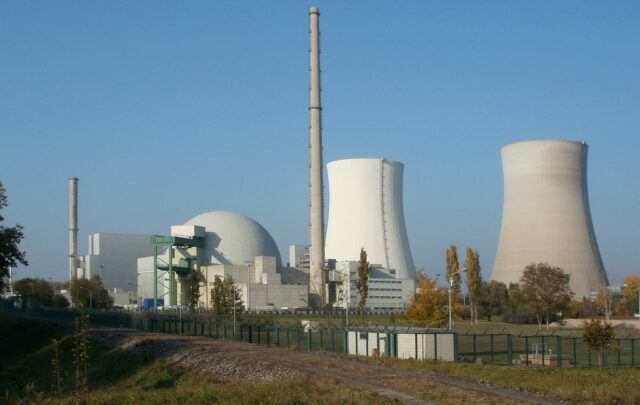
I suspect this phenomenon is the reason that Heinberg has a sort of selective blindness which renders him unable to see one of our largest sources of non-fossil energy, and one which has vastly more energy potential than fossil fuels ever had. Because his attention is divided between fossil fuels and renewable alternatives, he completely misses the enormous non-renewable alternative–nuclear energy. Because it doesn't fit in either category that he's paying attention to.
Nuclear energy has many drawbacks. A major one is pollution generation: Nuclear energy creates very dangerous and long lived waste. Any attempt to scale it exponentially means it will quickly overwhelm the society that tries to use it with costs associated with managing the pollution. The longer lived the pollution, the less you can generate. Nuclear advocates have been saying "yes, but around the corner is the technology to eliminate nuclear waste" and yet 90 years after we put nuclear power into production, where is it? The US does not even have a long term waste storage site because no one wants to be stuck holding the "hot" potato. In this way nuclear power is like a credit card: you get ~40 years of power generation out of a plant, and then you get a few thousand years where you pay to babysit the nuclear waste. It is very likely the total energy input to society is net negative.
Everyone looking for solutions to our problems should read Limits to Growth. The two core issues are natural resource depletion (ex. peak oil, peak uranium) and pollution generation (ex. climate change, nuclear waste).
All energy sources create both issues. Nuclear has fuel has source issues but the worst is the pollution generation. I don't expect to shift your position Jag. You have a lot of passion around nuclear. But others get a vote and hopefully will think long term.
"Nuclear energy has many drawbacks. A major one is pollution generation: Nuclear energy creates very dangerous and long lived waste. "
Everything we do has drawbacks and dangers. Just for relative context:
Global deaths from fossil fuel pollution per year: at least more than 3 million (possibly more than 8 million)
Global deaths from nuclear power spent fuel–ever: zero
Also, waste does not automatically mean pollution. By definition, it is not pollution if it is contained. Also also, it is only waste if we don't have a use for it. (Gasoline used to be a "waste" product from kerosene and lamp oil production.)
"Which means any attempt to scale it exponentially means it will quickly overwhelm the society that tries to use it with costs associated with managing the pollution."
What we currently call nuclear power "spent" fuel is actually 96% unfissioned. (95% of it is uranium.) The unfissioned fraction would be fuel in molten salt fast reactors. So would DU. Just consuming the supply of "spent" fuel and DU we already have in storage (so far) would provide over 10,000 terawatt-years of heat energy. (All the fossil fuels we have ever burned have provided about 700 terawatt-years.)
At a nuclear-energy production rate of 50 terawatt-years per year (all primary energy right now amounts to 19 terawatt-years per year) we would be producing 19,500 tonnes of fission products per year. The fraction of that which would still be radioactive after ten years would be 3,500 tonnes. We have uses for some of the radioactive stuff, and might develop more, but even if we threw all of it away, we would need to drill maybe 150 Deep Isolation-style boreholes per year to contain it–encased in synroc, inside sealed canisters, packed in clay, inside steel wellbore casings, more than a kilometer deep in stable rock or self-healing salt formations. (We currently drill around 70,000 structurally similar wells per year.) And it would only take around 300 years for the radioactivity to drop to natural levels found in some granites.
"The longer lived the pollution, the less you can generate."
Longer-lived means less radioactive. The bismuth in Pepto-Bismol has a half-life of 20 quintillion years. From our perspective, it is practically stable. (Especially since humans are far more radioactive.)
"Nuclear advocates have been saying "yes, but around the corner is the technology to eliminate nuclear waste" and yet 90 years after we put nuclear power into production, where is it?"
All of the current Gen 4 reactor development projects only started after Fukushima. That's not a coincidence. The old ossified paradigm had to die to create space for a new one.
"The US does not even have a long term waste storage site because no one wants to be stuck holding the "hot" potato."
We know "spent" fuel contains tens of trillions of dollars worth of energy. We aren't going to just throw that away when we know we can develop the means to extract it.
"In this way nuclear power is like a credit card: you get ~40 years of power generation out of a plant, and then you get a few thousands years where you pay to babysit the nuclear waste. It is very likely the total energy input to society is net negative."
It is a huge net-energy positive even with today's old-tech reactors. Forms of nuclear now being developed will be orders of magnitude better.
"Everyone looking for solutions to our problems should read Limits to Growth. The two core issues are natural resource depletion (ex. peak oil)"
Peak oil is not a limit if oil can be replaced. We already know how to turn CO2, water, and uranium into hydrocarbon fuels.
"and pollution generation (ex. climate change)."
Pulling 1.5 trillion tonnes of CO2 out of the air at today's capture efficiencies could be accomplished for roughly 350 terawatt-years of energy–around a third of the unused energy in "spent" fuel. We're currently at around 1.4 trillion tonnes heavy compared to pre-industrial CO2 levels.
"Nuclear has fuel .. source issues"
The fuel sources are plentiful. We just haven't ramped up production yet.
"but the worst is the pollution generation."
Amounting to zero deaths vs. the millions of deaths per year from the pollution it could displace. And on the other side of the ledger, huge benefits from what we could do with that much clean energy. If waste is its worst issue, that just means it is an amazing bargain.
"I don't expect to shift your position Jag."
I have changed my position before on many things. All it takes to persuade me is sound evidence, science, and reasoning. Is it any different for you?
"You have a lot of passion around nuclear."
There are good and bad ways of doing it, and we need to be smart about how we use it, but I don't see any alternative for the rapid CO2 drawdown we need in order to halt and reverse planetary heating and ocean acidification.
"But others get a vote and hopefully will think long term."
That's what I'm hoping too. I'm especially hoping the thinking will be rational and sensible.
A key problem is that the technology for fission power is 10x-100x as complicated as that for hydrocarbon-fueled plants – the known disasters have come from human cognition of the operators being unable to deal with unanticipated conditions in those complex systems.
The other, and I think, overriding problem can be imagined as a boundary condition of the intrinsic characteristics of these plants: if everyone just walks away from a running hydrocarbon-fueled plant, it burns up and goes dead. End of story. If everyone walks away from a running fission plant, then you contaminate vast swathes of land for millennia and make it useless. Even if fission plants work perfectly, you still contaminate vast swathes of land because nobody has any idea how to transport/store contaminated matter permanently/safely. Only a couple of failed attempts exist.
"A key problem is that the technology for fission power is 10x-100x as complicated as that for hydrocarbon-fueled plants "
It has been. That doesn't mean it must be. And we routinely opt for paths of greater complexity for the sake of advantages and enhanced capabilities. Our phones, appliances, cars, airplanes, etc are all way more complicated than they used to be.
"the known disasters have come from human cognition of the operators being unable to deal with unanticipated conditions in those complex systems."
We knew before the first disasters that the early designs were vulnerable to disasters. That's why we built steam containment domes and redundant water management systems before the first catastrophe. And designing to manage that disaster risk was the main driver of overall system complexity. Some of the new designs look very simple by comparison–because they eliminate the disaster risks in the first place.
"if everyone just walks away from a running hydrocarbon-fueled plant, it burns up and goes dead. End of story. If everyone walks away from a running fission plant, then you contaminate vast swathes of land for millennia and make it useless."
Many of the new designs are walk-away safe. I especially like the Kairos approach–nearly zero contaminant dispersal risk even if you were to breach the reactor vessel with a bomb.
"Even if fission plants work perfectly, you still contaminate vast swathes of land because nobody has any idea how to transport/store contaminated matter permanently/safely. Only a couple of failed attempts exist."
I don't know what this refers to. Spent fuel storage and transport has a remarkable zero-death safety record. Very few heavy industries can even come close to that. And I don't know of an instance where spent fuel contaminated vast swaths of land. And the record-holder for land area rendered unusable and people displaced is, by far, hydropower–over 100,000 square miles inundated, including precious tropical forests, and over 80 million people permanently displaced from their homes. And that's not even touching the river ecosystem damage.
I find myself near the end of my life having been able to climb into the bottom of the 10% category. I have a good amount of solar power – intermittency is important. Solar won't move food or water hundreds of miles to my town (diesel/trucking is always on my mind).
I just reread Turchin's 2023 book. The overproduction of elites I see everywhere – as I drive to school (in my 11 year old prius) I see new teslas, corvettes, and all sorts of high priced SUVs – McMansion developments all around. At school I see underprivileged youth; not all of them, for sure (some have wealthy-enough families) – who have to deal with Anthropocene futurelessness. I cannot imagine any overarching prescription for collapse which will work, given the obscene wealth distribution and accelerating political disasters.
It's hard not to be depressed, unless one addresses that directly/independently, preferably in a high-functioning way.
_____________________________
But, yes, we're left with physics. Survival demands adaptation. The best adapters are favored for survival and offspring. (This is not meant to applaud the current Affluent because history is full of collapsed civilizations with dead Affluent.)
This is a hard time to be in for people with big hearts and forward looking minds.
The first large group of modern humans who tried to leave Africa (that we know about) ran into an ice age and were wiped out. Sometimes the world is unkind. But they intermarried with the neanderthals who did survive the ice age. So we know there was some acceptance and love and child caring and lots of other human emotions. Same with the next group of modern humans who did make it. Sometimes it takes thousands of years to resolve an issue. We might end up looking back on peak fossil fuels as an inverted ice age.
Turchin is great. I really recommend "War, Peace and War". I think chapter 8 about France peaking and then declining into civil war (twice) really captures our present moment. I feel aghast at what might come. Also some peace that so much bloodshed watered the stones of what are now lovely tourist destinations. The peace of a graveyard. It is an odd feeling. Our genetic souls have been here before.
Ursula K. Leguin's "Always Coming Home" has become a new to me favorite for thinking about the long term, post peak energy, post ai, post climate change. Post Carbon 🙂
Yuval has a slightly different take on the attempt/failure of Homo Sapiens to leave Africa the first time, which takes into account the archeological evidence for the Cognitive Revolution in Homo Sapiens, which occurred (in Africa) about 70kyear ago and subsequently allowed them to outcompete the Neanderthals that were already established in Eurasia when they (H.S.) tried for the second time to leave Africa. He refers to this as "The Human Flood" (i.e., out of Africa). Evidently some N. males mated with H.S. females, but this is ongoing work.
Lots of history in Turchin. Our knowledge about everything from physics to archeology to biology, etc., is increasing almost on a yearly basis (except for the expanding list of key sciences the republicans are shutting-down) – which is why I like his 2023 book. I'm a bit overwhelmed. Knowledge was not expanding this rapidly in the mid-last-century!
Kim Stanley Robinson's "Aurora" talks about (biological) life being a "planetary phenomenon" – and not independent (as some would have us believe) of the planet upon which it arose. This reminds me of the importance of the impacts of Climate Breakdown on the earth's biome. I'm thinking of the End Permian Mass Extinction here. We're nowhere near the levels of greenhouse gas for that, but the rate if increase (now) might have a disproportionate impact – it's certainly unprecedented!
Le Guine is awesome!
I had not read that. I will check it out. Thanks.
My hope is we keep evolving the tools of cooperation and mind body awareness until the rate of trauma healing out runs the rate of trauma infliction. A crazy dream. But I get to imagine any future I want 🙂
Yes, we living in an amazing time for understanding. I was watching the Burn's documentary of the American Revolution and a passing thought came to me about how did the privateers insure those ships? Then a quick google turned up a whole Phd thesis on the topic. Think about that! A whole persons lifetime dedicated to this historical finance question from 250 years ago! (Ship insurance is back in the news, so it might be important again). What abundance!
Howard Odum talks about nature moving in pulses. All this fossil energy transforming up the tropic ladder into knowledge. How might we keep even a fraction of the knowledge as we move onto the energy downslope? Can we keep even a fraction of the biospheres genetic heritage we currently have? Maybe we find a way to encode it in our DNA like the silly movie "The Fifth Element"? Or perhaps something lower tech like the blue glazed white tiles of a Mosque 🙂 They have a lovely look. Maybe if it is pretty enough people won't tear it down?
YES. The sad thing is that, had we started on a responsible effort toward transitioning 30 years ago–including recognition of limits, of the need to reduce use–it would have been more easier. With the trajectory now toward denialism, snuffing out wind projects and solar subsidies and giving the gas to gas–and oil and coal–the transition will be to a terribly impoverished renewable energy future, at least in the US.