

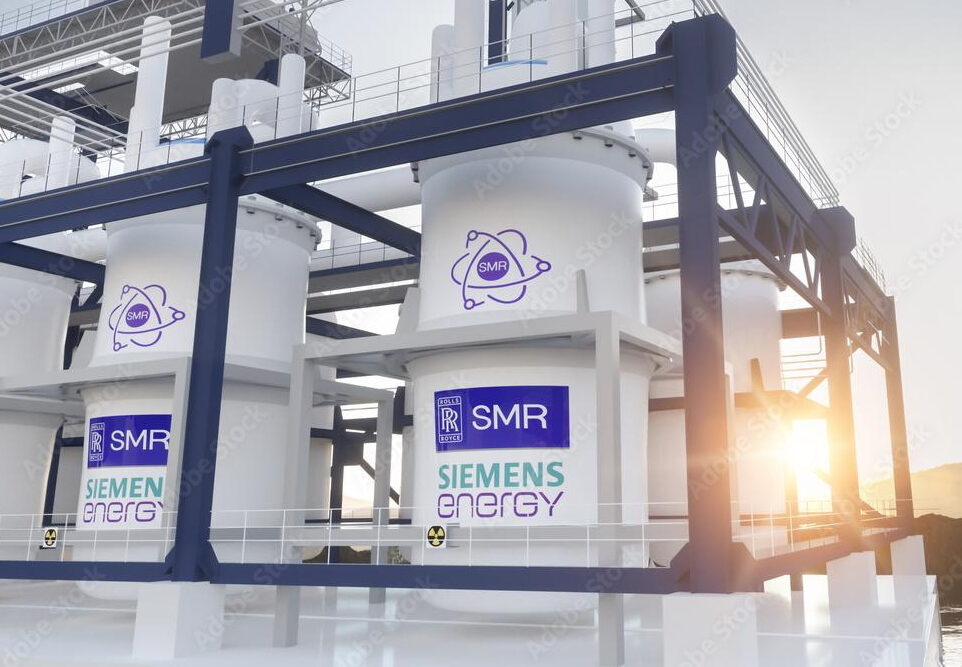
The nuclear power industry is currently promoting designs for small modular reactors (SMRs) that will supposedly be cheaper, safer, and faster to build than older nuclear power plants. Bill Gates and Amazon are investing in the technology. Moreover, some environmentalists, including Mark Lynas and Bill McKibben, support SMRs in the hope that they can lower carbon emissions. And, according to polls, far more Americans now approve of the development of nuclear energy than was the case just a decade or two ago.
This year, the world has been plunged into a global energy crisis: with the closure of the Strait of Hormuz, nearly a fifth of world oil shipments have been held up, with economic impacts likely to reverberate for months or years. World leaders are suddenly desperate for energy alternatives, and are turning to solar, coal, and nuclear. At the same time, electricity demand for data centers is exploding, and builders of those centers hope to use SMRs to power artificial intelligence (AI).
In short, it looks like a great moment for the nuclear industry.
Yet Indigenous peoples, technology critics, and old-school environmentalists still oppose nukes—even in new, highly touted forms. I agree with their critiques. In this article, we’ll look at the current nuclear revival and see why it may end up being a zombie attack.
Nuclear Renaissance?
Before looking at SMRs specifically, it’s helpful to understand the status of the nuclear industry in more general terms. The industry’s potential resurgence comes after three decades in the doldrums following the Chernobyl catastrophe in 1986. Today, roughly 440 nuclear power plants, spread across 30 countries and with a combined net capacity of around 400 gigawatts (GW), provide about 10 percent of the world’s electricity. The US, which has the largest number of plants of any country (96), is seeing a slow phase-out of old reactors (average age 44 years), but has commissioned three new ones during the last decade. China is now operating 60 reactors, with up to 40 others under construction. India is likewise hoping to grow its nuclear industry rapidly and is experimenting with fast breeder reactors. Globally, the International Energy Agency (IEA) forecasts total nuclear power capacity to grow to over 700 GW by 2050, and small modular reactors are expected to make up a significant share of this growth. A year ago, the Trump administration unveiled an ambitious nuclear strategy that includes a goal to quadruple the United States’ nuclear capacity by 2050, with SMRs playing a key role.
The principal drivers of renewed interest in nuclear power are climate change (globally), the Trump administration (in the US), tech companies’ voracious demand for electricity, and Asian nations’ hunger for more industrial power. Most nations want to limit their carbon emissions, and the main low-carbon alternatives to fossil fuels are solar, wind, hydro, and nuclear. Solar and wind are intermittent (“variable”) sources, requiring energy storage to align electricity supply with demand. Hydro has limited potential for growth. That leaves nuclear power, which has the advantage of being reliable and steady, and has possibilities for expansion.
If it’s helpful to understand why the industry is growing again, it’s just as important to know the reasons for its long period of dormancy:
- Cost: Nuclear power plants are complex and expensive, employing technology that’s internationally regulated due to concerns about the proliferation of nuclear weapons. Despite over 80 years of the industry’s development, nuclear plants still take a long time to build and are often plagued with cost overruns.
- Fuel: Uranium, the fuel for nearly all existing nuclear power plants, is a depleting nonrenewable resource, and supplies are running short. Uranium mining is a dirty, expensive process, and mine closures, mostly due to resource depletion, are expected to lead to fuel shortfalls by 2035. While geologists have identified more uranium resources, opening new mines will entail further environmental destruction and harm to human communities, of which the uranium mining industry already has a grim history.
- Waste: Despite decades of research, the global nuclear industry still has found no good place to put the 300,000 tons of nuclear waste—as well as 480,000 tons of depleted uranium in the US alone—that it has produced in the last 80+ years.
- Safety: While nuclear accidents are relatively rare, they can be devastating and expensive when they occur. The Fukushima disaster of 2011 resulted in direct cleanup costs of up to $180 billion as of 2016, but the damage still has not been completely contained, and indirect costs to human health have been estimated at half a trillion dollars. Further, nuclear power technology is still tied to the threat of nuclear weapons proliferation.
- Water issues: Nearly all nuclear power plants use water as a coolant and are highly vulnerable to droughts and floods. Droughts reduce the availability of water for cooling, while floods (nuclear plants are generally built next to rivers, lakes, and other bodies of water) damage safety infrastructure and risk contaminating water sources.
If the nuclear industry can overcome its historic obstacles, a door is open. According to the industry, small modular reactors are the main way forward.
SMRs: Promise or Hype?
The main arguments for SMRs are that they would be cheaper and faster to build than conventional power plants; that they would be safer; and, being smaller, that they could be installed to power remote towns or data centers. The idea is to build components in a centralized factory and then assemble those components at power generation sites.
“Small” is defined as 300 megawatts of electrical power or less. While most existing nuclear plants are in the one-gigawatt (1,000 MW) range, some proposed SMRs are 20 megawatts or less; these are called “micro” reactors.
For the most part, SMRs are still at the design stage. China has one SMR under construction. In the United States, TerraPower, founded by Microsoft’s Bill Gates, has received a permit to build a 345-megawatt (not exactly “small,” but close) sodium-cooled reactor in Kemmerer, Wyoming.
Clearly, it is possible to get funding and approval for these new-generation power plants. The big question is, can SMRs deliver on their promises to overcome the historic drawbacks of conventional nuclear power?
- Cost: SMRs will only be cheaper to build if large numbers are ordered; the first prototypes may be even more costly than conventional plants. Meanwhile, construction costs per MW of capacity will likely be higher, and operating costs are largely unknown until real-world data can be collected. The cost of electricity from SMRs is therefore also yet to be determined, but preliminary estimates put it much higher than solar or wind.
- Fuel: Most proposed SMRs use uranium, but some designs on the drawing boards would use depleted uranium or thorium as fuels (see below). For now, however, the uranium fuel constraint looming over the nuclear industry remains in place. SMRs also won’t use their fuel more efficiently than conventional reactors, despite some claims to the contrary.
- Uranium from Seawater: The supply limits of uranium could be greatly expanded by harvesting it from seawater, where the potential resource is enormous—albeit at a concentration of about 3.3 parts per billion. The total oceanic uranium resource is estimated at 4.5 billion tons, over 500 times all identified land-based uranium resources. However, extracting the uranium will take a lot of energy: the best existing technology using absorbent materials will offer an energy return on energy invested (ERoEI) of about 4:1, which is lower than the ERoEI for solar, wind, hydro, fossil fuels, or conventional uranium mining.
- Waste: Some proposed SMR designs would be breeder reactors that could get rid of depleted uranium or even nuclear waste by using them as fuels—but this technology has faced significant challenges (see below). Otherwise, SMRs will do nothing to solve, and may actually worsen, the nuclear waste dilemma.
- Safety: SMRs are designed to be safer than conventional nuclear plants, using passive, gravity-driven cooling systems that don’t require electricity or human intervention to shut down. However, their overall safety is controversial. There is still no real-world data to support the industry’s promises. And having lots of smaller nuclear plants dotted across the landscape could make it easier for nuclear materials to end up in the hands of bad actors. The resilience of SMRs in the face of more frequent and more severe natural disasters is also controversial; a 2021 study concluded that storms, droughts, and higher ambient temperatures linked to climate change are likely to pose operational risks to all nuclear power plants.
The biggest remaining advantages of SMRs are the speed with which they could be deployed once the manufacturing infrastructure is in place, and the prospect of providing non-grid-tied dedicated power sources for data centers.
What about further technological advances?
When confronted with the limits of one technology, nuclear advocates often shift the conversation to another. However, close examination usually shows that each technological “solution” has its own problems:
- Fast breeder reactors: If nuclear fuel is scarce, why not develop fast breeders, which produce more nuclear fuel than they consume? Currently, Russia operates two fast breeders and India’s first one reached criticality in late April. China has a fast breeder reactor for research. The US, France, and Japan operated breeders in the past but have shut down research along these lines due to high capital and operational costs, safety risks related to sodium coolant, and nuclear proliferation concerns.
- Alternative cooling systems: Water-cooled reactors (a category that includes nearly all existing commercial nuclear plants) pose risks of loss-of-coolant accidents due to pipe breaks, high-pressure operation failures, age-related component deterioration, and earthquakes or other natural disasters. The industry’s solution: use sodium or helium as a coolant. Unfortunately, sodium is highly chemically reactive and ignites upon contact with air and reacts explosively with water, while helium is a depleting non-renewable resource that is becoming economically scarce at a rapid rate.
- Thorium reactors: If uranium is scarce and might lead to weapons proliferation, why not use more-abundant thorium? China already has an experimental two-megawatt thorium reactor in the Gobi Desert. However, thorium reactors have steep development costs and produce a highly radioactive byproduct, uranium-232, which decays into isotopes that emit penetrating gamma rays, making fuel handling and maintenance more hazardous and costly. Also, thorium reactors require a “driver” fuel: thorium-232 is fertile, not fissile, meaning it needs a different radioactive fuel (like uranium or plutonium) to initiate the chain reaction. Therefore, proliferation concerns remain.
Currently, there is little real-world data regarding these “new” nuclear technologies, even though all have been discussed or experimented with for decades. The nuclear industry hasn’t actually solved its many dilemmas, and the current nuclear renaissance isn’t being driven by novel solutions so much as by the rapid worsening of society’s energy-related problems, primarily climate change: world leaders are now so desperate for reliable low-carbon energy sources that they are willing to overlook substantial risks, if only the nuclear industry will put a shiny gloss on its latest iteration of products. And leaders of the tech industry, keenly aware of the soaring electricity demand from AI, are even more desperate for ways to power the exponential growth of their companies without risking a backlash from the rest of society, which may suffer from higher electricity prices or shortages.
If not SMRs, then what?
Nuclear power is a product of high-tech modern industrialism. The proponents of nuclear power assume—and nuclear reactors rely on—global supply chains, uninterrupted grid power, reliable water resources, and functioning political systems. The future that’s unfolding around us is a polycrisis in which supply chains, grid power, water, weather, and politics-as-usual are all threatened. In these unfolding circumstances, the only solutions that make sense are ones that are small-scale, local, low-risk, and nature-based.
What to do about carbon emissions? Yes, we need to replace fossil fuels with low-carbon energy sources—but these should be as low-tech as possible, and we should aim to reduce overall energy usage.
What to do about AI data centers? That’s easy: don’t build them. We are rushing headlong into an AI-managed future without an adequate understanding of what AI is, does, or is likely to do in the future. Besides, AI appears to be perhaps the biggest investment bubble in history.
Most political and economic leaders have taken the attitude that we must go to any possible lengths to save industrial modernity. But industrial modernity is the essence of our problem: it is a crisis-generating machine—and one that, prior to its inevitable self-destruction, is creating enormous wealth for a small minority of people, while entrapping everyone else in dreary systems of employment, payment, debt, dependency, and distraction that leave little time for reflection on the futility of it all.
Moreover, SMRs will do nothing to solve our immediate global energy crisis. The oil shortages that are already sweeping over the world in the wake of the US-Iran war cannot, in most cases, be offset with electricity—at least not right away. While electrification is a good interim energy strategy for gradually winding down modernity with minimal casualties, it’s one that will take time, and some things will be hard or impossible to meaningfully electrify—including heavy manufacturing and air travel. Meanwhile, the world needs gasoline, diesel, and jet fuel now; SMRs will take decades to deploy.
The opinion you hold about SMRs will have a lot to do with your general attitude toward technology. If you think humanity’s fate and future rest with high tech (including AI and advanced rockets to enable colonization of other planets), then you’re almost guaranteed to believe that SMRs will help us get there. But if you think, as I do, that the global polycrisis is an inevitable outgrowth of industrialism and its consequences (resource depletion, pollution, and overpopulation), then you’re likely to view SMRs as a pointless and dangerous waste of resources.
Once we see why industrial modernity is unsustainable, the most important question becomes: what is a viable exit strategy? On our way out the door of modernity and back toward simplicity, we need to minimize the creation of new problems and re-learn nature’s elegant solutions. When our priorities are thus reoriented, nuclear power makes no sense.




Comments
We changed commenting systems on September 10, 2026 as part of a site-wide functionality and security upgrade. Your past comments have not disappeared, and you can still log in with your old Disqus account credentials if you wish. Contact us with any questions.
Thank you. An excellent summary. Here's what I think Richard should do for his next essay: suppose world leaders were ethical, responsible adults looking for the best ways to guide humanity through the great transition that is coming (I know. It's hypothetical). Not that he could prescribe a clear path or set of ten steps, but what are some avenues to explore?
That is a good article idea. Especially for those who have made it through the stages of grief for the Buck Rodgers dream future of the 1950's. (if, like me, you ever bought into that).
Nowadays I think about more appropriate tech. And for me it looks like a 1920's town / city structure. Stone & mortar replaces concrete in earthquake free zones. Trains linking the towns and cities. Horses and small cars replaced with low speed / low power electric motors. Homes have electric washing machines and small electric appliances. Medicine is mostly preventative and most children reach adulthood. Thus population can be balanced with only 2.1 children per couple. That allows a much more egalitarian social structure between the sexes.
Only a handful of heavy industries need 24/7 power. Hydrogen could be used for those processes in a carefully controlled industrial setting. It would still be risky. Like a modern petrochemical plant, but likely possible. Mostly for steel, glass, mortar, metals, electronics.
We have made several key scientific discoveries that could still change society substantially without needing a huge amount of energy. Birth control. Vaccines. Solar PV. Battery charging automation. Wood fiber insulation and vapor permeable air barriers allowing near passive house level building efficiency. Industrial scale glass windows and solar panels. Industrial scale metals recycling.
One key is walking down the population and consumption levels in a fair manner that does not provoke societal instability. But that might not be possible because humans are descended from hierarchy ordered primates. They tend to get violent on the down slope. So the actual pattern might be more stair step: civil war drops the living standard and destroys existing infrastructure, and then what is rebuilt better matches the available energy. Parents defer having kids on the down slope because of economic and political uncertainty (ex Russia, Japan, Korea, etc).
If that is true, then what we would need to do is get the knowledge for that next social structure through the civil war periods. Mostly by spreading it to zones not currently in conflict. And then spreading it back into the zones recovering from conflict. A kind of permaculture Red Cross. An organization that teaches appropriate tech, PTSD recovery, mindfulness, permaculture.
Thank you. There are a few fundamental problems with fission power, but I would primarily worry about individual unit failure, since in that case it doesn't starve itself into an inert state within human-relevant timespans. Imagine offshoring fissile-fuel processing, as will undoubtedly be tried at some point.
I wonder if this is the industry's answer to the spent-fuel-storage problem?**
Plutocracy indeed!!
And… McKibben! (IIRC, called-out a few years ago)
___________________
** which is to say, just leave the fuel in the can on-site, like is already done , in the US, at least.
Don't have to imagine it: We already get all our reactor fuel from Russia (yes really!).
"SMRs will only be cheaper to build if large numbers are ordered; the first prototypes may be even more costly than conventional plants."
SMR costs will be all over the place due to the many different designs. But Kairos Power has already built three of their full-sized reactor vessels for testing purposes, with a build cost about three orders of magnitude cheaper than traditional gigascale, high-pressure forged reactor vessels–or roughly 60 times cheaper per MW of capacity. And that's building them one at a time–before the benefits of mass production kick in.
"The cost of electricity from SMRs is therefore also yet to be determined, but preliminary estimates put it much higher than solar or wind."
What nuclear reactors produce is heat. We have a lot of direct uses for heat. Nuclear heat per MWh is about a third the cost of nuclear electricity.
"The supply limits of uranium could be greatly expanded by harvesting it from seawater, … However, extracting the uranium will take a lot of energy: the best existing technology using absorbent materials will offer an energy return on energy invested (ERoEI) of about 4:1,"
The best materials-based collectors now use adsorbents instead of absorbents. And the best adsorbent benchmarks have already been surpassed by electrochemistry. As for energy investment, the highest is going to be for old-style uranium pit mining. At Rossing, they have to move and process 3,000 tonnes of ore to yield one tonne of U. The best for land mining is in-situ leach mining–which typically consumes 0.5 to 1.5 MWh per kilogram of U produced. Electrochemical extraction of U from seawater has been demonstrated at 1.94 MWh per kilogram of U with an estimated process cost of $83 per kg.
https://www.nature.com/articles/s41893-025-01567-z
"Some proposed SMR designs would be breeder reactors that could get rid of depleted uranium or even nuclear waste by using them as fuels—but this technology has faced significant challenges"
The existence of problems with old approaches does not constitute an argument against fixing those problems with new approaches.
"Otherwise, SMRs will do nothing to solve, and may actually worsen, the nuclear waste dilemma."
Some designs likely won't help. Others could be of tremendous help. (The cited paper only looked at three of the designs currently being developed–out of dozens.)
"SMRs are designed to be safer than conventional nuclear plants, … However, … There is still no real-world data to support the industry’s promises."
The reason that was a big problem for new designs was that the NRC wanted real-world data before they would grant permits to build any new designs. So how do you get the real-world data if you aren't allowed to build the reactors to produce the data? Fortunately, this roadblock has recently been mostly eliminated.
"If nuclear fuel is scarce, why not develop fast breeders,"
Already happening. And in a molten salt fast reactor, one kg. of uranium could produce 7400 MWh of electricity, or 22,000 MWh of heat (compared to the 2 MWh of energy it would take to extract a kg. of uranium from seawater). However, although molten salt fast reactors are currently classed as Gen 4, I think they should be considered Gen 5. They aren't going to be ready for another 15 to 20 years, and they would be more revolutionary than any other Gen 4 reactors.
"The US, France, and Japan operated breeders in the past but have shut down research along these lines due to high capital and operational costs, safety risks related to sodium coolant, and nuclear proliferation concerns."
None of that experience would apply to molten salt fast reactors.
"Water-cooled reactors … pose risks of loss-of-coolant accidents…. The industry’s solution: use sodium or helium as a coolant."
Or use molten fluoride or chloride salts–which use abundant materials and are not chemically reactive. Bonus, they chemically bind cesium, strontium, and iodine. Double-bonus, molten salt liquid fuel and molten salt Triso reactors cannot have core meltdowns.
"China already has an experimental two-megawatt thorium reactor in the Gobi Desert. … thorium reactors require a “driver” … (like uranium or plutonium) to initiate the chain reaction. Therefore, proliferation concerns remain."
Reactor-grade uranium or plutonium are negligible proliferation hazards. The huge proliferation hazard from the China thorium design is that it provides the means to produce extremely high purity U-233. A U-233 bomb could be small enough to carry in a briefcase.
"world leaders are now so desperate for reliable low-carbon energy sources that they are willing to overlook substantial risks,"
A full transition to low-carbon energy won't do a thing to cool the Earth. What it will probably do is accelerate the heating. If we actually want to cool the Earth, we need to pull more than a trillion tonnes of CO2 out of the air. Nuclear is the only clean energy option we have which would have a realistic chance of producing the hundreds of terawatt-years of energy needed to remove that much CO2 within the timescales we need.
"the only solutions that make sense are ones that are small-scale, local, low-risk, and nature-based."
We know of no such solutions which could extract the tens of gigatonnes of CO2 per year needed to avoid climate catastrophe (and possibly an ocean acidification catastrophe).
"SMRs will do nothing to solve our immediate global energy crisis."
No other forms of energy can either. But if nuclear can play a major role in helping to save the planet over the long run, that really should be enough reason to use it.
"some things will be hard or impossible to meaningfully electrify—including heavy manufacturing and air travel."
Which is where direct use of nuclear heat, and synfuels derived from nuclear heat come in.
"Meanwhile, the world needs gasoline, diesel, and jet fuel now;"
We have ample supply of oil for those in the near future.
"SMRs will take decades to deploy."
And decades to transition from petroleum fuels to synthetic hydrocarbon fuels, and decades to pull down CO2 levels. Sometimes, really big problems do not have quick solutions.
"The opinion you hold about SMRs will have a lot to do with your general attitude toward technology. If you think humanity’s fate and future rest with high tech … then you’re almost guaranteed to believe that SMRs will help us get there."
I think we do not know of a low-tech way to pull more than a trillion tonnes of CO2 out of the air in just a few decades.
"But if you think, as I do, that the global polycrisis is an inevitable outgrowth of industrialism and its consequences (resource depletion, pollution, and overpopulation), then you’re likely to view SMRs as a pointless and dangerous waste of resources."
Energy ascent is the most certain and benign path to population reduction. And nuclear can also help in many areas of resource depletion and pollution.
"Once we see why industrial modernity is unsustainable,"
It hasn't been established that industrial modernity is unsustainable.
"the most important question becomes: what is a viable exit strategy?"
I think the most important questions right now are how do we cool the planet and reverse ocean acidification.
"On our way out the door of modernity and back toward simplicity, we need to minimize the creation of new problems and re-learn nature’s elegant solutions. When our priorities are thus reoriented, nuclear power makes no sense."
With more sensible priorities, it makes a great deal of sense.
I like your overview of the possibilities that new technological developments have to solve many of the (legitimate) problems Richard raised. However, I think you're being overly optimistic if you expect those developments to happen on a time scale that is sufficiently short to save us from run-away climate change (which is very likely already in-progress). Also, Richard was really focused primarily on the SMR's about to be rolled out ASAP, because the investors in those companies want to see those investments pay off within what's left of their lifetimes, not the Gen-4 / Gen-5 SMR's that are still largely on the drawing boards. Finally, neither Richard nor almost anyone else really gives due consideration to what I regard as the main defect of SMR's, which is their vulnerability to terrorism, especially state terrorism (meaning wars or, as they're called these days, special military operations). The SMR's about to be built reduce costs in part by omitting the containment vessel that traditional reactors have, which make them even more vulnerable to such attacks, no matter how safe they may be under normal circumstances. In short, we'd still be better off doing things Richard's way, to the maximum extent possible. To the extent that we have a choice!
"I think you're being overly optimistic if you expect those developments to happen on a time scale that is sufficiently short to save us from run-away climate change"
I wouldn't say I 'expect' it. The disruptive potential of pandemics, wars, economic crashes, tipping points, etc. is always lurking out there. But I have a sense that the odds of this happening are good and improving. The petroleum majors know the easy oil is almost gone, and we've already reached the point where they have to sink an oil barrel's worth of energy to harvest a barrel's worth of oil, and that energy ratio only gets worse from here on out. Their labcoat guys also know the energy economics of synfuels are improving, and at some point, will become more competitive than petro-fuels. That's why Oxy petroleum paid a billion $ for Carbon Engineering–a company that had developed promising tech for extracting CO2 from the air and also had done a lot of work on hydrocarbon syncrude production and refining. The only ingredient they are missing is cheap heat.
The CEO of Oxy has already indicated that she would love to get into nuclear, and they are watching developments there with keen interest, but in the meantime, they've already built the first production-scale direct-from-air CO2 capture facility near Odessa TX, and it will go operational by mid-summer. It has a million tonnes per year capture capacity, but since it uses gas for its heat source, its drawdown capacity is only a half-million tonnes per year. But if it used nuclear heat, its drawdown capacity would be the same as its capture capacity. So for the near future, they plan to work on refining their CO2 capture proficiency, and continue to develop their syncrude technology, and by roughly the mid-30s, we could see the first molten salt fast reactor demo units go hot. By 15 years from now, we could be to the point where we can extract uranium from seawater at 2 MWh per kilogram (already demonstrated at lab scale), and then molten salt fast reactors could turn each kg. into 22,000 MWh of heat, and then that heat could be used to produce 100,000 gallons of gas, diesel, or aviation fuel (at current efficiencies). Harvesting just 4 tonnes of U from the seas per day could produce 400,000,000 gallons of gas per day–more than the U.S. consumes now.
And that's how they can make a smooth transition–ramping up syncrude and nuclear infrastructure while petro-production declines, and they can continue to use their refining and distribution infrastructure. Now, that only gets us to the point of having a large CO2 recycling infrastructure, but the majors also want to set up an international, verified, CO2 credits market, and we can shift to large scale CO2 sequestration by shifting the CO2 credit exchange rate, and by tax incentives, and by direct CO2 purchases, and by regulations and mandates (which could also require some cleanup from their oil extraction days). And in exchange, they get to continue doing their business indefinitely.
"Also, Richard was really focused primarily on the SMR's about to be rolled out ASAP, because the investors in those companies want to see those investments pay off within what's left of their lifetimes, not the Gen-4 / Gen-5 SMR's that are still largely on the drawing boards."
The oligarchs definitely care about multi-generational wealth, and the rules of investment have changed. The old investment model was that you buy a piece of a company, and then when it starts making money, you get a proportional piece of the profits. And then when you needed cash from your shares, your only option was to sell them (and pay taxes on any gains). We don't operate that way any more. In a world of crypto, and NFT's and hundreds of trillions of $ washing through the derivatives markets, banks now treat stock ownership in tangible companies like gold-backed collateral, so the rich can keep their stocks, borrow against it for liquid capital, not have to pay taxes on that cash, actually get a tax deduction, and then when the stock value goes up, they can retire the old loans by borrowing more at a more favorable rate. And sometimes, just the increase in stock value is the engine of wealth creation. (Oklo stock went up 20x in 18 months from mid 2024, without a penny in income.)
"Finally, neither Richard nor almost anyone else really gives due consideration to what I regard as the main defect of SMR's, which is their vulnerability to terrorism, especially state terrorism (meaning wars or, as they're called these days, special military operations). The SMR's about to be built reduce costs in part by omitting the containment vessel that traditional reactors have, which make them even more vulnerable to such attacks,"
That big concrete dome was for containing steam. That's not needed for reactors which don't use water for core coolant. For something like the Kairos approach using Triso with molten salt coolant, the isotopes have more robust containment. To start with, the actual fuel grains are tiny, about the size of a poppyseed. This matters because smaller containment vessels are sturdier and experience less tension at the surface than large vessels for a given internal pressure. Then, the fuel is embedded in a porous matrix to provide room for gas–which reduces internal pressure. Then there's a triple coating on each grain, with a shell of silicon carbide (carborundum) which is tough enough we make armor plates out of it and heat-resistant enough we make kiln fixtures out of it. Then the fuel grains are embedded in a porous fuel ball matrix, and then the balls themselves are also carbide coated. The breakdown temperature for Triso's carbide shells is around 2300 deg. C while the max operating temperature is around 650 deg. C. Even if something like a bomb were to fracture balls in the molten salt coolant, any traces of escaping cesium, strontium, and iodine isotopes would be immediately bound and captured by the salt chemistry, and then if the reactor vessel were breached in such a way the salt-ball mix could flow out, it would freeze in the cold outer environment, adding another lock to the captured isotopes. This would be nothing like the dispersal risk we have from the highly volatile and mobile elemental cesium, strontium and iodine that gets released during meltdowns of today's reactors. Far easier and more effective targets for terrorists would be municipal water supplies, dams, grid infrastructure, chemical refineries, natural gas depots, fertilizer plants, pipelines, chemical or fuel rail tanker cars, passenger rail, rail stations, airports, airplanes, ferries, cruise ships, supertankers, tall buildings, government buildings, bridges, tunnels, stadiums, theaters, restaurants, hotels, nightclubs, schools, hospitals, malls, parades, concerts, and military bases, to name a few.
"In short, we'd still be better off doing things Richard's way, to the maximum extent possible. To the extent that we have a choice!"
Richard's way includes no means for mass extraction of CO2 from the atmosphere. There is simply no cooling the planet and fighting ocean acidification without that. Also, Richard's way is far less likely than everyone worldwide voluntarily abandoning their smart phones. Yes, in theory, we could choose to do that. But we definitely will not choose to do that.
the most important question becomes: what is a viable exit strategy?
Perhaps there is no "exit strategy" other than a "final-exit" strategy? Population overshoot is resolved by a dieoff of the population that has exceeded carrying capacity. That dieoff can happen in many ways:
One way out is for a lot of people to die from lack of food or water. Naturally, this path faces resistance.
Another way is for people to kill each other by warfare. This path has some supporters, those who think it will the the "other people" who will be killed, but it has the danger of escalating into a nuclear cataclysm and resulting in extinction.
Another way out is for almost everyone to become extremely poor, have few children and keep it up until population reduction happens from people getting old and dying. This path also faces resistance, especially from those who are affluent. Any political party or politician advocating privation and death is bound to fail.
Most people would prefer to keep the benefits of modernity and hope that gradual reductions in total fertility rate (TFR) would reduce the population to sustainable levels. Nobody want to root for mass premature death, but even if TFR dropped below 1.0 all over the world, it would take many decades for world population to decline to a sustainable level. The ecosphere and the climate can't sustain their ongoing damage for that long without severe disruption.
There are a lot of patchwork things to do to reduce the damage and they always get a lot of publicity in places like Resilience, but if we look at atmospheric CO2 as the primary indicator of global environmental damage, it just keeps going up and up.
The upshot: there is no exit strategy.
Here's another problem with nuclear, at least under the current adminstration:
https://readsludge.com/2026/05/19/musk-recruited-nasa-head-pushes-nuclear-agenda-tied-to-spacex/
Surely, it's blindingly obvious that we need to reduce consumption of electricity but what are the odds of industrial capitalism doing this? Zero, zilch, nada, nothing!
In UK electricity use has gone down over the last 20 years as a result of more efficient appliances and off-shoring work to China etc. AI data centres are a big risk now.
Yes, climate change seems to be becoming an almost myopic focus of environmentalists, and they're increasingly saying that nuclear is part of the solution. But what if there is a massive nuclear build-out, based on many assumptions, like future fuel availability, and climate change isn't halted? What then, with perhaps thousands of nuclear reactors around the world?
"…what if there is a massive nuclear build-out, based on many assumptions, like future fuel availability, and climate change isn't halted?"
There are only two ways to halt global warming (and then hopefully start reversing it). One is to reduce the incoming solar energy (eg. with solar radiation management), and the other is to increase the outgoing radiant heat energy (eg. by reducing the greenhouse gases in the atmosphere). Nuclear power, by itself, won't help with either of those. Neither will wind, solar, hydro, or geothermal. But nuclear could be the abundant energy source which powers a lot of CO2 drawdown.
And some kinds of nuclear might experience some temporary fuel supply problems as we ramp up nuclear energy, but cycling these reactors at lower capacity factor until fuel production catches up should be no more difficult to manage than the larger amount of intermittency we have to contend with for wind and solar. At least with nuclear, the outages could be coordinated and scheduled.