

This is the second article in a three-part series featuring an interview with Richard Heinberg by Manuel Casal Lodeiro of Instituto Resiliencia, originally published in the Spanish magazine 15/15\15 and reproduced here with permission. Read the first part here.
This year marks the 20th anniversary of the publication of Richard Heinberg’s The Oil Depletion Protocol: A Plan to Avert Wars, Terrorism and Economic Collapse (2006). This book was based on the protocol designed by geologist Colin Campbell and later improved by Kjell Aleklett, also known as the Uppsala or Rimini Protocol. The protocol aimed to design a system to reduce oil extraction rates in oil-producing nations to match the global oil depletion rate, which was roughly 3 percent per year at that time. 15/15\15 spoke with Heinberg about the current state of oil geopolitics from a protocol point of view and the protocol’s present-day validity.
15/15\15: Countries like Spain have decided to approve short-term measures to ease the price increase in fuels and fertilizers due to the Israel-USA attack on Iran. They have also approved other structural measures, but only to accelerate the deployment of so-called renewable energies. But those systems largely depend on petroleum, so will their massive installation, without putting the brakes on the growth of fossil fuel consumption, really help reduce our dependence on oil? For example, it is of no use for agriculture to install more wind generators or photovoltaic systems when what you’re lacking is nitrogen fertilizer.
Richard Heinberg: The current sharp spike in diesel fuel prices is likely to be a significant drag on the construction and installation of renewables—as well as to increase the cost of food and most other things. People tend to forget that, despite all the solar panels and wind turbines, the heavy work of the global economy is still mostly being done by diesel fuel.
15/15\15: It’s the blood of the global economy, as some say. And without enough blood circulating, nutrients cannot reach all parts of a system, and it’s bound to die. Is our situation that dire?
R.H.: Our current way of life cannot survive the end of fossil fuels, but our current way of life is a huge problem anyway. We need to envision other ways of living on the planet, ones that acknowledge limits and the vital importance of all other species.
15/15\15: Do you believe that what is being pushed forward in many countries is a real “energy transition”?
R.H.: A real energy transition plan would address the question of scale. Humanity’s problem currently is not just that we are using the wrong energy sources, but also that we are using energy at unsustainable rates. Regardless of the energy sources we choose, we will not be able to continue using as much energy as we do now for more than a few more years, possibly decades. When we begin to look centuries ahead, it becomes clear that all energy sources impose environmental and human costs that increase as the scale of energy usage rises. A hypothetical solar or nuclear future, at current energy usage rates, would require more minerals or uranium than can realistically be extracted. Recycling would help, but there are also limits to recycling. In the end, the main solution to our energy and climate problems must be to find a way to use less, but to do so in a way that enables humanity to gradually adjust. That’s what the Oil Depletion Protocol would do. That’s a realistic energy transition.
Assuming that we will continue to use as much energy as we do now, but from alternative sources, and that we will continue to use more as the economy grows, is unrealistic. It’s an imaginary energy transition that is destined to continue existing only in the imagination.
15/15\15: So, could we say that the defining characteristic of a real energy transition is not that it’s done towards renewable energy but to less energy in the first place?
R.H.: Actually, it’s both. We do need to replace fossil fuels with renewable energy, but also to reduce energy usage. In the end, the renewable energy that we will rely on may not be high-tech; it may be low-tech, just because that’s what’s possible over the long run.
15/15\15: And what about the fact that the energy policies which are supposed to make us oil-free are so blatantly incoherent? Are they facilitating a backlash that will end up benefiting denialism or the fossil fuel industries?
R.H.: I think the main public response to these policies is deepening cynicism. What’s needed is obvious: reduce the extraction and burning of fossil fuels. What we get instead is endless discussion about how to do that without hurting oil-producing countries that depend on fossil fuel revenues, or investors in fossil fuel companies, or people in countries that aren’t yet addicted to high rates of oil consumption (they need the chance to “develop,” after all). End result: we use more fossil fuels. Not less. People see this and they conclude that the political class is ineffectual and leading us all off a cliff. Which is about right.
15/15\15: We’d like to know about the current situation in the USA regarding the discussion on the necessity of abandoning fossil fuels, and consequently, economic growth. Have there been significant advances in the political or social debate, or maybe steps backwards?
R.H.: That discussion is far more advanced in Europe than in the United States. Here, there are only two groups in the energy and economics conversation: group one (which currently controls the government) believes fossil fuels are good and we have plenty to enable endless economic expansion; group two believes fossil fuels are bad, but we can easily and quickly change to other energy sources and continue growing the economy; only politics stands in the way. Both groups believe economic growth is good and essential. The obvious reality that economic growth cannot continue for long on a finite planet is acknowledged by only a tiny minority that is never heard from in policy discussions.
15/15\15: And that is the perfect breeding ground for imperialism: let’s grow at all costs, even at other countries’ or future generations’ expenses. Even in the progressive and pro-renewable field!
R.H.: Yes, although I make the argument in my book Power: Limits and Prospects for Human Survival that capitalism and imperialism preceded the fossil-fueled growth imperative. The industrial revolution took hold independently in two places: 11th-century China and 18th-century England. China was rapidly developing a capitalist economy, while England was both capitalist and imperialist. Both countries started using much more coal. In China, the industrial revolution was then shut down by the hereditary aristocracy, which saw coal-fueled capitalism as a threat to its political-economic power. In England, the aristocracy had already been humbled by the merchant-imperialist class, so the Industrial Revolution surged ahead. And we are still living in the wake of that surge.
15/15\15: Do you still believe that the “economic collapse” mentioned in your book’s subtitle can be avoided?
R.H.: “Collapse” is a scary word. Some people interpret it as meaning a sudden fall into chaos and nothingness. Collapse in that sense is not inevitable. A broader definition of “collapse” might be, “a loss of organization and scale, a (usually involuntary) simplification of society.” Collapse in the latter sense is inevitable, simply because humanity has grown its population and resource usage to levels that cannot be sustained long-term. We could still simplify in ways that minimize pain and casualties.
15/15\15: Without the protocol, you warned, a “century of chaos” awaited us, as your second chapter’s title said. There have been two decades of chaos until now, and it’s growing faster. You warned in that chapter that the depletion protocol would only be accepted if it was acknowledged that the alternative would be worse. Yet, some people do seem to be catching up with the dilemma: a peaceful sharing of the last oil remaining, which can be burnt without totally destroying the climate, vs. an all-out struggle to death to burn every single thing burnable . . . only that they have chosen this second option! Did you imagine that the degree of nihilism and energy imperialism would reach such levels as we are witnessing?
R.H.: I find the persistence of growth-based, fossil fuel-based economic and political thinking frustrating but not surprising. As I explained in Power, nature rewards organisms that maximize power (i.e., rate of energy transfer), and we humans are the most powerful species ever, partly as a result of fossil fuels. We’re drunk on power, addicted to it. But we also suffer from the side effects of too much power. Worsening economic inequality and environmental dilemmas are symptoms of too much power.
Nature has ways of limiting power, as did Indigenous human societies. We need to relearn those ways of limiting our own power. But that’s hard to do when power is our chief addiction.
15/15\15: And even if the war on Iran ends tomorrow (and we wish it would end sooner), the big elephant in the room will still be there, won’t it? Petroleum is finite and will eventually be depleted. Do you think governments will learn from this new proof of vulnerability and take measures to really move towards post-oil societies?
R.H.: As I mentioned above, there are currently some efforts to ration oil among mostly Asian countries that are unable to import much oil due to the closure of the Strait of Hormuz. Those countries would be wise to learn from this experience: economic addiction to oil entails pain on many levels, including withdrawal symptoms. The solution is not to find a more reliable drug pusher, but to reduce dependency.
This interview has been edited and condensed for clarity.




Comments
We changed commenting systems on September 10, 2026 as part of a site-wide functionality and security upgrade. Your past comments have not disappeared, and you can still log in with your old Disqus account credentials if you wish. Contact us with any questions.
"A hypothetical solar or nuclear future, at current energy usage rates, would require more minerals or uranium than can realistically be extracted."
'Realistic', in this sense, is a social opinion term. It doesn't refer to what is physically possible. In molten salt fast reactors (which we are developing now), the world supply of uranium already in storage could supply over 200 years of fuel at a production rate of 50 terawatt-years of heat per year. (Our current global rate is less than 20 TWy/y.) To continue consuming at that rate beyond 200 years, we would need to extract around 20,000 tonnes of uranium from seawater per year. The oceans currently contain 4.5 billion tonnes of uranium, with an influx rate of around 35,000 tonnes per year. In physical terms, that would be indefinitely sustainable–and that doesn't even count the energy that would be available from renewable sources or from thorium.
"Assuming that we will continue to use as much energy as we do now, but from alternative sources, and that we will continue to use more as the economy grows, is unrealistic. It’s an imaginary energy transition that is destined to continue existing only in the imagination."
Most of what we routinely do today once existed only in the imagination. A lot of it was once considered impossible.
"Petroleum is finite and will eventually be depleted."
Economics will drive the transition to synfuels long before we run out of petroleum.
Leading to evermore consumption and increased global population growth. Absolutely nonsensical propasition.
Energy-rich first-world countries typically have much lower reproduction rates than the energy-poor developing countries, and the same trend is seen over time. When the aggregate standard of living rises, fertility rate falls. And consumption, of itself, doesn't matter. What matters is the amount of resource extraction and the amount of created waste. There is a lot of recycling we could be doing which we don't right now because the cost of energy is too high. Abundant cheap energy could help with that.
Consumption IS resource extraction and waste.
Exxon Mobil released it's Energy Outlook to 2050 in late 2024 after the election. I suspect that may be why it didn't get the attention I think it should have. There are many summaries available including this brief article. https://dieselnet.com/news/2026/02exxon.php Here is the paragraph that caught my attention.
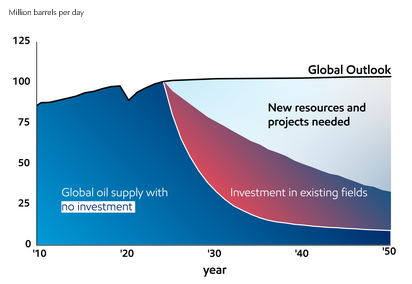 If you read the report you will find that investment in existing fields is already being done and the results will still only delay the fall in oil supplies. The red shaded area labeled "New resources and projects" refers to the hydrogen powered transportation in which natural gas is used to generate hydrogen and carbon is captured with CCS technology in order to reduce carbon emissions. The CCS technology they discuss is currently not available at scale or affordable if it could be scaled up. The chance of keeping carbon dioxide concentration in the atmosphere low enough to avoid warming of 2C is slim.
"The Outlook shows oil production declines at a rate of about 15% per year. At that rate, in the absence of continued investment, by 2030 oil supplies would fall from 100 mb/d to less than 50 million barrels—about half the output needed to meet demand."
Here is the graphic that summarizes their projections for oil supply. And this was before the War with Iran.
The current loss and damage to Middle Eastern Gulf oil supplies will accelerate the oil supply decline. Even if we invested in existing fields we are still going to see a rapid decline in oil supplies in the next five years. One of the world's largest oil companies already pointed this out in 2024.
Thank You!