

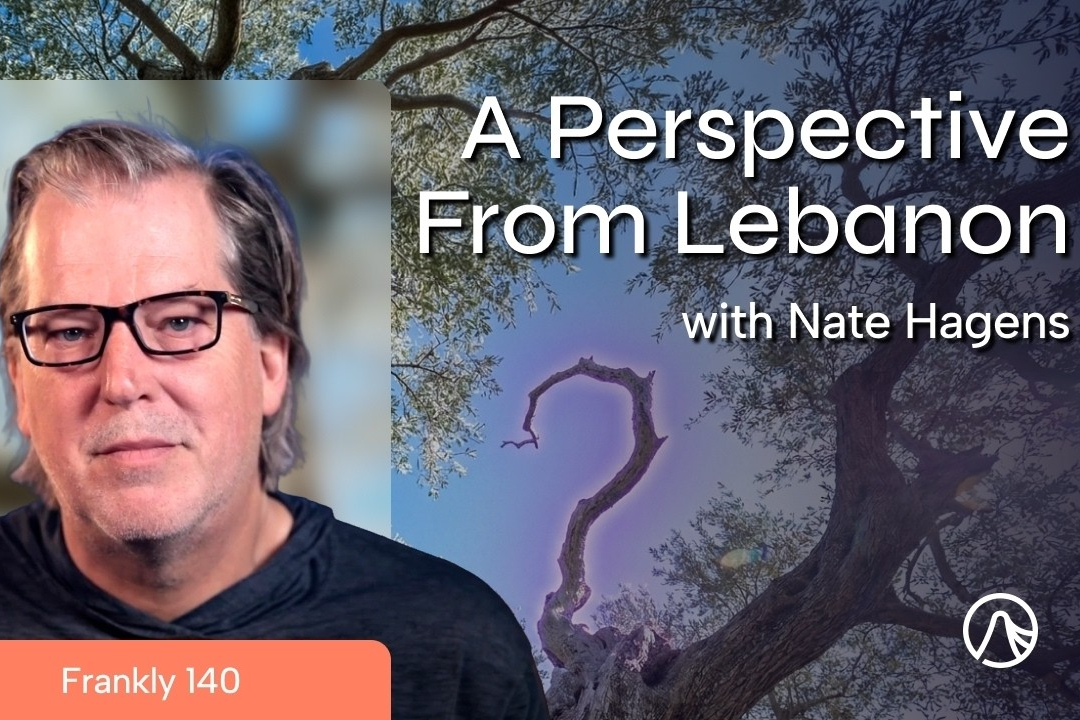
Recorded on Apr 30, 2026 | In this week’s Frankly, Nate steps away from analysis and reflects on a call that reframed his thinking. He shares a recent conversation with a close friend living in Lebanon, who, amid ongoing daily violence and loss, has been hosting displaced families and leading meditation practices in her community. Nate notes that her grounded presence, alongside the trust she carries from a centuries-old lineage in her village, reveals the ways in which social capital and contemplative practice can hold someone steady as the world around them changes.
From that conversation, Nate distills the wider work of this platform into three questions he believes may matter more than the macro-analysis he usually offers. Who are we going to be when comfort and convenience start thinning out? How are we going to live with a biophysical haircut on the horizon? And what are we willing to protect, even at a cost? He notices how many people watching from the relative safety of the Global North live in a constant low-grade state of stress, even without immediate cause, while his friend remains grounded despite being surrounded by actual danger. Nate suggests that separating our internal responses from the external world is the primary work ahead of us, and closes by naming the recent shift in his own curiosity toward the question of who we might become as humans sitting at the precipice of a species-level transition.
When comfort and convenience start thinning out, who are you going to be? How do you separate your internal fight or flight response from what is actually happening around you? And what are you willing to give some of your life’s energy to protect?
The TGS team puts together these brief references and show notes for the learning and convenience of our listeners. However, most of the points made in episodes hold more nuance than one link can address, and we encourage you to dig deeper into any of these topics and come to your own informed conclusions.
01:27 – Beirut, Lebanon
01:30 – Recent bombings in Beirut (More info), History of Israeli-Lebanese conflict
01:45 – Israel occupation in Lebanon and residents losing their homes
02:58 – Fight-or-flight response
04:00 – History of the Jews in Lebanon
04:13 – Effects of meditation in community
04:20 – The importance of developing a meditation practice: Personal and Societal, How to develop a meditation practice
05:17 – Social capital (More info)
05:35 – Where most people trust others and where they don’t around the world, 53% of U.S. adults say Americans have bad morals and ethics
05:43 – How to build trust:
05:55 – Frankly #106: 10 Things Worth More Than a Pound of Gold
06:07 – Israeli murder of journalist Amal Khalil during most recent bombings in Beirut
06:13 – Israel has killed 260 journalists in Gaza, Lebanon, Yemen and Iran
07:17 – Equanimity
08:13 – More-than-human predicament (Metacrisis), Planetary boundaries, Carbon Pulse (Possible future shapes of the Carbon Pulse, Future growth scenarios)
09:00 – Becoming ecoliterate,
09:14 – Rocks in the river metaphor
13:00 – Cultivating agency (Self-leadership),
13:15 – Bayo Akomolafe: A Slower Urgency
14:49 – Merlin (Bird identification app), Meadowlark
15:27 – Biophysical macroeconomics (More info)



Comments
We changed commenting systems on September 10, 2026 as part of a site-wide functionality and security upgrade. Your past comments have not disappeared, and you can still log in with your old Disqus account credentials if you wish. Contact us with any questions.
Most of my friends/classmates (in Northern Arizona) are poor with no healthcare insurance. Food vs. Shelter is the existing (and growing) issue (healthcare needs notwithstanding). This is a biased sample of people, of course, as I am unable to interpret the coded language of the local Affluent (those who own their own homes and take long distance vacations more than once a year – almost entirely "Boomers"), and thus do not socialize with. So, not "on the horizon," but "already here," and, of course, rapidly getting worse. I just reread Turchin's book – popular immiseration seems to be tracking.
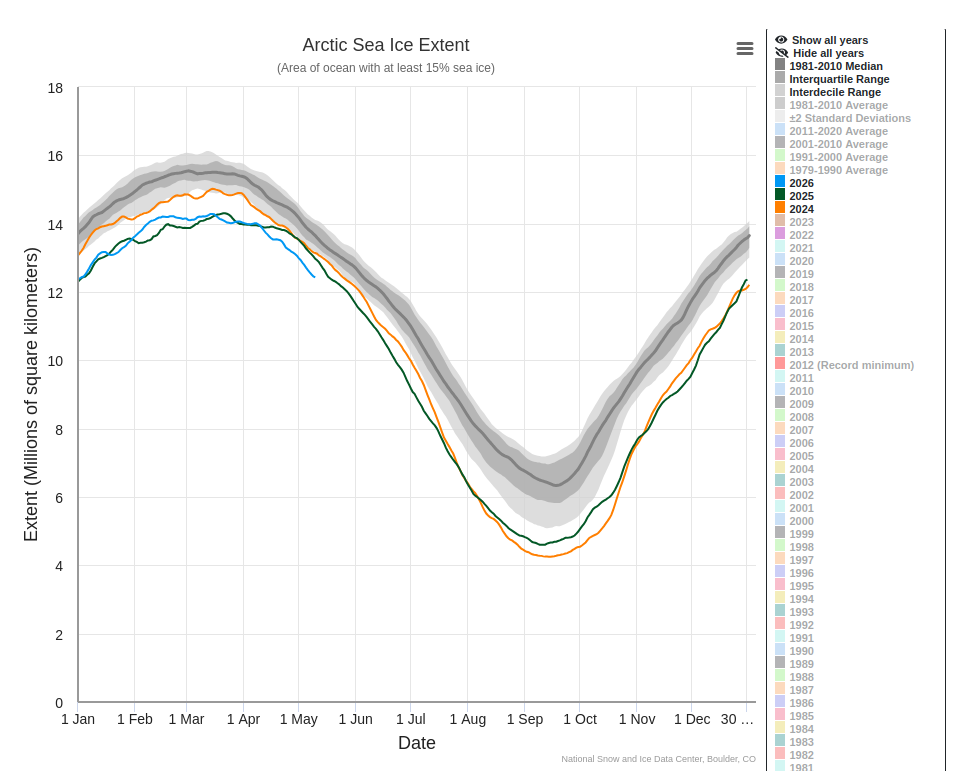
May continues to track hotter than the last two years, hence the concern about rapidly increasing stress on Western Civilization.
__________________________