

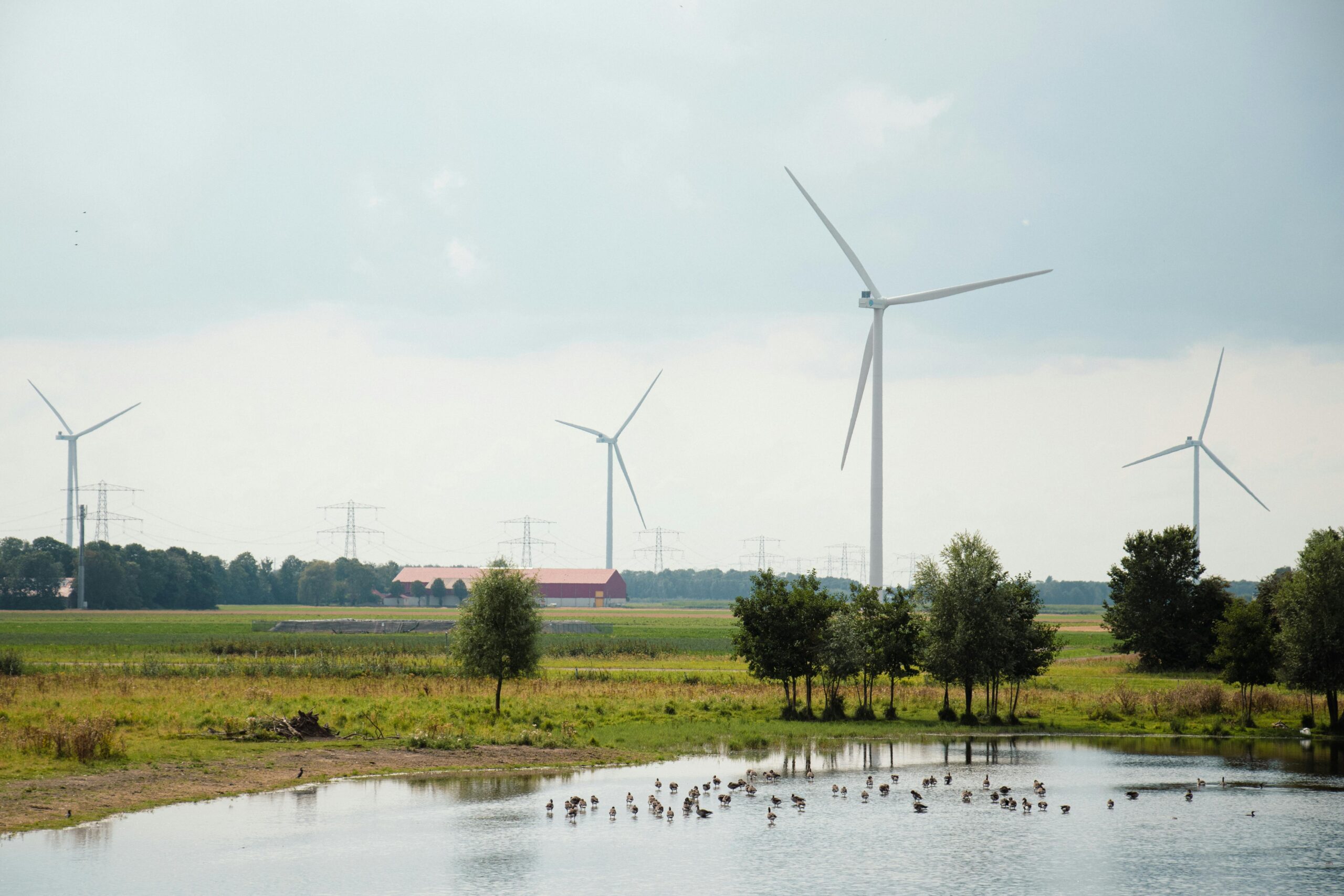
This interview series brings together Dave Murphy, an energy transition scholar, and physicist Tom Murphy, both founders of the Planetary Limits Academic Network (PLAN).
Across this series of discussions conducted by fellow founder Ben McCall, they explore a range of themes on the converging crises reshaping our world, including the polycrisis, ecological overshoot and the strengths and limits of modernity.
Read the whole series: Part One | Part Two | Part Three | Part Four | Part Five
Ben McCall: Dave, what do you think we can confidently assert about what a “sustainable” civilization would look like on the ~1000-year timescale? Are you inclined to agree with Tom’s perspective?
Dave Murphy: The population of the Earth was roughly 300 million in 1000 AD. One thousand years later, it is 26 times greater, at 7,800 million. I doubt that the planet’s population will be 26 times greater in 1000 years, reaching 202,800 million. That is about all I can confidently assert. I don’t think future societies will be anything like the past. I agree that we are now in a precarious position with a society built on stocks that are running low, but we are also transitioning to inexhaustible flows. The system we are moving towards is also much more efficient. What we disagree about seems less about whether the future will be different and more about what we know and don’t know about the future, and what we are to do about it now. So I see possibilities, but how those possibilities unfold is unknown.
I strangely think of the hawkish former Secretary of State and friend to few scientists, Donald Rumsfeld, whose musings about such prognostications are without parallel:
Reports that say that something hasn’t happened are always interesting to me, because as we know, there are known knowns; there are things we know we know. We also know there are known unknowns; that is to say, we know there are some things we do not know. But there are also unknown unknowns—the ones we don’t know we don’t know. And if one looks throughout the history of our country and other free countries, it is the latter category that tends to be the difficult ones.
Borrowing this analytical framework, I might suggest the following:
- Known-Knowns: There are planetary limits.
- Known-Unknowns: The scale and duration at which modernity can continue in the future based upon renewable energy.
- Unknown-Unknowns: I feel as though there is much that is unknown about the future, and we should be humble in our approach (e.g., nobody foresaw with any accuracy the timing and scale of the war in Gaza, or the rate of adoption of solar power). But I get the impression that the doomer’s perspective leaves less doubt. There is little room for anything unknown when the fate of modernity is “basically guaranteed.”
This conversation also reminds me of something I heard at a Peak Oil conference years ago. An investor was asked, “How do you think about long-term investing?” The investor’s reply was “I tend to think about getting the short-term right, and, over time, that means I get the long-term right as well.”
I bring this up simply to say that we need to think about civilization today and in the future, and hold them both equally. Just because it is hard to predict what might happen in the “messy decades-scale” view, doesn’t mean we should abandon hope for people today. Aren’t decisions made today civilization-relevant as well?
Ben: The picture Dave has implicitly painted here, of the possibility of a “neomodern” civilization that can persist for thousands of years relying on inexhaustible flows rather than depleting stocks, is certainly an appealing one! Dave has suggested that “the scale and duration at which modernity can continue in the future based upon renewable energy” is a known-unknown. Tom, I sense that you would disagree with that suggestion, or at least say there are known-known constraints on that scale/duration.
Tom Murphy: Right—I think we can say more about what is likely to succeed or fail. By definition, unsustainable systems (like modernity, I would say) are guaranteed to fail. Even centuries ago, when the scale of human activity was orders of magnitude lower, we were already ecologically unsustainable, as accumulating declines became apparent. The trends are now alarmingly steep: decidedly unsustainable and thus marching unambiguously toward failure.
I wish I could share optimism for inexhaustible flows and continued efficiency improvements—to great personal relief! But many factors intercede, for me. Energy—while very important to modernity—is only one part of the story. If any element critical to modernity is exhaustible, then it won’t matter if another is inexhaustible. For instance, even tireless energy flows like sunlight, wind, and the hydrological cycle are diffuse and require an enormous amount of “stuff” in the form of non-renewable materials to capture, convert, and store the energy. Ecologically harmful mining would therefore need to continue indefinitely (incompatible with planetary limits), to replace worn devices. Recycling is not an everlasting answer: it might extend the clock a few more centuries, but it can’t change the end result. Meanwhile, efficiencies already tend to be within a factor of two of theoretical limits, so not much gain remains in that quarter.
Beyond the confines of energy, modernity relies upon rapidly declining stocks and overtaxed flows in the form of aquifers, soils, materials, forests, and fish (to name a few)—sadly resulting in permanent, accelerating species loss. Meanwhile, enormous waste and pollution streams (beyond CO2) overwhelm the assimilative capacity of the ecosphere. Not only does the chimera of inexhaustible energy fail to address these dimensions, but it is also precisely the availability of large amounts of energy that drives these destructive trends. Powering modernity by alternate means could easily end up hurting more than helping, where it counts.
It is true that biology has figured out how to make indefinite use of inexhaustible flows, using a bare minimum of common minerals. But artificial systems are nowhere close to achieving such a feat in energy or any other domain. I don’t see us getting there, and certainly not soon enough to matter. To illustrate the gap, we are utterly incapable of running a controlled artificial ecosystem that can support human life, even for months, let alone indefinitely. Relatedly, the space station routinely replenishes its oxygen via costly rocket delivery from the surface so that inhabitants can breathe (aggressive recycling can’t keep up).
Humans are a powerful species, clearly capable of planetary exhaustion. It seems the only way we can live sustainably is by putting ecological health first and—through this lens—either rethink or abandon every human (cultural) construct. I doubt the result is something we would still call modernity.
As for feeling our way forward, I would prefer to avoid likely dead-end paths that could simply dig the hole deeper. My hope lies not in technological provision of the very energy that destroys environments, but in deciding that other goals are more important for humanity.
Ben: Dave, what do you see as the flaws in Tom’s argument here?
Dave: I am sorry to disappoint, Ben, but Tom’s perspective leaves little room for agreement.
First, energy and technology are neutral. The statement “precisely the availability of large amounts of energy that drives these destructive trends” is incorrect. The existence of donuts doesn’t drive weight gain; the decision to consume them does. The availability of large amounts of energy may enable destructive trends, but it does not drive them. Humans are steering the modernity spaceship. We are the ones choosing overexploitation of nature and trading that for short-term growth in GDP. We created these mental constructs, and we can create new ones that are more harmonious with nature.
Second, the statement “If any element critical to modernity is exhaustible, then it won’t matter if another is inexhaustible,” is clever trickery. The statement is true when taken in the abstract, but apply that as a hypothesis to the past 250 years, and it fails miserably.
For example, let’s propose this hypothesis:
H1: Horses are the most powerful tool in agricultural production.
If we tested this hypothesis in 1650 A.D., we would probably support it, but testing it today would clearly result in rejection.
Or, for another example, take this:
H2: Whale oil is critical for modernity.
Well, if this hypothesis were posed in 1850 A.D., then H2 would similarly be supported. Today? Not so much.
The point is this: the economy is evolutionary and adaptive; an element that is critical today might not be critical in 30 years. This ability to shift resources has been shown time and time again over the past centuries. Why do people keep ignoring the ability of the economy and human society to adapt to constraints? And before I get cast aside as a techno-utopian, let me state my views on this. I do not think that technology can solve humanity’s biggest challenges, but I don’t see them as limiting them either. I simultaneously hold the views that technology can alleviate many (if not most) of our resource and technical barriers to sustainability, while also holding that the biggest challenges we face are not solved by technology. They are not mutually exclusive views. Can these technologies provide a sustainable future? Yes – they can. Will we get there via technological invention alone? No.
We are avoiding the heart of the matter, which is summed, I think, in the following two questions:
First, what does it mean to be sustainable from Tom’s perspective? Inferring what I can from his comments, it seems that any human perturbation to natural ecosystems is unsustainable, or perhaps another way, any interruption to the natural energy flows through a natural ecosystem is inherently unsustainable. Modernity was unsustainable before the industrial revolution, according to his perspective, and now it is even more so. Not only is there no space in this view for what is described herein as modernity, but there also isn’t space for humans or any type of human society. Until we have a clear picture of what sustainability means, we will simply talk in circles.
Second, do we have an ethical obligation to other members of that Spaceship, i.e. society? Does each of us have an obligation to “love thy neighbor?” If so, what does it mean to love thy neighbor in this context?
The ultimate question, which brings us back to the beginning of this conversation, is whether we, as a species and society, can adapt in the future to become more sustainable, and perhaps, at some point, just plain old “sustainable.” Tom and I agree on one point: getting there will require cultural change. It is the “how” and the “what” that cause discord. That is, how human society will shift to a sustainable version of itself and what that sustainable version looks like. I disagree that we need to rethink or abandon all human cultural heritage. I think the solutions will come from building on that accumulated cultural knowledge, particularly from, for example, Indigenous communities that lived in harmony with nature for millennia. What do we humans gain from abandoning human culture, which is perhaps the defining characteristic of our species?
This interview has been edited and condensed for length. This interview is part of a series that features conversations between Dave Murphy and Tom Murphy on the polycrisis and planetary limits.
Read the whole series: Part One | Part Two | Part Three | Part Four | Part Five


Comments
We changed commenting systems on September 10, 2026 as part of a site-wide functionality and security upgrade. Your past comments have not disappeared, and you can still log in with your old Disqus account credentials if you wish. Contact us with any questions.
I was surprised that this question still has to be discussed. But clearly it does. And Dave's opinion is so full of assumptions and denials, and he probably represents the majority of Americans. Because we don't want to work harder or have less stuff.
Agreed. Tom wins, in my view. He didn't say we should jettison all culture–it's precisely the indigenous cultures–not modernity–that he wants to emulate. And I was surprised by the approving quotation of someone saying that he could get long-term investing right by getting short term investing right. That's like saying as long as I take care of my own family, I can assume the larger community is fine. On the other hand, I wouldn't mind seeing Tom lay out what he sees as a sustainable arrangement–for example, his argument with Chris Smaje in which he says agriculture is inherently unsustainable–may have to continue it for awhile as a necessary evil. Chris and I think it could be sustainable. Probably not for today's (over) population,but for a lower number (what that number is, I submit, is a key known unknown).
I disagree with the contrasting of "inexhaustible" vs. "depleting". A finite, irreplaceable, and depleting source can nonetheless be inexhaustible on human scales. We could use the Earth's nuclear fuels as much as we want, and by the time the expanding Sun turns the Earth into a lifeless rock most of the Earth's present supply of nuclear fuel would still be remaining. And while these two might have arrived at agreement that that there will be some sort of collapse or muddling period such that modernity as we currently recognize it cannot last, that agreement is not binding on the rest of humanity.
Will there be a part four? Tom needs a chance to rebut Dave's techno-optimist fantasy. Power is energy use over time, and the greater the power we wield, the greater the entropy per unit time that we dissipate. Dave's position is thermodynamic nonsense.
"Power is energy use over time,"
Yep.
"and the greater the power we wield, the greater the entropy per unit time that we dissipate."
Yep.
"Dave's position is thermodynamic nonsense."
The thermodynamic limits on energy consumption are so large that we will probably never bump into them. We are currently consuming around 19 terawatt-years per year in primary energy. And as our global energy use goes up, our reproductive rate slows, and it looks like we are headed for a population contraction. So if we can reach an energy plateau at less than 75 terawatt-years per year primary energy, even if we were to derive all of that from uranium alone, a million years at that level would burn less than 30 billion tonnes of uranium–out of a crustal reservoir of around 60 to 70 trillion tonnes. Then add tens of trillions of tonnes each for Earth's crustal and ocean supply of thorium, deuterium, and boron nuclear fuels, plus however much we might use renewables, and it seems pretty clear that we could easily consume at these levels for however long humans continue to exist on Earth.
I don't think anyone can imagine what life will look like on earth in 1,000 years. There are too many unknowns and we certainly can't rely on the past to inform our future because we've caused so much change to the biosphere on earth. Perhaps the best we can do is look at our ability to survive specific crises.
The obvious impacts to consider are global warming and environmental toxins because these impacts are hitting us now. Global warming is accelerating and we no longer have the resources to adapt. We are spending money we don't have (debt) to build weapons of destruction because our global economy is failing.
We don't know exactly what is causing human infertility but we do know that human reproduction is declining below replacement level. If we can't replace our species we will go extinct. I suspect that exposure to environmental toxins is responsible for much of the infertility. How fast will toxins decline? Can we identify the worst of them and limit our exposure? Can we change our family structure and move towards a society that values its children more?
Species extinction rates are still rising along with habitat destruction. We are still seeing decline in biodiversity. How will the loss of species impact our future?
Environmental destruction will limit even resources that normally would be renewable. Soil depletion is one of these. Fisheries, forests, and groundwater decline are more of them. Unless we can stop over consuming we cannot renew the environment and we will face worsening shortages and fights over dwindling resource access. Just saying "Please be kind and share" isn't a solution.
Fossil fuels gave us a surplus with which we built our civilization and dramatically increased our population, well beyond the carrying capacity of our biosphere. Our governing system, following the democratically elected leaders who in turn follow the rule of law according to a constitution, may not be sustainable without abundance. Fossil fuels gave us abundance of highly concentrated, portable, easy to use energy. What kind of governance will actually work when we no longer have abundance? Will we favor handouts to others if we don't have enough to feed ourselves? Will we still value people who won't contribute to the needs of the group? I suspect that within this century humans will face the reality of evolution, i.e. the survival of the fittest.
Who will survive? It depends on how far off in the future you are talking about. Most Baby Boomers will be gone in the next decade and a half. By 2040 I suspect we will see a significant decline in life span and infant mortality. As global warming accelerates heat waves, droughts, and crop failures will kill many people who don't have shelter from extreme heat or water to grow food. Fighting over land and resources will spread across the world. By the end of this century humans who still survive will be those who can reproduce, those who can protect and teach their children what they need to know to survive. Similar to our distant ancestors we will need knowledge of plants as medicine, skills at tool and cloth making, hunting, gathering, storage, and cooking of food. Those who survive will know how to bond with other humans who help build shelters, protect the tribe, and keep it together. Humans are social creatures. We need social behaviors that build cohesion. We need storytelling to pass on cultural knowledge. We need to find reasons to value life.
"Global warming is accelerating and we no longer have the resources to adapt."
It would be better to head off global warming than to adapt to it. We don't yet have the system in place to do that, but we know of ways to do it that would not bump into resource limitations and we are doing development work to get there.
"We don't know exactly what is causing human infertility but we do know that human reproduction is declining below replacement level."
The reproductive rate remains high in countries with high poverty, low energy access, poor healthcare, poor family planning resources, low education rates, low female empowerment, low urbanization, high food insecurity, and high levels of natural resource degradation. There is a consistent pattern of falling reproductive rate when these areas improve.
"Fossil fuels gave us abundance of highly concentrated, portable, easy to use energy. What kind of governance will actually work when we no longer have abundance?"
The fact that fossil hydrocarbons gave us concentrated energy abundance in no way means we can't have concentrated energy abundance without them. There is vastly more energy sitting in Earth's available nuclear fuels than ever existed in fossil hydrocarbons.
"By 2040 I suspect we will see a significant decline in life span"
The decline in life span that is happening in the U.S. is the result of policies. There is no similar decline happening in countries with sensible and humane policies.
I think we've already passed the point where we could hold warming below 1.5 deg. C and may even approach 1.75 deg. C this year. The sea surface temperature anomalies are already spiking ahead of what models are predicting will be a super El Nino. I think we've passed tipping points and now we will experience the reality of higher global temperatures. That is what adapting means. To be ready for what will come.
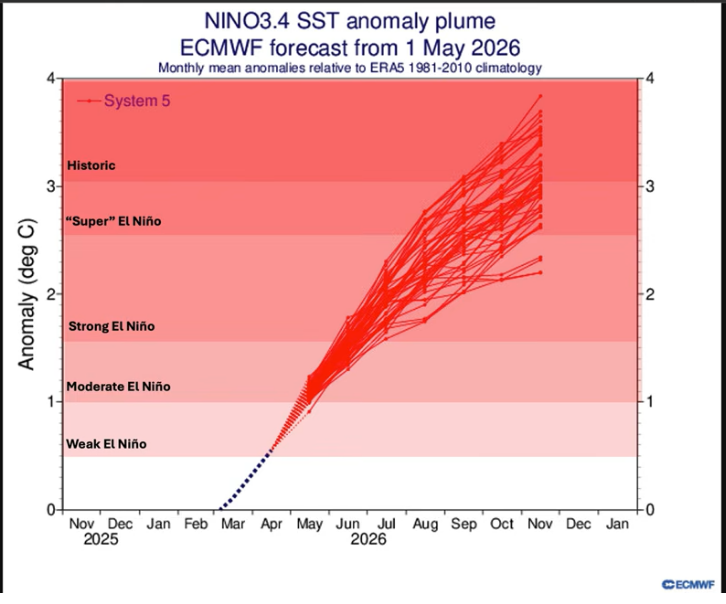
Certainly, we should be doing everything we can to limit GHG emissions. We should have already been well underway. Instead, we've added renewables to our energy stack but have not reduced fossil fuel use.
With respect to global infertility, "Fertility rates have fallen to unprecedentedly low levels worldwide, reflecting a widespread fertility crisis." https://www.sciencedirect.com/science/article/pii/S0015028225019958 It's true that the demographic transition has been responsible for women deciding not to have as many children, but I'm not referring to this. I'm referring to rapid declines in fertility, where people who want to have children are finding they can't conceive.
I don't consider nuclear to be renewable. https://maweb.org/why-is-nuclear-energy-not-considered-renewable/ I do think we need to continue using nuclear for electricity generation but there are finite stocks of uranium available, the waste is still an issue, and newer, safer, more renewable types of nuclear reactors are still waiting to be scaled up. IMO, even solar and wind are non-renewable because the materials we need to fabricate them and their replacements in 30 years are also limited. I view our installation of solar PV system on our earth bermed house as a bridge to the future. I hope to pass our home on to one of our children but honestly parts to repair the system are already unavailable. A fan went out in our inverter and we were told the company no longer supports the product. Our system was barely 6 years old and we were told that we might have to replace our inverters and batteries at a cost of $25,000 which is half the cost we paid for the entire system when it was installed, all because a fan failed!
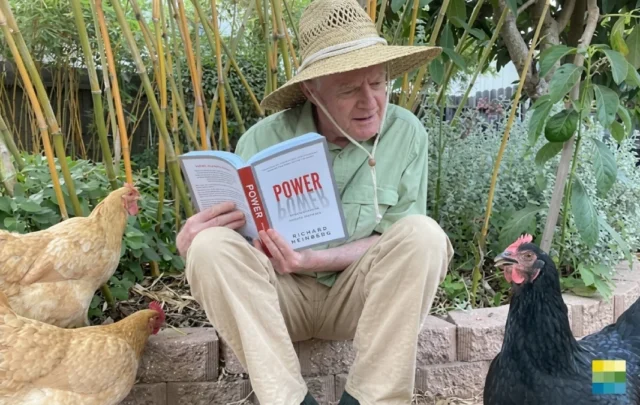
Nate Hagens of the Great Simplification has done many excellent interviews with people such as Simon Michaux, Craig Tinsdale, and Michael Every discussing the energy transition. This recent one was excellent. https://www.resilience.org/stories/2026-03-05/could-the-west-lose-the-resource-wars-ai-rare-earths-and-economic-statecraft/
"I think we've already passed the point where we could hold warming below 1.5 deg. C"
It isn't often mentioned but the goal to hold warming to a 1.5 deg. C target was not a limit to warming in any absolute sense, but merely by the end of this century. Even if successful, rapid warming would continue for centuries beyond that.
"and may even approach 1.75 deg. C this year."
If all we do is limit emissions, we will definitely blow past the 1.5 deg. average in another decade or two. And the faster we phase out the high-particulate fossil fuels, the faster we will heat up. Those particulates are providing a cooling effect offsetting a large chunk of our warming potential. When the skies clear and we get the full brunt of the sun, the pace of warming could zoom to half-again faster than the rate we have now, and possibly faster.
"Certainly, we should be doing everything we can to limit GHG emissions."
The added warming potential from GHG emissions is weak, but cumulative, and very long term. The cooling effect from particulates is very strong, but very short-lived. For the near term, we get slower warming if we don't phase out the heavy-polluting sources. (We have other reasons we need to phase out the pollution, but we should understand it will accelerate warming.) Ultimately, there are only two ways to actually start cooling the Earth's surface. We can reduce the incoming heat (solar radiation management) and/or we can increase the outgoing radiant heat (for which the most effective option we know of would be removing large amounts of CO2 from the atmosphere).
"I don't consider nuclear to be renewable."
We'll be able to use as much of it as we want indefinitely. Whether or not it is renewable is of no consequence.
"I do think we need to continue using nuclear for electricity generation but there are finite stocks of uranium available,"
Finite, but more than we'll ever need.
"the waste is still an issue,"
The waste has never killed anyone–a truly staggering safety record. The world supply of spent fuel from Gen 3 reactors is probably going to exceed 400,000 tonnes. In molten salt fast reactors, about 375,000 tonnes of that would be usable fuel–enough to produce 950 terawatt-years of heat energy. Pulling 1.5 trillion tonnes of CO2 out of the air at today's capture efficiencies could be accomplished for roughly 350 terawatt-years of energy. We're currently at around 1.4 trillion tonnes heavy compared to pre-industrial CO2 levels. There is literally more energy sitting in our spent fuel than we would need to eliminate global warming and ocean acidification entirely.
"and newer, safer, more renewable types of nuclear reactors are still waiting to be scaled up."
It'll be a few more years before they start to enter production, and we'll need to scale up our fuel production as well. But drawing down our surplus CO2 is going to be a decades-long operation. A delay of 10 to 15 years before we can start is insignificant compared to what we can accomplish with the drawdown.
"IMO, even solar and wind are non-renewable because the materials we need to fabricate them and their replacements in 30 years are also limited."
"Renewable" was always only a marketing term. It has no practical worth when it comes to fighting warming/acidification.
"Nate Hagens of the Great Simplification has done many excellent interviews … This recent one was excellent. …could-the-west-lose-the-resource-wars-ai-rare-earths-and-economic-statecraft/"
Uranium harvesting and nuclear reactors don't need any scarce or critical resources, and the grid simplification they could enable could greatly reduce the demand for other resources, like copper. Also, fission products contain some rare-earths.
Dave's position is so frustrating because it is using similar arguments as climate change deniers and fails to acknowledge basic truths. His apparent counter-examples of past transitions completely ignore the physics of non-renewable resources and doesn't counter Tom's argument at all: that depletion of a critical resource tops abundance of a non-critical resource. Of course, Dave's right that what is critical may change over time but it cannot be true that modernity can always switch its critical resources for those that aren't currently critical. We already see with with, for example, copper. Copper ore is so degraded now (0.5% copper is now a high quality ore) that one might have expected the technologists to have come up with a suitable alternative that is in high abundance, since the problem has been known about for decades.
Regardless of how long critical minerals can be substituted for, it surely can't be argued that we can base a society on non-renewable resources for ever? And yet, this is what Dave tries to do. Aside from that, the environmental damage being done is devastating to the rest of nature and, thus, to ourselves. Dave wants to continue that damage for as long as possible. Tom is right that the availability (i.e. use) of huge amounts of energy is exactly the problem because the use of that energy is needed to cause all of the damage we have. Dave's counter is that energy is neutral, it's how we use it that matters, but this misses Tom's point. Dave obviously thinks he can somehow persuade people to use energy in a benign way, just as he thinks he can somehow persuade people to use technology in a benign way. How is he going to do that?
Dave is not going to stop people using energy and technology in a harmful way. If it's available, enough people will use it in a way that damages the environment and other people. But this misses the point that energy and technology can't be used in a totally benign way. They require the destruction and fragmentation of habitat, and the pouring into the environment of huge amounts of novel chemicals and toxic materials. That can't be avoided.
The only real question is how long can modernity last. People like Dave want it to last as long as possible, thus causing the most destruction possible. The end of modernity is a scary prospect but pretending it's all going to be alright doesn't lessen the ultimate suffering.
"Dave's position is so frustrating because it is using similar arguments as climate change deniers…"
I'm not seeing the similarity.
"His apparent counter-examples of past transitions completely ignore the physics of non-renewable resources"
None of his examples violated any physics.
"Regardless of how long critical minerals can be substituted for, it surely can't be argued that we can base a society on non-renewable resources for ever?"
We don't have forever. Human existence is finite, so for our purposes, a supply of a non-renewable resource which will exceed our needs is good enough. In the specific case of energy, we could easily base our society on non-renewing terrestrial fuels for millions of years, but we don't even need that. If we can use finite fuels to avert impending catastrophe, that is good enough reason to do so now. Even if we don't know if they can last beyond a few thousand years, it is still worthwhile to trade a huge problem which needs addressing on the order of decades for one which may need addressing thousands of years from now.
"the environmental damage being done is devastating to the rest of nature and, thus, to ourselves. Dave wants to continue that damage for as long as possible."
I didn't see where Dave gave any such indication that's what he wants.
"Tom is right that the availability (i.e. use) of huge amounts of energy is exactly the problem because the use of that energy is needed to cause all of the damage we have."
We will need huge amounts of energy to avert the larger amounts of damage we are on track to cause.
"Dave's counter is that energy is neutral, it's how we use it that matters,"
That has been the case so far.
"Dave obviously thinks he can somehow persuade people to use energy in a benign way, just as he thinks he can somehow persuade people to use technology in a benign way. How is he going to do that?"
That will be a vastly easier project than persuading people to not use energy and technology.
"Dave is not going to stop people using energy and technology in a harmful way."
It is still worthwhile to trade large harms for small harms.
"If it's available, enough people will use it in a way that damages the environment and other people."
Any such damages to environment and people have to be weighed against the benefits to environment and people, as well as comparing against the harms and benefits of the alternatives–including depriving people of access to energy and technology.
"But this misses the point that energy and technology can't be used in a totally benign way."
A totally benign existence is not an option. Humans have never lived in a totally benign way.
"They require the destruction and fragmentation of habitat, and the pouring into the environment of huge amounts of novel chemicals and toxic materials. That can't be avoided."
That has not been proved.
"The only real question is how long can modernity last. People like Dave want it to last as long as possible, thus causing the most destruction possible."
That is not a necessary implication.
"The end of modernity is a scary prospect but pretending it's all going to be alright doesn't lessen the ultimate suffering."
Pushing for a good outcome is not the same as assuming or pretending it will happen. Modernity can be a force for enormous good or enormous harm. It all depends on how we use it.
I see parallels with climate change deniers when Dave says things like "energy and technology are neutral" or that large amounts of energy doesn't drive destructive trends. His allusion to the infinite ingenuity of humans is akin to the self-style rational optimists. He even thinks technology can provide a sustainable future. That technology can be maintained indefinitely is against physics. The use of finite resources can't be sustained. That's just physics.
The "we don't have forever" argument misses the point. If our way of life in unsustainable (i.e. cannot go on indefinitely) then it will end. This is the point Tom is making. You're right that if we could mine and refine critical non-renewable resources at the rate we need then that would be sufficient to maintain our way of life. So how can we ever be certain of being able to maintain that for some specific length of time? Mineral ores are already severely degraded, at between 0.2% and 0.7% of copper in the ore. To get a ton of copper, 500 tons of ore may need to be mined. And it will get worse, requiring increasing amounts of energy to get access to it. The ecological damage is thus only increasing and we've already devastated biodiversity.
Your position is that we should stave off the end of modernity at every opportunity until we physically can't. That's a reasonable position but there is no reason why that is better than acknowledging limits now and trying to wind down modernity to cause the least suffering. Still, your position is the default position of civilisation at the moment. I don't see that changing no matter how obvious the unsustainability of it becomes. Change will then eventually happen catastrophically.
Dave also misrepresents Tom's position as "any human perturbation to natural ecosystems is unsustainable." That isn't Tom's position. He knows that any perturbation that nature can't assimilate is unsustainable.
"I see parallels with climate change deniers when Dave says things like "energy and technology are neutral"
A denier might say that CO2 emissions are not harmful, but when Dave says energy is neutral, that doesn't mean it is not harmful. It means the energy does not inherently dictate how it will be used. It could be beneficial or harmful or any mix thereof. That part is up to us.
"or that large amounts of energy doesn't drive destructive trends."
Doesn't *necessarily* drive destructive trends, though it could be used that way. That's not denialism.
"He even thinks technology can provide a sustainable future."
He would only be wrong if that's impossible. I haven't seen any proof of that.
"That technology can be maintained indefinitely is against physics. The use of finite resources can't be sustained. That's just physics."
I don't know how you arrived at this notion. Are you thinking that "indefinitely" means infinitely, perhaps? It doesn't. It only means the end point is out beyond what we can foresee. I know of no physics limitation against that.
"You're right that if we could mine and refine critical non-renewable resources at the rate we need then that would be sufficient to maintain our way of life."
I think we can maintain modernity. Our way of life can and likely will change within that framework.
"So how can we ever be certain of being able to maintain that for some specific length of time?"
For a specific length of time is easy. Just specify a short length of time. If you are asking how we can think a resource could last us indefinitely, one way could be if it is based on a process of unknown duration. We know, for example, that uranium washes into our oceans at around 35k tonnes per year (roughly the middle of a range of estimates). So if we were to extract 35k tonnes U per year from the oceans, and then use that to power molten salt fast reactors (to produce roughly 90 terawatts average primary energy–as opposed to the 19 TW we produce now) how long would we be able to do that? Nobody knows. We don't foresee an endpoint.
"Mineral ores are already severely degraded, at between 0.2% and 0.7% of copper in the ore. To get a ton of copper, 500 tons of ore may need to be mined. And it will get worse, requiring increasing amounts of energy to get access to it."
On the other hand, we know that the infrastructure to support wind and solar needs around 5 to 6 times the amount of copper as traditional power plants, so perhaps a high nuclear future would knock the needed amount of copper down. And after a grid infrastructure is built, maybe recycling could figure prominently in its upkeep.
"The ecological damage is thus only increasing and we've already devastated biodiversity."
Here are some other things a high nuclear future could make possible. CO2 drawdown from the air and seas. Fewer humans (fertility rates fall when we migrate to first-world living standards). Increased urbanization (shrinking the human land footprint). Displacement of fuel crops–freeing up agricultural land and removing a big driver of deforestation. Concentrated-energy food production (aquaponics, lab meat, microbial nutrients etc.)–these could also shrink our land footprint and could reduce pesticide and fertilizer runoff. Potential to knock down hydropower dams to restore fish runs and river ecosystems. No more coal and lignite mining. No more mercury, arsenic, and other heavy metals from coal smog. Nuclear ships for less port smog. Cleaner-burning synfuels for less combustion smog. Synfuel production reducing and displacing petroleum extraction. Water desalination and mass water transport. Pyrolysis for nearly endless plastic recycling. I don't see how any of those would be unsustainable, and I see how several of them could actually produce ecological benefits.
"Your position is that we should stave off the end of modernity at every opportunity until we physically can't. That's a reasonable position but there is no reason why that is better than acknowledging limits now and trying to wind down modernity to cause the least suffering."
I would say a big reason is fighting global heating. If we don't rapidly extract the surplus CO2 we've emitted, the world will be heating up for centuries–at a faster rate than now. (Smog is actually slowing down the warming.) Another reason is all the mass death that would happen if we ditched modernity at our present numbers.
"Still, your position is the default position of civilisation at the moment. I don't see that changing no matter how obvious the unsustainability of it becomes. Change will then eventually happen catastrophically."
I'm not seeing the obvious unsustainability.
Finite non-renewable resources and decreasing ore grades necessitating increasing complexity to mine and refine them guarantees that modernity is unsustainable. Continued destruction of biodiversity to accommodate human modernity just adds to the unsustainability. Nuclear needs more than just uranium but you seem to assume that it will always be economical to extract uranium from sea water. Apart from experiments, sea water provides none of the uranium required by economies today. But electrical energy alone cannot keep modernity going. There are limits which humanity has yet to acknowledge (at least in terms of how economies are run). Countries don’t even try to set time limits on how long modernity can last or continue at its current level.
Tom has more at: https://dothemath.ucsd.edu/2023/09/can-modernity-last/
"Finite non-renewable resources and decreasing ore grades necessitating increasing complexity to mine and refine them guarantees that modernity is unsustainable."
It guarantees that we will have to transition to another kind of modernity if modernity is to continue.
"Continued destruction of biodiversity to accommodate human modernity just adds to the unsustainability."
I don't see how that is necessary to modernity itself.
"Nuclear needs more than just uranium"
Nothing that is in short supply.
"but you seem to assume that it will always be economical to extract uranium from sea water."
We aren't going to deplete the supply of uranium in seawater enough to affect the economics of extraction.
"Apart from experiments, sea water provides none of the uranium required by economies today."
The current built production capacity is sufficient for our present needs, and for now, in situ leach mining is still cheaper than mining uranium from seawater. Ocean U is the future backstop which will cap how high U prices can go when demand increases.
"But electrical energy alone cannot keep modernity going."
Nuclear energy is heat and radiation. You can make electricity from it, but you can also do a lot of other stuff. The most important thing can do with it is draw down the surplus CO2 in the air, but we can also use it for water desalination, district heat, industrial heat, ship power, fertilizer production, hydrocarbon fuel production, hydrocarbon plastic and rubber production, pyrolytic recycling of plastics, industrial radiation, and medical and industrial isotope production.
"There are limits which humanity has yet to acknowledge"
We will need to detect them before we can acknowledge them.
"Countries don't even try to set time limits on how long modernity can last or continue at its current level."
In much the same way most people don't set time limits on their own life spans.
"Tom has more at:"
I agree it's not going to work if we try to just replace fossil fuels with renewable energy. But nuclear isn't renewable energy.
Two things. Actually, one primary thing. Resources are finite and we've already accessed the low hanging fruit. It gets harder and more complex (i.e. increasing energy just to extract the same amount, if it is even feasible to access it) from here.
The other thing is nuclear also requires resources and I think you missed the point about extraction of uranium from sea water. It takes a lot of energy and has a limited rate of extraction.
"Resources are finite"
So are humans. Some of our resources are so large we will never bump into their limits.
"and we've already accessed the low hanging fruit. It gets harder and more complex (i.e. increasing energy just to extract the same amount, if it is even feasible to access it) from here."
This assumes no advancement in extraction technology. The old excavation methods for mining uranium are giving way to in-situ leach mining, which uses far less energy per unit extracted even when working with much lower ore concentrations.
"I think you missed the point about extraction of uranium from sea water. It takes a lot of energy and has a limited rate of extraction."
The energy input for a recent electrochemical method reported in Nature was less than 2 MWh per kilogram. That is much less than the energy needed to do excavation mining, and only slightly worse than in-situ leach mining. Estimated production cost with this method is under $100 per kg. The leading adsorbent approach is in a similar price range. They demonstrated an extraction rate of 23.66 g per kg of adsorbent in seven days using natural seawater. So each tonne of reusable adsorbent in the water could collect roughly a tonne of uranium per year.
I've no idea why you'd think humans could never bump into the limit of some resources (unless you see modernity going away before that could happen) but it's not "some" resources that matter, it's any critical resources.
It doesn't depend on advancement of extraction technologies. Of course, they could keep extraction going for longer but always due to increasing complexity, and increasing complexity just amplifies our predicament because of the extra need to keep growing to support that extra complexity, as well as the extra energy needed.
Uranium from seawater has an EROEI of about 4:1. Civilisation runs on about 15:1 or higher.
"I've no idea why you'd think humans could never bump into the limit of some resources"
I said why. Because the resource amounts are so large. We will, for example, have scarcely touched the Earth supply of nuclear fuels by the time humans are gone from Earth.
"but it's not "some" resources that matter, it's any critical resources."
And I assume 'critical' also means irreplaceable. But do you actually know of any?
"Uranium from seawater has an EROEI of about 4:1."
That sounds roughly like the figure from the source Heinberg cited. That calculation included pumping seawater, which wouldn't be needed for in-sea extraction. Also, he calculated 5 MWh for enough adsorbent and processing to extract 12.5 kg. in a year based on a rate of 6 g U per kg. adsorb per 50 days. That's obsolete. A refined approach has demonstrated an extraction rate of 23.66 g per kg of adsorbent in seven days, That's a 28-fold improvement, which reduces the energy to 180 kWh or call it 250 kWh since the processing won't reduce at quite the same scale as adsorbent manufacturing, He also figures 5 MWh for 100 SWU of enrichment, despite previously noting it only requires 7-8 SWU per kg. of enriched uranium–and he's figuring for 1.25 kg. so that should have been more like 10 SWU, or 500 kWh. (Also, enrichment is going to be the same no matter where the uranium comes from, so this is not specific to seawater extraction.) So his corrected inputs amount to 750 kwh input against his energy return figure of 218,750 kWh for an EROEI of 290 to 1.
"Civilisation runs on about 15:1 or higher."
This will be even easier to achieve once we move to molten salt fast reactors, which will have EROEIs in the thousands to one.
Critical resources? Well, I suppose you might be able to say that a shortage could spur innovation into alternatives, even if they aren't as good. But copper is an obvious one. I've heard aluminium touted as a replacement, for decades, but despite copper ore grades down to less than 0.5% and deposits in harder to reach locations, aluminium is not making a dent in the applications of copper. There are plenty of other examples.
The EROEI of sea water uranium reaching a level needed to run a civilisation seems to be more hopeful than anything. Of course, you must realise by now that nuclear power will never be the dominant source of power for the world, but I guess a strong desire for modernity to go on, somehow, does raise optimism for any apparent solution to enable that to happen. Hey, part of me hopes that also, but I know it would just drive more environmental destruction, so another part of me hopes solutions aren't found.
"Critical resources? … copper is an obvious one."
I don't know. I remember my grandfather hoarding copper, convinced it was going to become rare because he heard there was only enough proven reserves for another 40 years. That was in the 50's when the proven reserves were around 150 million tonnes. Today, we're mining almost 23 million tonnes per year, but we're still projecting enough proven reserves for another 40 years–around 900 million tonnes.
"I've heard aluminium touted as a replacement, for decades,"
If you are talking about in electrical applications, that's only around 20% of what we use copper for. The largest chunk–over 40%–goes to make parts of buildings, and there are all kinds of substitutes for copper there.
"There are plenty of other examples."
I'm doubtful that qualifies as one example.
"The EROEI of sea water uranium reaching a level needed to run a civilisation seems to be more hopeful than anything."
Where we get the uranium is of no consequence. The difference in energy inputs is trivial. The dominating factor is how we use the uranium. With old-tech reactors, we can only extract around 0.5% of the energy in natural uranium. That is suppressing the energy-return side of the ratio. Molten salt fast reactors should be able to boost that to nearly 100%. We have firm confirmation that electrochemical extraction from seawater can now be done for under 2 MWh per kg. of U. My hunch is that will turn out to be generally worse than for the adsorbent approaches, but it's easier to quantify with some precision, and at the very least, it sets the ceiling. And the heat output energy in a molten salt fast reactor would be 23,600 MWh per kg. U at 99% burnup for an EROEI of 11,800 to 1. That is easily good enough to sustain a civilization.
"Of course, you must realise by now that nuclear power will never be the dominant source of power for the world,"
I think Mark Jacobson represents one of the more blue-sky views for how much energy we could get from renewables, and his plan would have an average global RE output of around 14 terawatts. If the petroleum companies succeed in making a transition to nuclear synfuels, their potential market could average around 5 terawatts of hydrocarbon fuels. There have been some lab-scale demonstrations of synfuel production at over 40% efficiency, but going with a more conservative 30%, that would need 16.7 terawatts average input energy. And let's target 30 gigatonnes CO2 drawdown per year, and say nuclear carries 25 of that 30. That would need 5.7 terawatts. So even if nuclear did nothing except CO2 drawdown and synfuel production, that would still be over 22 TW-years per year of primary energy. If we got that from fast reactors, that would need about 8300 tonnes of U per year. If we used the supplies of uranium we already have in storage, that could last us around 250 years at that rate. (But that rate of CO2 drawdown would only need around 60 years to remove all the surplus CO2 in the air.)
"but I guess a strong desire for modernity to go on, somehow, does raise optimism for any apparent solution to enable that to happen."
The physics says it is possible. Whether we go that way or not is up to us.
"Hey, part of me hopes that also, but I know it would just drive more environmental destruction,"
Have you seen what lignite mining has done in Germany, or mountain-top removal mining in Appalachia? We could stop all of that–as well as petroleum production. We wouldn't need to grow energy crops. We could stop burning trees for energy. We could move to more concentrated forms of food production. We could increase our urbanization and decrease our rural footprint. We could expand on the low-fertility-rate trends seen in first world countries and shrink our population naturally. We could have more and better kinds of recycling. We could knock down or bypass the worst hydropower dams and restore river ecosystems and fish migration. I worry more about the energy-collapse path. That would cause a mass exodus out of our cities, and would greatly increase hunting and foraging. And we would be less likely to pursue luxuries like rewilding, reforestation, and wetlands restoration–and far less likely to have long-shot projects like resurrecting extinct species, or investigating animal communication.
"so another part of me hopes solutions aren't found."
Environmental destruction is now the default future if we do nothing. The Earth is going to cook if we don't rapidly pull back the CO2 we've already released. And we aren't going to accomplish that if we don't implement the energy solutions needed to keep modernity going.
Most of the worlds environmental problems were caused before climate change started to have an impact. That destruction won’t stop if warming is stopped (critical though that is).
It’s all very well being optimistic about resources but the fact is that ores are becoming degraded and it’s becoming more complex and more energy intensive to mine some reserves. Time is another factor. Maybe many things are physically possible, given enough energy and will but we’ve heard about “coulds” for a long time that aren’t shifting to actual actions. Nuclear is not going to be the main source of energy in the world. Fossil fuels aren’t going to magically be replaced with other forms of energy. Their use is still rising (or was until the Strait of Hormuz was closed).
Believing that modernity can go on with alternative resources without wreaking havoc on the rest of nature is, I feel, a path that leads to even worse outcomes. But there are no prohibitions on beliefs. However, reality is what it is.
That is an excellent question. "How long can modernity last?" People resist the idea of going to back to an 1800's lifestyle….as if they have control over the matter. I think we need to start seriously thinking about what our lifestyle would look like if we were living within the sunlight energy budget captured by plants. https://press.asimov.com/articles/sunlight-budget
Yes, sunlight captured by plants is the only way for other species to use sunlight. Solar panels have to be manufactured and installed, which takes more than just sunlight. When considering sustainability, I tend to think of sunlight as being completely "consumed" by Earth's natural systems or being re-routed back to space (to ensure Earth doesn't get too warm for life). The planet that existed before human civilisation was the result of Earth's natural energy flows. Then humans started to divert those flows.
Living within the Earth's natural energy and resource budget is what all other species have done, and what humans did before discovering coal. I don't think that there is any likelihood that, collectively, humans would choose to live within natural limits. However, long term, that's what all species have to do.
The real issue neither Murphy quite lands on is that it is not modernity that is unsustainable. It is capitalism. The system requires growth not as a byproduct but as a structural necessity. A firm not growing is dying. An economy not expanding is in crisis. That is not a cultural choice. It is baked into the operating system.
The externalities problem is the killer argument. Markets are extraordinarily efficient at pricing what they can see and extraordinarily blind to everything else: carbon, biodiversity, topsoil loss, aquifer depletion, the value of a landscape. These are not market failures in the technical sense. They are features.
There is a rough consensus among ecological economists that a decent material life for everyone on earth is achievable within planetary boundaries. The American consumption model, when applied globally, is not. The problem is not scarcity. It is a distribution and a growth imperative that makes redistribution politically impossible.
Tom Murphy's doomerism lets capitalism off the hook by making collapse feel inevitable rather than chosen. Dave Murphy's optimism sidesteps who controls the adaptation and in whose interests. The political economy is the missing variable in both accounts.
I've tried but I can't think of a non-destructive use of an inexhaustible source of energy.
It's a shame that the editing of this part of the conversation was just to cut Tom's next comment out, especially as Dave's comment started this part of the conversation. See Tom's version of part 3, here: Two Murphys, Part 3 .