

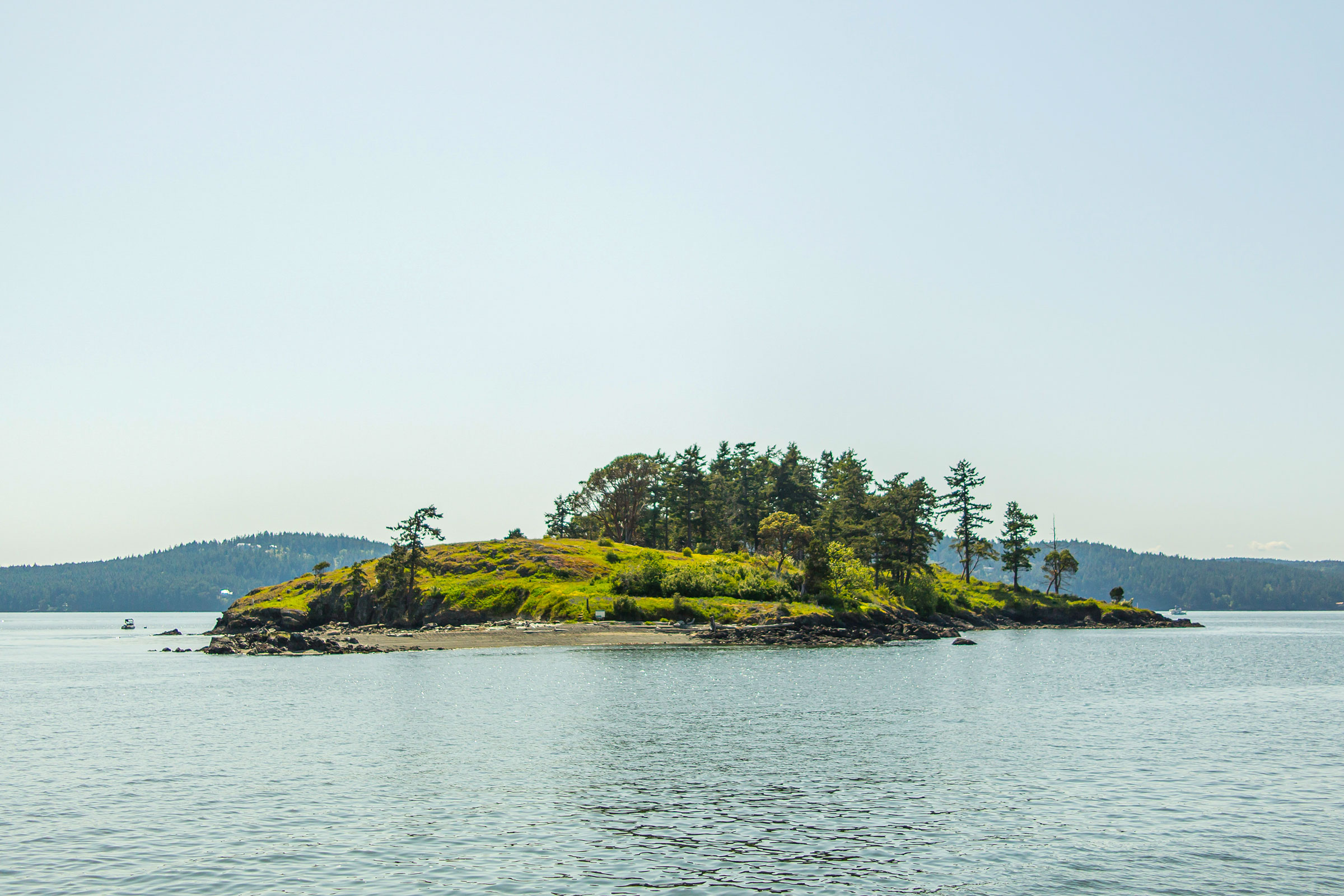
It’s May, and I’m on a boat in the San Juan Islands, an archipelago in the far northwest corner of Washington State. The clouds are low and the waves are olive green. I am heading to a place that sounds like a fairy tale: an island covered in flowers where just one person lives, all alone, tending the land. The island is a rare example of an ecosystem that was once more common in the San Juans: a diverse prairie characterized by a purple flower called camas. For that reason, The Nature Conservancy (TNC) acquired the island in 1980 and pays a steward to tend it.
But the island also represents something important about the future of biodiversity conservation: it will require people. Yellow Island is not a pristine relic. Its diverse meadows have been shaped by humans over thousands of years, and they will always require people to maintain them. And this lovely isle is by no means the only biodiverse ecosystem that needs ongoing human care to flourish.
For many Western conservationists in the 20th century, the ultimate goal of conservation was unsullied wilderness of the kind they believed existed just prior to European colonization. Simply extract humanity, they thought, and such landscapes will flourish in a kind of timeless balance for eternity. In the current century, that vision has been critiqued as a colonialist fantasy that ignores deep histories of Indigenous influence on ecosystems and sets up an unattainable ideal in an era of global climate change.
Western conservationists have become more aware of the extent to which many biodiverse, beloved ecosystems were maintained by people through burning, weeding, hunting, harvesting, livestock grazing, and cultivation. Landscapes with low-intensity use are often more biodiverse than places with no use. The idea of keeping people out of nature to preserve it is making less and less sense. Many landscapes need people.
Without human-free purity as the goal, some conservationists are instead focusing on diversity, abundance, and maintaining the many ways nature supports good lives for people. These goals are often best attained by identifying and supporting healthy human-nonhuman relationships. But what do those non-exploitative, non-destructive relationships even look like?
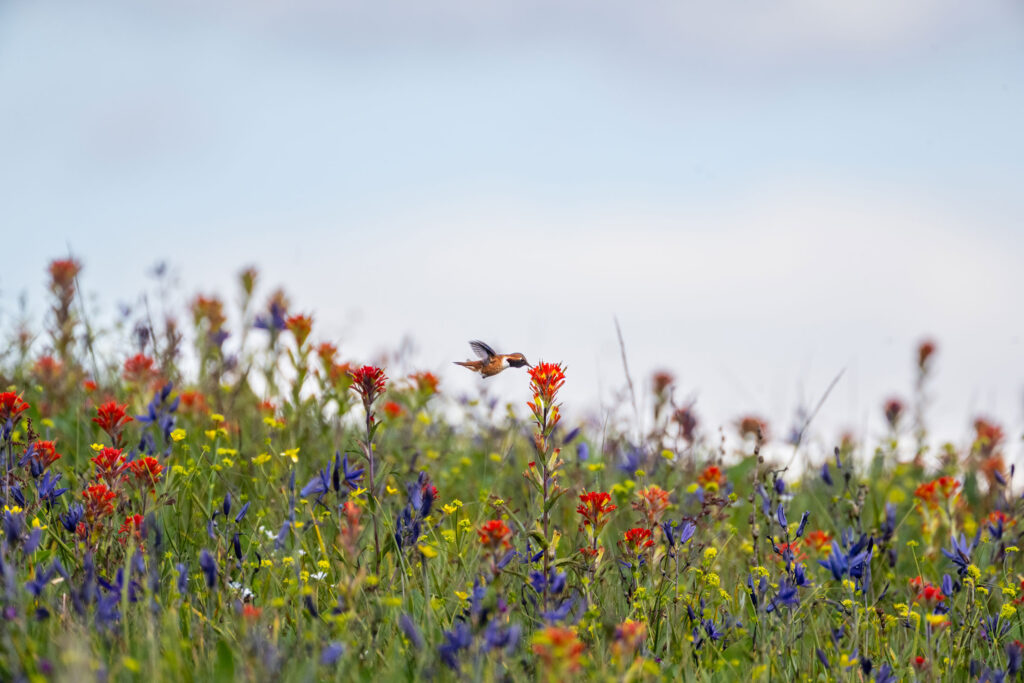
I am approaching one possible answer. Every spring, this little island of just 4.5 hectares (11 acres) explodes with flowers. Orangey-red paintbrush and pale chartreuse Lomatium with its mid-century modern blooms, chocolate lily and buttercups, and yarrow and stonecrop all grow in abundance, along with the flower for which this island is famous: camas, or Camassia quamash, a tall spike of deep purple blooms above, an edible bulb below. Yellow Island is thought to be named for its summer hue—the pale gold of dried grasses and flowers. It’s a prairie outlier in an archipelago otherwise predominantly green, where island after island is covered in conifers down to the waterline.
Coast Salish peoples tended the ecosystem of Yellow Island—and many more like it throughout the archipelago. Most prairies were appropriated for intensive livestock grazing after Europeans arrived; only a precious few patches persist in the area today.
These meadows were places to grow camas, whose bulb was a staple of Coast Salish cuisine. The women who traditionally managed them used fire to keep bushes like snowberry, ocean spray, and serviceberry from smothering their crop, and to keep trees from taking over the island. And they almost certainly weeded. Coast Salish peoples likely selected camas plants that divided well and produced large bulbs, shaping the populations they grew on a genetic level. Harvest itself—the hoeing, digging, and dividing—ultimately makes camas more productive.
Yellow is not a wilderness in any sense. It is perhaps closer to a garden that grows interspecies relationships.
At the moment, the only resident of Yellow Island is steward Ángel Quimbita, 27, a native of Los Angeles, user of both he and they pronouns. Quimbita greets visitors who arrive on the island, explains why it is such a special place, and gently but firmly enforces rules against picnics and dogs. “I tell people it’s somebody else’s grandmother’s garden.” They advise people to comport themselves “like you would walking around a church.” They gather data on plant presence and abundance to contribute to a long-term dataset. And Quimbita weeds the island. A lot. They try to weed two hours a day, minimum, although sometimes there are so many visitors they can’t fit it in. Quimbita is in no danger of running out of work.
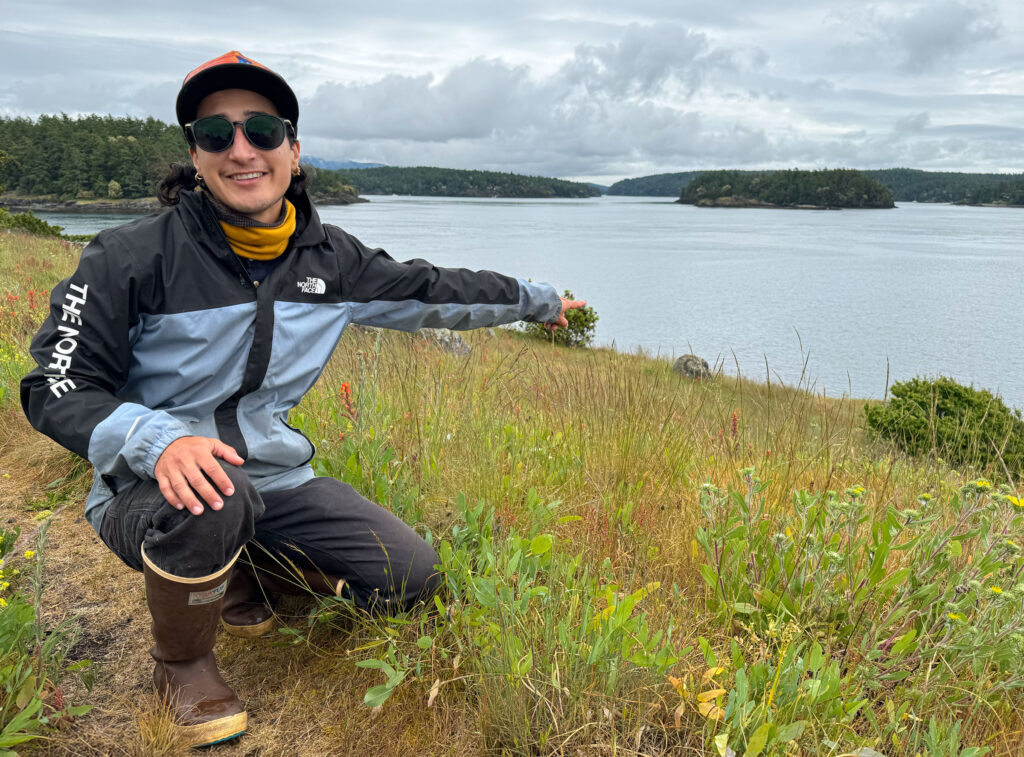
Taking a cue from Indigenous management, TNC has burned parts of Yellow Island several times, though those experiments are on hold at the moment. The weed whacker can also be used in place of flames. Previous stewards sometimes applied herbicides. Quimbita prefers to pull weeds by hand and invites volunteers out to help. A few decades ago, they say, environmentalists tended to see humans as destructive forces only, but now Quimbita is desperately trying to get more people out to Yellow to touch it and help shape it. Here, they say, “relationship building is the restoration work.” Yellow Island was once a place of gathering, tending, and harvest, and it could be again. “The more people out here, the better.”
I spend a few days on Yellow, learning from and working with Quimbita. At night, tucked in the rustic guest cabin on the far side of the island, I listen to seals snort and groan in the darkness and imagine a world in which jobs like Quimbita’s are much more common. Aside from room to persist, perhaps what biodiverse ecosystems really need to remain viable is people willing to do the work of instantiating good relationships with other species.
People often ask Quimbita how they can stand to be alone. They say that, on the contrary, living on Yellow can feel like living “in a fishbowl.” People passing on boats peer at Quimbita through binoculars. Kayakers and boaters show up at all hours—up to 60 a day at peak bloom—and sometimes try to walk right into Quimbita’s house. The shores of nearby islands, and their houses, are close enough that sometimes party music floats over the water, and Quimbita can even identify what people are listening to. (The Eagles, often.)
Undeveloped islands have an air of remoteness, but Yellow, I come to understand, is actually centrally located—if we see waterways as thoroughfares. For the Coast Salish, who once traveled regularly by canoe, the little island is in a high-traffic area. “We think of water as a separator, but water is a huge connector,” Quimbita says. Seeds are constantly arriving, carried by the wind or glued to otter fur or boots with mud. The island is indeed busy with recently introduced plants: deadnettle, Himalayan blackberry, sheep sorrel, and, especially, many species of fast-growing annual grasses.
Thus, Quimbita will never finish the task of weed removal. The island will never be completely “restored” to any point in the past, nor is that the goal to which Quimbita or TNC aspires. Purity is not the objective. The goal is to create an environment in which rare plants, beautiful plants, traditionally beloved plants—especially Queen Camas—can be happy. So Quimbita focuses on pulling plants that will outcompete natives to the detriment of the local ecology. Some newcomers, like Sierra pea and vetch, don’t take up much space and aren’t aggressive, so Quimbita hasn’t yet chosen to weed them out. On the other hand, snowberry is native, but it would crowd out the camas, so Quimbita mows it in places.
This is a negotiation, not an autocracy. But if left totally alone, the things that make Yellow special would erode. Grasses would swamp lilies; blackberries would engulf the slopes like vines taking over Sleeping Beauty’s castle; Douglas firs would reproduce and expand until their branches meet, plunging the ground into shade.
Westerners tend to either slot vegetated land into “nature” or into “agriculture,” even though something like a camas meadow is clearly both. “Coast Salish gardens are similar to permaculture,” says Samuel Qol7ánten Barr, a member of the Samish Indian Nation—part of the Coast Salish group—and executive director of the Coast Salish Youth Coalition. “You have a few species that you are gently promoting, nudging. But by doing that, you also help all the other species.”
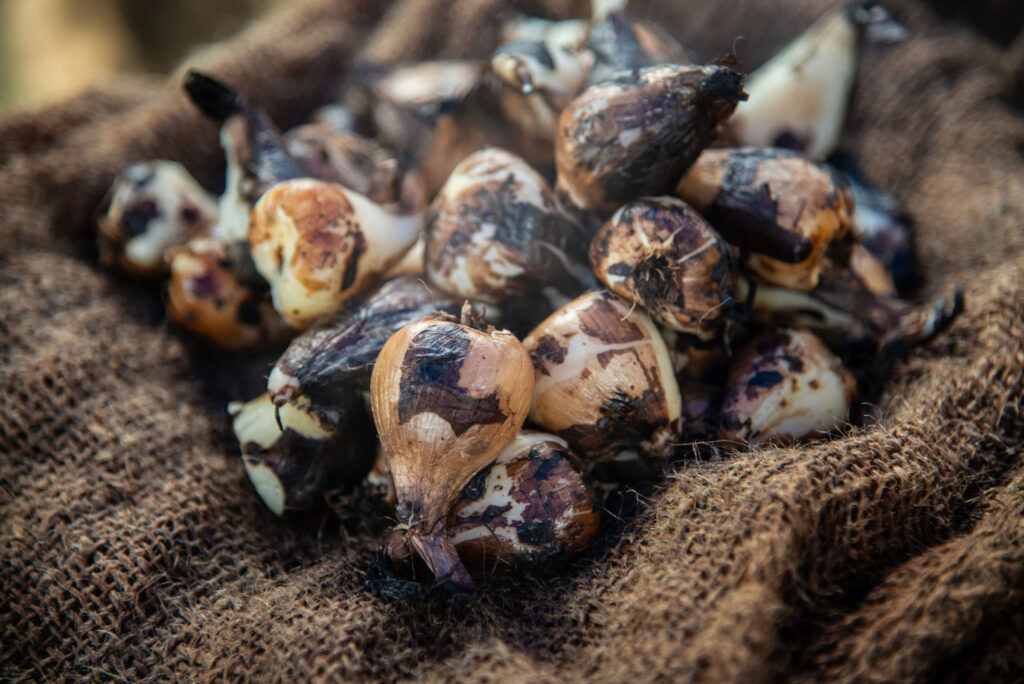
Among other endeavors, Barr runs a seasonal youth crew that helps steward camas prairies around the San Juans. They burn, plant, harvest, bake, and eat. Camas bulbs are usually baked, low and slow, until their indigestible inulin breaks down into fructose, creating an oniony, creamy, sweet treat. It might seem unusual to eat rare plants: “Some people are really surprised that we eat the foods that we do,” Barr says. But “for traditional peoples, there’s a promise there.” Taking, as well as giving—in the form of replanting, tending, and habitat maintenance—makes for a reciprocal relationship. Camas hasn’t been harvested on Yellow Island in a long time. TNC has been asked by various people to harvest there but says the organization’s role is to honor the wishes of its tribal partners—if harvesting is to occur again someday on the island, it will be led by the Coast Salish community.
Camas meadows aren’t a quirky exception. Many biodiverse landscapes around the world were created by people in part to produce food. Ove Eriksson of Stockholm University has spent years studying the so-called semi-natural grasslands of Sweden. These ecosystems host around 40 different plant species in every square meter—grassy wonderlands that may be dotted with gentians and alive with the rattle of drum grasshoppers. The grasslands were formed by animal husbandry practices dating back thousands of years that kept the surrounding conifers from encroaching. A third of Sweden’s threatened species occur mostly in these spaces and their associated ecosystems. And the best way to protect them is to have people continue using them for food production in traditional ways, says Eriksson.
The challenge is that while some small-scale cattle farmers still graze their animals on the grasslands, there’s little money in it. They have to compete with much larger operations grazing cattle on fertilized fields. Government subsidies help keep the smaller operators afloat and represent a reality: If society values agricultural methods that prioritize biodiversity over financial profit, governments, nonprofits, institutions, and consumers will need to pay for it.
For many farmers, the notion of food cultivation includes protecting biodiversity. Since 2002, the Food and Agriculture Organization of the United Nations has supported people working on more than 100 Globally Important Agricultural Heritage Systems, territories inhabited by communities that have intricate relationships with the land. Similarly, the 450-member nonprofit Agroecology Coalition is fundraising to support agriculture that “prioritizes diversity and works with nature, not against it” and advocates for supportive policies.
But there are many other landscapes, like Yellow Island, that have fallen out of active food production. Such places are not conceptualized as agricultural landscapes, but as part of “nature,” and they may represent a larger fraction of “nature” than one might expect.
A 2021 study by ecologists and geographers from around the world created global maps of historical land use and concluded that nearly three-quarters of terrestrial nature has been shaped by Indigenous and traditional peoples over thousands of years. An astonishing 95 percent of temperate and 90 percent of tropical woodlands show long histories of use, despite being referred to as “natural,” “intact,” and “wild” by conservationists. These lands are where people consistently improved soil health, water retention, biodiversity, and other metrics of a healthy ecosystem, using ancient practices known by the modern label of regenerative conservation. The researchers concluded that the current biodiversity crisis has primarily been caused by “the appropriation, colonization, and intensifying use of the biodiverse cultural landscapes long shaped and sustained by prior societies.” The problem isn’t that humans use nature; it is how.
It seems a fair assumption that preserving the biodiversity and ecosystem patterns in many of these landscapes will require resuming management practices that shaped them, or adopting new practices in sync with new conditions. Who will do this work?
There are already a few professional land stewards, like Quimbita. And many other jobs include land tending. The titles one could group under “land tender” or “interspecies relations” include forester, farmer, range manager, park ranger, wildlife biologist, game warden, wildland firefighter, landscaper, groundskeeper, and many more.
I reached out to a number of experts on the conservation workforce: people who knew about state and federal conservation corps, people who are trying to train others in techniques of prescribed burning, and labor researchers at think tanks. I asked them whether there were any real prospects of land tending growing as a sector in the coming decades, perhaps even in response to declining desk jobs in the AI era. The general consensus: That would sure be nice. But so far, there’s no sign of transformative investments.
A 2024 report by the International Labour Organization, the United Nations Environment Programme, and the International Union for Conservation of Nature found that some 60.5 million to 63 million people worldwide work in the “nature-based solutions” sector, one subset of land-tending jobs. The sector focuses on ecosystem management strategies to address both environmental problems, such as climate change, and social problems, like lack of clean drinking water. (A huge fraction of these jobs—some 53 million—are associated with India’s Mahatma Gandhi National Rural Employment Guarantee Scheme, which promises at least 100 days of manual work a year to each rural adult, whether that means digging irrigation canals or planting trees.) That seems like a lot of jobs, but it isn’t clear whether the sector is getting larger or not, primarily because the jobs have so many different titles. A farmer who floods their fallow fields for migrating waterfowl and an employee of the wildlife refuge on the same flyway may both help the very same duck, yet no dataset groups them together. The 2024 report concludes that if countries were to earnestly try to achieve the environmental targets set in international treaties, the world would likely see some 20 million to 32 million new jobs in this sector by 2030, mostly in agriculture and forestry.
In the United States, some entry-level conservation jobs are tackled by various state, federal, and private conservation corps, including AmeriCorps and smaller groups like the Northwest Youth Corps. An initiative to train 20,000 young people in an American Climate Corps was canceled soon after President Donald Trump was re-elected.
Corps programs help recruit a broader demographic to the field, says Martha Ross, a senior fellow at Brookings, a think tank in Washington, D.C., who researches and writes on labor markets. “A lot of environmental jobs are coded as white and middle class,” Ross says. If the sector is to scale up, she adds, it needs to be able to draw in people who don’t currently see themselves as environmentalists. It needs to have, she says, “a more blue-collar, trades focus.”
Routes into land tending that don’t require college degrees would also make it easier for Indigenous youth to get well-paid jobs maintaining their tribes’ traditional ecosystems, according to Barr. There’s more than one way to get an education. The Coast Salish traditional model was “being in one place forever,” he says. The current model of leaving home to get a college degree and then building a conservation career by moving from place to place to take a sequence of jobs isn’t compatible with the traditional pathway of intergenerational knowledge transmission. “Young people are really forced to choose—are they going to go to college or stay and get close to their elders?” Barr says.
The major investment in land tending that I’ve been dreaming of since I visited Yellow Island might sound radical, but it’s not a new idea. It is what most people did “for a living” in the preindustrial era. And there have been previous efforts to invest in this sector in more modern times, such as the Civilian Conservation Corps in the 1930s, a government jobs program that built trails, planted trees, erected fire lookout towers, and installed erosion and flood-control infrastructure on public lands. Today, though, marshaling the political will to create stewardship jobs and train a workforce on the scale that is really needed seems like a fantasy in most countries. In the United States in particular, conservation hiring has crashed since Trump began his second term, but as Ross says, “the way change happens is by taking something that is unlikely and making it happen anyway.”
One morning on Yellow Island, Quimbita and I weed annual grasses together. We don gloves and knee pads, grasp the handles of 5-gallon buckets, and walk halfway up the island’s central hill, where rufous hummingbirds demonstrate aerobatic maneuvers to potential mates.
Although I have to learn which species to pull from Quimbita, I come with experience weeding my home garden, which I suddenly realize is relevant. The best way to pull a weed is slowly. Pull too quickly, and the top of the plant will simply tear off, and it may sprout anew from its roots. So it is best to pull slowly but firmly, very gradually increasing your force until you feel the entire plant, roots and all, begin to yield. The reward is the sensation of deep roots slithering through soil, of the plant detaching from the earth and coming to rest, in its entirety, in your hand.
We weed for hours and only clear a small patch. I feel a bit daunted. But then I remember what Quimbita said about this work. It is not a single task to complete. The tending itself is the goal. We are not going to turn back time here to some untainted Eden. As Quimbita says, “We can only go forward.”


Comments
We changed commenting systems on September 10, 2026 as part of a site-wide functionality and security upgrade. Your past comments have not disappeared, and you can still log in with your old Disqus account credentials if you wish. Contact us with any questions.