

Sometimes, seemingly unrelated little details of the microworld can teach us how the macroworld works. This is particularly true when we study processes in nature. I recently had a kind of eureka moment while reading a scientific study on photosynthesis. If you find yourself in the summer heat, or live in a hot climate, you might appreciate the deep physical and spiritual joy that comes with leisurely walking in the shade beneath a plant canopy. The joy of being safe from the unrelenting and destructive, but at the same time, life-giving power of the sun’s rays above you. Just imagine exposing your naked human skin to the desert sun for the entire course of a day!
In order to turn those rays into useful chemical energy, but also to protect itself from destruction, those plant leaves are full of pigments that absorb or reflect varying frequencies of light. The energy from some frequencies is channelled to two types of large molecules, called photosystems. These photosystems are among the most chemically violent molecules in biology: if they are pumped up energetically by solar radiation, they can literally burn through tissue, leaving a path of destruction in their wake. Astonishingly, though, by way of the genius of biochemistry, the same activated state also serves as a protection. When there is too much light, its energy is safely dissipated as heat.
So how is it possible that the same state can be both destructive and protective? The answer lies in timing, which is the point where we can learn something about our own human biology: plant leaves have evolved intricate techniques to prevent those photosystems from staying in the activated state for too long, and thus cause harm. Something similar happens with our nervous system: we are constantly bombarded with information from all our senses, and we need that information to survive. But it can get too much. The same attention that keeps us safe can be turned against us when we perceive too much danger and too many threats. Our nervous system gets into overdrive, exhausts us, drives us crazy, or – as a protective mechanism – shuts itself down. This is the conundrum we face when we are confronted with the polycrisis: another war without an end, another human-caused “natural” catastrophe, another systemic injustice. It is just getting too much for our own psychic health.
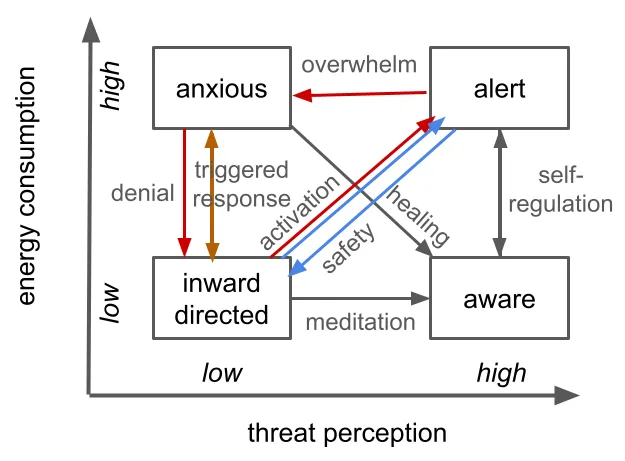
The answer lies again in timing – and in responsiveness. To understand what I mean, consider the sketch shown above. Under normal, everyday circumstances, our nervous system is in what I here call the “inward directed” state. Inward here does not mean introspection, but refers to the perspective of ourselves and our inner circle of family, friends and colleagues. We may be here because we are safe, ignorant, or because our nervous system has simply shut those threats out.
Suppose we are either safe or ignorant. During the normal functioning of our nervous system, a perceived threat will cause us to move into the activated state, where more energy is directed towards our senses and our brain’s intuitive and rational cognition. Heightened attention lets us better perceive not only the existence of threats, but also the level of the danger. In a healthy environment, we act and then return to the resting state – this cycle is shown in blue. However, when the danger persists or is intractable, we may stay in the activated state; it becomes chronic and starts to cause harm. The result is shutdown and denial. Once we are in a state of denial, we are not easily aroused anymore, but we can still be triggered if the denial is the result of trauma. In that case, we immediately move to the anxious state.
The problem is that both the anxious and the inward-directed state have low capability of threat perception. Climate and other polycrisis activism, when it does not endow people with a sense of agency, most times keeps them in either the red cycle of fatigue, or worse, the orange cycle of triggered responses. So how can we keep our sanity in the face of existential crises?
The answer can only lie in a journey of self-regulation and, if necessary, healing. As the plant leaves have found a way of diverting dangerous light energy into harmless heat dissipation, we have to find ways of neutralising the dangerous psychic energy of crisis perception. When the threat is so great that even successful attempts at meaningful action fail in the long term, we need to become more adept at maintaining our flexibility to pivot between the inward-looking resting state and the acutely activated state most capable of foresight.
In doing so, we may slowly but steadily approach a new state which I here call “aware”. In this state, we carry with us the insights from the activated state and acknowledge them without falling prey to their impact. Through self-regulation, we prevent the activated state from persisting, and through meditative practices, we become more aware of our nervous system’s states and our bodily and mental reactions to overwhelming threats. Like a martial-arts master, we stay in an energy-saving state of awareness and reserve the alert state for brief moments of active combat. Preserving mental and physical energy, we sustain our capability to survive.
These four states are an abstraction of what is, in reality, a very fluid system. So there are a number of subtleties within this scheme that deserve attention. Different types of people react differently to the polycrisis; some are natural optimists, some are pessimists, and some tend towards anxiety. Since natural optimists would be less prone to anxiety, we may think that their views are more balanced, offering a more sober analysis.
There is certainly truth in that. However, from my own experience, it is the activated state that gives us the most accurate and useful “feel” for the situation we are in, even if it borders on anxiety. For example, it has been in states of light anxiety when I most acutely felt the enormity of the experiment we as humanity are currently conducting with planet Earth, the unfathomable evil and cruelty of current world affairs, or the mortal threat to the fabric of mutual and intergenerational trust posed by greed-driven deployment of artificial intelligence. Often, it has been observed that there is wisdom in the shutdown of our nervous system, leading to trauma. But there is also wisdom in the anxious state, if contained and accompanied by wisdom.
What this means for activism is that we need to act in small enough groups where members are able to regulate themselves and each other. Groups that are conscious of the challenges to maintaining psychic health divide up the work so that most group members can be allowed to rest in safety. This is a concept of activism that counters the common approach of mass arousal, where everybody is meant to feel the same, concentrating energy on the movement’s goals. It is a model resembling tribal societies more than civic movements. But it may still be the most appropriate in the face of overwhelming crises.




Comments
We changed commenting systems on September 10, 2026 as part of a site-wide functionality and security upgrade. Your past comments have not disappeared, and you can still log in with your old Disqus account credentials if you wish. Contact us with any questions.
This would have been better if it included the graphic it refers to instead of picture of a little street fire.
The author is referring to the graphic in the middle of the article, with two axes and four boxes.