

As we engage with the unraveling of modernity, it’s important that we do so through a broad perspective informed by insights into our human psychology—both personal and collective. It’s also crucial to consider our cultural and historical contexts. Technical knowledge alone isn’t enough; we also need good judgment to tackle such a complex challenge.
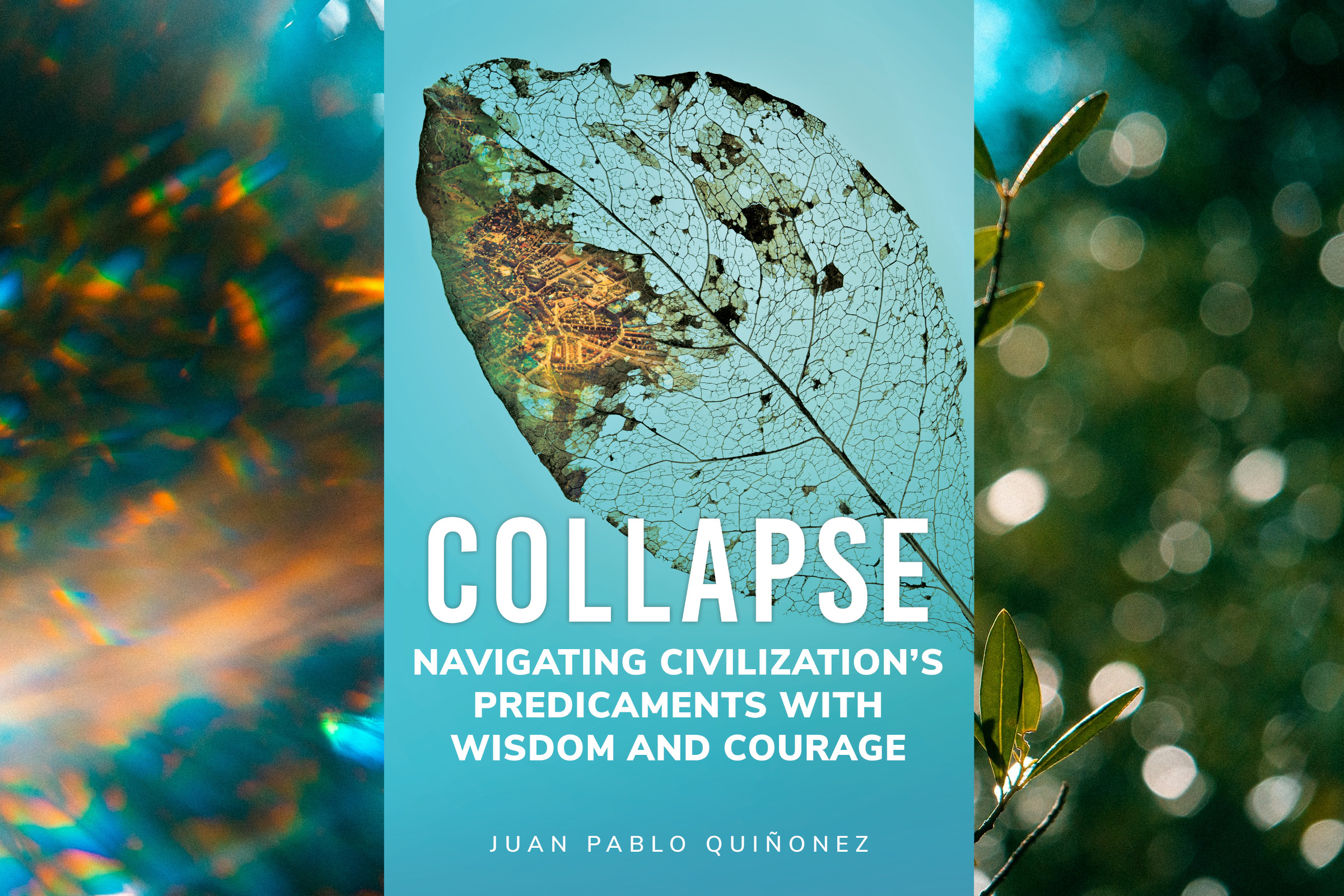
In my forthcoming book, Collapse: Navigating Civilization’s Predicaments With Wisdom and Courage, I strive to bridge interconnected facets of our converging crises, commonly referred to as the polycrisis. These challenges are rooted not only in the human condition and our sociocultural realities but also in the constraints of thermodynamics, ecological flows and the limits of complex systems, among others.
My context differentiates my approach to the subject. My perspective is shaped by time spent living outside conventional systems, at times for months at a stretch, including extended periods in the boreal forest. Experiences like these sharpen the contrast between life inside and outside modern industrial structures, making visible patterns that are easy to overlook from within. They have informed my thinking on resource use, energy dependence and the organization of modern societies.
There are several mental barriers to discussing collapse. As primates, we primarily rely on social bonds for survival. To foster coordination and cohesion, to be on the same page as others in our in-group or “tribe,” we’re handed down worldviews and mental paradigms. When the grip of those lessons loosens, or when we consciously release them, at some level within us, it’s comparable to rejecting our tribe. That’s one difficulty in perceiving the polycrisis. Another is that in-group worldviews often serve as a shield from anxiety about our mortality. That’s why people can have a strong emotional reaction when defending their worldviews. At a psychological level, it’s akin to a serious threat.
As we may have already noticed, humanity is not making substantial progress at the pace required to address the converging crises. Modern civilization has undergone unsustainable growth, and its core tenets rest on a shaky foundation of misguided premises: infinite resources, domination of nature, hubris, the cargo cult of tech and the domination and control of people. And the challenges are consistently becoming more difficult. Humanity is also grappling with conflicts, geopolitical tensions and widely diverging points of view. But, while the difficulty is increasing, our collective ability isn’t.
As our awareness increases, we should be careful not to fall into a common trap. We have a variable desire for certainty or closure—both a conscious and an unconscious psychological need. Landing many in the extremes of either blind optimism or toxic pessimism. Some may believe an external entity will fix our collective crises—technology, god, science—or that the end of the world is coming and there’s nothing that can be done. I suggest that the more accurate and wiser path lies closer to the middle: a decline in societal complexity will accelerate relatively soon, and we must consciously navigate these challenges. That wiser path is adaptable and flexible. It’s not easy to remain in that flux, in a state of unknowing; however, if we choose one of the extremes, if we cling tightly to more comprehensible ideas of salvation from outside, or of total destruction, we’re surely falling into a mental trap.
The interconnection of everything, interbeing, is another recurrent theme in my work. We can’t just look at some pieces of the puzzle and expect to get an actionable, coherent picture of the whole. To have a holistic view, we must look at it from many angles and consider the observer’s psycho-emotional, social and cultural context. With enough self-awareness, we are more likely to ask the right questions and be sincere with ourselves about our own biases. If we believe that it’s all about the facts, we’re then oblivious to the fact that everyone interprets facts differently. To really see the big picture, it’s necessary to stand back—way back—to find ourselves both attached and detached from what we’re examining. As we engage with the polycrisis, when we’re able to simultaneously hold these seemingly contradictory perspectives—our individuality and our complete interconnectedness—that’s when we begin to “get it”.
Collapse offers a controversial, blunt and pragmatic introduction to the unfolding polycrisis—and I do not tiptoe around the subject. It is written for readers already immersed in these questions as well as those who only sense, however faintly, that some form of descent or structural crisis is now baked in.
Some readers have noted that my book does not offer concrete ideas that fit into neat boxes. The polycrisis itself doesn’t fit neatly into a box, and that’s why my approaches to it can’t either.
Now that I’ve finished writing Collapse, I keep revisiting the idea that the closer our understanding is to reality, the more likely we are to respond in ways that align with it. When navigating unknown terrain, if we mentally distort what we see to match where we think we are on our map, we’re bound to get lost. To perceive reality accurately, we must strive to refrain from projecting preconceived ideas onto it.
We’re embedded in this live experiment. We are part of the whole, and we are creators. However, in this age of reckoning, we must become conscious creators rather than unconscious ones. For too long, we’ve been adrift, caught in the winds of self-replicating patterns and ideas that have turned our societies into self-terminating cults. There’s no escape, no way out but through. No one is at the wheel, yet we all are. We are immersed in a complex system where our actions have disproportionate and unpredictable effects. Knowing this can be both liberating and empowering: what we do matters.




Comments
We changed commenting systems on September 10, 2026 as part of a site-wide functionality and security upgrade. Your past comments have not disappeared, and you can still log in with your old Disqus account credentials if you wish. Contact us with any questions.
Great piece, but I would argue with: 'But, while the difficulty is increasing, our collective ability isn’t'
Actually, it is and has been for some time.
The room, and time, remaining to manoeuvre, are both shortening. Given our level of overshoot (6-7X) we have a predicament rather than a problem, and a best that can be achieved in the circumstances, versus 'we can achieve anything'. We egalitarian types will have trouble realising that Hardin was right with his lifeboat essay – I certainly did.