

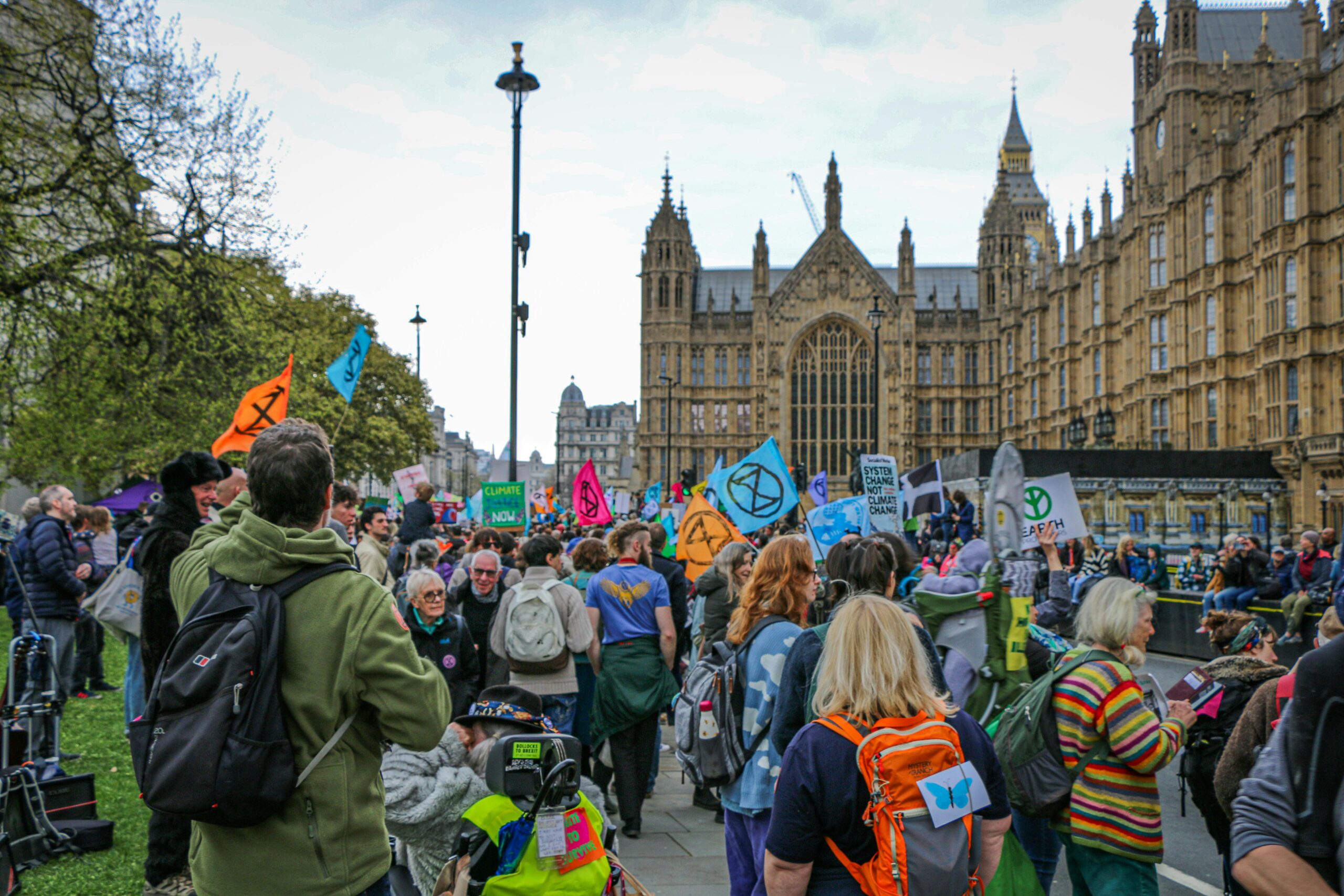
The climate crisis impacts everything: our economies, our environment, war and peace, the survival of democracy, our understanding of science and the well-being of generations to come. Yet, even among those who accept this reality, there is deep disagreement on what a constructive climate movement should look like.
This is why, despite our differing views on climate politics, the two of us share a growing concern about the direction of the climate movement. A project that ought to be broad, open and compassionate has come to be dominated by a narrow set of ideological demands which leave little room for genuine diversity of political perspective. Increasingly, participation in the climate movement has come with an ideological entry fee—where new participants must adhere to specific views beyond climate issues.
Those who want to participate are expected to accept a “package deal” of positions on issues such as race, gender and social justice. These issues are important in their own right. But when agreement on them becomes a condition of entry into climate activism and action, the movement closes the door to a majority of people who share its concern. This ideological gatekeeping undermines the very purpose of a movement that should be uniting us against a shared threat.
When movements become inward-looking, they tend to repel allies, flatten internal debate and deepen the political divisions already tearing our societies apart. We’ve seen this firsthand. Rupert Read, who helped launch Extinction Rebellion, recalls how the movement was initially conceived as a space beyond party politics: a coalition broad enough to bring together people with divergent political views around a common cause. But over time, Extinction Rebellion drifted toward an intransigent form of hyper-identity politics. A strong focus on racial justice, international justice, plus gender identity rights began to function as a kind of gatekeeping mechanism, silencing members and potential supporters who did not share every part of the agenda.
This shift showed itself in three ways. First, members were often asked to adopt the slogan “No climate justice without racial justice,” which, in practice, meant aligning with the Black Lives Matter (BLM) movement’s specific outlook. As a result, even those who supported racial justice but had reservations about BLM’s approach were pushed to the margins.
Second, calls to “center the Global South” translated into expectations that Western participants should express collective guilt, defer to non-Western voices and adopt hyper-‘progressive’ immigration positions that command relatively little civic support across the West. Third, a similar dynamic emerged over trans rights, with members often expected to affirm contentious claims – for instance, that trans women are indistinguishable from biological women across all contexts, including sport, prisons and debates about male-on-female violence. As a result, even those broadly supportive of racial justice, global justice and trans rights could feel excluded unless they endorsed the approved formulation.
This pattern of ideological exclusion is not unique to Extinction Rebellion—far from it. Similar tendencies could be seen developing in other groups in the climate movement, such as the School Strike for Climate (also known as Fridays for Future). The result is what Vlad Vexler has called depoliticization: a curious spectacle in which, as the world burns, activists devote themselves to enforcing inward-looking ideological conformity rather than building broad coalitions required for political change. In this way, the movement undermines its own aims, as rigid adherence to a fixed set of positions overtakes practical progress.
The consequences extend beyond the loss of potential allies. When a movement starts to feel closed off and ideologically policed, it creates fractures that other political forces can exploit. So far, ‘eco-fascism’—where far-right groups use environmental concerns to justify exclusionary, authoritarian politics—is rare. The far-right remains uncertain about climate change, sometimes combining denial with reluctance to pursue the forms of climate adaptation and protection its constituency increasingly needs.
We predict a reversal in the 2030s. As climate denial mostly recedes on the right, hard-right pro-climate movements may emerge. For them, ecological concern could become a vehicle for white nationalism, opposition to democratic institutions and authoritarianism. This would be a bitter irony if it arose because the climate movement failed to engage a broad political spectrum.
At this critical moment, the climate movement faces a choice: broaden its appeal or risk continued division by insisting on narrow terms of entry. Recognising the urgency of the crisis does not require ideological conformity. The climate crisis affects everyone, regardless of race, class or political ideology, and a movement that acknowledges this diversity will be more effective.
We propose adopting two principles that will enable such pluralism.
The first is straightforward: activists should resist the temptation to use identity politics as a barrier to entry. The stakes are too high to exclude potential allies over disagreements on broader social or political positions not directly related to climate action.
The second principle is pluralism in strategy and tone. There are genuine disagreements about how climate activism should speak and act. Some favour sounding the alarm at full volume; others advocate for a more measured approach. Some view sweeping transformation as essential; others lean towards making more incremental progress. Some prioritise ‘mitigation’, reducing future climate harm; others prioritise adaptation, preparing for impacts we can no longer avoid.
Each side in these debates has something to offer. The aim should not be to impose a single message or tactic, but to find an approach capable of speaking in many registers to many audiences. As climate politics enters a critical phase, exclusion is a luxury we cannot afford. We need all hands on deck.
Climate action, together with the defence of democracy against authoritarianism, is among the defining collective tasks of our age. The two challenges are closely linked. Unless we preserve, reform and supplement our democratic institutions, meaningful climate policy will be impossible. And unless we moderate the impacts of the climate crisis, the social shocks ahead may wash away our democracies.
The stakes are too high to be immobilised by polarisation. We need to work through disagreement and act together in defence of a shared future—across differences.
Dr. Rupert Read is Co-Director of the Climate Majority Project, co-editor of Deep Adaptation, and co-author of Transformative Adaptation.




Comments
We changed commenting systems on September 10, 2026 as part of a site-wide functionality and security upgrade. Your past comments have not disappeared, and you can still log in with your old Disqus account credentials if you wish. Contact us with any questions.
This feels really important and significant to me. I'm just about to write more about the tension between, and necessity of both, belonging and co-creative work. What I see us as dealing with is a culture-wide lack of belonging, which drives the tribal movements which insist on all kinds of ideological conformity. But it doesn't have to be that way. We do need to offer each other the belongingness that comes from being deeply heard and accepted as we are, but at the same time we can have a wider culture, not only of respect for others with different perspectives, but also a recognition that collective effective action depends on the collaboration between people with different perspectives, skills, attitudes, etc. Yes, there are probably some non-negotiables and boundaries, but these need to be addressed by personal dialogue, not ideological creed or performative conformity.
This resonated with me. I'm a member of the Green Party, but at the last UK election, after a lot of soul searching, I voted Labour because I just couldn't bring myself to endorse the extremist pro-trans position of the Green candidate. I now wish I hadn't voted for anyone, or just spoilt my ballot paper.