Indigenous wisdom offers a diagnosis of what ails our world — and understanding it is the first step toward a cure.
Something is devouring our world. Forests collapse. Species vanish. Billions live in grinding poverty while a few hundred individuals accumulate wealth beyond imagination. People attribute this to bad policies, corrupt politicians, or individual greed. But what if the problem runs deeper — embedded not in particular decisions, but in the very essence of our civilization?
In a chapter of my new book Ecocivilization, I explore this question through a powerful Indigenous myth: the Windigo.
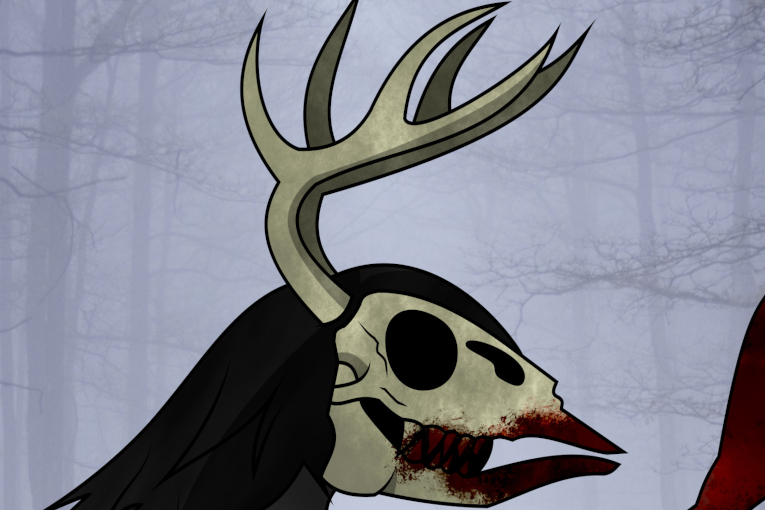
Windigo (also known as Wetiko) is the name given by the Ojibwe to a cannibalistic monster driven by insatiable hunger. The more it consumes, the more ravenous it becomes. It can never be satisfied, because its appetite is not directed toward nourishment but toward devouring for its own sake. For the Ojibwe, the European invaders who arrived on their lands seemed animated by just such a force. Faced with conquistadors who killed, enslaved, and betrayed in pursuit of gold, they recognized a kind of spiritual derangement, a hunger that turned everything it encountered into an object for exploitation.
The Monster Is the System
This metaphor offers a chillingly accurate diagnosis of the dominant system that came to engulf the world. At its heart lies a mode of seeing that objectifies humans and nonhumans alike. Forests become timber reserves. Animals become livestock. Oceans become fisheries. People become labor inputs or human resources. Once the living world is reduced to a stockpile of exploitable assets, moral limits dissolve.
Consider the structural logic of our economy. A corporation that prioritizes its workers’ wellbeing over quarterly returns will find itself outcompeted and eventually eliminated by rivals that don’t. An investor who chooses ecological stewardship over maximum profit will lose out to one who doesn’t. A political leader who proposes genuine limits to growth will be outspent and defeated by interests that profit from the status quo. The individuals change; the behavior persists. That is the hallmark of a systemic pathology — not aberrant actors, but a structure that produces the same destructive outcomes regardless of who occupies its roles.
This is what I call Windigo Inc.: the institutionalization of insatiable hunger as the organizing principle of our civilization. It isn’t a conspiracy. It doesn’t require villains (though it produces them). It’s a self-reinforcing system that rewards extraction and punishes restraint, that transforms every living thing — forests, aquifers, human relationships, the Earth itself — into resources to be consumed in the pursuit of endless growth.
The Spawning of Windigo
This mentality did not emerge from nowhere. My chapter traces a longer history of how hierarchical societies, private property, empire, and militarized extraction progressively formed a five-thousand-year-old “wealth pump,” funneling surplus upward from the many to the few. Virtually all ancient states, early empires, and aristocratic orders organized society around this pattern. But modern capitalism introduced something distinctive and even more dangerous. It inculcated this long history of domination with a worldview that treated nature as a machine, knowledge as power, and limitless accumulation as a civilizational imperative.
This was the mechanistic worldview that formed in early modern Europe and serves as the ontological paradigm of the modern world. It’s no coincidence that this was the time and place that saw the emergence of the limited liability corporation, white supremacy, and colonialism: a project that treated entire continents and peoples as raw material.
This was followed by the Industrial Revolution that made extractive power scalable; and more recently, neoliberalism elevated these tendencies into a governing ideology, insisting that unrestrained competition is not just efficient but morally correct.
Capitalism, in this sense, is not merely an economic system. It is the economic manifestation of the Windigo mentality. Like a malignant process within a living organism, it must keep expanding or collapse. It cannot recognize enough. Every gain becomes a platform for further gain. Every efficiency becomes a launchpad for more extraction. Every frontier, whether a rainforest, a public institution, or even the human nervous system, becomes a new zone for enclosure and monetization.
A Silent Malignancy Feeding on Itself
What makes this system so difficult to confront is that much of its violence is concealed. In earlier eras, domination was often direct and visible. Today it’s frequently structural, embedded in the normalized architecture of everyday life. The smartphone in your pocket carries within it the suffering of child miners and exhausted factory workers continents away. The tax havens of the ultra-rich quietly drain public wealth from schools, hospitals, and essential infrastructure. Land grabs displace traditional communities while luxury developments flourish in their place. Democracy itself is captured by networks of concentrated power that operate behind the reassuring language of governance and reform.
This is why the diagnosis matters. If we misidentify the crisis, we will continue treating symptoms while the underlying pathology spreads. The Windigo diagnosis reveals that the threat we face is not only ecological or political. It is civilizational. It is rooted in a system whose deepest logic is to convert the living world into fuel for its own endless expansion.
This is where the Windigo diagnosis becomes uncomfortable for progressives and conservatives alike: it’s not primarily a story about evil people. Many of the executives accelerating extraction are intelligent, often compassionate in their personal lives, and genuinely believe they are creating value. Many of the politicians enabling ecological destruction consider themselves patriots. The system does not require bad intentions. It systematically selects for behaviors that reproduce itself and eliminates those that threaten it.
Naming the Disease Is the Beginning
To name this is not an act of despair, but the beginning of honesty. And honesty is the ground from which transformation becomes possible. If the crisis is systemic, then the response must be systemic as well.
Once we name Windigo Inc., we can begin to ask the questions that matter the most:
- What would an economy look like that is structured around sufficiency rather than endless growth?
- What institutions could channel human ingenuity toward flourishing rather than extraction?
- What values — drawn from Indigenous wisdom, from contemplative traditions, from sciences of complexity and ecology — could replace the Windigo’s insatiable hunger with a different animating principle?
That is the larger journey of Ecocivilization: to understand the pathology we have inherited, and to illuminate the life-affirming possibilities that might yet allow us to turn toward a different future.
Ecocivilization: Making a World that Works for All
Melville House: available May 26, 2026
PREORDER: Bookshop.org