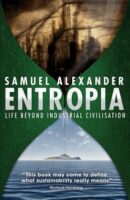
 In 2013 Samuel Alexander published his work of eco-fiction, Entropia: Life Beyond Industrial Civilisation. It is a story that gives account of a sufficiency-based community that emerged after the collapse of industrial civilisation. Interestingly – and rather ominously – the collapse-scenario Alexander presented as the catalyst for the breakdown of civilisation was based on oil supply being disrupted due to bombing around key choke points in the Middle East in 2027. As the current situation (March 2026) around the Strait of Hormuz continues to destabilise the global economy, it is timely to return to Alexander’s analysis outlining ‘the Disintegration of Empire’ (being Chapter Two of Entropia). For those wanting to read about the simpler way society that emerged after the collapse, paperbacks of Entropia are available here and pdfs available here. The following is written from the perspective of the year 2099.
The Disintegration of Empire
The picture of Entropia that I will endeavour to paint in this book does not begin with a blank canvas. Our community was, and is, a creature of its time, and our way of life on the Isle can only be understood in relation to the collapse of industrial civilisation out of which it emerged. Accordingly, I feel the nature of that collapse must be described, or at least outlined, in order to make clear why our society took the form it did.
Before sketching that history of collapse, however, it is worth acknowledging that no matter how well our economy and broader society may be functioning today, we have not been able to escape – nor did we ever think we could escape – those darker, painful elements in life that are built into the human condition. I feel this is an important acknowledgement to make, because I do not wish to give the impression, or give rise to the expectation, that our way of life on the Isle is or has been free from difficulty, grief, and strife. I assure you, Entropia is no utopia! We are human! And that means we are as susceptible to suffering as any other community. I will not dwell on these grim themes for long, but to give some tonal balance to the picture this book will paint, some darker shades must be introduced from the outset, at least around these foundational edges.
Let me begin by stating the obvious: the Great Disruption was by far and away the most destabilising and traumatic series of events our community has ever had to endure. While I was not alive during this tumultuous period, and so cannot speak from experience, it is an historical era that is given prolonged attention in our schools and the Academy, so all of us are very familiar with it, even though we now only have the distanced perspective of historical scholarship. My understanding of this period is also enriched by the many stories my grandparents used to tell me when they were still alive. My grandmother, in particular, was an engaging storyteller, and her soft-spoken but vivid anecdotes about the Great Disruption taught me that human suffering is always personal, always specific, no matter how broadly it is shared. It hurt here, she would explain, and it felt like this. She would speak not so much of hunger in the abstract, as of the time the bean crop failed; not of loss, but of her own shattered dreams of security; not of pain, but of grandfather’s arthritis, which he endured silently as he worked in the vineyards and orchards in the hope of feeding the community he loved. She would speak of how the sparkle in a friend’s eyes forever disappeared as a result of spiralling despair, and of the quiet sadness she could see in the eyes of every parent who could not assure their children that the future would be kind and safe. Most striking of all was my grandmother’s account of the Isle’s only suicide – the melancholy story of a young Tibetan woman called Nishka, for whom the Great Disruption was too much to bear. A genuine prodigy of the violin, and blessed with a face of penetrating beauty, Nishka seemingly could not find solace even in our warm community, choosing instead to take her own life in a warm bath – violin in hand. On the wooden stool next to the bath she left a composition, entitled ‘Avoiding the Rush’, to which even today only the brave-hearted dare to listen. The melody too easily evokes the harrowing image of a girl playing her own requiem in a bath, with bloodied wrists. Naturally, such events shook the community to the core, but the gut-wrenching images and emotions they evoke help to humanise an era that otherwise might be too easily intellectualised by those of us who came later.
The first issue to highlight, then, is that the Great Disruption brought with it widespread anxiety, fear, and often tremendous suffering – like any radical discontinuity in social and economic life would be expected to do. Although we had been transitioning for many years toward self-sufficiency, our way of life at the time remained highly dependent on imports of industrially produced food and materials. What is more, despite the fact that ‘building resilience’ was high on our list of stated priorities, when the cargo ships suddenly stopped arriving, the social and economic shocks we faced were by no means painlessly absorbed. We may have been better placed than most of humankind, but as the Great Disruption shook the world and isolated us permanently from the rest of civilisation, we found ourselves grossly underprepared, both mentally and in terms of our social and economic systems. In retrospect we see that many of our attempts to build resilience were really little more than pleasant, well-intentioned games, which did little to absorb the shocks that were eventually delivered upon us. At the same time, perhaps some things just cannot be prepared for, however diligently a community might try.
In the face of civilisational collapse, the internal or psychological shocks typically hit first. Human beings are creatures of habit and custom, and we have an overwhelming tendency to assume tomorrow will be similar to today. Even when we see our world falling down around us, calling for an urgent and sustained response, we divert our gaze in an attempt to distance ourselves from the radical changes that are announcing themselves on the horizon. But wilful blindness in the face of civilisational deterioration is at best a short-sighted strategy, one that ultimately leads to the crash just hitting harder and louder, and with the distressing element of surprise. It is like watching a balloon being blown up, breath by breath, and assuming that since no breath so far has burst the balloon, adding more air should not produce any great changes. And so we go about our days, business as usual. When we wake to our new circumstances, however – as the balloon bursts violently – we find that the world we knew has been shattered, and our insides begin to twist with the angst of terrifying uncertainty. We complain that nobody warned us; that we could not possibly have known. But we were warned, we did know, and now our inaction looks not just foolish but shameful.
Coming to terms, psychologically, with the Great Disruption was challenging enough. It was as if our parent civilisation had committed suicide, tragically leaving our community orphaned and alone. Cut off from the Old World, our universe suddenly seemed a whole lot smaller and our minds had to adjust to this new cosmology. But soon the sheer physical reality hit home, which is to say, the fear of being hungry gave way to the physical experience of hunger itself. A collapsing civilisation does not wait for people to adjust mentally to the new circumstances. While everything was breaking down in chaos, testing people to the limits of their mental fortitude, it was precisely then when the physical dimensions of collapse became dominant, compounding our challenges. By this stage there was no time to sit around adjusting mentally to the new situation. Instead, urgent, practical questions had to be faced about how to secure the provision of basic material needs, especially food. Suddenly everyone was a farmer, a scavenger, a jack-of-all-trades, and an inventor.
Fortunately, as noted earlier, we had quite well-developed systems of local food production on the Isle, so nobody faced starvation, as such. Nevertheless, for some time, while we desperately expanded those systems after the crash, our diets were significantly tightened. Instead of three meals a day, we had one or two. The variety of food was also limited to the most productive and nutritious crops, such as beans, potatoes, and lentils, although people did not lament the lack of variety, for they were grateful simply to have enough food to survive. Most people began to look worryingly thin, and they carried the mental and physical strain of the circumstances in their eyes.
Innumerable things our community once took for granted – conveniences and comforts that we once considered necessities – were no longer available. Everything, it seemed, was scarce: from food, to medicine, to materials. Soon enough our material standard of living barely resembled what preceded it, in ways that will be discussed further in due course. We endured these material privations stoically, however, determined to struggle onwards through this period of trial with our community and spirit of positivity more or less intact. There were social conflicts too, of course – such as the long, heated debates over how much of our minimal oil and coal reserves to use, and for what purposes – but generally these were measured, mature conflicts. Everyone knew that there was no place for childish egoism in times of social distress and economic crisis.
My point in briefly reviewing this period is simply to highlight the fact that our community, far from having a smooth or idyllic commencement, was born of struggle and considerable hardship. Nevertheless, even the clouds of a violent thunderstorm can have a silver lining. As it happened, this early, post-crash period shaped us in ways that are still with us, for what did not kill us made us stronger.
¨ ¨ ¨
There is obviously much more to say about how our community dealt with its isolation, and this book will describe our existing way of life in detail, as it has taken form roughly seven decades after the crash. This chapter, however, presents an historical review of industrial civilisation’s rise and demise, because this is necessary to provide a backdrop against which life on the Isle today can be fully understood. At first this may seem like rather too dark and heavy a foundation, but the flourishing sufficiency economy we have created on the Isle will seem clearest when defined in contrast to the industrialised, growth economies of the Old World, which now lie in ruins.
Fortunately, I have in my possession an old essay, dated 8 June 2031, written a few years after the Great Disruption, which provides a remarkably concise, if somewhat polemical, history of this collapse. I shall reproduce this essay below, knowing that I am unable to improve it. At some stage over the course of recent generations the author’s name was lost, or perhaps the essay was originally published anonymously – a practice that was not altogether uncommon on the Isle in earlier generations. Whatever the case, that issue need not concern us presently. What is important is that our journey through Entropia is given some historical context, and the following essay serves that purpose well. As the great poet, Thomas Hardy, once wrote: ‘If a path to the better there be, it begins with a full look at the worst’.
On that basis, I present the essay:
¨ ¨ ¨
Reflections on the Great Disruption
Those who cannot remember the past are condemned to repeat it. – George Santayana
Karl Marx, capitalism’s preeminent critic, believed that he had uncovered the laws of history, on the basis of which he predicted that there would inevitably come a time when capitalism would come to an end. He believed that human beings would never stop fighting for justice – no matter how hopeless things got – and this gave him confidence that the injustices he considered inherent to capitalism would one day be overturned. Just as the slaves had overthrown their lords, and just as the bourgeoisie had overthrown the aristocracy, Marx concluded that it was inevitable that eventually the working classes of the world would overthrow the capitalist class. This was the revolution, or series of revolutions, that would usher in a communist utopia, representing the true end of history. It was not a question of ‘if’, but only ‘when’. Of course, owing to the fact that the rich and powerful would never voluntarily give up their unjustifiable privileges, it followed that the communist revolutions would almost certainly have to be violent revolutions. From a Marxist perspective, at least, it seemed that there was no other way for a post-capitalist society to emerge.
However, as early capitalism developed into the global economic system it became in the late 20th century – a system that we now know as Empire – the prospects of a global communist revolution seemed less and less likely, even as the moral and ecological critiques of capitalism seemed ever more relevant and penetrating. While there was certainly deep and widespread discontent among the world’s people – even if they did not always understand the fundamental causes of their discontent – Empire had a way of distracting people and indeed entire nations from developing any latent revolutionary ambitions. This was done primarily through the lure of consumer goods and the promise of globalising the ‘American Dream’, a technique of seduction that proved remarkably successful at quashing oppositional sentiments before they even reached the level of consciousness. Many people found themselves locked into a consumer existence, unable to imagine any alternative; many more others, of course, were locked into extreme poverty by the same system, left to imagine alternatives they were unable to realise. If, on very rare occasions, the working classes did manage to organise themselves with subversive intent, the capitalist state always showed itself to be willing and able to suppress or fragment all uprisings that threatened the status quo. Thus Empire marched on, extending its reach to all corners of the globe, brutally shaping the world according to its cold logic of profit-maximisation. Money, not man, became the measure of all things. Man had lost control.
Nevertheless, those in the orthodox Marxist tradition still clung to the hope that their progressive conception of history would prove to be correct. The working classes, they maintained, would eventually become aware both that they were being robbed by the capitalist system and that collectively they had the power to stop such robbery. It was predicted that through the development and expansion of this ‘class consciousness’, capitalism would finally fall by way of revolution. Again, it was believed that this scenario was built into the laws of history, just as gravity is built into the laws of physics. There was to be no escaping it.
Little did Marx and his left-wing disciples know, however, that capitalism would indeed fall, but not by way of revolution – by way of collapse. This was a potential outcome to which the tradition gave almost no attention, primarily because capitalism transformed over the course of the 20th century in ways that Marx could not possibly have predicted from his 19th century perspective. Scathingly critical of almost every aspect of capitalism, Marx was nevertheless admiring of its productive capacity, but what he never put his mind to was the possibility that capitalism’s great productive capacity, which was supposedly its greatest asset, would actually become the driving force behind its own demise. More precisely, Marx never foresaw that capitalism, far from being overthrown by a proletarian revolution, would actually grow itself to death, like a cancer cell, leaving in its wake not a communist utopia, but the many faces of deindustrial civilisation. This inevitable outcome of growth is a form of purgatory, one might say, from which humanity has yet to emerge, and indeed may never emerge. For what it is worth, the growth economies of communism would have led humankind down the very same path, had they been globalised.
As life ‘beyond civilisation’ begins – not with a bang but a whimper – there may be some value in looking back on the disintegration of Empire, if only so that we may better understand the present as we look to the future. Accordingly, let us reflect on the basic dynamics of this period of collapse, and examine its underlying historical causes, in the hope that humankind might avoid ever condemning itself to repeat this tragic story.
Energy as the Lifeblood of Civilisation
If there is one factor that defines the rise and fall of civilisations more than any other, it is energy. Energy is the physical basis for development, the lifeblood of civilisation. It is the tool we use to try to solve our problems, even if its use can also cause those problems. Historically, when an affordable supply of energy could meet energy demand, civilisations grew in size, strength, and complexity. Problems were solved and things would seem to progress. When civilisations expanded beyond their sustainable capacity, however, and energy surpluses dried up, new problems or existential threats would arise that could not be solved – wars, ecosystemic change, disease, etc. – and solutions to existing problems could not always be maintained. Consequently, progress would come to an end and begin to turn back on itself.
In such times national debt would be vastly increased, or currencies would be debased, in an attempt to fabricate energy and at least maintain the status quo. But borrowing from the future in this way was simply the precursor to economic collapse. Money is not energy. Wars would also arise as competing political forces saw opportunities to advance, but military expenditure would simply draw more energy and funds away from maintaining social systems and infrastructure, generally leading to the fragmentation or breakdown of centralised systems of administration, governance, and rule.
No matter how robust and glorious a civilisation might once have seemed, all of them throughout history have eventually entered the downward spiral of deterioration and collapse. There seems to be no escaping this tragic re-occurrence. It seems to be built into the fabric of human society, although every civilisation claims to be different – until it collapses. Collapse means involuntary simplification and economic contraction, whereby individuals and communities are forced to give up their old, energy-intensive ways of living and adopt a radically lower material standard of living. Tragically but inevitably, collapse also means significant population die-off, as the energy required to maintain sufficient food production and distribution becomes unavailable, resulting in widespread famine, disease, and death. Entrenched power structures are also destabilised in such times, inviting social disorder and opening up space for new power struggles to emerge in the forms of civil and international conflict. So it was throughout history, and as outlined below, these essential dynamics also coloured the rise and fall of humankind’s first truly global civilisation – Empire.
Seeds of Empire
Let us begin this autopsy way back on the edge of prehistory. The transition from hunter-gatherer societies to agricultural societies was not so much a revolution in food production as it was a revolution in energy supply. It is in this transition that the seeds of Empire were sown. The nature of hunter-gatherer societies was dictated by the limitations of energy supply, for there was no energy surplus to maintain much social complexity. The modest energy available primarily came in the forms of food and fire, and these modest supplies meant that complex social, economic or political institutions could not be supported. Through the uptake of agriculture, however, which was vastly more productive than hunting and gathering, humankind was able to secure increased energy supply through its increased food supply. This meant that fewer people were required to dedicate their time and energies to food production, because they could be supported by a sub-section of the population – farmers.
Civilisations accordingly began to develop increasing numbers of ‘non-food’ specialists – people who were freed from the task of sourcing or producing food and who therefore could dedicate their time to such things as building houses, producing more tools and weapons, forming an army, or taking on leadership or bureaucratic roles of governance, education, and administration. In this way agricultural societies began to develop increasing levels of social complexity, which required an increasing supply of energy to maintain. The increased energy supply also provided the foundations for population growth, although at first that growth was modest.
It should be noted that hunter-gatherer societies did not always adopt agricultural practices such as planting seeds, or domesticating animals, as soon as they discovered them. In many cases, there was a period of hundreds or even thousands of years between discovering agriculture and adopting it (and the transition was often gradual rather than abrupt). This was because, from the perspective of hunter-gatherers, the transition did not immediately seem to be an obvious advance. With few material needs, hunter-gatherers found that they could provide for themselves with only two or three hours labour each day. An agricultural existence, however, despite being more productive, required working much harder, and without much to show for it (at least at first). Indeed, anthropologists have studied the fossils of early farming communities and discovered that their skeletons are typically shorter than those of hunter-gatherers, indicating a reduced nutritional intake. Furthermore, by being sedentary (as opposed to nomadic), agricultural societies faced new sanitary issues arising from the accumulation of human and animal excrement, and this gave rise to diseases that actually reduced the average lifespan of individuals in early agricultural societies, compared with hunter-gatherers. Without wanting to romanticise hunter-gatherer societies – which of course had their own limitations and problems – one can nevertheless understand why they were often doubtful about the merits of agriculture as a way of life.
All the same, no matter how much hunter-gatherers might have preferred their materially simple but leisure-rich existences, there were certain realities that came to influence their calculus. Most importantly, when neighbouring tribes or societies adopted agriculture, their numbers and power increased by virtue of their increased energy supplies, even if at first their standard of living also decreased in some respects. Their power increased, as noted above, because agriculture provided enough food for parts of the population to be employed solely as warriors or soldiers, and other parts of the population to make or develop more sophisticated weapons, armour, defences, etcetera. This created a power imbalance between agricultural and hunter-gatherer societies, and the latter were provided therefore with a strong incentive to adopt agriculture – not for the reason of increasing their standard of living, but merely to avoid being eradicated by their increasingly powerful farming neighbours. Humankind thus became entangled in a form of ‘arms race’, from which, as we know, it was never able to escape.
Was Agriculture a Mistake?
As well as locking humankind into an arms race, the other way in which agriculture sowed the seeds of Empire was how it required enforceable property rules. Nomadic peoples were free to wander a sparsely populated Earth, and they did not need property rules to protect their ‘wealth’ because they would only accumulate as much as they could safely carry. But when societies went to the effort of cultivating land and tending to crops, they obviously had an incentive to defend that land from intruders, in order to reap where they had sown. Furthermore, sedentary societies were much more inclined to accumulate wealth, houses, and land, because they did not have to carry their possessions or assets everywhere they went. (In an aside, housing also initiated the disconnection of humankind from nature, in ways that over time would become insidiously harmful). Monetary systems, which arose in agricultural societies, also made accumulation much easier.
All this led to social and economic inequality becoming much more pronounced, which contrasted with the egalitarian nature of hunter-gatherer societies. Where once the world was held in common, agriculture created the need to distinguish between ‘mine’ and ‘thine’, a distinction that Jean-Jacques Rousseau was correct to suggest is the true foundation of civilisation:
The first man who, having enclosed a piece of ground, bethought himself of saying ‘This is mine’, and found people simple enough to believe him, was the real founder of civil society. From how many crimes, wars, and murders, from how many horrors and misfortunes might not anyone have saved mankind, by pulling up the stakes, or filling in the ditch, and crying to his fellows: ‘Beware of listening to this imposter; you are undone if you once forget that the fruits of the earth belong to us all, and the earth itself to nobody’.
At first tribes and societies created boundaries, fences, and walls around their farms and territories, into which ‘others’ were not entitled to tread. Not long after, personal relationships within agricultural societies became similarly structured by property claims and disputes. This established a way of thinking that eventually gave rise to laws and governments, which were created to protect property interests – the property interests of the rich and powerful, at least. By this stage, for better or for worse, most human beings were no longer tribal wanderers, but increasingly citizens or subjects of a kingdom or state.
Notably, agriculture also laid the foundations for slavery, an institution that was essentially unknown in hunter-gatherer societies, if only for pragmatic reasons. Leaving moral issues to one side, it was simply uneconomic for hunter-gatherers to maintain slavery, because the benefits of slavery did not outweigh the costs. That is, it was easier to hunt for one’s own food than to try to force others to do it. In contrast, the sedentary nature of agricultural societies, and the emergence of non-food specialists which agriculture supported, changed this calculus, making slavery an ‘economic’ means for a society to gain further energy supply through enforced labour. This established a ‘ruling class’ and an ‘under-class’, laying further foundations for Empire.
Starting from around 10,000 years ago, therefore, humankind increasingly looked to agriculture as a way of life, primarily because it provided the most energy. This transition also introduced new diseases, slavery, property rights, governments, standing armies, inequality, and class relations. Was it worth it? Perhaps this was humankind’s greatest mistake. Or perhaps it was a necessary experiment that just happened to be conducted disastrously. Whatever the case, adopting agriculture was like crossing the Rubicon: having once done so, a society could never return.
Fossil Fuels and the Growth Model of Progress
For thousands of years human civilisations rose and fell without there being any revolutionary changes to the types of energy that human beings employed. Food remained the primary energy source (for human labour, as well as animal labour), and wood was used to fuel fires for cooking, light, and warmth. As basic technologies developed, there was also limited use of hydro energy, through waterwheels, and wind energy, through boats and windmills. Early in the 18th century, however, humankind’s relationship to energy changed fundamentally, primarily due to the invention of the steam engine. This invention allowed human beings for the first time to harness, on a large scale, the truly immense energies stored in the fossil fuels – coal, at first, and later natural gas and oil.
These technological and energy advances ignited an explosion of mechanised economic activity that we now refer to as the industrial revolution. Increasing numbers of people were forced or seduced away from their farms and into urban factories, and a vast rail network emerged which allowed commodities to be traded and transported around continents with relative ease. Three centuries of unprecedented economic growth followed, which produced an exponential rise in material standards of living, primarily in Western societies but eventually elsewhere. For the first time the prospect of globalising affluence through mechanised production entered the human imagination. Industrial civilisation had been born, founded upon fossil fuels.
Within those nations that progressed from circumstances of widespread poverty to circumstances of moderate or comfortable material security, the human lot seemed to improve considerably. Although there were always costs, sometimes great costs, associated with economic growth – such as factory labour, pollution, deforestation, and social dislocation – for many decades these costs were seemingly outweighed by the material benefits that resulted. This perceived success led to the entrenchment of what political and economic historians now refer to as ‘the growth model of progress’.
Put simply, the growth model assumed that the overall wellbeing of a society was approximately proportional to the size of its economy, because more money or higher Gross Domestic Product (GDP) meant that more individual and social desires could be satisfied via market transactions. No matter how rich a society became, growing the economy was thought to be the only effective way to eliminate poverty, reduce inequality and unemployment, properly fund schools, hospitals, the arts, scientific research, environmental protection programs, and so on. In other words, the underlying social problem (even within the richest nations) was believed to be a lack of money. Economic growth therefore was heralded across the political spectrum as the goal towards which societies across the globe should be directing their collective energies. The notion of a macro-economic ‘optimal scale’ was all but unthinkable. It was assumed that a bigger economy was always better.
For three centuries, then, fossil fuels provided humankind with the cheap and abundant sources of energy needed to pursue economic growth without apparent limit. Those fossil fuels also provided the energy foundations for exponential growth in population, which was more a side effect of industrial civilisation than an intentional aim. When once the earth appeared relatively empty, over the course of the 20th century it became full-to-overflowing.
Uneconomic Growth, Commodity Fetishism, and the Technocratic Faith
The growth model of progress, as we now know, turned out to be severely flawed, although dislodging it from the social imagination proved exceedingly difficult. John Stuart Mill, writing in 1848, was one of the first to point out that the costs of economic growth may one day exceed the benefits, at which time, he argued, the most appropriate form of economic governance would be ‘the stationary state’. By this he meant a condition of zero growth in population and physical capital stock, but with continued improvement in what he called ‘the Art of Living’. This aspect of his oeuvre, however – today his most famous – was either ignored or summarily dismissed by his contemporaries, and for many generations it lay forgotten in the intellectual dustbin. Although small groups of theorists and activists would try to revive and popularise its wisdom, limitless growth remained the overriding objective of governments across the globe. Indeed, it became clear that the market imperatives of capitalism meant that Empire had to grow or die.
Early in the 21st century, as the social and environmental costs of economic growth became more pronounced and harder to tolerate or ignore, the undercurrent of growth scepticism strengthened. Many rigorous sociological studies showed that economic growth in affluent societies had stopped contributing significantly to human well-being; that is, it became clear that a rise in material ‘standards of living’ was no longer strongly correlated with ‘quality of life’. Economic growth had even begun undermining many of the things upon which well-being depended, such as responsive democratic institutions, social solidarity, spiritual and aesthetic experience, and stable, functioning ecosystems. The clear implication of these findings was that economic growth should no longer be the primary measure of policy and institutional success in affluent societies; that well-being should not be conflated with materialistic success and that, after a surprising low threshold, well-being should be sought in non-materialistic realms. But, again, the impact of this line of thinking was essentially non-existent in political and economic circles. Corporate interests – the heartbeat of Empire – ensured that growth economics remained firmly entrenched in the politico-economic realm, and well into the 21st century the reigning orthodoxy was that the answer to almost every problem – including the problems of personal happiness, social justice, and environmental protection – was more economic growth. There seemed to be no alternative. So long as most people felt that an increased material ‘standard of living’ was required to increase ‘quality of life’, Empire was politically safe.
Unsurprisingly, the legal and political structures of Empire were shaped by this unfettered desire for limitless growth, and those structures both shaped and were shaped by the cultures of consumption that came to define industrial societies. An insatiable craving for more consumer goods and services seemed to animate entire populations. Such commodity fetishism was observable in Western societies from the onset of industrialisation, if not before, but it was really in the decades after the Second World War when consumption became a truly acute and debilitating social practice. Unmistakably a collective psychological disorder, commodity fetishism reached its zenith at the beginning of the 21st century, establishing a materialistic culture without any sense of sufficiency. For reasons which are still not wholly understood, life in these times was structured around the endless pursuit of material luxuries and comforts, and no matter how rich people became, it never seemed to be enough.
During this era the West, in particular, entered a phase of social decay. Despite unprecedented levels of material wealth and sophisticated technologies, most Westerners during these times were working longer hours than they had in the past, and aside from sleeping and working, Westerners generally spent more time watching television than doing anything else. Their diets and lifestyles became highly processed and too often carcinogenic. The division of labour reached an undignified extreme, which may have efficiently maximised growth, but it also meant that people became wholly dependent on the market. People soon found themselves locked upon a consumerist treadmill that had no end and attained no lasting satisfaction. The consumer way of life could not provide many people with a meaningful and fulfilling life. Furthermore, urban sprawl led to highly artificial living environments that disconnected people from a community of neighbours and from any real engagement with nature. This was the hollow culture that transnational corporations celebrated as the ultimate fulfilment of human destiny, the peak of civilisation. But this culture was based on mistaken ideas of freedom, wealth, and happiness, and over time its economy ate away at the natural life-support systems upon which it depended.
It should be noted that counter-cultures certainly existed during this era, offering loud warnings about the social costs and ecological impacts of the global economy. But these oppositional movements ultimately failed to prevent corporate profiteers and consumer cultures from having a devastating and irreversible impact on global ecosystems and biodiversity. Scientists, who used to categorise geological ages into periods of millions of years, began using the term ‘anthropozoic’ to refer merely to the three centuries following the industrial revolution. During this geological blink-of-an-eye, human economic activity violently degraded the planet in many ways, including pervasive deforestation and the mass extinction of species, climate destabilisation, soil erosion, ocean acidification and depletion, and the overconsumption of many non-renewable resources, most notably, oil.
But would not technology eventually solve all these problems? Despite the zealous faith of technocratic optimists, technology was unable to protect the planet because technological innovation was generally governed by an imperative of growth, not an ethics of sufficiency. This meant that all efficiency gains resulting from technological advancements just went into producing and consuming more, not reducing impact – a paradox first formulated by W.S. Jevons. Technology could not save Empire, because efficiency without sufficiency is lost. By the end of the 20th century it must have been perfectly clear that industrial civilisation had an ecological time limit and that time was running out. But Empire continued to march onward, with wilful blindness, Mother Nature be damned. Needless to say, Mother Nature had ways of dealing with civilisations foolish enough to disrespect her.
As the entire system began to fray, personal and national debts often increased to crippling levels, in an attempt to fund and maintain these destructive, high-consumption lifestyles. The world was greedily borrowing from the future to pay for immediate extravagances, justified on the assumption that future growth would be similar to past growth. But as Rousseau once wrote: ‘Civilisation is a hopeless race to discover remedies for the evils it produces’. When the post-war decades of growth came to an end, the world found itself with so much economic and ecological debt that it could not stay afloat. The global economy – like the Titanic of civilisations – began to sink.
Expensive Oil and the Twilight of Growth
In the name of infinite growth, the planet was being stripped bare of its resources. Economists, however, who became chief policy advisors to governments during the 20th century, found little cause for concern. They argued that when certain resources got scarce, prices would go up, providing human beings with incentives to develop substitutes or new technologies. This was the essential market dynamic that economists pointed to when they argued that resources (and therefore the potential for economic growth) were essentially infinite. For present purposes let it simply be noted that at least one critical resource was not easily substitutable – oil – and this biophysical reality was to change the global economy in ways that Empire had not expected.
In order to grow, industrial economies required a cheap and abundant supply of energy, especially oil. Tens of billions of barrels of oil were consumed every year, each barrel of which represented the equivalent of years of embodied human labour. Oil is a finite resource, however, and over the course of the 20th century all the easy-to-find oil was consumed, leaving only the less accessible and lower-grade oils, which were much harder and more expensive to produce. Human beings always pick the low-hanging fruit first. What is more, just as oil supply was tightening, the poorer parts of the world were entering industrialisation, intensifying the competition over the shrinking oil resources. This increasing scarcity and competition made the price of oil go up sharply, but contrary to the theories of economists, oil was not easily substitutable. As a dense source of transportable liquid energy, it turned out oil was essentially unique, meaning that alternatives could not be produced in ways that could control the price. In particular, there was no affordable way to run the world’s one billion automobiles without oil, to say nothing of the planes and ships. As for the potential of nuclear energy, it never lived up to its hype, for reasons of expense, insurance issues, social antipathy, and the very real concerns over safety, waste disposal, accidents, and terrorism. Consequently, oil-dependent economies found themselves unable to free themselves from their oil addictions, even though oil was getting increasingly expensive. Naturally, this had consequences.
When the costs of oil increased significantly, this added extra costs to everything dependent on oil, like transport, mechanised labour, plastics, and industrial food production, among many other things. This pricing dynamic sucked discretionary expenditure and investment away from the rest of the economy, causing debt defaults, economic stagnation, recessions, or even longer-term depressions. That was what the world began experiencing early in the 21st century, and it was an economic abyss out of which Empire never emerged. Crude oil production began to plateau while demand was still increasing, and this put huge upward pressure on the price of oil, signifying the twilight of growth economics. The world was not running out of oil, as such, but it had already run out of cheap oil. Although very few perceived the significance of all this, humankind soon discovered that it was living at the dawn of a new age.
Expensive oil, in other words, began suffocating the debt-ridden, global economy, bringing an end to three centuries of growth. Unfortunately, mainstream economists, including those in government, seemed oblivious to the close relationship between energy, debt, and economy, and this meant they were unable to see that expensive energy was one of the primary underlying causes of economic stagnation and recession. Consequently, they crafted their intended solutions based on flawed, growth-based thinking, not recognising that the new economics of energy meant that the growth model, which assumed cheap energy inputs, had become dangerously out-dated. When growth-based economies did not grow, households, firms, and nations struggled to repay their debts, and quickly things began to unravel in undesirable ways.
A perfect storm had developed. Acute economic, energy, ecological, population, and cultural problems were crossing paths at the same time, feeding off each other and making the whole even more disastrous than the sum of its parts. The global economy was looking increasingly fragile while at the same time the planet’s ecosystems were trembling under the weight of over-consumption. It was only a matter of time before something gave way. It could have been anything.
Ghawar, the Suez Canal, and the Sumed Pipeline
Expensive oil was already suffocating the global economy, in the manner just outlined, when in 2027 one of the world’s largest oil fields – Ghawar, in Saudi Arabia – was bombed. Although the Ghawar field was a decade past its production peak, it remained a hugely significant resource in terms of global supply. Within an hour of the first bombing, the Suez Canal and the Sumed pipeline in Egypt were also attacked.
It may have been that expensive oil or ecosystemic collapse was going to bring Empire to an end within a decade or so anyway, even in the absence of geopolitical disruptions. Many were surprised that it had not already fallen. But these bombings proved to be the decisive beginning of the end for Empire – the events that unequivocally initiated the Great Disruption. The attacks were meticulously orchestrated by six young Princeton graduates (four of North American descent, and two of Egyptian descent), all of whom moved to Saudi Arabia after graduating to organise and implement their plan. They crashed two small planes full of explosives into critical areas of the Ghawar oil field, and two similarly loaded planes were crashed into the largest oil refineries nearby. Another plane destroyed an oil tanker on the Suez Canal, and a final plane destroyed a point in the Sumed pipeline. All this caused billions of dollars of damage, but more importantly it upset key supply lines for so long that Empire could never recover.
In an attempt to explain and justify their actions, the six activists left the world a book-length suicide note, entitled ‘Lifeblood’. To cut a long argument short, they claimed that Empire had become ‘a force of pure evil’, one that was ‘brutally raping Mother Earth and oppressing the vast majority of humankind for the benefit of a privileged few’. Motivated, they claimed, by ‘a fierce love for nature and humankind’, they acknowledged the suffering their actions would bring. Nevertheless, on utilitarian grounds, they argued that if Empire were permitted to continue its march, ‘the overall suffering of planet and people would be far greater still’. Accordingly, as self-proclaimed martyrs, they gave their lives in the attempt to bring Empire to an end and minimise overall suffering.
Many people believe that there were alternative, less violent, and less disruptive means of bringing about a post-capitalist society, and so castigate these six individuals as ‘terrorists’ of the highest order. Others feel that only violence could have stopped Empire. Irrespective of one’s view, however, it is hard to deny that their plan was exceptionally well formulated, executed, and directed, in the sense that they had the insight to see that Ghawar, especially, was the most exposed Achilles’ heel of Empire. With only the six of them involved – only six of them! – these attacks ignited an oil crisis of unprecedented magnitude and endurance, making the price of oil skyrocket at a time when the global economy was already struggling to deal with the impacts of expensive oil and excessive debt.
In the suicide note, the six ‘Lifeblood Bombers’, as they became known, also claimed that in coming years other groups would execute the bombings of several other oil refineries and supply lines around the world – including the Strait of Hormuz – events that supposedly were already planned. These threats never materialised, however. Many historians today believe that those other bombings were never actually organised, but merely were fabricated threats intended to ensure that oil markets remained high out of fear of further disruptions.
Whatever the case, when the price of oil trebled on the day of these attacks, oil dependent economies realised all at once that the world had changed forever. Without any time to mitigate the impacts of this critical turn of events, the global economy, which had developed three centuries of momentum, hit a wall of steel. It was unable to absorb the impacts of this great, ultimately fatal energy shock.
The party was over.
The Dawn of Deindustrial Civilisation
The declining staircase of Empire was steep and unmerciful. Expensive oil made most international trade uneconomic, meaning that almost overnight nations were faced with the challenge of providing for themselves using only local resources, so far as that was possible. International trade institutions broke down out of redundancy, never to recover. Chronic food shortages provoked political unrest around the world, leading to a series of revolutions, including in the United States, and political boundaries were redrawn, with most large states shattering into much smaller, regional units. Banking and finance systems broke down causing bank runs and chronic deflation throughout the world. Most devastating of all, however, was the resulting population die-off. It would be indecent to state the estimated number of people who perished as a result of Empire’s collapse – from starvation, war, and especially disease – but suffice to say that it is well beyond the emotional capacity of human beings to understand.
When looking back on Empire’s rise and demise, we see that its progressive development closely resembles a snake eating its own tail, a snake seemingly unaware that it was consuming its own life-support system. In fact, when Empire finally choked on its own way of life, what was surprising was not so much how quickly its existence came to an end, but rather why so few people had foreseen its collapse. For was not collapse the painfully obvious outcome of an economic system whose internal logic was that of limitless growth on a finite planet? If we were to personify Empire and consider it in Freudian terms, we could say that Empire, like Thanatos, had a ‘death wish’, an unconscious desire to annihilate itself and everything that stood in its way, even Gaia. As we now know all too well, late in the third decade of the 21st century, Empire’s death wish was fulfilled by way of the Great Disruption, an event, or rather series of events, that dispassionately throttled the life out of that once mighty economic system, leaving industrial civilisation limp and in tatters, like so many fallen civilisations before it. A stunned and fragmented humanity was left to build new worlds, in whatever ways it could, out of the warm ashes of Empire.
This is the fate we were given, so this is the fate we must love.
For those wanting to read about the simpler way society that emerged after the collapse, paperbacks of Entropia are available here and pdfs available here.