Perhaps the main problem for capitalism and the problem with capitalism is that it is dependent on the same free “services” from nature and humans as it destroys?
I recently read Alyssa Battistoni’s book Free Gifts–Capitalism and the politics of Nature. I can strongly recommend the book. Instead of discussing how one could integrate nature into economics or why one shouldn’t do that, the main topic of the book is why capitalism has not managed to commodify nature. After all, we expect capitalism to be expansionist and convert all aspects of human life into markets from which profits can be generated. Still, despite the immense ”values” or ”services” that nature provides, they have only to a small extent been privatised and commodified. The few nature-markets that exist are far from free and they are essentially created by governments or, to some extent, by NGOs or philanthropic organisations. The carbon trading scheme by the EU is probably the biggest environmental market scheme. But the only reason it leads to reduced emissions is that the EU reduces the cap on emissions administratively. The only thing left to the market is thus the allocation of the emissions among participants in the scheme. There is no net profit and thus no capital accumulation derived from this in total, even if some participants can profit and others lose.
Alyssa Battistoni gives a number of explanations as to why capitalism has failed to penetrate nature: It is hard to define ownership of ecosystem services (I don’t like the term and prefer the more neutral word function over services, or Georgescu-Roegen’s flow-fund-stock categories) as they are difficult to enclose; many services are mobile, such as the air we breath and whales that migrate; others are not mobile enough to capitalise from – you can only market the shade of the tree where it stands. You can’t store the services, and their reproduction is dependent on intact ecosystems. Finally, most ecosystem services are not exclusive as all benefit from them. Those natural resources that can easily be privatised have been privatised, such as mineral deposits and farmland.
Parallel to reading Free Gift, I have also read Liquidate: How Money is Dissolving the World by Alf Hornborg. I plan to write a review of that one soon, but in the context of Free Gift, I found the following passage particularly relevant:
“The notion of objective values, whether based on socially necessary labour time or the value of ecosystem services, thus assumes that everything – including nature – can be evaluated in monetary terms. This follows logically from the view that money is a representation of value, rather than vice versa [my italics].”
Essentially, it is saying a similar thing as what Battistoni says, but in a somewhat different way: ecosystems have no value because we have not managed to assign any price to it.
Alyssa Battistoni also draws some very interesting and relevant parallels between nature and care and reproductive work; another very important aspect of human life that capitalism has not managed to fully convert into ownership and market rule. For sure, it has tried, and partly successfully so. I think here on how education, cooking, care of children and the elderly have been taken out of households and converted to salaried work. Sometimes this salaried work has been taking place in the public sector and sometimes in the private sector. But regardless of the institutional form, by making some activity into salaried work, capitalism has been expanded, as all that money will be spent in capitalist markets or paid in taxes to the government, which in turn will spend it on people getting salaries, on infrastructure or on goods provided by the market.* As of late, even reproduction itself has become much more of a market, both the dating and the actual reproduction (by means of IVF, surrogate mothers, insemination services etc.).
Ending the chapter on care and reproduction, aptly titled Labor of life, Alyssa Battistoni writes:
“In observing that many kinds of human labour that we recognise as worthwhile are not valuable on capitalism’s terms, we might begin to question those terms in their own right. Instead of simply asking why reproductive work in particular is devalued, in other words we might begin to ask: What kind of system is it that evaluates the work of generating and sustaining human life as worthless – and why should we trust it to evaluate anything else as we think it should?”
This obviously also apply to how capitalism treats nature.
Interestingly, conservatives (I mean real conservatives) are most likely to resist this commodification of care and reproductive work while progressives (liberals and socialists) are likely to welcome it – as a vehicle for women’s liberation or free choice. To make women into labourers was certainly in the interest of capitalism, as it simultaneously increased the labour force and created new markets for household work, ready-made-food and labour saving appliances. In 1970s the KFC marketed its chicken buckets with the slogan “women’s liberation”, according to Michael Pollan in Cooked. There are some interesting similarities between this and the debates about whether one should put a price on nature.
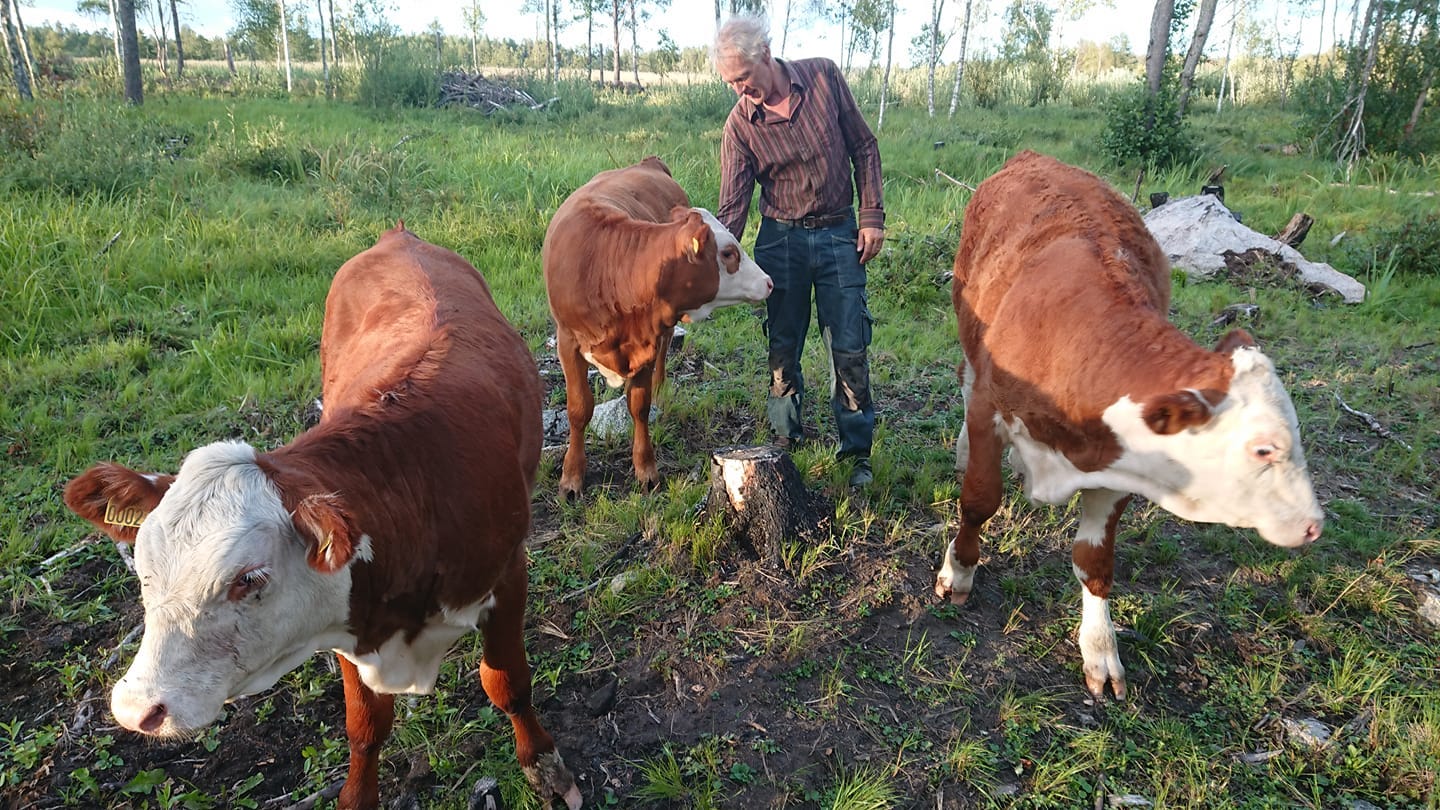
When growing crops and raising animals, especially in a small scale’, the distinction between nature and culture, between work, leisure and reproductive work, and between the economy and life is blurred. Me with Bosse, Spritta and Villa. photo: Ann-Helen Meyer von Bremen
Even if Alyssa Battistoni doesn’t make that connection explicitly, when she discusses the similarities between nature and social reproduction, I come to think about the effects of the harm and erosion that capitalism causes both nature and human life. The degradation of the Earth and the biosphere is quite apparent and it threatens the reproduction and regeneration of nature. What about the degradation of the humans and the institutions for our maintenance and reproduction? Capitalism has got women into equal wage-slavery as men and simultaneously weakened the social institutions, such as families, extended (sometimes intergenerational) households and villages that have been responsible for care and reproductive work. Some of their functions have been taken over by the state or the market, but some are just gone.**
The individualism that is one of the fundamental cultural expressions of capitalism has also weakened the role of non-market care or reproductive work. Perhaps it is the increasing pressure from capitalism on families, household and reproduction that is the reason for falling fertility rates? Perhaps, also the increasing mental health crisis and loneliness also should be seen in this light? Perhaps a major problem for capitalism and the problem with capitalism is that it is dependent on the same free “services” from nature and humans as it destroys?
Notably, one should also realise that the interest of individual capitalist companies and the overall interest of “capitalism” as a system may not at all be the same. This is something often not well understood, especially not by those that believe there is some vicious global elite that is controlling the System. Some capitalist companies are more dependent on intact ecosystems than others and some capitalist companies are more dependent on a growing population than others. Those opposing interests are quite obvious in the alleged green transition. To produce electric cars or solar panels is no less capitalist than pumping oil, but they represent different capitalist interests.
In that sense, the degradation of nature is a striking example of the tragedy of the commons, as nature and intact ecosystems are commons. Alyssa Battistoni mentions that the most apparent problem with the management of the commons is when it is confronted by market rule, as this is what makes the joint resource into a profit making vehicle and stimulates competition among the users of the common pool. One could apply the commons perspective also on human reproduction, echoed in the African (?) proverb: It takes a village to raise a child.
I recommend that you read the book and these more comprehensive reviews of the book by Bart Hawkins Kreps (he has written three pieces) and Jordan Daniels.
* Many people on the left side of politics make a much bigger case than warranted of whether something is made by the government or by market actors. It is true that public management of services have more democratic legitimacy and no profit motive. They mostly fail to see, however, that a big government means a lot of taxes which in turn means that people have to work more and earn more to pay their taxes. Countries with a high tax rate, such as Denmark and Sweden are no less capitalist than countries with a low tax rate, such as Japan or USA. Taxes is one of the main vehicles of forcing people into the market economy. As explained by Wangari Maathai:
“When the British decided to collect revenue and finance local development, they did not want to be paid in goats. They wanted cash. They also wanted to create a labour force, but they did not want to force people to work. So they introduced an income tax for men in most parts of the country that could be paid only in the form of money. This created a cash-based rather than a livestock-based economy. Of course, the colonial government and the British settlers were the only ones with money in their hands. So the local people, especially men, were indirectly forced to work on settlers’ farms or in offices so they could earn money to pay taxes.”
** The paragraph can perhaps be interpreted as an argument that reduces women to child bearing automata. That is not my intention. It is certainly not a given that women should do all or most of the care and reproductive work, even if they, mostly, have certain advantages when it comes to reproduction. On the level of the personal, I am all in favour of a “free choice” to have no children or ten children. Meanwhile, I believe that “free choice” to a large extent is determined by external (biological, material and cultural) factors and that we are less free than most want to believe. There are certainly many men out there, and some women, not having the choice to become a parent if they so wished. As a species, we clearly have no free choice to refrain from reproduction (some extreme self declared nature lovers seem to promote a death cult of human extermination).