

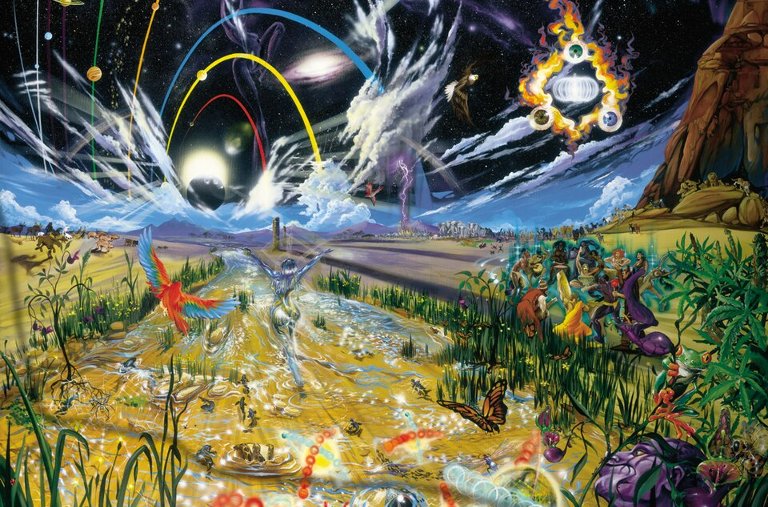
A recent piece in New Scientist has reminded me that it is a myth that humans, if they are wise and clever enough, can learn to “manage” the biosphere.
The piece is about the unfortunate trade-off between pollution reduction and global warming. It has been known for some time that successful efforts to reduce air pollution have resulted in fewer particles in the atmosphere, particles that reflect sunlight back into space. This reduction has actually accelerated global warming even as it has improved air quality and reduced illness and death.
The warning in the New Scientist piece comes from imagining a scenario in which world governments somehow agree on global action to curb warming climate by “spraying reflective particles into the stratosphere that dim the sun. The strategy works: temperatures at ground level stabilise, and life goes on as normal despite escalating carbon dioxide concentrations in the atmosphere.”
But then in 2050:
[S]omething goes wrong. The spray guns break down, the money runs out, a pandemic hits or a global war disrupts operations. Whatever the case, the planet starts to heat up, fast, as years of pent-up emissions kick into effect. Ecosystems can’t cope, wildlife perishes en masse, societal chaos ensues.
The phenomenon is called “termination shock.” The piece explains that we’ve been experiencing something like a termination shock because efforts in the last two decades to reduce air pollution have been so successful. The result has been temperature warming faster than anticipated, unexpected regional changes such as increases in tropical cyclones, and increased monsoons responsible for greater flooding. One researcher said that effects of a termination shock caused by a sudden cessation of worldwide program that inserts large amounts of reflective particles in the atmosphere would be much worse than what we are seeing today. Read the entire piece New Scientist for the complete list of horribles.
Having recently re-read James Lovelock’s Gaia: A New Look at Life on Earth I was reminded of some key points he makes about attempts to manage the biosphere. Before getting to those points, for those who are unfamiliar with Lovelock and his Gaia Theory, it goes something like this: The Earth can be seen as a single organism using its natural processes that involve both living and nonliving materials to maintain conditions favorable to life. He calls this system Gaia after the Greek goddess of the Earth. (I can recommend the book which is highly readable for the layperson.)
Lovelock’s key points for my purposes here are that humans are a part of this Gaian system just like all other Earthly beings and that we have our role to play in keeping conditions favorable to life. The idea that humans could manage such a complex system is almost laughable to Lovelock who notes:
There can be no prescription, no set of values, for living within Gaia. For each of our different actions there are only consequences.
Earlier in the book Lovelock states:
Each time we significantly alter part of some natural process of regulation or introduce some new source of energy or information, we are increasing the probability that one of these changes will weaken the stability of the entire system, by cutting down the variety of response.
Two possible negative outcomes he mentions are runaway positive feedback and sustained oscillation. Runaway positive feedback could over time move Earth’s climate permanently into one resembling that of Venus where surface temperatures can melt lead. Sustained oscillation could cause the Earth to cycle quickly between an ice age climate and a tropical one.
Lovelock notes that modern peoples live mostly in cities and so focus on solving problems that arise between individual people and between people and the urban institutions they create, not the problems that arise between people and the natural world they inhabit. This puts humans at an increasing disadvantage in attempting to determine how best to live within Gaia over the long term.



Comments
We changed commenting systems on September 10, 2026 as part of a site-wide functionality and security upgrade. Your past comments have not disappeared, and you can still log in with your old Disqus account credentials if you wish. Contact us with any questions.
Native Americans and others showed that it is possible for humans to take a management role that benefits the biosphere. The difference is that theirs is a humble attitude, from a perspective of being one small node in the web of life, and using small, natural things like fire to make adjustments, rather than an arrogant use of massive changes from a perspective of being the ruler and owner of the world, and seeing the world as a machine they can tinker with.
So does this mean there is only way way to bake a cake, or walk a hillside, or take water from a stream for drinking or irrigating? Every being uses the resources that are necessary and/or available to survive. All but one have, for eons, been capable of doing so within the bounds of harmony, which is not rigid, but fairly flexible as long as limiting factors are not breached in such a fashion that negative cascades occur.
The scenario in this short essay does not give enough info, in many regards, to determine what mix of either purposeful or random energies may/can/will/will not bring termination shock. The huge elephant in the room has been there, visible to any who were not hiding under their mommies' dresses sucking their thumbs. That elephant is simply myopic narcissism coupled with stochastic violence on every level of human behavior.
This changes the probabilities of the outcome of life on Earth as much as any extra-biotic phenomena like tectonic shifts, volcanism, asteroid strikes, etc. Humans are mostly incapable of grokking the subtleties of myriad patterns that actually follow other patterns in Gaia-like fashion. Context is everything in Earth reality, both intra- and extra-terrestrial fashion.
I have almost no confidence humans are worth keeping here, and I am one. If we cannot, with all the alleged gifts of perception, etc., get out of our own way for more than a year of two out of 10k years, then we really have no collective future with Earth. Which, IMO, is why we are so hell bent upon destroying it. In short, we fear elephants more than we love them.
Really, the only option beyond all our machinations, consumptive, violent, non-chalant, selfish, myopic, laconic, and any contra to these, is to absolutely STOP 95 percent of what we are now doing, immediately, hunker down, lose 30 percent of our body weight, and finally learn evolved adaptive behaviors that other living beings have been using for eons.
If we make it, well, maybe ok. If we do not, after perhaps 10k more years, Gaia patterns will re-materialize out of quantum entanglement, where they went to hide from us until we perished. Life has a nasty habit of staying around, but there is no requirement that we have the last word, or any word for that matter. On some level, all humans know better, much better, but lack volition and empathy, because some of us are so fucked up that, without either of those, we create dirty laundry that we are living inside of that we mistake for golden thongs holding nuggets of prurient masculinity,
Testosterone myopia is that elephant, and male humanity has no answer than another rape dressed up in perverse misogyny.
Maybe trying to manage the biosphere is a bit like trying to bake a cake. I speak as a newly initiated baker of cakes. Every action has consequences, some of which are desirable and some of which are not. For example, if you add more lemon juice, it may improve the flavour but make your cake wet and soggy. Or if you bake it for longer to try to make it rise more, your cake may rise perfectly but be dry and indigestible. And so on. Don't mess with the recipe unless you know exactly what you are doing.