

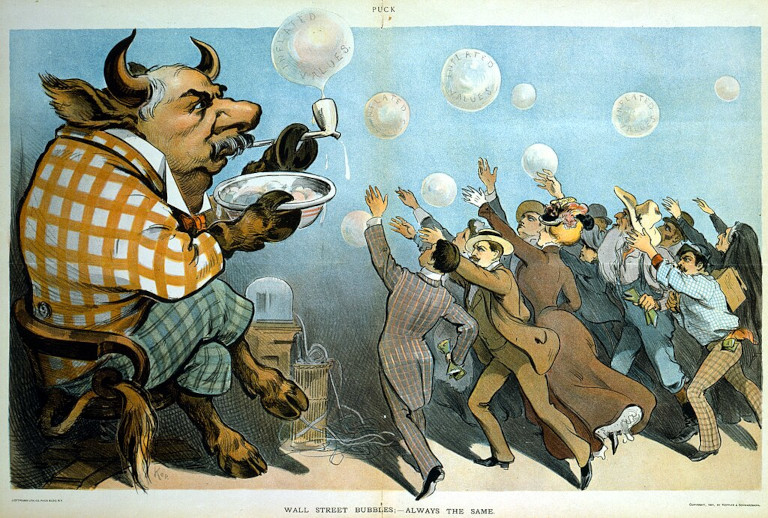
I remember years ago eating lunch with my father and his financial advisor. I stated what I thought was an indisputable fact. I said history suggests that stock markets can not only go down but stay down for many, many years. I cited the 1966 top in U.S. stocks and the secular bear market that ensued and lasted until 1982. He asked me if I was recommending that investors bet against America.
I said I wouldn’t put it that way. I explained that the world was moving toward an era of energy scarcity, and that since energy is the key factor in economic activity, this could affect the value of stocks. Even if he disagreed, I said that none of us live as long as the stock market has been around and so it seems worthwhile to know about this history of long-term bear markets that might affect our very finite financial lives. He was unruffled.
I turned out to be right about energy costs; the price of oil hit a new record in 2008. But he turned out to be right about the general direction of the U.S. stock market, even if you count the crash of 2008 from which we more than recovered before going on to ever more unsustainable heights. My father was very pleased with the results of this man’s advice.
By the way, you really have to look around for charts of major U.S. stock indices that include the entire period I mentioned in my conversation. I looked up a popular gauge of the U.S. stock market, the Dow Jones Industrial Average. The Yahoo Finance chart only goes back to 1992. The popular MarketWatch site has a chart that goes all the way back to 1970. The venerable weekly financial publication, Barron’s—which ought to have a sense of history since it’s been in continuous publication since 1921—only goes back to September 30, 1970, not quite as far as upstart MarketWatch. The charts in MarketWatch and Barron’s make it appear that stocks more or less went sideways in the 1970s which was not how it seemed to someone who was invested at the time.
To get a real sense of what happened from 1966 to 1982 in the U.S. stock market it’s helpful to have two things: A longer term chart and the cumulative inflation rate for that period. I like the following 100-year chart of the Dow Jones Industrial Average because it allows the user to contract it to cover just the period you want to look at. If you do that, you’ll see that the Dow Jones average bounced between about 1,000 and about 600 for the entire period.
Okay, you say, that’s not a good look, but investors who held stocks received dividends. That’s true. But when we add the other piece of information that I suggest is crucial, cumulative inflation, dividends may not seem all that significant. According to the Consumer Price Index Calculator (found on the site of the U.S. Bureau of Labor Statistics) from January 1966 to August 1982—the putative starting and ending months of the secular bear market—cumulative inflation in the United States was 207 percent. That means that the purchasing power of a stock portfolio tracking the Dow Jones Industrial Average went down by about two-thirds during this period and possibly more depending on when you bought in. In other words, you could only buy about one-third of what you bought in 1966 in 1982, and certainly less if you sold nearer to the bottom.
The puzzling resilience of stocks since 1982 is in part due to an error of perception and in part to what appears to be a deliberate policy on the part of governments to keep stock prices high by bailing out the financial sector of the economy every time the economy has wavered. The error of perception is that few people realize that stocks essentially made no upward progress from August 1998 through February 2009. There was ups and downs, but no new highs in the Dow until 2013.
Since the great financial crash in 2008, governments and central banks around the world seemed to have made it their priority to keep stock prices elevated. This has been good for one-way financial advisors and Wall Street prognosticators who stay forever on a bullish note. And it’s been great for the wealthy who own the lion’s share of stocks.
Those who are longtime readers know that I am skeptical that the world economy can continue to grow much if at all as resource constraints and the constraints of the complex, energy-intensive systems we rely on place limits on our economic output. I rather envision a period that looks more like the 1970s than the recent past: high inflation and economic stagnation resulting from dwindling resource growth and even contraction in some cases as the ravages of climate change continue unabated. I expect most basic commodities we require will generally continue to rise in price as they have of late.
Of course, we might very well face another financial crash as a result of these constraints and because of the enormous financial leverage in the world financial system, in other words, too much borrowing by households, corporations and speculators. Such a crash would tend to bring down commodity prices as economic activity declines. But this path to lower prices is not one that favors a rise in stock prices.
Regarding this scenario, I’ve been for some time premature in calling for its arrival. But now I see circumstances lining up in a way that suggest my wait won’t be much longer. If I’m right, the reaction of the world’s governments and central banks to a serious economic downturn will be to attempt to revive the economy with bailouts and new government spending that will likely dwarf what we saw during the COVID crisis. But with resource and infrastructure constraints bearing down on the world economy, such measures may not prove nearly as effective except in one regard. They are likely to cause inflation that is as high or worse than what we experienced in the 1970s.




Comments
We changed commenting systems on September 10, 2026 as part of a site-wide functionality and security upgrade. Your past comments have not disappeared, and you can still log in with your old Disqus account credentials if you wish. Contact us with any questions.
Interesting and informative. I would adjust your forecast only regarding "the ravages of climate change will continue unabated" – (fyi, human author) – climate change is still accelerating, and its economic ravages are only just beginning. The effects of climate change will crash the world economy in ways that no one can say, but rest assured, just studying climate science is persuasive evidence most "economic, finacial, and policy" experts are dazed and confused – biosphere degradation (its more than climate) will be far greater than most "economic experts" have imagined in their worst nightmares. Capitalism will not save capitalism from itself, nor will technology save technology from itself.
I can't imagine bringing up the wealth and poverty pumps to either of those fellows!
Good piece. One is reminded of two well known statements: 'The stock market can remain irrational longer than you can remain solvent,' and 'Anyone who beieves in endless (or infinite) growth on a finite planet is either a madman or an economist.'