


It is September and throughout Italy the heat and dry conditions continue. It has been the hottest two months ever recorded. What little rain we have had has hardly penetrated the hard ground. There are food shortages already. The prices in the supermarkets are higher. In the south, the citrus crop is threatened; there is fungus on the lemons and the orange harvest is plagued by insects. Sicily and Sardenia are experiencing their worst drought in recent history and are among the six Italian provinces in an extreme water crisis. In the north, the Po River, which supplies the water for all our rice and supports 40% of Italy’s agricultural output, suffered a major drought two years ago. Now, with very low flow, it is experiencing the slow and progressive infiltration of salt water from the Adriatic Sea, leaving the land worthless for farming. And the coastal waters of the Adriatic, where Italians love to vacation, are registering water temperatures of 30 degrees and above. As a result, the water along the beach is coated with a foam of microalgae making fishing difficult if not impossible. Four provinces have asked the government to declare a state of emergency. And, though I only read this in fairly alternative agricultural blogs, decreases in agricultural yields may be as high as 40%.
And Italy is faring far better than the 59 countries/territories facing ‘high levels of acute food insecurity requiring urgent food and livelihood assistance’. Nambia, facing drought, plans to kill elephants for meat. That was the headline in the New York Times last week.
In the face of this crisis, we talk about community resilience and we tell ourselves that when the shit hits the fan, the local farms will feed us. That would be wonderful but in fact it is not possible. Not now.
And why is there so little about this in the news? Both The Guardian and La Repubblica bury any environmental news after the sports section. The New York Times gives less space to articles about devastating species loss, deforestation, and starvation than they do to recipes. (That was rhetorical. We all know why.)
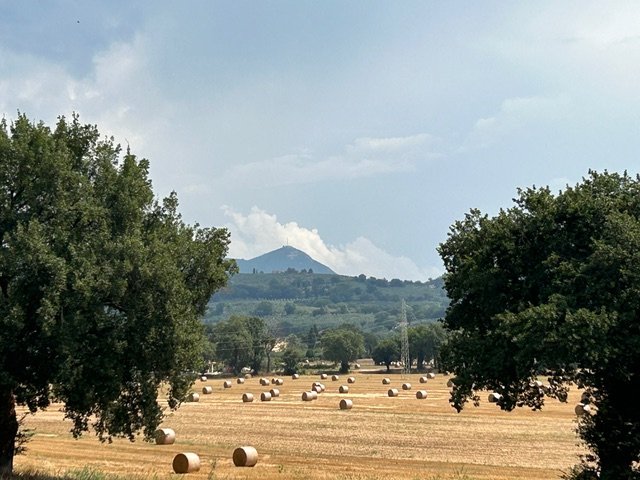
It is one thing to read about food shortages, drought, famine in the newspapers. It is another thing to be on the ground in this heat, on the parched earth working in silence where just a few summers ago there was a cacophony of wild bird conversations. The local farmers here have no crops for the community. In Umbria, in my valley, we are all farmers on small family farms. Umbria is the bread basket of Italy and we primarily grow grains: wheat, hay, farro. The fields are not irrigated; the seeds are sown after the fall rains, in mid-October, and grow into late spring. They need to be cut dry, in mid-June, the beginning of our hot and dry summer. Then the land is left fallow until the rain returns. Hay, the major crop around here, is for our large animals. Though I also grow hay, I am an exception, the only farm in my valley registered to sell eggs. Our cash crops do not/cannot feed the community.
To be clear, the local farmers can feed themselves. Behind all of our homes, we have the orto, the family vegetable garden. It has kept us alive through Italy’s wars and times of famine. It includes much more than seasonal vegetables. We all have fruit and nut trees, grapes, berry brambles, and the inevitable potato patch. Every family in the valley has olives and figs. Adjacent to the family garden are shelters for our chickens and ducks, though many also raise pigeons, geese, and guinea fowl. And rabbits. Some have a few donkeys and sheep which browse for food in the meadows and forests which comprise most of the land in our valley.
We grow enough to live very comfortably… in our private gardens. And therein lies the caveat: the orto is only for the family. It is not part of our business. We have just enough of all the food and nutrition essentials out back behind the house to see ourselves through each season. (And just enough stored rain and underground springs to keep those plants alive.) But there is not enough to share with the surrounding communities—and this year there is less. We cannot possibly feed the local population, even with farmland extending right up to the major cities in our province. Only in our private gardens do we begin to rival the produce section of the supermarket.
And the world cannot depend on industrial agriculture, nor would we want to. They were and are a large part of creating this mess. In the U.S., aquifers are shrinking nationwide, threatening supplies of drinking water and America’s ability to be a world grain provider. Industrial agriculture has a history of water pollution, waste and abuse. World-wide, 70% of our water is used by agriculture. Agribusiness is the single largest consumer of our water resources—660 trillion to 1 quadrillion gallons annually. Our ever increasing water extraction has depleted our watersheds and compromised our irrigation systems.
The small farms throughout the world cannot fill the gap; they currently provide only 28–31% of our food. With drought conditions those values are less. And the CSA’s—many with scores of large plastic greenhouses and energy-intensive machines to wash and sort, cool or heat, and spray water automatically—are far from regenerative and resilient, verging close to industrial agriculture. (And factory-created food from bacteria? It could not be further from being simple, natural and self-sustaining.)
Collapse is here. It is all around us. Our ecosystems, our wildllife are in perilous decline. And our farmland. We need to know where our nutrition and clean water will come from in the future and how we will obtain it. I agree with Chris Smaje that the future for most people will be rural. If we are to survive, if our ecosystems and our wildlife are to survive at all, most of us need to become small scale farmers, backyard and rooftop market gardeners, homesteaders… And that is what ‘sustainable’ is all about—providing for our own needs while not diminishing the resources for others (including other creatures). There was a time when everyone knew how to grow their own food, to forage, to hunt. Children too. We grew food in cities during the world wars—victory gardens. What happened to being pro-active, to being self-reliant (within your family or immediate community). We often say that our best, most memorable times are sharing food with family and friends. That says it all. But we are so far from being capable of taking care of our most basic needs—acquiring food, water, shelter. We talk the talk about getting back to basics, living small, learning simple crafts, honoring indigenous wisdom, being part of the natural world…
Well, now it’s time to fully embrace our intentions… while we still can..
© www.thesubversivefarmer.net September 2024
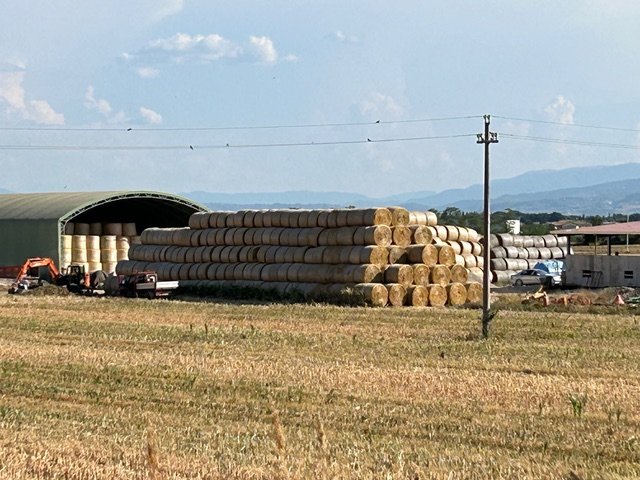
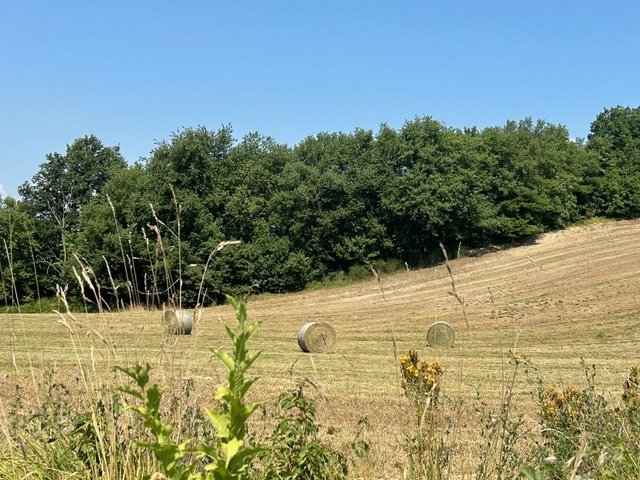
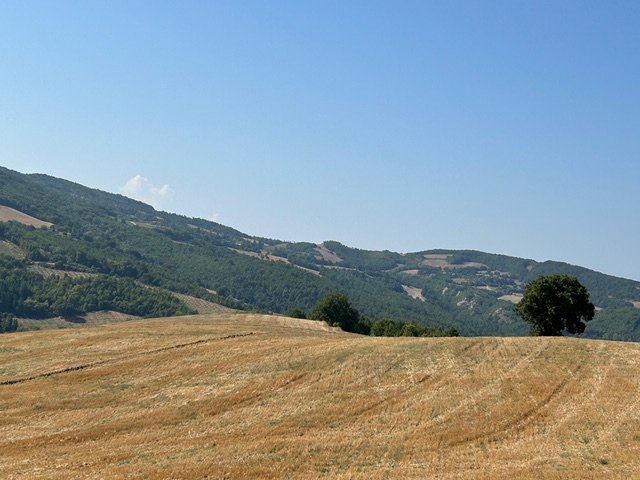
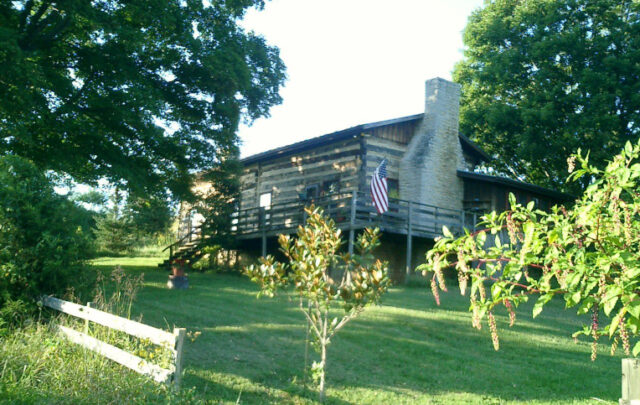
The photos were taken this month, all within 25 kilometers of my farm. There were no crops being harvested or planted anywhere along the road. Just yellow fields where the hay and wheat were cut.
Further reading:
https://www.sciencedirect.com/science/article/pii/S2211912417301293 on How much of the world’s food do smallholders produce?
https://www.ncei.noaa.gov/news/us-drought-weekly-report-august-27-2024


Comments
We changed commenting systems on September 10, 2026 as part of a site-wide functionality and security upgrade. Your past comments have not disappeared, and you can still log in with your old Disqus account credentials if you wish. Contact us with any questions.
We have had heat and drought affecting crops and comfort here in Appalachia, too. And swarms of bees, wasps, yellowjackets and hornets, probably desperate for moisture (nice to know there are still that many pollinators about).
One thing I wonder about is the statement that small farms provide only 28-31% of our food–because I've seen 70% named. I wonder if the difference is whether you count, or don't, self-sufficiency rations, food that feeds the growers but does not enter the marketplace.
If memory serves, the small farm 70% figure is global, the ~30% is for the US? We need some clarity on this. I asked a long-time farmer if we grew enough food for the bioregion's population of 170,000 people and he laughed. We are in an 'agrarian community.'
Here we go again, Mary Wildfire. Zia Gallina, as I understand it, is an American expatriate, with a physician husband. She began her cultivating growing herbs, greens and ornamentals in her front yard, so she understands gardening in an incremental way. This article is alarming, but accurate. And this is as far as I've ever seen Zia go in warning of collapse.
I am curious how definitive Zia's small producer figure (28-31%) is too, and where she got it, though I'm more inclined than Mary in believing it. (Her reference is Science Direct and my browser needs updating to access it.) Zia is intuitive in feeling the need of the urban dwellers in her locality. All the farming in the Charlotte, NC region has evaporated in the last 20 years. We don't even see the few steers large landowners kept to fill their freezers anymore. I am aware of only 2 vegetable gardeners in the city limits of the town where I live. One is my pitiful patch and the other is a Miracle-Gro hobbyist next to the funeral home. Our tomato grower north of town closed last year. Someone set up a project at the County Extension Service to collect and share seeds but so far no envelops have been left at our public library branch in the receptacle provided. I think people around here are less self-sufficient than ever before.
For me the key observation Zia shares, and with which I concur, is that Americans are being shielded and diverted from learning about how endangered our food supplies have become. Certainly neither of our major political parties want us discussing such things.
If we are to survive, if our ecosystems and our wildlife are to survive at all, most of us need to become small scale farmers, backyard and rooftop market gardeners, homesteaders…
This is true, yet impossible for the vast majority. I have yet to see anyone present a plausible path for converting our present practice of industrial-agriculture-feeds-urbanites into a system of small subsistence farms where everyone produces their own necessities, food being the most important.
City folk with enough money to create a small farm can buy some land and start up the long learning curve of becoming a subsistence farmer, but this group is very small. The vast majority of people in urban areas have no means to buy land in the country and there are no government programs to subsidize the process.
I suspect that even in the unlikely event that everyone in government woke up to the fact that industrial civilization is doomed, moving people out of cities and onto small farms at scale is beyond human capability. And just imagine the panic if such a gigantic effort were actually attempted. It would confirm that cities were doomed and were being abandoned.
I've said this before, and I apologize for harping on it, but there will be no collective small farm solution to the polycrisis. It is up to individuals, families and small groups of like-minded people to get out of the city and onto a small farm while they still can. Once things start really breaking down, escape will become very difficult.
Leave off "collective small farm" and I'm right there with you.
That said, I think collective small farms are the only real coping strategy available for everyone but the very rich, who will enslave people to grow their food. It just ain't gonna work for eight billion. I'd give it a billion, tops.
Look around you, at your friends and family. Which one out of every eight is going to "make it"?
I started a Farming Club here this year and have about 10 people who come out each week to farm with me, basically growing their own food (produce) with my guidance. Am working to expand this to a full diet in collaboration with other farmers. This is now my vision for some sort of transition. Bring groups out of town and onto the land and teach them to grow their own food, using mostly hand tools for the weeding and harvesting, with expert farmers as leaders. Perhaps if this was subsidized it could scale. But it only works for small towns and cities surrounded by productive land. Too many people live in mega cities and those have no solution for viability in the kinds of worst cases that seem quite plausible.
Great piece, I can empathize a lot. Things are starting to break down worldwide, a lot earlier than expected.
It does increasingly seem like agriculture has reached the point of diminishing returns. Combining this insight with my own experiences in small-scale tropical horticulture in Thailand, I've recently written the following essay about the issue:
https://animistsramblings.substack.com/p/agriculture-diminishing-returns
What you are doing is great! The people who travel to your farm will be learning valuable skills. In an emergency they might even prevail upon you to take up permanent residence (accepting refugees is something that every farmer should be comfortable with).
I live in a sparsely populated area of Hawaii that could easily feed everyone living here and everyone living in nearby towns. Unfortunately, right now even people with plenty of fertile land don't grow much of their own food. If imported food stops coming, I just hope there will be enough time to make a fairly smooth transition to local production. Having a year-around growing season helps a lot, but switching cold turkey would still be hard.
Having a few months stockpile of food for everyone would help a lot. In temperate regions it should be at least a year. During the early Cold War, civil defence agencies kept stores of emergency food for public consumption. Getting this practice resumed would be a good prepping project for stakeholders in every community, big or small. We have a Strategic Petroleum Reserve, why not Strategic Food Reserves?